It’s ok, you can stare at the sun:
Editing The Greats, Ctd
Pivoting off John Simon’s anecdotes about editing Auden, Lionel Trilling and Jacques Barzun, Alan Jacobs suggests they might point to “a kind of rough Taxonomy of Authorial Character”:
As a Trilling — the character in the middle — I understand the Barzun kind of writer, but struggle to accept the Auden type. I’ve only ever edited one book, on which I worked with my colleague Ken Chase, and in general it was a pleasant experience. But one of the essays — I shall of course never reveal which one — came to us in shocking condition, full of typos and incoherent sentences and undocumented (or incompletely or inaccurately documented) citations. Ken and I probably spent more time on that essay than all the others combined, and it seemed to me then, and seems to me now, that to send an essay to editors in that condition was both unprofessional and arrogant. I’m your editor, not your servant, I thought. But I suppose real professional editors have that thought at least once a day….
David Mills adds:
This, by the way, is a description that would upset some writers — not Alan — who pride themselves on being difficult, because the difficulty they think a marker of their gifts. The real professional engages the editor, assuming he knows what he’s doing and that there’s a reason for his suggestions. The writer may not accept them (I don’t when I’m on the other side of the relation) but he responds to them.
I should add that the taxonomy is incomplete. It doesn’t include, for example, the writer who writes like Auden but acts like Barzun. There are a lot more of these than you might think. And it doesn’t include the writer who writes like Barzun and acts like Auden. Fortunately there are a lot more of these than you’d think.
If Love Were All
Surveying contemporary pop music, Matthew Linder finds that romantic love and sex “are seen as the harbingers of an ultimate transcendent reality, where the physical reaches the spiritual” and the “key to a meaningful existence.” His theologically-inflected critique:
Seeking transcendence through a romantic relationship (as these pop songs do) is what Pastor Timothy Keller refers to as an apocalyptic romance. This term borrowed from cultural anthropologist Ernest Becker is defined as:
If he no longer had God, how was he to do this [find meaning in life]? One of the first ways that occurred to him… was the ‘romantic solution’: he fixed his urge to cosmic heroism onto another person in the form of a love object. The self-glorification that he needed in his innermost nature he now looked for in the love partner. The love partner becomes the divine ideal within which to fulfill one’s life.
Contemporary love songs are a reflection of our culture’s search for ultimate meaning, by thrusting the divine upon an imperfect person. A reversal of the perfect divine who thrust upon himself our flesh to be the bread of life, the living water, make us born again and give us eternal life. Transcendence is found in another person but only in the god-man, not in the person we have turned into a god.
The Prince Of Skepticism
To celebrate their 50th anniversary, The New York Review of Books is making available classic essays from their archives. In this selection from 1971, the political theorist Isaiah Berlin ruminates on Machiavelli’s contribution to the politics of doubt:
If what Machiavelli believed is true, this undermines one major assumption of Western thought: namely, that somewhere in the past or the future, in this world or the next, in the church or the laboratory, in the
speculations of the metaphysician or the findings of the social scientist or in the uncorrupted heart of the simple good man, there is to be found the final solution of the question of how men should live. If this is false (and if more than one equally valid answer to the question can be returned, then it is false) the idea of the sole true, objective, universal human ideal crumbles. The very search for it becomes not merely utopian in practice, but conceptually incoherent … .After Machiavelli, doubt is liable to infect all monistic constructions. The sense of certainty that there is somewhere a hidden treasure—the final solution to our ills—and that some path must lead to it (for, in principle, it must be discoverable); or else, to alter the image, the conviction that the fragments constituted by our beliefs and habits are all pieces of a jigsaw puzzle, which (since there is an a priori guarantee for this) can, in principle, be solved; so that it is only because of lack of skill or stupidity or bad fortune that we have not so far succeeded in discovering the solution whereby all interests will be brought into harmony—this fundamental belief of Western political thought has been severely shaken. Surely in an age that looks for certainties, this is sufficient to account for the unending efforts, more numerous today than ever, to explain The Prince and The Discourses, or to explain them away?
Should Atheists Come Out Of The Closet?
Joshua Knobe of Yale talks to Ara Norenzayan of the University of British Columbia about the latter’s research on prejudice against atheists:
The Truth In Fiction, Ctd
Ian McEwan admits he’s occasionally doubted the God of fiction:
Like a late victorian clergyman sweating in the dark over his Doubts, I have moments when my faith in fiction falters and then comes to the edge of collapse. I find myself asking, “Am I really a believer?” And then, “Was I ever?” First to go are the disjointed, upended narratives of experimental fiction. Oh well … Next, the virgin birth miracle of magical realism. But I was always Low Church on that one. It’s when the icy waters of skepticism start to rise round the skirts of realism herself that I know my long night has begun. All meaning has drained from the enterprise. Novels? I don’t know how or where to suspend my disbelief. What imaginary Henry said or did to nonexistent Sue, and Henry’s lonely childhood, his war, his divorce, his ecstasy and struggle with the truth and how he’s a mirror to the age—I don’t believe a word: not the rusty device of pretending that the weather has something to do with Henry’s mood, not the rusty device of pretending.
However, a childhood revelation reminds him that fiction can also contain all that’s true:
Things that never happened can tangle with things that did, an imaginary being can hold hands with the flesh-and-blood real. He may live in your house, as a Henry of my own once did, or he may read all that you have read and even make love to your wife. The atheist may lie down with the believer, the encyclopedia with the poem. Everything absorbed and wondered at in the faithless months—science, math, history, law, and all the rest—can be brought with you and put to use when you return yet again to the one true faith.
Recent Dish on the truth in fiction here.
Face Of The Day

Street art by Adnate in Fitzroy, Melbourne, Australia, via Street Art Utopia. Photo by Flickr user ajhaysom.
Laughing Through Lent
Peter Leithart uses Shakespeare’s Cymbeline to turn the typical understanding of Lent on its head, arguing that Lent “seems a grim and black season of self-accusation”:
But that’s all superficial. Lent is better understood as a season of Christian comedy. … The knot of misunderstandings and deceptions is the very thing that in Othello or King Lear drives the characters helplessly toward a bloody denouement. Cymbeline avoids the cliff because the final scene is a riot of confession. Shakespeare assembles the remaining characters at a prison and begins to unravel the tangled skein. The queen shows no remorse, but on her deathbed she confesses her intention to feed her husband a “mortal mineral” that would have wasted him away “by inches.” It’s the first domino, and other confessions rapidly follow. Iachimo acknowledges that he lied about seducing Imogen, prompting Posthumus, disguised as a common soldier, to confess his guilt in believing the lie. Imogen, who has no sin to confess, reveals her true identity. Cymbeline’s two sons, kidnapped long before, have wandered into the action, and their true identities are unveiled too.
Leithart concludes:
Comedy happens to characters who share Shakespeare’s belief about human helplessness and express that belief in penitent confession. Helpless self-accusation, it turns out, is the road to joyful restoration. It is a happy Shakespearean (and Christian) paradox that final happiness depends on practices associated with the most somber season of the Christian calendar.
The View From Your Window
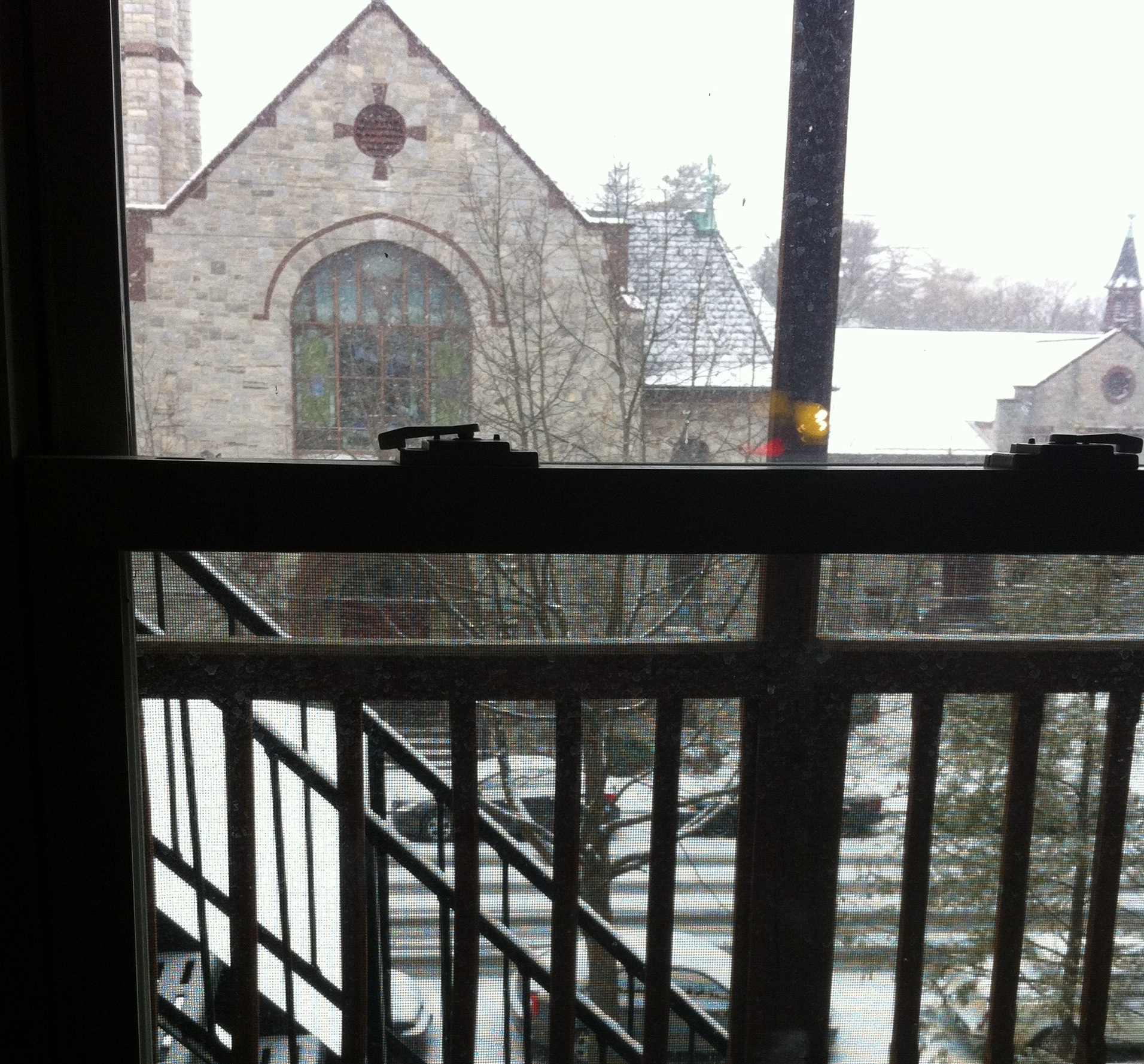
Carlisle, Pennsylvania, 3.12 pm
Hair Sacrifice
An interesting story and slideshow from Colors Magazine:
Every day at the Tirumala Venkateswara Temple in India, about 10,000 people sit cross-legged on the floor of the tonsuring room and let one of the 500 temple barbers shave off their hair. For many Hindu pilgrims, the shave is an intensely moving experience, as they believe that by sacrificing their hair here they will gain Lord Venkateswara’s protection and be cleansed of material debts.
Once the hair hits the floor, however, it enters the world of business. The strands are collected by attendants, packed into large steel bins, washed, and sorted according to length and quality. Twice a year, the stored hair is auctioned off and exported, mainly to the USA, UK and China, where it is used to make hair extensions and wigs. Long, untreated Indian hair is in high demand; the temple’s longest hair sells for RS20,000 (US$375) a kilogram.
Last year, amid concerns that buyers were forming a cartel, conspiring to keep bids low, the temple stopped its open auctioning process and began to sell online instead, through secret tenders. So far, it’s proving extremely lucrative; in 2011, the temple sold 561 tonnes of hair for RS2 billion ($36.9 million).

