Why Wyatt?

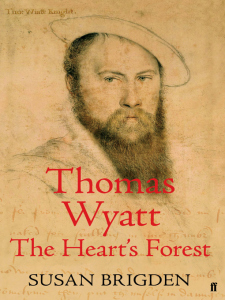
Alastair Fowler reviews a massive new biography of the 16th century poet and ambassador, Thomas Wyatt, a man he describes as “hard, brilliant, arrogant, dangerous, quarrelsome, given to violent rages, sexist; yet sexually attractive, contemptuous, secretive, loyal to the king but also (usually) to friends.” Why this complex figure matters for English literary history:

Wyatt certainly reformed English poetry. In George Puttenham’s Art of English Poesie (1589), Wyatt and Surrey figure as “the wyatttwo chief lanterns of light to all others who have since employed their pens upon English poesy . . . in all imitating very naturally and studiously their master Francis Petrarch”. But Petrarch was an alien genius, whom Wyatt seldom imitated very closely. Did he truly reform English poetry in the direction of regularity? In metre “sweet and well-proportioned”? Not if modern critics such as H. A. Mason are to be believed. For [biographer Susan] Brigden, Wyatt’s claim as a reformer of poetry mainly rests on his introducing the Renaissance sonnet, classical epigram and Horatian epistle. This is just, but may miss some of Wyatt’s originality.

Although Wyatt’s oeuvre is uneven, his poems at their best achieve searingly honest expressions of intense experience. He gradually changed English poetry by this seriousness, bringing his overwhelming passions into equilibrium with a counterweight of fully considered words. No English predecessor had managed to sustain self-examination so far: it is his only Petrarchan quality. One might almost say Wyatt owed some of his poetic achievement to an affliction of guilt.

Quote For The Day

“There is more looking down, less eye contact. The difference is between the first three days of Burning Man, when everyone is ‘Hey, what’s up?’ to the final three days of Burning Man, when the tent flaps are down. Brooklyn is turning out to be the last three days of Burning Man,” – Ari Wallach, a futurism consultant, on the allegedly fading hipsterdom of Brooklyn.

When Brennan Met Boal

A man who was once equivocal about torture, and is now the Obama administration’s nominee for running the CIA, John Brennan, was personally consulted about Zero Dark Thirty in an hour long chat with Mark Boal, the screenwriter:

John Brennan, who currently serves as the president’s chief counterterrorism adviser, detailed that meeting for the first time in written answers to questions from the Senate Intelligence Committee… Brennan told the committee that he and other White House officials met with filmmaker Mark Boal on June 30, 2011, for an unclassified discussion “on how White House officials viewed the opportunities and risks associated with a film about the raid that killed bin Laden” the previous month. He did not elaborate on what that meant.

The “opportunities” associated with the movie. Hmmm. A reader writes:

My take on this film is essentially this:  it is close to being an official CIA take–not General Hayden or Porter Goss’s CIA, but the Obama era CIA.  Maybe we did dumb things in the past, but we meant well and we were doing what we were instructed to do – and in the end we got our guy.  So it can’t come as a surprise to learn of Brennan’s involvement.

Or Obama’s indifference to prosecuting war criminals, which is as acute as the Pope’s in prosecuting child-rapists.

Becoming Part Of The Story

In an excerpt from the book Why We Write, Susan Orlean shares her favorite part about writing:

The best time I’ve ever had as a writer—this is strange, but true—was years ago when I was reporting a story for the New Yorker, and I traveled with a black gospel group for a couple of weeks, writing about their world.

There was this moment when we pulled into some tiny town in Georgia, and we were having dinner in a local diner and I had an out-of-body experience. I couldn’t stop being amazed, thinking, This is my job. I’m in Georgia with this black gospel group, and I’m talking with people I would never have met as long as I lived if this wasn’t my job.

I was feeling the exhilaration of stepping into an alternate universe. If my life had taken a different path, I might have been having dinner at a country club in a suburb in the Midwest, but I’m not. I’m here. I’ve had a version of that experience many times, and it’s always so powerful.

Faces Of The Day

Fernando Decillis

Amanda Gorence admires the artistry on display:

Photographer Fernando Decillis traveled to Pasto, Columbia for the elaborate Carnaval de Negros y Blancos, a five day festival celebrating the Epiphany that has been a tradition since 1912. The festival begins on January 3rd as children take to the streets in celebration for El Carnavalito (The Little Parade). The following days each have a theme rich with tradition and history, leading up to El Desfile Magno (The Great Parade), the final parade on the last day of the festival.

El Desfile Magno is a mind-blowing display of immaculately crafted floats made by incredibly talented artists. The artists are usually honored with this task through family ties and only after years of studying the traditional craft. There are 20 competing floats, with the grand prize being 30,000,000 Colombian Pesos (a little less than $17,000 USD).

Bookshelves By Algorithm

Hillary Kelly is unsatisfied with literary suggestions from Amazon, GoodReads, or the latest newcomer, Bookish:

Bookish is hardly the first site to lure readers with the promise of perfectly calibrated recommendations (though it is unique in its employment of editors—real humans—who are empowered to supply recommendations as well, though its not clear in what capacity). Amazon, perhaps the gold standard in the industry because of its unparalleled data set, has long offered recommendations in the form of matching books that were “Frequently Bought Together” and the “Customers Who Bought This Item Also Bought” carousel. Assiduously tracking its customers’ habits, Amazon may know more about my purchasing patterns than my boyfriend does—and let’s keep it that way—but its recommendation engine has two crucial failings: Amazon does not know about books I buy or obtain in other capacities, and it assumes that I’m voracious for more from authors I’ve already purchased.

Jeva Lange is more positive:

Points to Bookish for their reader review section. The scoring system, which has so epically failed for Amazon, is designated into categories “readers,” “critics,” and “all” for ease of filtering out insane readers with vendettas or for focusing on the votes of those a little less highbrow than newspaper critics.

Chad W. Post doubts Bookish will catch on:

[W]hy would I stop buying from Amazon (if I don’t have huge moral issues), to go to Bookish? Why would I stop updating the GoodReads account I’ve been using for years to try and recreate it on Bookish? Remember Riffle? Remember Google+? They both faced similar issues, and neither really overcame it. What I don’t understand is why these companies don’t get that. Create something actually new and you’ll get what you want. Improve slightly on what people are already sort of, pretty much satisfied with, and they’ll ignore you.

A Poem For Saturday

Annika_Eva/ Der Liebenden Schlaf

“Marriage” by Wendell Berry:

How hard it is for me, who live
in the excitement of women
and have the desire for them
in my mouth like salt. Yet
you have taken me and quieted me.
You have been such light to me
that other women have been
your shadows. You come near me
with the nearness of sleep.
And yet I am not quiet.
It is to be broken. It is to be
torn open. It is not to be
reached and come to rest in
ever. I turn against you,
I break from you. I turn to you.
We hurt, and are hurt,
and have each other for healing.
It is healing. It is never whole.

(From New Collected Poems © 2012 by Wendell Berry. Reprinted by permission of Counterpoint Press. Find more of Wendell Berry’s work published by Counterpoint here. Image from the series The Sleep of the Beloved by Paul Schneggenburger at the Anzenberger Gallery until March 8.)

Writers Could Have It Worse, Ctd

Avi Steinberg challenges Gilbert:

Roth’s cranky advice for the young writer is an old Jewish chestnut. The sages of the Talmud offered the same piece of advice to anyone who wanted to join the faith: don’t do it, it’s seriously not worth it, it’s just an objectively bad idea. The ancient rabbis suggest that you ask a potential convert, “Are you not aware that today the people of Israel are wretched, driven about, exiled and in constant suffering?” It’s a rhetorical question. But if the person replies that he or she indeed embraces wretchedness and constant suffering, you explain to him or her how taxing it is to practice the religion. You mention the gruesome punishments for breaking the Sabbath and other laws. You try very hard to dissuade any would-be applicants. You mess with them—and that is how you welcome them. Joining, in other words, happens through a process of opposition, irony, and dissent. If you’re going to join a messed-up club, you have to pass the messed-up entrance exam.

The View From Your Window Contest

vfyw_2-16

You have until noon on Tuesday to guess it. City and/or state first, then country. Please put the location in the subject heading, along with any description within the email. If no one guesses the exact location, proximity counts.  Be sure to email entries to contest@andrewsullivan.com (the old address will still work as well). Winner gets a free The View From Your Window book. Have at it.