Untangling The Art From The Artist

Jen Graves ponders the case of sculptor Charles Krafft, who Graves once praised as iconoclastic and satirical, but is now lending his voice to White Power podcasts:

In 2003, Krafft made a ceramic teapot in the shape of a bust of Hitler, with eerie holes for eyes. A Jewish collector named Sandy Besser, now dead, bought the Hitler teapot and added it to his overtly politically themed collection, which he later donated to FAMSF, where it went on display in 2007. Burgard wrote about it in a catalog as explicitly and clearly antifascist. “These blind-looking eyes also evoke associations with… the world turning a blind eye to the horrors of the Holocaust.” …

[Now] as an experiment, Burgard showed the Hitler teapot to a colleague who had never seen it before and the colleague agreed with Burgard’s original interpretation. What does it mean that when Krafft made this portrait of a demonized Hitler, he was actually beginning to spread the word that the demonization of Hitler has been greatly exaggerated?

Advanced Product Placement

Alyssa is uncomfortable with it:

Increasingly, we’re starting to see shows and movies where product integration isn’t incidental—it’s the frame for the entire product. And it’s selling companies, rather than discrete products. First, there was CBS’s attempt to put together a show based at Groupon, the online coupon dealer. Now, Vince Vaughn and Owen Wilson are starring in a movie, The Internship in which they’re interns at Google … [I]t’s a win-win for companies who can sell themselves as settings to Hollywood. It’s a good deal for movie or television productions that can get substantial subsidies by setting shows and movies in corporations. But for me, it’s a decided bridge too far.

Replacing Medicaid With Obamacare

Wisconsin’s Scott Walker recently became the 13th governor to turn down federal money to expand Medicaid, opting instead to move Wisconsinites between 100% and 200% of the poverty line into the ACA health care marketplaces. Sarah Kliff thinks Walker’s idea “might have legs”:

Walker’s office estimates that, under this approach, the state will extend health insurance coverage to just over 224,000 Wisconsinites. That’s not quite as many as would gain coverage under the Medicaid expansion, although it’s relatively close: 224,580 instead of 252,678. The premiums for those who ended up purchasing coverage on the exchange, instead of receiving it through Medicaid, are relatively low for those right at the poverty level. They would increase as income went up.

With this approach, Wisconsin will miss out on one of the most appealing features of the Affordable Care Act: the federal government footing the entire bill for Medicaid enrollees newly eligible under the health reform law. … Walker expects that enticing [funding] will ultimately get cut back and that could leave Wisconsin on the hook for a bigger chunk of the Medicaid bill than it ever expected.

Avik Roy cheers Walker on:

Obamacare’s exchanges, while seriously flawed, are reformable in a way that Medicaid is not. Indeed, the exchanges could someday be expanded to provide coverage for people who are today on Medicare and Medicaid, resulting in true, long-term entitlement reform. Scott Walker’s plan is a small but important step toward that goal.

Geoffrey Cowley pushes back, writing that “the new state insurance exchanges are designed for employers and middle-class consumers, not for the poor” and that “many people who can’t afford the premiums won’t qualify for assistance”:

Walker’s plan does open the state’s Medicaid program to thousands of childless adults who have languished for years on waiting lists. But to open those slots, it will force thousands of current Medicaid patients—most of them people with children in their care—into the private insurance market. … It’s worth noting that the exchange at the center of Walker’s initiative is the same one he has refused to build in partnership with the federal government. To avoid expanding Medicaid, he is handing off Medicaid patients to another federal program. His tagline for the initiative: “From Dependence to Independence.”

What Is Love? Ctd

Since you’re already thinking of the song, here you go:

A reader writes:

“Micro-moment of positivity resonance“?! Weak sauce. Weaker than most of the newfangled “scientific” approaches to The Subject of our Human Lives. What Fredrickson describes are what she purports to be a leading researcher of: positive feelings and emotions toward another. That’s not what we mean by really being in love with someone. Love is so much richer and deeper and can be anything but laced with positive emotions. T. S. Eliot gets it:

Who then devised the torment? Love.
Love is the unfamiliar Name
Behind the hands that wove
The intolerable shirt of flame
Which human power cannot remove.
We only live, only suspire
Consumed by either fire or fire.

Another writes:

Leaving aside the Christian framework, the thing that doesn’t ring true about the UNC researcher’s definition of love is that I am often most aware of how much I love someone in those moments when I like them the least.

For instance, when my children are at their most obnoxious, and least pleasant, I become acutely aware of how much concern I have for their own development and their own futures. When they engage in behaviors I would never tolerate in a person I felt no love for, my hopes for what is best for them supercede my own pain, and my own anger.

In essence, I often experience love most in a context where positive emotions are the hardest to be found. In fact, I’d define love as what’s left when the magic is gone, when the warm fuzzies disappear, etc. Love’s what’s there when anyone else would walk away. Because it’s easy to “love” when all is sweetness and light.

Another connected with Fredrickson:

This is the part that hit me the most about the article: “She means that love is a connection, characterized by a flood of positive emotions, which you share with another person—any other person—whom you happen to connect with in the course of your day.” (My italics) I’m in a gay threesome, and I could not agree more.  People have always wondered how I get through the day without being jealous.  How I used to explain my absence of jealous feelings was that I love everyone differently – my relationship with person X is different than with person Y, because they are different people and we are in different stages of our relationships.  And I have always disliked putting people in a hierarchy; “person X is my best friend” has never really made sense to me.

Fredrickson’s description is a way better way to explain it.  My best friend is whomever I am communing with at that point in time and getting enjoyment out of it – with whom I am sharing, even if it’s just for a minute or two.  I’m focusing on THAT PERSON, and all others fall by the wayside at that very moment.  My jealous feelings disappear once I realize that my partners have a right to the same kind of connections.

Another:

I am seven weeks away from marrying the love of my life. We’ve been together for eight-and-a-half years. We’re living in a weird period of impatient anticipation of what we’ve been working toward, what we want. Thus, we’re both prickly (and exhausted from final planning) right now.

Love, I’ve recently recognized, is that moment when you desperately need forgiveness from the one who inspires your best self for having just been, in some small, petty way, your base self.

Droning On About Drones

Kelsey Atherton refocuses the debate over the “targeted killing” memo:

The paper hardly mentions drones. It just sets out rules for a targeted killing policy and lists “pilotless aircraft or so-called smart bombs” as possible tools for carrying out those killings. The policy itself is not technology-specific. Yet somehow drones have become shorthand for targeted killing. Why? While it’s true that drones are the best-known tool for carrying out targeted strikes, they are only one of many methods by which the United States attacks individual terrorists from afar.  …

[I]t’s natural to conflate the two, but most drones are used for other purposes, such as surveillance and scouting, and non-drone means have been used for targeted killings. … We may talk about the “drone war” and debate the drone memo, but we’re not really looking at the use of a specific technology. Instead, the “drone debate” is about policy, and how the United States chooses to attack its enemies in the War on Terror. Fancy as modern drones may be, it’s the policy that makes this kind of war new.

Quotes For The Day

“What I’ve said tonight matters little if we don’t come together to protect our most precious resource, our children,” – president Barack Obama, February 12.

“‘Ten civilians were killed last night in a joint Afghan and American operation that took place in Chogam Valley in Shigal District,’ said Fazlullah Wahidi, the provincial governor. He said four women, one man and five children between the ages of 8 and 13 were killed; four teenagers were wounded, three of whom were girls,” – NYT, February 13.

Map Of The Day

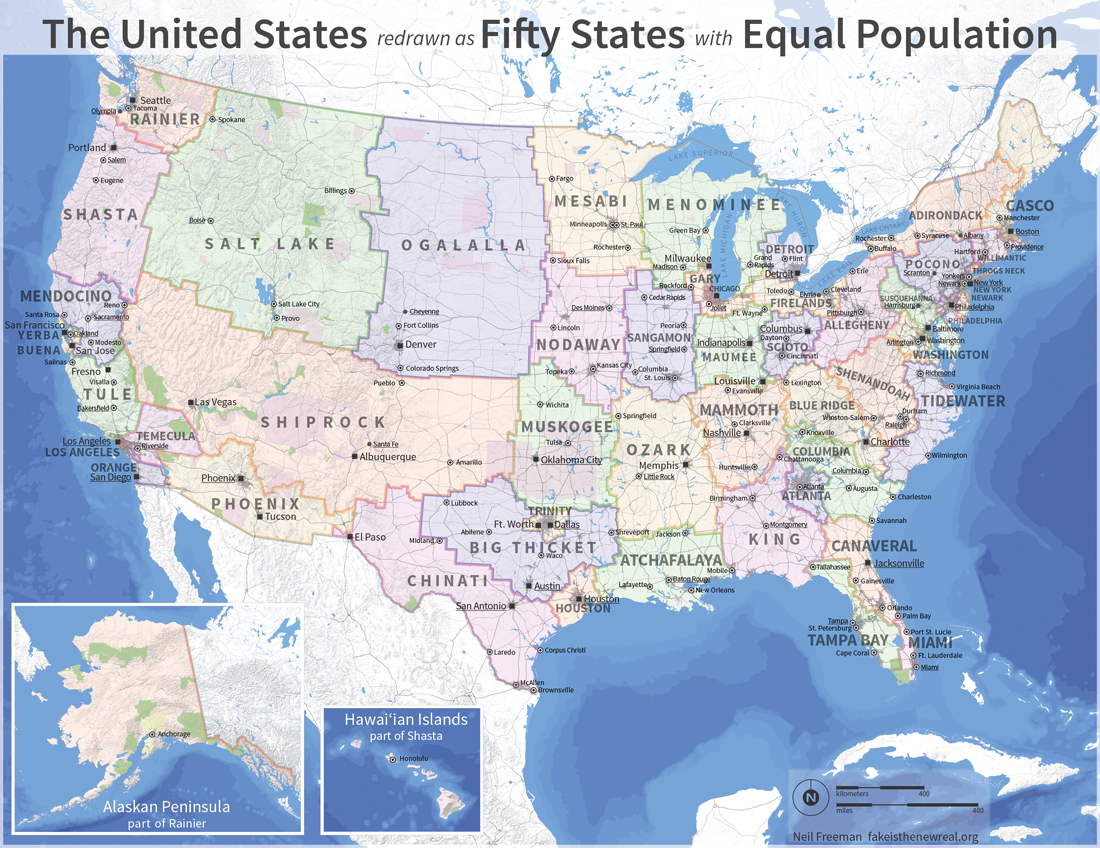
electoral10-1100

Neil Freeman takes a novel approach to fixing the Electoral College:

The fundamental problem of the electoral college is that the states of the United States are too disparate in size and influence. The largest state is 66 times as populous as the smallest and has 18 times as many electoral votes. This allows for Electoral College results that don’t match the popular vote. To remedy this issue, the Electoral Reform Map redivides the fifty United States into 50 states of equal population. The 2010 Census records a population of 308,745,538 for the United States, which this map divides into 50 states, each with a population of about 6,175,000.

(via TPM)

The Mobile Disruption

Henry Blodget thinks that the drive for companies to be “mobile only” or “mobile first” is misguided. He advocates a “mobile, too” approach:

With the explosive growth of smartphones, tablets, and super-sleek laptops, mobile usage continues to grow as a percentage of overall Internet usage. In some countries, moreover, smartphones have already vaulted past laptops and desktops to become the dominant personal-computing device. In these countries, companies should obviously focus on mobile first.

But in the developed world, which already has a massive installed base of desktops and laptops, bigger screens are still extremely important. And they are likely to remain so, even when everyone who uses them also owns a smartphone and tablet.

Cory Bergman responds:

[N]ews organizations should shift to a mobile-first approach immediately. This doesn’t mean we ignore the desktop, but prioritize mobile over it — make mobile the default everything. When brainstorming a new product, start with a phone or tablet design and work backwards to the desktop. Set performance goals based on mobile performance over desktop.

Benedict’s Christianist Strategy

VATICAN-POPE-RESIGN-ST PETER

Philip Jenkins examines the causes of Pope Benedict’s failure to make significant progress toward his goal of re-evangelizing Europe. The most important reason why? Benedict’s strategy of retrenchment and relying on the most fanatical movements within the Church:

[T]rue reconversion, Ratzinger believed, could only be achieved by small, dedicated groups of highly active and committed believers, like the small, super-loyalist movements that emerged during the sixteenth century, chiefly in Spain and Italy. The Jesuits and Opus Dei are the best-known examples, but also influential were the Italian Focolare, the Sant’Egidio Community, and Communion and Liberation, Spain’s Neocatechumenate, and the Mexican-founded Legionaries of Christ. So were charismatic offshoots like Rinnovamento nello Spirito Santo (“Renewal in the Holy Spirit”) and the Emmanuel Community. Like the early Jesuits, such groups demanded extremely high levels of participation and activism, and some were accused of cult-like behavior. Focolare, for example, subjects members to ritualized public confessions and retreats that serve as a kind of total immersion in the group and its doctrines. Still, such movements spread widely, partly because they offered such a high role for lay activists, especially women.

Both Ratzinger and John Paul II saw these movements as the leaven, the yeast, that could energize and restore a Christian Europe that that could once again play its full part in the global Church. By the mid-1980s, John Paul was citing them as a beacon of hope, even the start of a modern-day Pentecost, and this wholehearted support continued when Benedict took office in 2005.

You see now why it was so convenient to overlook some of the abuses that some of these groups engaged in. They seemed to be the only new energy in the Western church. And you see now also a little of the desperation – as Wojtila and Ratzinger tried to rescue the Church from its death-spiral in Europe. Of course, tolerating the abuses of, say, Maciel, was, in the end, utterly self-defeating. You look desperate and you become complicit in rank evil.

This wasn’t a strategy of engagement with the modern world, with its great intellectual advances and deep moral problems; it’s a neurotic desire for purity. It aims at convincing no one. As Jenkins intimates, it replaces dialogue with cult-like obedience. Loyalty replaces love. It is the practical corollary to the lost promise of Joseph Ratzinger and did nothing in the end but speed the demise of an already dying Church.

It reminds me of how the GOP thought the Tea Party would save it. But nothing will save Catholicism but an openness to truth and a love of others. It’s there – throughout the real church, which exists everywhere the people of God come together. It just needs re-connecting with its institutional guardians.

(Photo: the Vatican struck by a lightning bolt the day Benedict announced his resignation. By Getty Images.)