SOTU: Tweet Reax

US-POLITICS-STATE OF THE UNION-OBAMA

(There is a glitch in the formatting of the tweets after the jump, so click here to view the whole reax in the proper format.)

GIF of the exploding fist-bump here.

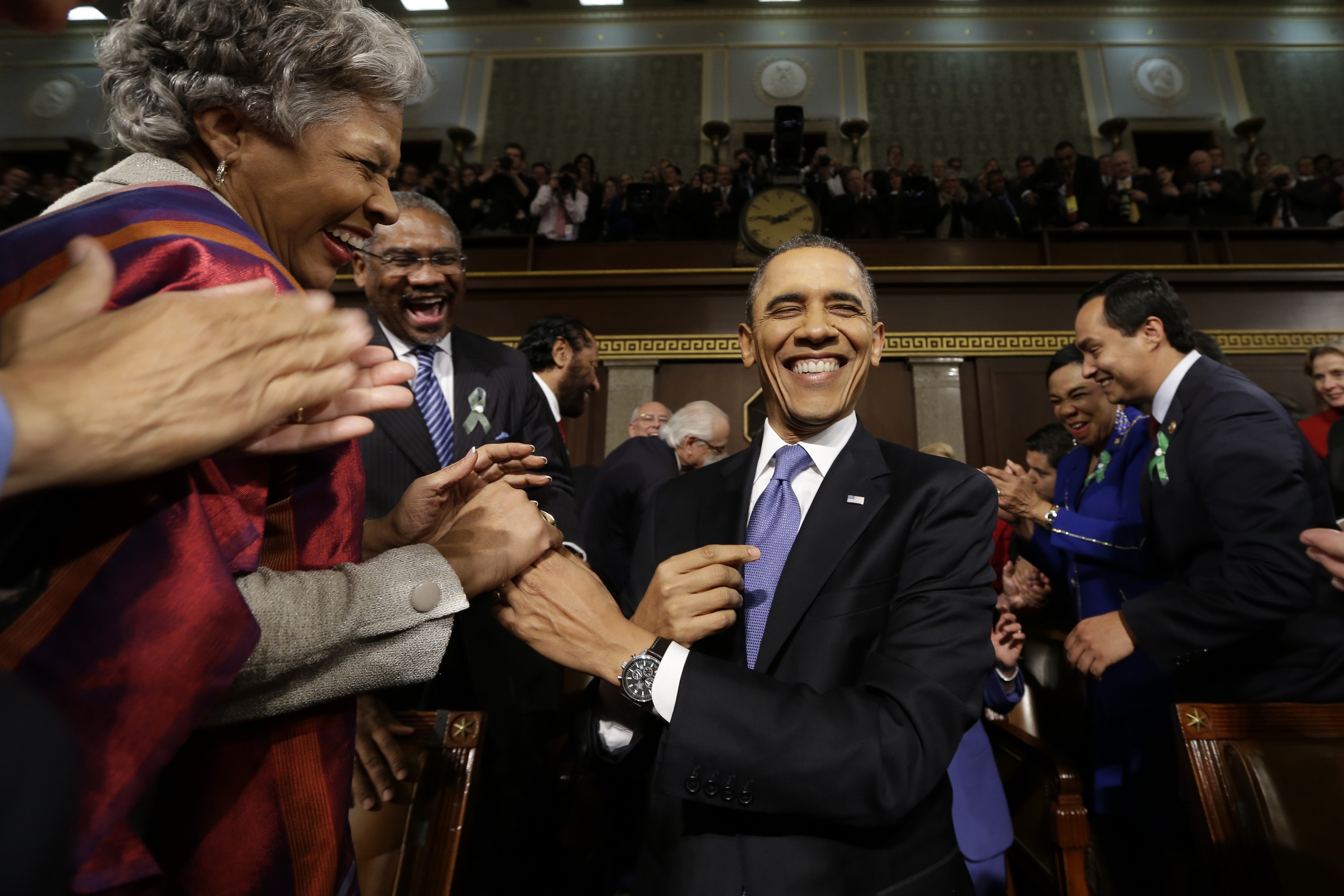
(Top photo: Rock musician and gun rights activist Ted Nugent listens to US President Barack Obama deliver his State of the Union address before a joint session of Congress on February 12, 2013 at the US Capitol in Washington. By Mandel Ngan/AFP/Getty Images)
Live-Blogging The State Of The Union

President Obama Delivers State Of The Union Address

10.12 pm. Now we’re really into Reagan territory. The 102 year-old is pretty damn amazing. And, yes, it is a national scandal that she had to wait six hours to vote. Then a heroic cop. “That’s just the way we’re made.” I have to say that even to these jaundiced ears, that peroration moved me. The passion, the reason, the sincerity: this was an invigorated president, trying to shift the mood away from zero-sum partisanship to non-zero-sum citizenship. It’s what we always hoped from him, and I think it places the Republicans in a horrible bind. Are they going to prevent a vote on guns? Are they going to refuse Bowles-Simpson Medicare reform? Are they willing to force a sequester rather than cooperate with this popular president? Does the Speaker not appreciate a 102 year-old getting to vote? Why did he stay seated? I have a feeling that moment will strike people.

Meep meep.

10.08 pm. He’s ending on Newtown. Ticking off the majority’s support for background checks, citing the support of the police for ending weapons of grotesque destruction. A thousand gun-deaths since Newtown. And then the emotional power/blackmail of the parents of a little girl culled by a gun. “They deserve a vote” is a great line.

10.05 pm. “Families, gay and straight.” The confidence with which he now routinely includes gay people among his public statements is truly remarkable. It’s as if he’s been liberated to champion this civil rights movement, which he has done more than any president to advance and legitimize.

10.02 pm. A personal note of thanks for using the words Rangoon and Burma. Then the Arab Spring: it will be messy, we cannot control events, but we should back freedom. Pretty much: stay out of the way. A minor note on Israel: emphasizing security and a “just peace.”

9.54 pm. This is now the goal of the Afghanistan war: destroying the “core of al Qaeda.” But the promise is the withdrawal. The leaked 34,000 troop withdrawal was correct. Again, this was, remember, why he was elected – because he resisted the pro-war consensus in Washington. He’s ruling out ground invasions. And then a vague commitment for greater Congressional control and scrutiny – with no judicial element. Somewhat disappointing. And he sure sounds like he’s not backing down on drone warfare – or unilateral presidential war-making.

9.51 pm. I wasn’t aware – and should have been – that the minimum wage for a family of four is $14,000. But I’m surprised by the unapologetic liberalism there. Does he believe that raising the minimum wage would have no impact on jobs growth? Does he believe it would actually increase employment and growth?

9.48 pm. A tough line on immigration reform. But the real ovation came from expanding legal immigration. Still, the rhetoric again was not partisan, and included GOP talking points.

9.41 pm. People have been talking about Obama’s new swagger and self-confidence. I can see that in this speech, but I don’t see an aggressive partisan attack. He has consistently mentioned bipartisan initiatives; he has endorsed major tax reform as a way to avoid the sequester; he’s now onto one of the most critical issues in America today: the lack of good pre-K education.

9.38 pm. So he’s for more energy investment but with added research into cleaner emissions. And then what strikes me as pretty banal but has become somewhat partisan: rebuilding bridges and roads and infrastructure and Internet.

9.35 pm. I’m genuinely surprised that he’s put climate change so early and so emphatically. Tow valentines to McCain, I note. One a handshake at the start and now a tip to McCain’s previous proposal for cap and trade. I wish I believed it could truly work.

9.34 pm. Now he’s emphasizing investments in science. He’s speaking as if the crisis is over and morning in America is coming. By the way, the green ribbons are in honor of Sandy Hook. Lame.

9.33 pm. This is an optimistic speech, gaining momentum as it goes along. Then a nod to Clinton: not a bigger government, but a smarter one.

9.30 pm. Deficit reduction is important – just not as important as investing in the middle class. Krugman must be happy.

9.28 pm. He’s on a roll now, lambasting the fiscal brinksmanship of the last several years.

9.24 pm. He’s backing the Bowles-Simpson commission’s goals on Medicare over the next decade – that strikes me as a big concession.

And then he says “we must keep the promises we’ve already made.” I’m getting a little whiplash. But now we’re getting to comprehensive, bipartisan tax reform. Is this a late modification of Bowles-Simpson – with more populism and energy?

9.22 pm. And we’re right into the sequester – “a really bad idea”. But he prefers it to cutting entitlements while leaving the Pentagon alone. A pretty lame adjective for the fiscal crisis in Medicare: modest adjustments.

9.20 pm. Biden stands up for “country before party”. Boehner stays in his chair.

9.19 pm. “A rising, thriving middle class”: that’s becoming the theme of his presidency. Notice too the little inclusion of gay love.

9.16 pm. A unifying start, quoting Kennedy, and then a reminder of why he became president in the first place: ending the Bush-Cheney wars.

9.15 pm. What is that weird ribbon on Biden’s lapel?

Chart Of The Day II

A WaPo poll tested the popularity of various policies when Obama’s name is and isn’t attached to them. The results:

Obama_Poll

Waldman’s reaction:

[H]ow should Obama interpret this information? The answer is that there isn’t much he can do about it. The Postarticle suggests, tongue in [cheek] I’m assuming, that he shouldn’t mention that he supports a path to citizenship in his State of the Union address. But it isn’t like we’re going to have a big debate about immigration reform in which the President is able to keep his position a secret. That’s the thing about being in charge—for better or worse, voters are going to know where you stand, and the more attention an issue gets—in other words, the closer it gets to being resolved with new legislation—the more that’s true.

The State Of The Linguistics

The Guardian charted the reading levels of all State of The Union speeches and found that the “linguistic standard of the presidential address has declined.”  Nathan Yau offers on explanation:

My guess is this has to do with changes in how we write and talk more than anything else. Lee Drutman and Dan Drinkard for the Sunlight Foundation ran a more rigorous analysis on Congressional records back in May, and the declining trend is similar.

Is Rubio The Frontrunner? Ctd

Enten doubted it. Larison’s perspective:

It’s true that most Republicans will be even more willing to tolerate a relative moderate candidate in the 2016 cycle than they were this time, but being perceived as the relative moderate often depends on the other candidates in the field. On paper, McCain wasn’t that much of a moderate compared to his rivals, but he was perceived that way and encouraged people to think of him as such. If Jeb Bush chooses not to run, Rubio would be his obvious replacement and would likely reap the benefits of Bush’s connections. None of that means that Rubio will be the next nominee or even that he should be considered the favorite at this point, but there are fewer obstacles between him and the nomination than Enten thinks.

The Legacy Of The Twitter Revolutions

[tweet https://twitter.com/jihankazerooni/status/301376068441473024 ]

Last week, Marc Lynch struggled to unravel the continuing impact of social media on the Arab Spring:

[N]egatives such as sectarianism, fear, and hatred spread as rapidly on social media as do more positive ideas. The success of the Tunisian revolution inspired Arabs everywhere to believe that victory was possible, and Egypt’s success convinced many that victory was inevitable. But the reverse also proved true. The bloodbath in Syria, like the horrors of Iraq in the mid-2000s, had a chilling effect on popular mobilization. By midway through 2011, it was already clear that the end of the story did not have to be partying in Tahrir Square — it might be butchered women and children littering the streets and massive dispossession and grief. The sectarian hatred and division fueled by the Syrian bloodshed flowed through social media just as effectively as the unifying message of the early Arab Spring.

Brian Ulrich’s perspective:

As a historian, I am struck by how often changes in the information environment appear in explanations for revolutions.  What I know of the French Revolution comes from basic reading and conversations with a colleague in order to teach my world history survey, but there is definitely the idea that in the mid-1700’s a critical mass of literate urban dwellers began reading and spreading information contained in pamphlets, a culture which took an increasingly political turn in the aftermath of the debacle of the Seven Years’ War, and that King Louis XVI was simply unable to effectively engage with or manage the newfangled “public opinion.”  Juan Cole wrote of something similar in Egypt’s 1881 Urabi Revolt.  When I think of Iran’s Tobacco Revolt and Constitutional Revolution, I think in part of the telegraph and the spread of ideas and information via labor migration.  I have no idea if similar developments figure in the contemporary developments in China, Russia, and Mexico.  None of these situations, however, led quickly and easily to a happy and united community under a new political framework, an expectation much of the public has had of the Arab Spring that probably owes more to memories of the transitions of the fall of communism than the longer history of popular uprisings.

In a follow-up post gathering responses, Lynch clarifies his stance:

I believe that the underlying transformation of the Arab public sphere enabled by the radical, rapid spread of new information technology represents the single most enduring and profound change of the last decade. It is one of the primary obstacles to the return of traditional Arab authoritarianism, and to the emergence of a new Islamist domination.  The effects of that structural change, like those of any structural change, are complex and unpredictable, and can’t be reduced to reassuring narratives of “democratization” or frightening narratives of “state collapse.”  The new information environment empowers politics, which do tend to be messy and contentious and unsatisfying.  That’s good, but it doesn’t guarantee any particular outcome.

The Social Ladder Is Broken

The Economist summarizes the work of Gregory Clark, an economist who tracks social mobility over long periods of time:

Mr Clark reckons that even in famously mobile Sweden, some 70-80% of a family’s social status is transmitted from generation to generation across a span of centuries. Other economists use similar techniques to reveal comparable immobility in societies from 19th-century Spain to post-Qing-dynasty China. Inherited advantage is detectable for a very long time.

The Caricatures Of COPS

As the show enters its 25th season, Kelley Vlahos sighs:

For teenagers, voyeurs, and red-blooded law-and-order types who’ve made this show one of the longest running in American history, the pioneer cinéma vérité format ratifies the correct order of things—beginning smartly with heroes and villains, and ending with the crank of handcuffs and the door of a squad car slamming on another case, closed.

In between, the raw humiliation of both “perp” and victim on display punctuates a well-worn routine, good for a sanctimonious chuckle at someone else’s expense, inevitably explained away as the price of being morally weak, and stupid. Caricatures abound, and must seem reassuring to some: cornrows and gang tats, toothy wild-eyed white trash, skinny hookers with tracks running up and down their arms. Life’s generic losers. …

For serious viewers, hearing actual police officers like Russ Martin say things like, “just a normal day, you get to tase a man,” and watching one resigned black youth after another being pig-piled and hauled off by a disproportionate number of jacked-up white cops for a couple of teeny plastic-wrapped bundles of marijuana, is not entertainment, it’s a cringe-fest.

Return To Sender, Eventually, Ctd

Sarah Kliff recently claimed that the USPS is “the very best internationally at its most crucial task: Delivering mail.” Adam Ozimek finds a problem with the study Kliff cites:

[T]he letters in the study were sent from Cambridge, Massachusetts. Is it really surprising that letters sent from one U.S. address to another U.S. address and back were returned faster than letters sent to from a U.S. address to New Zealand and back?