
Astronaut Cuisine, Ctd

As an alternative to prepackaged meals, the Fab@Home team at Cornell University is trying to create 3-D printed food for astronauts. Adam Mann covers their efforts:

A 3-D printer could mix vitamins and amino acids into a meal to provide nutrients and boost productivity. There are limitations to the types of fresh foods that can be grown in space – NASA says some of the best crops for a Mars mission are lettuce, carrots, and tomatoes. With that you could make a salad, but a 3-D printer could manufacture croutons or protein-dense supplements. The device could take up less space than a supply of packets of food and, because each item is custom built, would help cut down on waste.

One big hurdle:

In the earliest tests of the hydrocolloid 3-D food printer, the Cornell team produced different fake items — bananas, mushrooms, mozzarella – all with the appropriate texture and flavor. “We quickly ran into the yuck factor,” said engineer JeffreyLipton, who leads Cornell’s Fab@Home lab, which makes open-source 3-D printer kits. “It was the Uncanny Valley of food,” he added. It was very close to, but still unlike, the cuisine people expected.

(Photo: A deep-fried space shuttle scallop built using Cornell’s Fab@Home 3-D food printer. Credit: Fab@Home)
Gold-Plated Corruption

Osnos finds a relationship between Chinese corruption and the market for luxury goods in the country:

[T]he luxury watch business enjoyed a banner year in 2011, growing forty per cent. But then China’s anti-corruption campaign began, and by September, Bo Xilai was in handcuffs, and watch exports to China suffered a devastating blow—down 27.5 per cent compared to a year earlier, according to the Federation of the Swiss Watch Industry. ChinaDaily quoted an industry consultant saying the anti-corruption drive “hurts the luxury watch business a lot.”

It’s not just watches. In 2009, the industry experts estimated that gifts to government officials made up nearly fifty per cent of all of China’s luxury sales.

Chart Of The Day

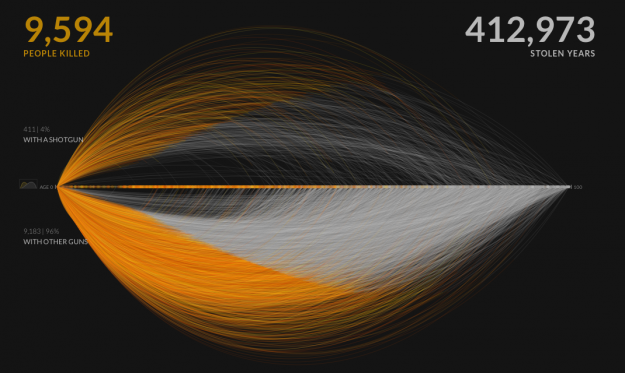
Nathan Yau admires a chart on US gun violence:

Information visualization firm Periscopic just published a thoughtful interactive piece on gun murders in the United States, in 2010. It starts with the individuals: when they were killed, coupled with the years they potentially lost. Each arc represents a person, with lived years in orange and the difference in potential years in white.

The Asteroid That Broke The Dinos’ Back

Alex Knapp reviews new research on the extinction of the dinosaurs:

While an asteroid impact is obviously a devastating event, what’s interesting about this impact and the extinction of the dinosaurs is that it might not have happened – except that for a million years prior to the impact, the Earth’s climate had started to undergo some significant climate changes. That meant that the asteroid impact caused much more harm to the ecosystem than it otherwise might have during a more stable era.

“These precursory phenomena made the global ecosystem much more sensitive to even relatively small triggers, so that what otherwise might have been a fairly minor effect shifted the ecosystem into a new state,” [researcher Paul] Renne added in the release. “The impact was the coup de grace.”

From The Pirate’s Point Of View

J.R. Jones reviews a new documentary by Thymaya Payne on Somali piracy:

Payne manages to show how Somali piracy fits into a larger pattern of exploitation linking the poor tribal state and the industrialized world. Since the civil war, Somalis have complained about European countries dumping barrels of toxic waste on their shores (Payne includes a photograph of one hideously scarred man) and giant fishing companies poaching from their territorial waters. In fact illegal fishing is another rewarding operation for pirates, costing Somalia an estimated $300 million a year and weakening environmentalists’ efforts to protect ocean populations. Piracy historian Matthew Rafferty argues in the film that this occurs with some complicity from the same Western powers waging war on piracy in the gulf: “It’s not like Japan, France, the United States has no idea where all this fish is coming from as the prices drop, as the catches go up.” The key insight of Stolen Seas may be that, in the eyes of Somali pirates, we’re the real buccaneers.

Joshua Keating interviewed Payne about how he got access to the pirates by outsourcing much of his filming:

I started working with younger Somali reporters and stringers, who grew up with a lot of these guys. I started to realize that the best thing for me to do was actually just to give them a camera and get out of it – out of the way – and get my ego out of the way because the story wasn’t so much about me going and getting on a pirate ship. So I actually trained this young Somali guy how to like shoot a documentary film in two days at a hotel in Somaliland and then said “okay, well keep in touch.”

College Credit 101

The Consumer Financial Protection Bureau is initiating an inquiry into the relationship between colleges, banks and debit card companies. One of the more egregious examples:

Preloaded debit cards have caught on in recent years as a method of giving college students access to federal grants and loans for living expenses. While they have come under scrutiny for high fees, they are a way to give money to students without using paper checks, and do not require a bank account. Critics say students would be better off opening a bank account than relying on preloaded cards. Higher One has dominated the debit card market for years, and has come in for much of the criticism for swipe fees, ATM fees and other charges that can chip away at students’ financial aid. As the cards have grown more popular, other banks, including Sallie Mae, have entered the market place.

Kay Steiger argues the practice is “obviously predatory in a lot of ways”:

Though my alma matter, the University of Minnesota, didn’t go quite so far as to use our student ID cards as ATM cards, they did fold in an application to open an account with TCM Bank along with the forms I was supposed to fill out for my student ID. Though it’s not necessarily bad to encourage student to open bank accounts, it did leave me with the impression that I wouldn’t get my ID card unless I signed up with this preferred bank. Of course in retrospect this seems crazy, but as an impressionable 18-year-old college student, it’s easy to see how manipulative marketing financial products can be when they appear to be endorsed by the college.

The Power Of Historical Fiction

Paula Marantz Cohen draws our attention to it:

[Historical fiction] smooths out the inconsistencies in the past and fills in the unknown. As readers, we know this is being done—the genre tells us so—but so powerful is the seductiveness of coherent storytelling that it makes us forget. For years I carried around an image of Sir Thomas More as an exemplary man—honorable and pious, as represented in Robert Bolt’s play (and the subsequent movie), A Man for All Seasons—only to have my notion turned on its head when I read Hilary Mantel’s Wolf Hall. Mantel’s version of the character now supersedes Bolt’s in my imagination. I could go to the history books and sort things out for myself, but it is unlikely that facts would make much difference. The vivid representation holds sway.

(Video: A scene from Aguirre: The Wrath Of God, whose historical accuracy is assessed here.)

Slacking Off Is Sustainable?

Kate Sheppard summarizes a new study suggesting that working less “could cut future global warming by as much as 22 percent by 2100”:

[Economist David Rosnick’s research] found that dialing back the amount of time the average person works by 0.5 percent per year would mean a significant reduction in greenhouse gas emissions. If you work 40 hours a week, that would mean shaving about 12 minutes off the average work week per year. Working one minute less per month seems pretty doable. Basically, we’re using a whole lot more of everything when we’re working–electricity, gasoline, heating, air conditioning, etc. Leisure is requires less greenhouse-gas-producing activity.

The View From Your Blizzard II

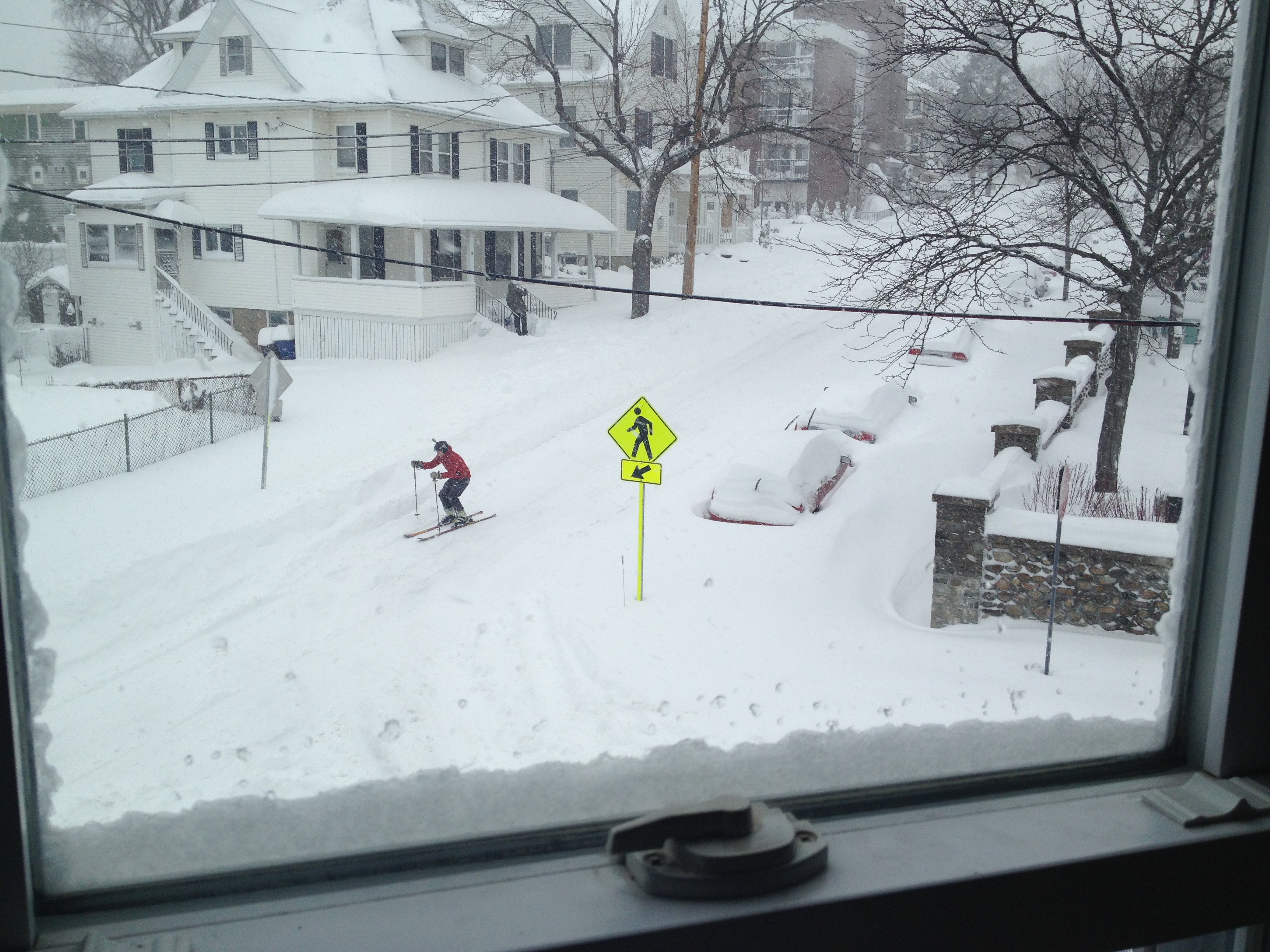
Somerville-MA-930am

Somerville, Massachusetts, 9.30 am.

The first batch from the weekend here. Readers kept sending in so many great ones that we just had to go another round:

Manchester-CT-1024 am

Manchester, Connecticut, 10.24 am

Kitchener-Ontario-2pm

Kitchener, Ontario, 2 pm

waltham-MA-850am

Waltham, Massachusetts, 8.50 am

Toronto-Ontario-930am

Toronto, Ontario, 9.30 am

Clarkdale, AZ 915 am

Clarksdale, Arizona, 9.15 am

Invisible Herders

Nicola Twilley recently spoke with Dean Anderson, a USDA scientist who believes virtual fencing could radically alter our interactions with herding animals. Anderson paints the scene:

[Y]ou could be driving your property in your air-conditioned truck and you notice a spot that received rain in the recent past and that has a flush of highly nutritious plants that would otherwise be lost. Well, you can get on your laptop, right then and there, and program the polygon that contains your cows to move spatially and temporally over the landscape to this “better location.” Instead of having to build a fence or take the time and manpower to gather your cows, you would simply move the virtual fence.

The method of moving the animals is similar to electronic fences used for dogs today, but calibrated to cows’ sensitive hearing. Anderson argues the technology could be a boon to developing countries:

Maybe with this technology, a third-world farmer could put a better thatched roof on his house or send his kids to school, because he doesn’t need their manual labor down on the farm. It’s fun for a while to be out on a horse watching the cows; what made the West and Hollywood famous were the cowboys singing to their cows. I love that; that’s why I’m in this profession. Still, I’m not a sociologist, but it seems as though you could take some of that labour that is currently used managing livestock in developing countries and all of the time it requires and you could transfer it into things that would enhance human well-being and education.