Today on the Dish, in the wake of the Pope’s resignation, Andrew articulated the tragedy of Benedict XVI and his failure to restore faith through reason, before asking where the man will end up next. He dug up clips from Hitch’s dogged pursuit of justice against this Herr Ratzinger and his underlings, as well as his own appraisal of Benedict’s “Deus Caritas Est.” Later Andrew noted the outgoing Pope’s disquieting (and suspicious) obsession with homosexuality, wondered why the Pope would duck out at this precise moment, and doubted if we’ll ever know the extent of his involvement with the Church’s cover up of child rape.
Elsewhere, Joseph Komonchak raised the significance of Ratzinger’s leaving rather than dying a Pope and Russell D. Moore applauded his common cause with evangelicals, while George Weigel also found it a strange time to exit stage left. We gathered reax to Benedict’s resignation, from commentators and readers alike, then rounded up thoughts on who might come next, where he might be found, and how he’ll be chosen.
In non-papal news, Bill Becker asked the president to treat global warming as his Great Depression as we tried to pinpoint when Obama’s healthcare law will take a bite of his base. Phil Bronstein traced bin Laden’s demise back to his shooter’s teenage heartache, and marijuana farming devastated the environment in California.
In assorted coverage, Chris Moody filed a must-read on Florida’s rugged hunters and headless pythons, Mathew Ingram called Andrew and Amanda Palmer birds of a feather while Nicholas Carr didn’t grade Google Scholar very generously. Alyssa Rosenberg and Kirby Dick shed light on sexual abuse in the armed forces, David Foster Wallace said a good word for puppy love and Eric Jaffe projected a future without traffic lights.
After VFYW in Clintondale, New York, we quenched our thirst for a MHB, broke out more reader emails on the Dish as a business venture, and spent a moment with a recipient of the Medal of Honor.
A resignation is truly a big deal. Since it hasn’t happened in 600 years, it changes the institution. It’s not outside the rules. The last Benedict to resign was Benedict IX (1032-45), “after selling the papacy to his godfather Gregory VI.” I’m unaware of any evidence of that kind this time around. John Paul II drew up contingency plans to resign if he became incapable of performing his functions – and yet he hung on for a very long time indeed. Tom Reese:
In Light of the World, Pope Benedict responded unambiguously to a question about whether a pope could resign: “Yes. If a Pope clearly realizes that he is no longer physically, psychologically, and spiritually capable of handling the duties of his office, then he has a right and, under some circumstances, also an obligation to resign.”
On the other hand, he did not favor resignation simply because the burden of the papacy is great. “When the danger is great one must not run away. For that reason, now is certainly not the time to resign. Precisely at a time like this one must stand fast and endure the situation. That is my view. One can resign at a peaceful moment or when one simply cannot go on. But one must not run away from danger and say someone else should do it.”
That was published a little over two years ago. And yet in his resignation letter, this is the rationale:
In today’s world, subject to so many rapid changes and shaken by questions of deep relevance for the life of faith, in order to govern the bark of Saint Peter and proclaim the Gospel, both strength of mind and body are necessary, strength which in the last few months, has deteriorated in me to the extent that I have had to recognize my incapacity to adequately fulfill the ministry entrusted to me.
I do think his reference to the world “being shaken by questions of deep relevance for the life of faith” is a critical qualifier here. He seems to recognize that the challenges the Catholic church now faces – its intellectual collapse in the West, the stench of moral corruption revealed by the decades of child-rape and cover-ups, and the resort to the crudest forms of authority and reactionaryism in response to new ideas, discoveries and truths about human nature – have now overwhelmed his physical and mental strength. At some point, the sheer human energy required to try and impose a moral authority already lost must have seemed hopeless.
Since Benedict’s election in 2005, the number of people leaving the Catholic Church in Germany has more than doubled, and it’s been the highest most recently in Ratzinger’s former Archdiocese of Munich and Freising. Only 30 percent of Germans are still Catholic today.
In Ireland, the collapse has been close to total. At the start of his papacy, Benedict declared his intent to bring Catholicism back to intellectual life in Europe. He didn’t just fail; he failed catastrophically, accelerating the Church’s demographic, spiritual and moral decline in the West. Key pillars of the Wojtila-Ratzinger counter-reformation – like the Legion of Christ, the creation of the repeat child rapist and drug trafficker, Marcial Maciel – crumbled to dust. Key enablers of abuse were given rewards – Boston’s Cardinal Law springs to mind; other minor figures – including the monster who raped over 200 deaf children, Father Lawrence Murphy – were allowed a quiet retirement with no serious punishment; I called for the Pope’s resignation two years ago, as the full extent of his complicity in the child-rape crisis came into closer view:
Ratzinger can no more be separated from John Paul II than Bush can from Cheney. And the cult of authority was John Paul II’s and Benedict XVI’s key contribution to the modern church. Now we see how this cult of authority was directly connected to enabling the church to enable, hide and defend the rapists of children … there is no escaping the verdict of history.
The Pope must resign. He has no moral authority left. And a new Pope needs to be selected who represents an end to the euphemisms, an end to any tolerance for this, and who will seek to restore the balance of authority achieved by the Second Vatican Council.
For me, the great tragedy of Benedict was his panic after the Second Council. There is no disputing the elegance of his mind or the exquisite meticulousness of his perfect, orderly German theology – and his work alongside the more consistently modernist Hans Kung will stand the test of time. But his post-1960s theology had as much relationship to the real challenges of the 21st Century as the effete, secluded German scholar, embalmed in clerical privilege for his entire adult life. And his early promise as a theologian calcified into the purest form of reaction and fear when given the power to enforce orthodoxy, which is what he essentially did for well over two decades. It was excruciating to watch such a careful, often illuminating scholar turn into a Grand Inquisitor. It was revealing that a bureaucrat who never missed even a scintilla of heresy was able to turn such a blind eye to the monstrous rapes of so many children. I wrote once:
Reading Benedict for a struggling gay Catholic like me is like reading a completely circular, self-enclosed system that is as beautiful at times as it is maddeningly immune to reasoned query. The dogmatism is astonishing. If your conscience demands that you dissent from some teachings, then it is not really your conscience. It is sin. And if all this circular dogmatism forces many to leave the church they once thought of as home? So be it.
When he was actually elected Pope, I was horrified by what it implied about the future. Back in 2005, I wrote:
I was trying to explain last night to a non-Catholic just how dumb-struck many reformist Catholics are by the elevation of Ratzinger. And then I found a way to explain. This is the religious equivalent of having had four terms of George W. Bush only to find that his successor as president is Karl Rove. Get it now?
I read much of Ratzinger’s theology back in the 1980s, as he assumed the power of Papal enforcer of orthodoxy. Here’s an extract from my 1988 TNR review of Ratzinger’s thought (alas, not online):
The metamorphosis of Joseph Ratzinger from Augustinian theologian to Augustinian policeman, and finally to policeman, may in part be due to the metamorphosis of the Church itself. The forces of change have been so great in the Church during the past two decades that some form of simple assertion of authority may have a prudential justification. John Paul II, however, has balanced Ratzinger’s zeal with a more humane approach. Together, they have played a “good cop, bad cop” routine with recalcitrant faithful. Ratzinger’s great gift to a Church all too easily distracted by the world is to call the faithful back to the fundamentals. But it is difficult not to feel dismayed by the way in which his earlier inspiration has ceded to the dictates of coercion, and his theological distrust of fallen man has translated so easily into disdain for Christians trying to live obediently in modernity. The man who might have guided the Church through reason has resorted to governing by force.
Sullivan’s take on Ratzinger back then was that he represented the marriage of the German Augustinian tradition (the same tradition that produced great Protestant theologians from Martin Luther to Karl Barth) with papal power, along with an unhealthy attitude about sex and gender. It’s a very toxic combination, producing a very political agenda in the guise of the non-political sovereignty of the Church. That’s why Andrew ultimately compared Cardinal Ratzinger then, and compares Benedict XVI now, to Dostoevsky’s Grand Inquisitor: a man driven by the logic of theology to, and perhaps beyond, the limits of Christianity itself.I hope Sullivan is wrong about the new pope, but there are unsettling analogies in his Catholic analysis of Ratzinger to the strangely un-Christian tendencies recently apparent in so many conspicuously Christian U.S. religious and political leaders.
I don’t think, alas, that I was wrong. And the desert in which the church has wandered since has been bleak but not without oases of new thought and eruptions of real grace and persistence of real faith. Those of us who have hung in must now pray for a new direction, a return to the spirit of the Second Council, a Pope of reform after an era of often irrational reaction and concealment of some of the worst evil imaginable. It can happen. Perhaps Benedict XVI finally grasped that. And finally did what he was never ever capable of doing before: let go and let God take over.
May the sunlight now come in; may accountability be taken; may a new fearlessness, guided by the Holy Spirit, give the church new life when its strength and vitality are in such profound crisis. May we see real punishment for the enablers of child rape; may we see more married priests and a serious discussion about women priests. May we see a return to the core truths of our faith: that God exists, that God is love; that this love became incarnate to rid us of the dead-end of worldliness into the wonderment of caritas. This is a chance for renewal. And repentance … as Lent inexorably approaches and Easter finally beckons.
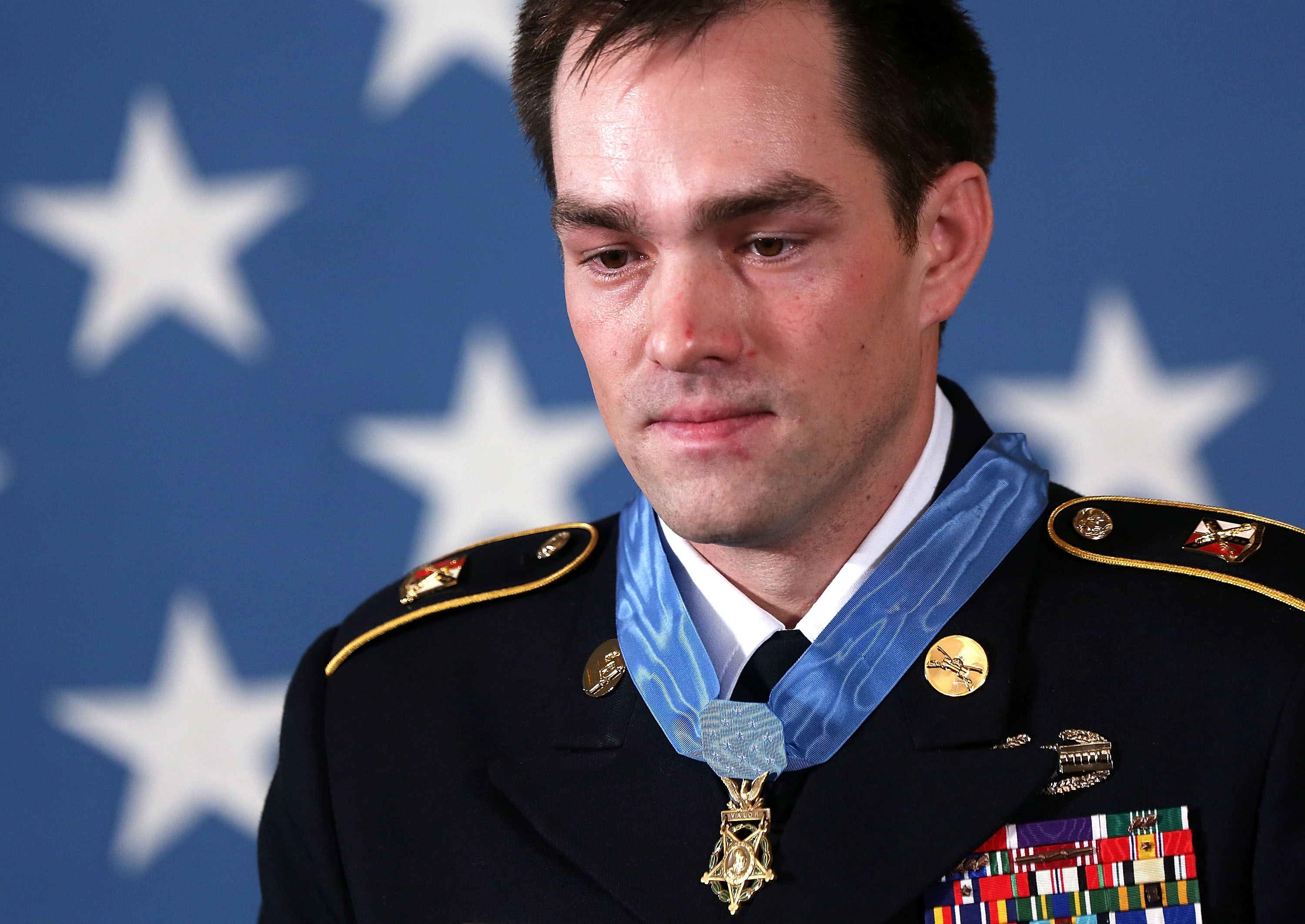
Clinton Romesha, a former active duty Army Staff Sergeant, stands after he was presented with the Medal of Honor for conspicuous gallantry by U.S. President Barack Obama at the White House February 11, 2013 in Washington, DC. Romesha received the Medal of Honor for actions during combat operations against an armed enemy at Combat Outpost Keating, Kamdesh District, Nuristan Province, Afghanistan on October 3, 2009. By Alex Wong/Getty Images.
The official details of Romesha’s heroism, also available here on Wikipedia, are below:
Staff Sergeant Clinton L. Romesha distinguished himself by acts of gallantry and intrepidity at the risk of his life above and beyond the call of duty while serving as a Section Leader with Bravo Troop, 3d Squadron, 61st Cavalry Regiment, 4th Brigade Combat Team, 4th Infantry Division, during combat operations against an armed enemy at Combat Outpost Keating, Kamdesh District, Nuristan Province, Afghanistan on October 3, 2009. On that morning, Staff Sergeant Romesha and his comrades awakened to an attack by an estimated 300 enemy fighters occupying the high ground on all four sides of the complex, employing concentrated fire from recoilless rifles, rocket propelled grenades, anti-aircraft machine guns, mortars and small arms fire.
Staff Sergeant Romesha moved uncovered under intense enemy fire to conduct a reconnaissance of the battlefield and seek reinforcements from the barracks before returning to action with the support of an assistant gunner. Staff Sergeant Romesha took out an enemy machine gun team and, while engaging a second, the generator he was using for cover was struck by a rocket-propelled grenade, inflicting him with shrapnel wounds. Undeterred by his injuries, Staff Sergeant Romesha continued to fight and upon the arrival of another soldier to aid him and the assistant gunner, he again rushed through the exposed avenue to assemble additional soldiers. Staff Sergeant Romesha then mobilized a five-man team and returned to the fight equipped with a sniper rifle. With complete disregard for his own safety, Staff Sergeant Romesha continually exposed himself to heavy enemy fire, as he moved confidently about the battlefield engaging and destroying multiple enemy targets, including three Taliban fighters who had breached the combat outpost’s perimeter.
While orchestrating a successful plan to secure and reinforce key points of the battlefield, Staff Sergeant Romesha maintained radio communication with the tactical operations center. As the enemy forces attacked with even greater ferocity, unleashing a barrage of rocket-propelled grenades and recoilless rifle rounds, Staff Sergeant Romesha identified the point of attack and directed air support to destroy over 30 enemy fighters. After receiving reports that seriously injured Soldiers were at a distant battle position, Staff Sergeant Romesha and his team provided covering fire to allow the injured Soldiers to safely reach the aid station. Upon receipt of orders to proceed to the next objective, his team pushed forward 100 meters under overwhelming enemy fire to recover and prevent the enemy fighters from taking the bodies of their fallen comrades.
Staff Sergeant Romesha’s heroic actions throughout the day-long battle were critical in suppressing an enemy that had far greater numbers. His extraordinary efforts gave Bravo Troop the opportunity to regroup, reorganize and prepare for the counterattack that allowed the Troop to account for its personnel and secure Combat Outpost Keating. Staff Sergeant Romesha’s discipline and extraordinary heroism above and beyond the call of duty reflect great credit upon himself, Bravo Troop, 3d Squadron, 61st Cavalry Regiment, 4th Brigade Combat Team, 4th Infantry Division and the United States Army.
Ben Smith claims that the president is preparing to “screw his base”:
Imminent elements of Obama’s grandest policy move, the health-care overhaul known as ObamaCare, are calculated to screw his most passionate supporters and to transfer wealth to his worst enemies. The passionate supporters are the youth, who voted for him by a margin of 60% to 36%, according to exit poll samples of people 29 and under. His enemies are the elderly: Mitt Romney won 56% of the votes from people 65 and over.
Yglesias counters by pointing out that “today’s 25-year-old is tomorrow’s 55-year-old.” Ezra also pushes back:
Universal health-care systems in general, and Obamacare in particular, move money from the rich to the poor. The program fully subsidizes insurance for anyone making less than 133 percent of the poverty line and partially subsidizes it up until about 300 percent of the poverty line. On the other side, Obamacare pays for itself in part by taxing the rich. Both parts of the bill effectively redistribute from older Americans to younger ones.
People who don’t get in auto accidents pay disproportionate premium-to-claim ratio when compared to those that do have accidents; the same is true of homeowners whose houses don’t burn down. You want to “screw” others in the insurance subsidization game? Start smoking in bed and leave your stove on when you go to work.
Alyssa interviewed Kirby Dick about the impact of his documentary about rape in the military:
Dick says that a distributor he works with who sells movies to the military and other institutions estimates that 235,000 service members—or nearly 10 percent of the 2.9 million members of the active and reserve armed forces—saw The Invisible War in 2012. “The military itself is using the film for sexual-assault training, in part because, of course, they have no tools,” Dick said. “Eighty-five percent of those [viewers] are men. I think men seeing this is the real game changer, too. I think the film, not only on a policy level but on a cultural level, [is changing] the military. What people would joke about, you see this film and you don’t joke about it anymore.”
The Invisible War is one of the reasons I write about popular culture. You need narratives to push policy ideas forward. You need characters, be they human or fictional, to embody the impact of policies, or the lack thereof. And sometimes, people who have been deaf to the stories told by real people in their lives can hear those stories more clearly from the remove of a movie screen.
Nicholas Carr fears that Google Scholar Citations and Google Scholar Metrics, used “for tracking and measuring the value of academic articles and other scholarly works,” are rife with the potential for abuse:
The new tools offer a lot of benefits, but they also provide both the temptation and the means to game the scholarly citation system. Attempts to manipulate citations aren’t new, but now it’s possible to take the shenanigans to web scale, to bring black-hat techniques of search engine optimization to the ivory tower. Nat Torkington points to a 2012 paper (pdf), “Manipulating Google Scholar Citations and Google Scholar Metrics: Simple, Easy and Tempting,” in which three Spanish scholars describe how they used fake documents from a fake researcher to skew Google Scholar rankings and measures.
As the researchers put it:
Switching from a controlled environment where the production, dissemination and evaluation of scientific knowledge is monitored (even accepting all the shortcomings of peer review) to a environment that lacks any kind of control rather than researchers’ consciousness is a radical novelty that encounters many dangers.
My son had what I think is a great idea for companies/merchants: they should have a sticker or something that identifies that they provide health insurance for their employees. I did some investigating when my dry cleaning went up and found a cheaper service but they didn’t provide health insurance for their workers, so instead of switching solely on price, I stayed with the old service and paid the extra 34c per shirt. I’m sure others would like to know who provides and who doesn’t. It would impact our patronage.
Another:
I am curious as to whether you provide health insurance for your employees’ families as well. I run a similarly sized business as yours and currently do not, but I am reconsidering.
Dish Publishing LLC provides healthcare for our staffers’ spouses. We would also cover employees’ children but no one on staff has kids. Another quotes me:
One thing I’ve learned from a foray into business is that you really do have to make some moral calls. I realize that I’m not such a capitalist, after all, since my goal, I realized, was not really to be rich (I’m doing fine) but to do what I love in as efficient and as fair a way as possible – and to work with people I respect and love.
I’m quite certain you are full of shit with this sentence. Why slur the “capitalists”?
Take your blinders off and rid your thinking of these strawman stereotypes. The vast vast majority of “capitalists” don’t really set off with the goal of “being rich” but in reality are just like you. “Capitalists” want to do what they love, work with people they like, and make a meaningful contribution to society. Capitalists are people like Ray Kroc, Steve Jobs, Trey Parker, Matt Stone, Sylvester Stallone, Henry Ford. Capitalists are simply people who have a passion for serving others and meeting people’s unmet needs and wants. If they do it well and enough other people appreciate what they do, the end result may just be that they become Rich. But it’s almost never the goal at the outset!
Another agrees:
You don’t have to be greedy, amoral, or Milton Friedman to be a capitalist! You are an entrepreneur innovating a new business model to support a unique product. Society values that product enough to pay for it, and you (and your staff and interns) prosper. Moreover, you are making choices along the way designed to make this model sustainable over the long term, which turns out to be in the best interest of all stakeholders (because your incentives are aligned with theirs).
In other words, you are the BEST kind of capitalist. Please don’t shrug off the label or else we’ll lose it forever to the Ayn Rand crowd!
Another circles back to healthcare:
Regarding the following quote from a reader: “Should I ever leave this position, I could possibly be forced into the open market where, as an otherwise healthy 43-year-old man, a minor heart attack three years ago would likely prevent me from EVER being covered outside a group policy offered by an employer.” Could you please tell your reader that, thanks to the Affordable Care Act, “EVER” means “for the next 11 months”? As of 1/1/2014, your reader (assuming that he is not an illegal immigrant) will be able to get non-group coverage through the exchanges, without his premiums being impacted by his prior heart condition. As someone who works in health insurance, I recognize I’m way too close to this subject to understand the average man-on-the-street’s perception of the ACA, but I’m flabbergasted that your reader was unaware of this.
Another reader on the subject:
I’m an avid Dishhead for a few years now and happy to be a new subscriber. Your reader inquired about your relationship to the Affordable Care Act in regards to paying your employees’ health care. I wanted to note that there is a current option for small business owners to apply for a tax credit of up to 35%, raising to 50% in 2014. An eligible small business in this case is under 25 employees with an average salary of $50K or less that provides at least half of the employees with health care. Perhaps that doesn’t apply to The Dish but it sounds like some readers (specifically one you featured who described their business of 9 employees) might benefit from looking into it. Here’s the IRS application page with more info.
Good luck on your new adventure. I’m eager to see where it leads.
Stephen Marche, noting that in Dante’s Divine Comedy, “the last Pope who gave up his job, basically because he was too good to stomach the politics, ended up spending all eternity upside down in a hole of fire.” But he sees the “mystery” of the Roman Church’s machinations as part of its appeal:
What is so tantalizing about this story is that we’ll probably never know the actual reason, not for decades, anyway. Today the speculations will swirl, but it’ll eventually peter out [sic] when the race for the next Pope takes over the news. The Vatican is simply too opaque to make even intelligent guesses. You know how opaque the Vatican is? The journalist who broke the story heard the Pope giving his announcement to the Cardinals in Latin, and understood it, and then ran with the story. (Let nobody doubt the value of a classical education again.) The Vatican is so opaque that only recently did they release secret files about Pius XII, otherwise known as Hitler’s Pope, that showed him saving the lives of Jewish refugees. Even that bit of magnificently good news for the Church was hidden in the vaults.
Can you imagine what Ratzinger’s full files on the global child-rape conspiracy contain? That evidence of criminality may never see the light of day – like the tapes of torture deliberately destroyed by the CIA. Andrew Brown, claiming that the Pope’s resignation had been “planned” for some time – he even adds that Rowan Williams, the former Archbishop of Canterbury, knew about this before Christmas – believes Benedict deliberately did this as a response to the years of drawn-out, sickly last years of his predecessor, Pope John Paul II:
During the decrepitude of John Paul II, Pope Benedict, as Cardinal Ratzinger, was his right-hand man. It may be that his experience then planted in him a wish to leave office while he was still able to discharge his duties. Modern medicine does not work well with autocratic regimes traditionally renewed by death or disease, and the papacy remains the last absolute monarchy in Europe.
In Benedict’s resignation statement can be seen an implied rebuke to his predecessor, who argued that clinging to life and power for as long as possible was itself a form of witness to Christ’s suffering.
In a helpful summary of the process used to select a new Pope, Alessandro Speciale finds that secrecy and tradition are at the heart of what happens, indicated in part by a term we’re sure to hear much of in the coming weeks – “conclave”:
The word conclave is derived from the Latin phrase for “with a key.”
It was first used by Pope Gregory X in 1274 in a proclamation outlining the procedure for electing a pope in a meeting place that can be securely locked.
The conclave should open 15 days after the pope resigns but could be postponed to 20 days. All cardinals under the age of 80 are eligible to vote for the new pope. Pope Paul VI limited the number of cardinal-electors to 120; currently 118 are eligible.
The cardinals live in seclusion in the Casa Santa Marta, a luxury residence inside the Vatican walls. They meet to vote under Michelangelo’s famous ceiling in the Sistine Chapel, adjacent to St. Peter’s Basilica.
Once the conclave begins, a cardinal-elector may leave only because of illness or other serious reason accepted by a majority of his fellow cardinals. Everyone associated with the conclave — doctors, nurses, confessors, masters of liturgical ceremonies, sacristans and various priest assistants and housekeeping and catering staff — must swear never to tell anything they learn about the election.
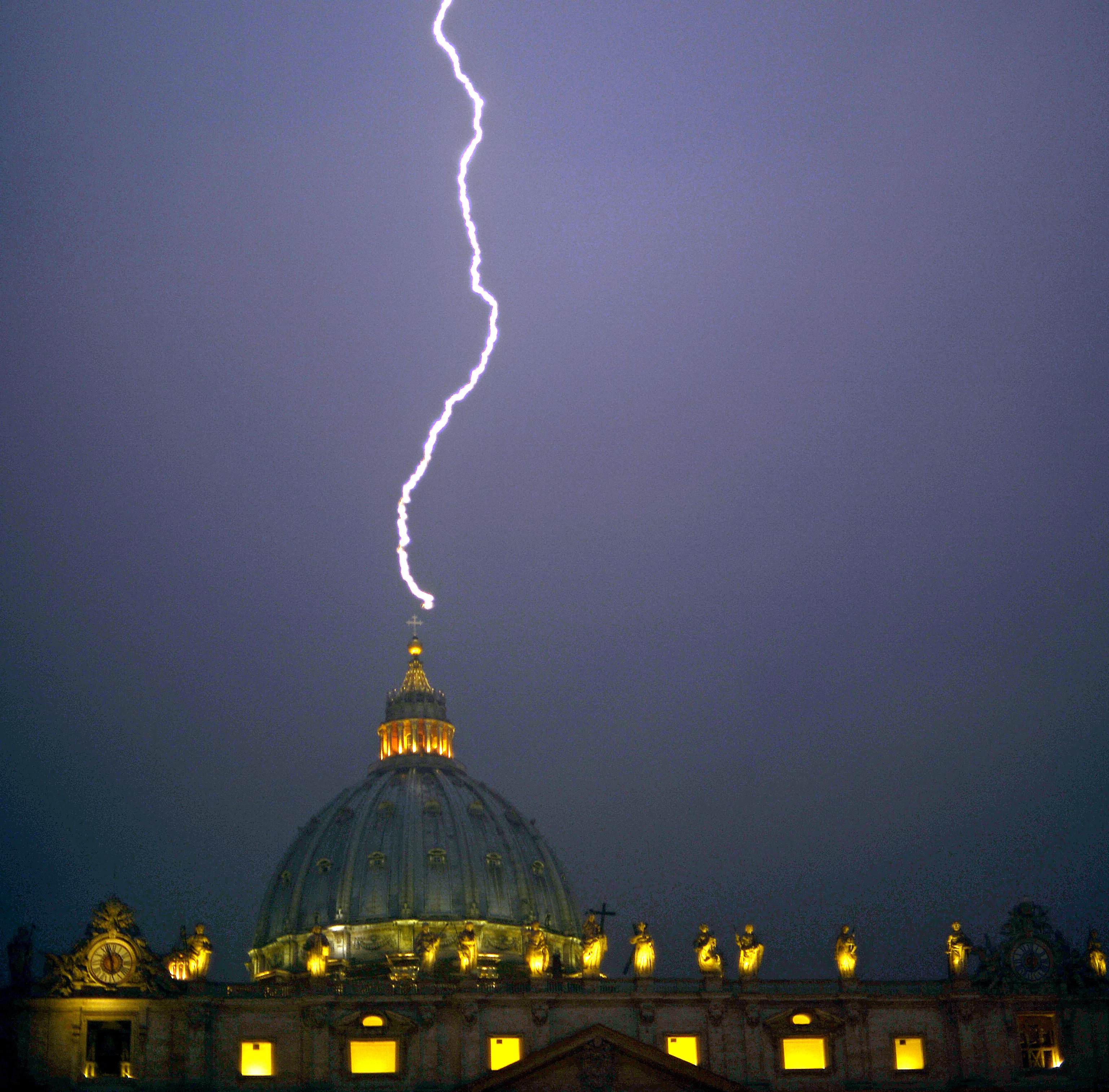
(Photo: Lightning strikes St Peter’s dome at the Vatican on February 11, 2013. Pope Benedict XVI announced today he will resign as leader of the world’s 1.1 billion Catholics on February 28 because his age prevented him from carrying out his duties – an unprecedented move in the modern history of the Catholic Church. By Filippo Monteforte/AFP/Getty Images)
Chris Moody files a dispatch from Florida, where hunters are encouraged to go after the Burmese python, an invasive species of snake “that can stretch to 23 feet and weigh 200 pounds”:
Chopping off the python’s head can lead to a bloodied severed head bearing needle-sharp teeth chomping at your legs. A python brain can remain active for up to an hour after decapitation. Florida officials recommend killing the snake by firing a pressurized bolt into its brain or shooting it in the head with a gun.
Catching the python by hand without a weapon offers a trio of hunters three unappealing choices: Be the sucker who takes on the head and gets a bite on the arm; the sucker who grabs the midsection and ends up with a snake wrapped around your neck; or the sucker in the back who will almost always be covered in urine and feces — a process known politely as “musking” a predator.-
(Photo: BR Slocum carries a snake catcher as he hunts for python’s in the Florida Everglades on the first day of the 2013 Python Challenge on January 12, 2013 in Miami, Florida. The Florida Fish and Wildlife Conservation Commission and its partners launched the month long 2013 Python Challenge to harvest Burmese pythons in the Florida Everglades, a species that is not native to Florida.The contest features prizes of $1,000 for catching the longest snake and $1,500 for catching the most. By Joe Raedle/Getty Images)