Life After Abbottabad

Phil Bronstein interviews the man who shot Osama Bin Laden about his time in the Nacy SEALs, the raid, and his life since then. The whole (extensive) interview is worth a read. Teaser quote:

In my yard, the Shooter told his story about joining the Navy at nineteen, after a girl broke his heart. To escape, he almost by accident found himself in a Navy recruiter’s office. “He asked me what I was going to do with my life. I told him I wanted to be a sniper. “He said, ‘Hey, we have snipers.’ I said, ‘Seriously, dude. You do not have snipers in the Navy.’ But he brought me into his office and it was a pretty sweet deal. I signed up on a whim.”

“That’s the reason Al Qaeda has been decimated,” he joked, “because she broke my fucking heart.”

Sarah Kliff focuses on his life since leaving the SEALs:

Tricare (the health insurance program that covers military service members and their families) does provide 180 days of transitional health insurance “but the Shooter is eligible only if he agrees to remain on active duty “in a support role,” or become a reservist.” Now, the Shooter is purchasing a private health insurance plan for $486 per month, which does not cover some of his treatments.

Update: A reader flags an item from a Stars and Stripes veterans’ blog asserting that the Esquire article “wrongly claims SEAL who killed Bin Laden is denied healthcare.”

Benedict’s Greatest Encyclical

Not a hard choice. My 2006 take on “Deus Caritas Est”:

It’s a beautifully written document: humane, outward, subtle and exactly, in my view, what the Church needs right now.

It’s a reminder of our basis as Church – in the love that Jesus brought into the world and commanded us to live. Benedict’s Augustinian realism that heaven on earth is impossible, that ideologies that pretend to solve all human suffering are lies, that we should not attempt “what God’s governance of the world apparently cannot: fully resolve every problem” – all these are profound truths at the center of our faith.

I’m struck, however, by the near-complete absence in the document of the love of “amicitia,” of friendship. It is far more central to the Gospel message than eros, and under-estimated in our current culture, to our great detriment. I also, obviously, share Benedict’s wonder at conjugal love. I see no conflict between the love of two homosexual men or women for each other and the mystery of heterosexual love. One day, it would be wonderful to see this doctrine of love extend to all God’s creatures. But these are brief, provisional comments. Amy Wellborn has a very insightful short essay on the Enclyclical. So does Rocco Palmo…  And yes, this does surprise me somewhat. It is not as extreme or as repressive as Benedict’s well-earned reputation. It is a sign, one hopes, of a papacy that can change and grow and concentrate on the central truths, not peripheral obsessions.

For that, a great sigh of relief. And, even, yes, hope …

Quote For The Day


“Even if eros is at first mainly covetous and ascending, a fascination for the great promise of happiness, in drawing near to the other, it is less and less concerned with itself, increasingly seeks the happiness of the other, is concerned more and more with the beloved, bestows itself and wants to “be there for” the other… The contemporary way of exalting the body is deceptive. Man himself becomes a commodity‚ he now considers his body and his sexuality as the purely material part of himself, to be used and exploited at will‚ as a mere object that he attempts, as he pleases, to make both enjoyable and harmless‚ it is more or less relegated to the purely biological sphere. The apparent exaltation of the body can quickly turn into a hatred of bodiliness,” – Pope Benedict XVI.

Ratzinger’s Anti-Gay Fixation

<> on June 2, 2012 in Milan, Italy.

Jim Burroway reviews it:

Pope Benedict XVI has been an anti-gay crusader of long standing. In a 2007 message for World Peace Day, in which the  Pope had a whole range of worldly ills which stand as a barrier to peace, he singled out gay marriage as “an objective obstacle on the road to peace.” This, while the Vatican opposed a UN resolution on decriminalization of homosexuality and the removal of the death penalty for those countries which impose it. While the Vatican is credited for exerting its influence against Uganda’s Anti-Homosxuality Bill in 2010, the Pope last December met with Parliament Speaker Rebecca Kadaga, the bill’s supporter, while she was in Italy for, ironically, a human rights conference.

Should he be selected, Ghanaian Cardinal Peter Turkson could be even worse. Ratzinger’s 1986 letter on the “objective disorder” of gay people combined with his subsequent attempt to ban all vocations from homosexuals in entering seminaries was eloquent enough about his own sexual panic.

(Photo: the infamous red Prada slippers, by Getty Images.)

The Stench He Leaves Behind

This embed is invalid

I can’t imagine I’m alone in wishing Hitch were still here to comment on Pope Benedict’s abdication – the video above certainly indicates he’d relish the time between the Pope’s resignation taking effect and the appearance of white smoke in Rome, when no one on earth could claim to be infallible. Though Hitch’s passing means we’ll miss his real-time observations, we still have his writings. Slate just republished this piece of his from 2010, in which he decried the Church’s handling of the child rape scandal – and found the Pope to be at the heart of the institution’s corruption:

Very much more serious is the role of Joseph Ratzinger, before the church decided to make him supreme leader, in obstructing justice on a global scale. After his promotion to cardinal, he was put in charge of the so-called “Congregation for the Doctrine of the Faith” (formerly known as the Inquisition). In 2001, Pope John Paul II placed this department in charge of the investigation of child rape and torture by Catholic priests. In May of that year, Ratzinger issued a confidential letter to every bishop. In it, he reminded them of the extreme gravity of a certain crime. But that crime was the reporting of the rape and torture.

The accusations, intoned Ratzinger, were only treatable within the church’s own exclusive jurisdiction. Any sharing of the evidence with legal authorities or the press was utterly forbidden. Charges were to be investigated “in the most secretive way … restrained by a perpetual silence … and everyone … is to observe the strictest secret which is commonly regarded as a secret of the Holy Office … under the penalty of excommunication.” (My italics). Nobody has yet been excommunicated for the rape and torture of children, but exposing the offense could get you into serious trouble. And this is the church that warns us against moral relativism!

And here’s this, from another essay of Hitch’s from around the same time:

Almost every week, I go and debate with spokesmen of religious faith. Invariably and without exception, they inform me that without a belief in supernatural authority I would have no basis for my morality. Yet here is an ancient Christian church that deals in awful certainties when it comes to outright condemnation of sins like divorce, abortion, contraception, and homosexuality between consenting adults. For these offenses there is no forgiveness, and moral absolutism is invoked. Yet let the subject be the rape and torture of defenseless children, and at once every kind of wiggle room and excuse-making is invoked. What can one say of a church that finds so much latitude for a crime so ghastly that no morally normal person can even think of it without shuddering?

It’s interesting, too, that the same church did its best to hide the rape and torture from the secular authorities, even forcing child victims (as in the disgusting case of Cardinal Sean Brady, the spiritual chieftain of the Catholics of Ireland) to sign secrecy oaths that prevented them from testifying against their rapists and torturers. Why were they so afraid of secular justice? Did they think it would be less indifferent and pliable than private priestly investigations? In that case, what is left of the shabby half-baked argument that people can’t understand elementary morality without a divine warrant?

Earlier today, I asked if lawsuits could proceed against the Pope himself, once he no longer is shielded from legal accountability as a head of state. Not surprisingly, Hitch was there first:

The case for bringing the head of the Catholic hierarchy within the orbit of law is easily enough made. All it involves is the ability to look at a naked emperor and ask the question “Why?” Mentally remove his papal vestments and imagine him in a suit, and Joseph Ratzinger becomes just a Bavarian bureaucrat who has failed in the only task he was ever set—that of damage control. The question started small. In 2002, I happened to be on Hardball With Chris Matthews, discussing what the then attorney general of Massachusetts, Thomas Reilly, had termed a massive cover-up by the church of crimes against children by more than a thousand priests.

I asked, why is the man who is prima facie responsible, Cardinal Bernard Law, not being questioned by the forces of law and order? Why is the church allowed to be judge in its own case and enabled in effect to run private courts where gross and evil offenders end up being “forgiven”? This point must have hung in the air a bit, and perhaps lodged in Cardinal Law’s own mind, because in December of that year he left Boston just hours before state troopers arrived with a subpoena seeking his grand-jury testimony. Where did he go? To Rome, where he later voted in the election of Pope Benedict XVI and now presides over the beautiful church of Santa Maria Maggiore, as well as several Vatican subcommittees.

In my submission, the current scandal passed the point of no return when the Vatican officially became a hideout for a man who was little better than a fugitive from justice. By sheltering such a salient offender at its very heart, the Vatican had invited the metastasis of the horror into its bosom and thence to its very head. It is obvious that Cardinal Law could not have made his escape or been given asylum without the approval of the then pontiff and of his most trusted deputy in the matter of child-rape damage control, then cardinal Joseph Ratzinger.

Well, a legal case against him and his decades of abetting child rape is now a possibility. He is no longer a head of state.

The Fundamentalist Pope


Russell D. Moore offers an evangelical take on Benedict, championing his stance on social issues:

Benedict has stood against the nihilism that defines human worth in terms of power and usefulness. He has constantly spoken for those whose lives are seen as a burden to society: the baby with Down syndrome, the woman with advanced Alzheimer’s, the child starving in the desert, the prisoner being tortured. These lives aren’t things, he has said, but images of God, and for them we will give an account. When society wants to dehumanize with language: “embryo,” “fetus,” “anchor baby,” “illegal alien,” “collateral damage,” and so on, Benedict has stood firmly to point to the human faces the world is seeking to wipe away.

Can someone point me to a moment when the Pope reproved the United States for endorsing and practicing torture? He uttered not a squeak when visiting the US. And where has he been on universal healthcare? We know where his bishops were: ignoring one vast moral leap for their usual sexual obsessions.

Why Now?

One should almost certainly take the Pope’s reasons for his remarkable abdication at face value. The sheer magnitude of the crisis facing Christianity in modernity is indeed a Sisyphean task for a man well into his 80s. Rocco suggests some other coincidences:

For what it’s worth, today’s date provides two possible rationales for the timing of Joseph Ratzinger’s epic announcement – first, this feast of Our Lady of Lourdes marks the church’s annual World Day of the Sick… in the Vatican, meanwhile, this is Independence Day: the anniversary of the 1929 Lateran Pacts which made the Holy See’s home-turf a sovereign city-state, with the Roman pontiff as its absolute monarch.

Nonetheless, the suddenness of this is striking. Are new revelations about the Vatican Bank or the child-rape crisis about to emerge? Is there a more urgent health problem that we are unaware of? Why not wait till after Easter at least? There will doubtless be a lot of speculation and gossip. The Vatican does all that very very well.

The Pope Resigns: Your Thoughts

Faithfuls React At Pope Benedict XVI Resignation News

A reader writes:

I was struck by the Pope’s resignation today as simultaneously profound and more of the same. For one, his act of resigning due to his being “subject to so many rapid changes and shaken by questions of deep relevance for the life of faith” (as you emphasized) can be take two ways: (1) He’s 85 years old, or (2) the weight of what he knows of the Church’s sex abuse scandal, having served as the Prefect of the CDF prior to his election, combined with the continued flow of information about this massive problem and its direct impact on the Church’s financial survival, has become too much for him to bear.

However, his abdication while still alive also gives him the power to anoint his successor virtually directly, ensuring the culture of denial, secrecy, resistance to progress, and emphasis on preservation of the Church over its people that his reign (and, indeed, his career) has personified. Color me ambivalent and leaning cynical.

Another writes:

There’s lots of speculation today that Benedict’s resignation is linked to some aspect of the child-rape scandal. I’d like to draw attention to what may be a supporting detail for that hypothesis I haven’t yet seen mentioned in today’s coverage: The effective firing of Cardinal Roger Mahony from all public duties by the Archbishop of Los Angeles on January 31. Though I’m no expert on the church, it struck me as extraordinary at the time that an Archbishop would be permitted to make such a public rebuke of a Cardinal. If the goal were to lower Mahony’s public profile, he could simply have withdrawn from those activities quietly.

It strikes me that we may be seeing ripples of something much larger moving under the surface. Perhaps it’s a sort of coup that reached critical mass among the church hierarchy – “Enough is enough.” Or perhaps something even more disgraceful is about to become known.

But Mahony will still help pick the Pope’s successor. Another reader:

The Pope resigns shortly after he’s burgled by his butler who he then pardons. Maybe it’s cuz I watched Mea Maxima Culpa last night but I simply cannot believe someone isn’t forcing him to do this as penance for something he covered up. There is some Godfather III stuff goin’ on here.

A survivor of sexual abuse writes:

In reading the coverage of Pope Benedict XVI’s resignation as pope, I’m struck by the almost complete absence of any references to the actual survivors of sexual abuse by priests. Most of the coverage of the pope talks about his papacy and his orthodox Augustinian views. If articles refer to the abuse he presided over at all, they make a veiled reference like, “the abuse scandal overshadowed some of his papacy.” But the voices of the actual survivors are nowhere to be found.

As a survivor of sexual abuse by a pedophile, I know that this is one of the most common tactics used to silence us and deny us a voice: refuse to acknowledge that we exist at all. So often, when I’ve tried to talk about my experience, people refer to it as “that alleged incident” or “that thing that happened to you.” And this just makes me want to remain silent, knowing that my voice is insignificant and won’t be believed. On a much larger level, I see this happening with the Catholic Church.

I don’t know what the answer is. I don’t know if the Church is hopelessly lost, or if it can honestly take an accounting of its crimes and redeem itself. But I do know that any honest accounting can’t begin until the voices of the actual survivors are listened to and given a central place at the table. As long as we are pushed to the side and ignored, no real change can occur.

Another:

A small thing but it stood out for me in your take on Ratzinger’s early retirement. In your reference to ordained priests raping children, you twice used the word “monster” and “monstrous.” I’m reminded oddly of a course on the Catholicism of Flannery O’Connor from my bachelor degree (I did a minor in Catholic studies). My instructor mentioned the etymological route of the word monster, from the Latin monstrare. To show, to demonstrate.

The point was that monsters, understood in the medieval sense, pointed to an evil in need of grace. These crimes, these vicious, inhuman crimes, stand out as a sign in their own right to the evil the church has papered over in recent years with dense encyclicals: Thomist, intellectual straw. But the crimes are what the world has seen of the church. These monsters and their monstrous crimes stood as their own visible demonstration of the condemnation of the church, and Ratzinger’s theology could not cover it.

Unfiltered reader thoughts at our Facebook page.

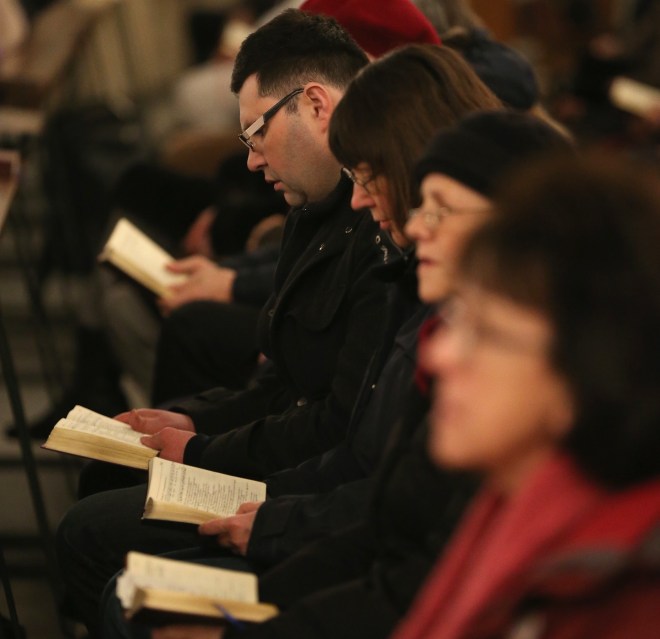
(Photo: Worshippers attend a special evening mass at St. Hedwig Catholic cathedral following the announced resignation of Pope Benedict XVI on February 11, 2013 in Berlin, Germany. Pope Benedict XVI, born Josef Ratzinger in Germany, announced to Vatican clergy on Monday that he feels too physically frail to continue meeting the demands of being the Pope and will step down officially on February 28. By Sean Gallup/Getty Images)