Where Did Obama Go Wrong?

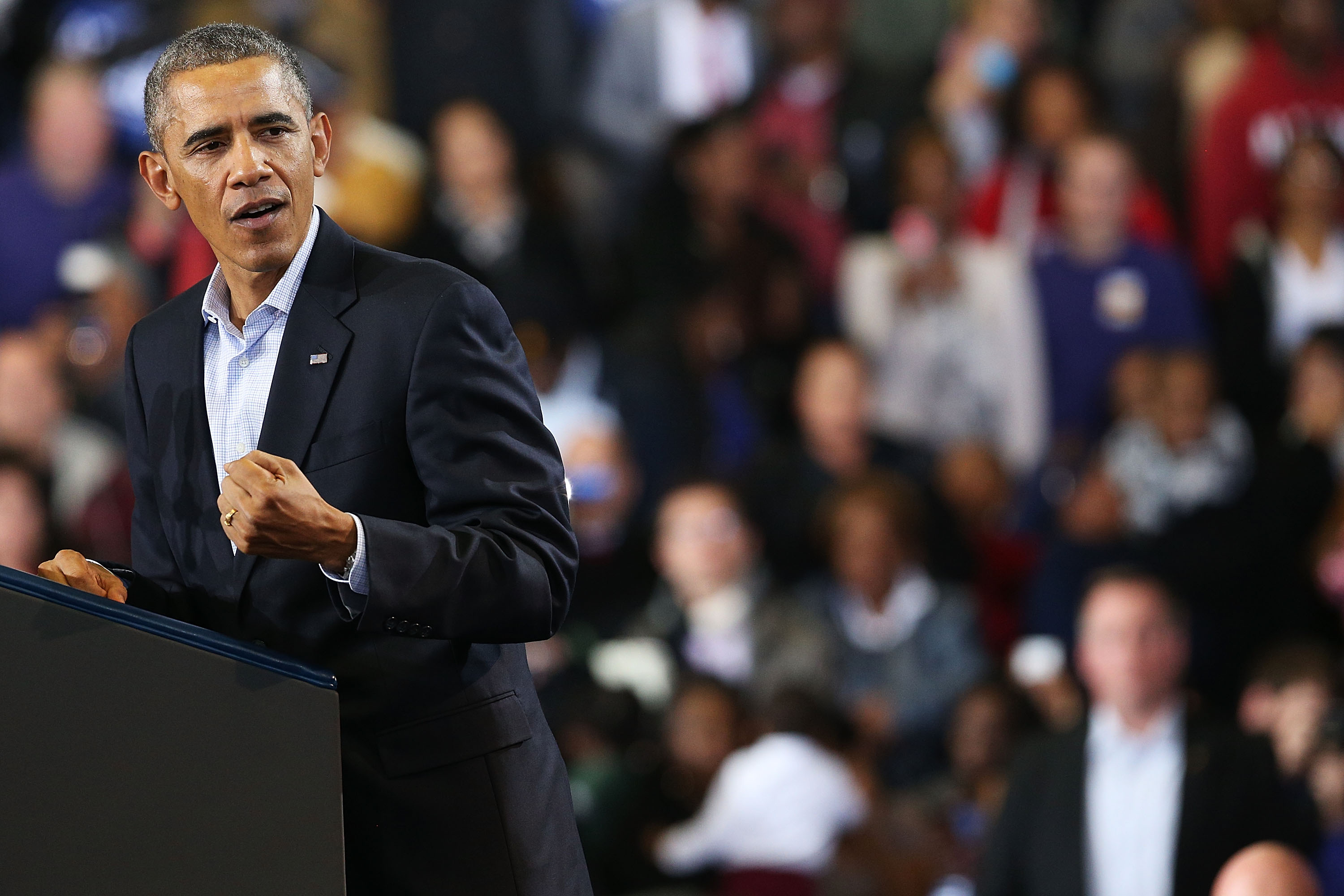
President Obama Attends Rally For The Re-Election Of Connecticut Gov. Malloy

[Re-posted from earlier today]

That’s the headline for a Washington Post piece today trying to come up with an answer for the president’s drag on the Democratic fortunes tonight. And, to my mind, it really doesn’t come up with a decent answer. It offers a mere chronology of events and never quite shows what Obama could have done that he didn’t, or what the alternatives truly were. Maybe you’ll find it otherwise. But I found it oddly empty of meaning.

For me, the most persuasive answer to the question was the botched roll-out of healthcare.gov. No one else can be blamed for this, and it hit the president’s ratings like a ten-ton truck, as well it might. October 2013 is when his disapproval rating first clearly topped the approval rating with some daylight and stayed there. And the fall of 2013 was also when he pivoted away from striking Syria – which brought a chorus of disapproval from the Washington bigwigs and, of course, the GOP.

These two events dented his image of competence. Both seemed amateurish to most people. And when an image is altered like that with clearly understandable and very public fuck-ups, it’s hard to regain momentum. Both also followed another nightmarish confrontation with the GOP over the debt limit and a very public failure to pass any gun control legislation even after Sandy Hook.

But what this superficial version of events misses is what happened next. The truth is: the Obama team subsequently achieved a near-miraculous rescue of Obamacare, achieved real success in enrollment, and have seen core healthcare costs slow down in such a way that could yet shift our long-term fiscal liabilities for the better. Obamacare is almost certainly here to stay – surviving one pitched battle after the next. As for Syria, Obama turned that crisis into opportunity, by seizing a compromise brokered by Russia which managed to locate, transport and destroy all but a few traces of Assad’s chemical stockpile. This remains a huge, and hugely under-appreciated achievement – and if you think I’m exaggerating, imagine what the stakes would now be in that region (and the world) if ISIS had a chance to get its hands on that stuff.

The same can be said of the economy. No other developed country has achieved the growth that the US has after the stimulus – including austerity-bound Germany. No other administration has presided over a steeper fall in the deficit. The brutal facts of the twenty-first century global economy has meant this has not been felt very much among the beleaguered middle class. But who is offering on either side a real solution to that by-product of globalization, trade and technology? Again, on the actual substance, Obama has a strong record – dented by the avalanche of hostility from the right and disgruntlement from everyone but the very rich.

Crisis-management? Well, what would the GOP have done with respect to Russia? As it is, that country is more isolated internationally than ever and is being punished economically by sanctions and a tumbling oil price. Ebola? Tell me when we have an outbreak in this country. IS? Again, I dispute the idea that this could have been avoided if the US had entered the Syrian civil war earlier – by funneling arms to rebels who have recently folded or joined al Qaeda. And Obama’s pragmatic response has been a form of containment at IS’ borders – again the least worst option available.

Behind all this has been a fanatically obstructionist and increasingly extreme GOP.

They judged early on that the real promise of Obama – his ambition to transcend the old politics in favor of pragmatic reform – could be killed if they simply refused to play along. That they denied an incoming president any support for a stimulus package in the middle of a spiraling economy was eloquent enough – but we now know of course that this was the strategy hatched privately before Obama even took office.

Then there is the disillusionment of some on the left who regard any use of surveillance against Jihadist terrorism as outrageous (even as they also oppose all other means of fighting the menace), who see Obamacare as a sell-out to the insurance lobby, who wanted much more populism against Wall Street, and who loathe drone warfare and the new campaign against IS. They have the right to object on all these grounds, and I’m sympathetic to some. But they have too often missed the tough reality of protecting American security in the age of global jihad, and no one gives him credit for the remarkable absence of major terror attacks on his watch. They also tend to miss substantive shifts Obama has made in other areas – the toughest emissions standards ever imposed by the federal government, for example, or the astonishing acceptance of marriage equality or openly gay servicemembers – and under-estimated the difficulty of governing in such a deeply polarized electorate.

And so, while I can easily find fault in many areas, I cannot see any substantive reason why Obama has lost altitude. And this – rather than endless accounts of how his popularity has fallen – is what should matter. And I say that particularly to those who supported him with such fervor in 2008 and grit in 2012. If you have real substantive disagreements with his policies, fine. But if this presidency was worth fighting for six years ago, it is worth fighting for again today. He never promised us perfection – merely endurance and persistence in substantively changing the nation and the world for the better. He has easily demonstrated that persistence against truly vitriolic demonization. The easy cynicism and cheap piling on are not, in my view, what he deserves. What he deserves is our support – while we are still lucky to have him in the White House. And that support should not end as the GOP wins tonight and as the Clintons hover in the wings. It should begin again in earnest – and make his actual substantive achievements as durable as they possibly can be.

(Photo:  U.S. President Barack Obama speaks in support of Connecticut Governor Dan Malloy on November 2, 2014 in Bridgeport, Connecticut. By Spencer Platt/Getty Images.)
Face Of The Day

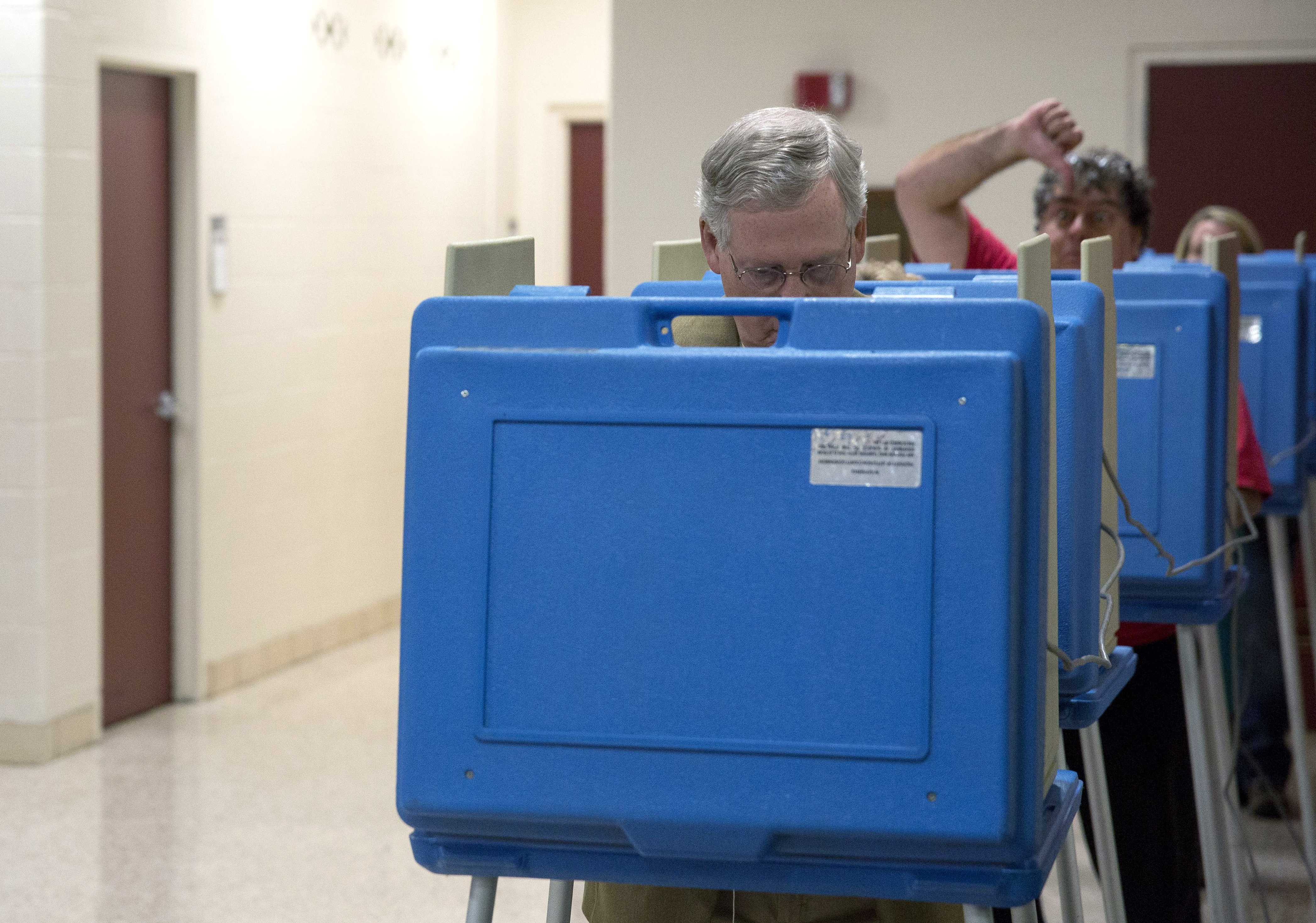
Sen. Mitch McConnell (R-KY) Casts His Vote In Midterm Elections

A voter gestures as Senate Minority Leader Mitch McConnell (R-KY) votes in the midterm elections at Bellarmine University in Louisville, Kentucky on November 4, 2014 . McConnell is running in a tight race against opponent Kentucky Secretary of State Alison Lundergan Grimes. By Aaron P. Bernstein/Getty Images.

The Return Of The Hawks

Michael Brendan Dougherty is depressed by the hawkish Republican candidates on the ballot:

The election may have real consequences for foreign policy, as the deadline for negotiations on an Iranian nuclear deal comes in just a few weeks. These throwback Republicans do not agree with a more libertarian or non-interventionist re-think of the GOP after the Bush presidency. If anything, they are likely to see the drawdown in Iraq after the surge as part of the ongoing problems in the region. They will pick fights with Obama over Israel now that the administration has made its displeasure with the government of the Jewish state so obvious and public. In many ways, this revival of GOP hawkishness is an attempt to re-run the 2004 campaign against John Kerry: They portray their opponents as weak on defense, and not fully committed to the national interest abroad.

If you believed, as I once did, that the Iraq War and the last years of the Bush presidency would change the GOP for decades to come, a Joni Ernst victory will highlight just how naive it was to think so.

Political Brutes

Justin E. H. Smith argues that humans “are not the only political animals”:

There are overwhelming empirical data revealing, to anyone who is willing to look, complex social organization across the animal kingdom, including collective deliberation, division of labor, ritualized conflict resolution, and other forms of behavior that, when identified in human society, are deemed political without hesitation. We know that elephants plan elaborate raids on human settlements to recover the remains of their slaughtered loved ones. We know that in ant colonies the appearance of elaborate systems of task-allocation is related directly to the size of the colony: just as in human society, the more individual members of the society, the more we may expect to find social differentiation. Thanks to the primatologist Frans De Waal’s popular work, we are now slowly warming up to the idea that there is such a thing, at least, as “chimpanzee politics.” …

[T]here is another way of understanding animals as political that even the most defiant human-exceptionalist cannot dispute:

not as separated out into their own discrete political societies, each according to its kind, but rather as part of a single, global political formation that includes, notably but not exclusively, human beings. Some recent political philosophy, in fact, is starting to approach its subject from just such a trans-species perspective. In their groundbreaking 2011 book, Zoopolis: A Political Theory of Animal Rights, Sue Donaldson and Will Kymlicka argue compellingly that animal rights theory has been limited to the extent that it has emphasized only negative rights of animals, a category that is conceived as universal and without any distinctions of moral significance within it. They argue instead that theorists would do well to focus on relational obligations that human beings come to have to animals that figure in different ways in human society. For them, nonhuman animals belong to the polis, too.

Update from a reader:

I came across this item regarding animal politics. Several species seem to make decisions by voting. A couple examples:

Red deer

The red deer of Eurasia live in large herds, spending lots of time either grazing or lying down to ruminate. Some deer are ready to move on before others are, and scientists have noticed that herds only move when 60 percent of the adults stand up — essentially voting with their feet. Even if a dominant individual is more experienced and makes fewer mistakes than its underlings, herds typically favor democratic decisions over autocratic ones.

A major reason for this, according to research by biologists Larissa Conradt and Timothy Roper, is that groups are less impulsive: “Democratic decisions are more beneficial primarily because they tend to produce less extreme decisions, rather than because each individual has an influence on the decision per se.”

African buffalo

Similar to red deer, African buffalo are herd herbivores that often make group decisions about when and where to move. In the 1990s, researchers realized that what initially looked like “mundane stretching” is actually a type of “voting behavior,” in which females indicate their travel preferences by standing up, staring in one direction and then lying back down.

“Only adult females vote, and females participate regardless of their social status within the herd,” biologist David Sloan Wilson wrote in a 1997 study. “When the average direction of gaze is compared with the subsequent movement of the herd, the average deviation is only three degrees, which is well within measurement error. On days in which cows differ sharply in their direction of gaze, the herd tends to split and graze in separate patches for the night.”

Facebook Gets Out The Vote

Facebook Voting

Dara Lind explains the power of Facebook’s digital voting sticker (seen above):

Facebook offered the “I Voted” sticker to most of its users in 2010 — but not all of them. A few hundred thousand users just didn’t see any sticker at all, and a few hundred thousand more got the sticker but no information about whether their friends had clicked it.

It turns out that people were a little more likely to vote — and definitely more likely to tell Facebook they’d voted — if they saw their friends had voted too. Eighteen percent of people who didn’t see a list of friends who’d voted clicked on the “I Voted” sticker; 20 percent of people who did see the list of friends clicked on it. And users who saw both the sticker and the list of friends were slightly more likely (about 0.6 percent) to actually go to the polls than users who didn’t see anything.

Robin Meyer is concerned:

Facebook can already figure out so much about us: our politics, our income, our sexual orientation—even when we’re about to fall in love. As Zittrain wrote earlier this year, the company could easily combine that tranche of data with selective deployment of its “I Voted” button and tilt an election. Just make certain populations more likely to see the button, and, ta-da: modification managed.

And Facebook, frankly, may be altering elections already. Social networks skewyoung and female: two reliably progressive-leaning demographics. Even if Facebook distributed the button equally to its users, it might still bring more liberal users to the polls than conservative ones.

conservatives have little to fear from Facebook”:

While Facebook, born on college campuses, was once the domain of the young and likely left-leaning voter, its demographics have been changing rapidly year-over-year as more parents and grandparents log on to the service to swap family photos and catch up with long-lost friends. (Indeed, parents signing up for Facebook is probably a reason some teens are fleeing to alternative platforms hidden away from their guardians’ watchful eyes.) Facebook use is definitely still more common among the young, but its user base is getting older by the year. Pew found at the end of 2013 that Facebook “usage among seniors has increased significantly in the last year,” for example, and it’s safe to assume that trend has continued through 2014. Pew’s numbers also show Facebook use cuts across several other demographic factors, like race and urbanites/suburbanites/rural adults. And Aaron Smith, a senior researcher at Pew, said in a July presentation that there are few partisan differences regarding Facebook use.

Ultimately, Facebook is now so ubiquitous that if it does what it promises to do Tuesday — show the “I Voted” sticker to nearly every voting age American — it shouldn’t bring out one side’s voters more than the other’s.

Marriage Equality Update

“Showed Significant Improvement, Still Incomplete”

That’s the grade Douthat tentatively gives the GOP’s performance this year:

Keep in mind that Republicans in 2014 have not merely been trying to outdo Mitt Romney’s (or John McCain’s) presidential effort; they’ve also been trying to outdo their own not-especially-impressive Senate efforts from 2010 and 2012, in which bad candidates and weak messaging and poor turnout operations handed a number of winnable seats to the Democrats. …

[I]f the polls hold, and the Republicans mostly win the states they should win and pick off a couple that seemed like reaches six months ago, then the G.O.P. will have accomplished something it conspicuously failed to do in the last few election cycles: The party will have run a mostly error-free campaign, with good or good-enough candidates and strategies (especially Gardner’s run in Colorado), that doesn’t effectively gift-wrap control of the Senate for the Democrats. And while Republicans will obviously need to clearer a higher bar in 2016, it will still be reasonable to call that kind of outcome progress for the party — a necessary, if obviously not sufficient, step toward being a majority coalition once again.

The Plight Of The Yazidis Still Isn’t Over, Ctd

A group of Iraqi Yazidi leaders came to Washington last week to meet with officials and plead for assistance in protecting their people and lands from a renewed assault by ISIS. Josh Rogin caught up with the visiting dignitaries and listened to what they had to say:

“Our hostages, children, women, and girls, between 4,000 and 5,000 of them, have been captured by ISIS and sent to other areas. We need help to rescue these hostages,” said Sameer Karto Babasheikh, the son of the Yazidi Supreme Religious Council leader. “In Mosul, they opened a market to sell Yazidi girls. Some of them ended up in Fallujah, some of them were taken to Saudi Arabia and Raqqa in Syria.”

On the mountain, between 6,000 and 7,000 civilians and between 2,000 and 3,000 Yazidi fighters are still trapped and struggling to stay alive, cut off from any supply routes, the Yazidi leaders said. Since the airstrikes trailed off to a trickle in October, ISIS has taken over the five remaining Yazidi towns near Mount Sinjar, killing hundreds of civilians and abducting hundreds more. Even the humanitarian airdrops have halted. The Iraqi government provided two helicopters to deliver aid, but they are old and fly only once or twice a week, Babasheikh said.

Reporting from Dohuk, Alice Su confirms that “there remains no open path for civilians to get out, or for aid to get in”, while the Yazidis blame the Kurdish Peshmerga for abandoning them:

Humanitarian agencies are ready to aid Sinjar as soon as military action opens a way. Around Zumar, for example, a town north of Mosul just recaptured from the Islamic State on Oct. 25, organizations like the International Committee of the Red Cross (ICRC) and the Danish Refugee Council (DRC) are already hard at work. “People in these risky areas are much more in need,” said ICRC spokesperson Dabbakeh Saleh. “They have been totally cut off from the rest of the world.”

A Peshmerga-led effort to liberate Sinjar would represent a reversal from the situation in August, when their retreat left the Yazidis exposed to the assault by the Islamic State. “There is no doubt that the Peshmerga not only did not fight in Sinjar, but they also did not evacuate people or tell the towns that IS had arrived in the south of the mountain,” said Iraq-based researcher Christine van den Toorn. “It was total abandonment.”

Previous Dish on the Yazidis here.

(Video: ISIS militants chat and joke about buying and selling Yazidi slaves on “slave market day”. Via Joel Wing.)

The Goldilocks Principle Of Grading, Ctd

A reader advances a great idea for the thread on grade inflation:

I teach upper-division cell biology at a major research university with more than 200 students a year, many of them desperately hoping to get into medical or dental school. It doesn’t matter what type of grades we give; they all want the highest possible so they can get into professional school.

The only thing that I believe will limit grade inflation is if the median score was reported along with every class grade (and the all important cumulative GPA would be reported along with the cumulative median GPA of the student’s classes). So while an A- might sound like a great GPA, if the student’s median GPA was an A- it would be very clear that this was just an average student. One might hope that students would actually seek out classes with lower median grades since otherwise they would have no chance to actually excel, and at a minimum, it would take pressure off those of us who teach and are trying to resist pressures to inflate our grades since we could fairly point out that it was in the students best interest to not have an absurdly high median GPA.

A few more readers chime in:

In an ideal world, intellectual mastery would matter more than grades. In such a world, the smart students would flock to the toughest professors. Unfortunately, that’s not the world we live in. Students live by the grade and die by the grade. As aren’t taken as exceptional but are expected.

Take me, for example. I was at my college on scholarship, so if my GPA fell below 3.5, I would be placed on academic probation. If it fell below 3.25, I would lose my scholarship and not be able to afford to go to school anymore. And this was on the lenient side. It’s nothing compared to the expectations for those going on to law school or trying to get into Ph.D programs.

Another protests that students actually don’t punish hard graders with harsh reviews:

It’s an academic myth that giving fewer As results in lower marks. I taught in a math department for years, and my grade distribution in my classes was pretty close to a normal distribution centered on 78 percent. Yet my evaluations were consistently among the highest in my college. The research literature backs me up. Consider this study, in which data from 50,000 undergraduate courses was analyzed:

After controlling for learning outcomes, expected grades generally did not affect student evaluations. In fact, contrary to what some faculty think, courses in natural sciences with expected grades of A were rated lower, not higher. Courses were rated lower when they were rated as either difficult or too elementary. Courses rated at the “just right” level received the highest evaluations.

Please help combat this myth!

Update from a reader:

In response to your reader’s proposal that students’ grades in a class be measured against the median so that everyone involved can accurately measure a student’s “achievement” in terms of positive or negative deviation from that median: Yikes!

It may be true that students are obsessed with grades as a path to scholarships and acceptance to graduate schools. But it’s not clear at all that professors or colleges should bend to that obsession either by further quantifying grades. Let grades be the problem of graduate schools trying to sort students or students trying to compete with each other. Our primary goal is teaching, and we need to ask ourselves whether grade inflation is a problem that interferes with that goal. In my experience, it’s not, but the obsession over grading is. We ought to think of ways we might limit that obsession rather than feeding into it.

How To Watch Tonight’s Results

Adjusted Lead

The Upshot will adjust vote tallies in real time:

More sophisticated analysts interpret leads through the lens of the outstanding votes. “There’s a lot of votes left to be counted in heavily Democratic Cuyahoga County,” Jeff Greenfield said on CNN in 2004. “Remember, some of the votes outstanding are down here in Marion County where Obama is winning,” John King said on the same network in 2008.

This year, The Upshot will aim to let you be your own John King. In about a dozen of the closest Senate races, we, like many others, will track the leads reported by The Associated Press. But we will also adjust those leads based on what we know about where the votes have come from. Our adjusted leads will be based solely on current and historical returns. They will not use data from exit polls, or any forecasts from Senate models. You’ll be able to find a link to the tracker on The Times’s midterm page and The Upshot’s home page.

Nate Cohn also has an extremely helpful primer on how the votes will come in in various states. On the Colorado race:

Our first real sense of where the night is heading might come just after 9 p.m., when the polls close in Colorado. Many counties will quickly count a significant number of mail-in votes, and these ballots will be fairly representative of the overall count. If one side is going to win by a few points, we could have a good idea by 10. But if you are thinking you’ll be able to go to bed then, put the pillow away. When the race in Colorado looks to be within one or two points, the networks might not even dare make a call until the next day. Despite the state’s fast start, just 80 percent of the vote was counted by midnight in 2012, and only 90 percent by 6 a.m. In 2010, Senator Michael Bennet’s 1.4-point victory wasn’t called until the next day.

And on Iowa:

The single most dramatic contest of the night might be Iowa. The first returns will disproportionately include Democratic-leaning early ballots, and Bruce Braley could hold a lead for hours even if Joni Ernst goes on to win by a slight margin. Eighty percent of the vote won’t be counted until midnight; a projection probably won’t come earlier unless Ms. Ernst wins by a clear margin.