
Phoenix, Arizona, 4.33 pm
Phoenix, Arizona, 4.33 pm
Maria Popova digs up a nonfiction gem from Henry Miller, To Paint Is to Love Again, in which he addresses the question:
Certainly the surest way to kill an artist is to supply him with everything he needs. Materially he needs but little. What he never gets enough of is appreciation, encouragement, understanding. I have seen painters give away their most cherished work on the impulse of the moment, sometimes in return for a good meal, sometimes for a bit of love, sometimes for no reason at all — simply because it pleased them to do so. And I have seen these same men refuse to sell a cherished painting no matter what the sum offered. I believe that a true artist always prefers to give his work away rather than sell it. A good artist must also have a streak of insanity in him, if by insanity is meant an exaggerated inability to adapt. The individual who can adapt to this mad world of to-day is either a nobody or a sage. In the one case he is immune to art and in the other he is beyond it.
It’s hard to believe all this was 17 years ago:
Tyler Malone interviews Adam Long, the director of the Hemingway-Pfeiffer House in Arkansas, where Hemingway once lived, about the subject:
Hemingway is sort of the prototypical machismo American writer, but that uber-masculinity aspect of his persona often gets played up. He seems to me a much more complicated man than the mythical bull-fight-loving tough guy allows. Do you agree? And if so, in what ways do you see a different side of Hemingway? And how can highlighting those alternate aspects of his personality help to open up his novels in different ways?
I agree that Ernest is more complex than his one-
dimensional macho performance. Certainly, Ernest was obsessed with masculinity, as were many men in his time and place. Because of this performance, he seems to have worked to ensure that his public persona was quintessentially macho. This probably becomes more and more true as his celebrity grows.
Beneath this, though, I think there is a much more complex person. Looking at his texts, I think that, at times, you see his narrators regret their own chauvinism. It seems to me that many of his narrators are speaking about past events, like one might in a confessional. I think seeing the difference in age in the first-person narrators and the events they narrate is important in seeing growth (or at least regret) in some of the Hemingway heroes.
Previous Dish on the author here, here, and here.
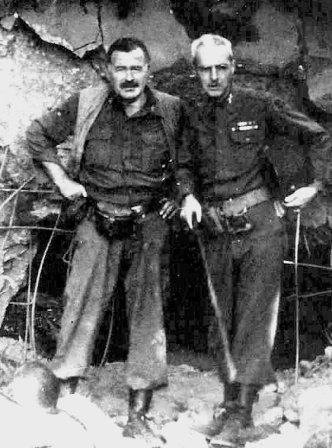
(Image of Hemingway with Col. Charles T. Lanham in Germany 1944 via Wikimedia Commons)
Judge strikes down same-sex marriage ban in Alabama and conservatives at #IowaFreedomSummit don’t even mention it. Even they know it’s over
— igorvolsky (@igorvolsky) January 24, 2015
Last weekend we plumbed it, with a particular focus on Friends. Now that the show can be streamed on Netflix, Ruth Graham has been re-watching it – and finding that of all the characters, Chandler is “the most agonizingly obsolete,” not least when it comes to his alleged homophobia:
Chandler, identified in Season 1 as having a “quality” of gayness about him, is endlessly paranoid about being perceived as insufficiently masculine. He’s freaked out by hugs, and by Joey having a pink pillow on his couch. (“If you let this go, you’re going to be sitting around with your fingers soaking in stuff!) In retrospect, the entire show’s treatment of LGBTQ issues is awful, a fault pointedly illustrated by the exhaustive clip-compilation “Homophobic Friends.”
But Chandler’s treatment of his gay father, a Vegas drag queen played by Kathleen Turner, is especially appalling, and it’s not clear the show knows it. It’s one thing for Chandler to recall being embarrassed as a kid, but he is actively resentful and mocking of his loving, involved father right up until his own wedding (to which his father is initially not invited!). Even a line like “Hi, Dad” is delivered with vicious sarcasm. Monica eventually cajoles him into a grudging reconciliation, which the show treats as an acceptably warm conclusion. But his continuing discomfort now reads as jarringly out-of-place for a supposedly hip New York 30-something—let alone a supposedly good person, period.
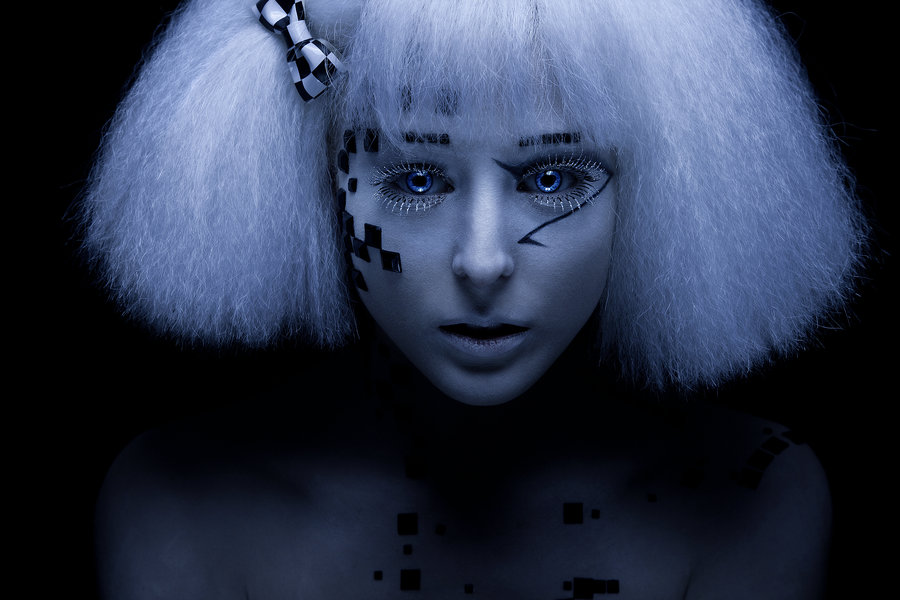
Hayley Evans captions:
I Must Be Dead (Mckay Jaffe) is a Pheonix-based photographer who challenges conventional representations of identity through experimental portraiture. Rich with narrative and exploding with color, his works are consistently enrapturing and unsettling, in that they collide sensuality with horror, beauty with death. The faces of his bizarre models are intensely expressive, and usually obscured in some way, such as with paint, masks, and/or deep shadows. … Some of Jaffe’s work comes from the Burning Man festival, where he captures subjects befitting to his oeuvre: people actively inhabiting alternative identities and lifestyles.
Jennifer Gori offers background on the artist’s name:
The sarcastic moniker ‘I Must Be Dead‘ … comes from a poem he has tattooed on his arm. His taste for tattoo art can also be found on the skin of his models, as many of the most famous tattooed pinups have ended up in front of his camera. It is clear that I Must Be Dead has a weakness for bodies, displayed in provocative poses, sardonic allusions and twisted humor, the result both disturbing and bewitching.
This weekend’s short story is Adam Haslett’s dark, powerful effort “The Beginnings of Grief“. Its gripping opening paragraphs:
A year after my mother’s suicide I broke a promise to myself not to burden my father with worries of my own. I told him how unhappy I was at school, how lonely I felt. From the wing chair where he crouched in the evenings he asked, “What can I do?” The following afternoon, coming home from work the back way, he missed a stop sign. A van full of sheet glass going forty miles an hour hit the driver’s side of the Taurus. According to the policeman who knocked on the front door in tears, my father died with the first shattering impact. An aunt from Little Rock stayed for a week, cooking stews and Danish pastry. She said I could come and live with her in Arkansas. I told her I didn’t want to. As I had only a year and a half left of high school, we decided I could finish up where I was, and she arranged for me to live with a neighbor.
Mrs. Polk was sixty, her mother, eighty-five. They had between them a closet of fourteen blue flowered dresses, which the maid laundered on Tuesdays. They watched a considerable amount of public television and spoke in hushed tones of relatives in Pittsburgh. I was given dead Mr. Polk’s study with a cot bed in the corner. The ladies paid no attention to my coming and going and I spent as little time at their house as I could.
Read the rest here. This story and others can be found in Haslett’s collection, You Are Not a Stranger Here. Peruse previous SSFSs here.

You have until noon on Tuesday to guess it. City and/or state first, then country. Please put the location in the subject heading, along with any description within the email. If no one guesses the exact location, proximity counts. Be sure to email entries to contest@andrewsullivan.com. Winner gets a free The View From Your Window book or two free gift subscriptions to the Dish. Have at it.
A new year, a new annual Edge question: “What do you think about machines that think?” James J. O’Donnell, a classical scholar, contends that “nobody would ever ask a machine what it thinks about machines that think”. He breaks down the question:
1. “Thinking” is a word we apply with no discipline whatsoever to a huge variety of reported behaviors. “I think I’ll go to the store” and “I think it’s raining” and “I think therefore I am” and “I think the Yankees will win the World Series” and “I think I am Napoleon” and “I think he said he would be here, but I’m not sure,” all use the same word to mean entirely different things. Which of them might a machine do someday? I think that’s an important question.
2. Could a machine get confused? Experience cognitive dissonance? Dream? Wonder? Forget the name of that guy over there and at the same time know that it really knows the answer and if it just thinks about something else for a while might remember? Lose track of time? Decide to get a puppy? Have low self-esteem? Have suicidal thoughts? Get bored? Worry? Pray? I think not.
Daniel Dennett tries to pinpoint the “real danger” of artificial intelligence:
What’s wrong with turning over the drudgery of thought to such high-tech marvels? Nothing, so long as (1) we don’t delude ourselves, and (2) we somehow manage to keep our own cognitive skills from atrophying.
(1) It is very, very hard to imagine (and keep in mind) the limitations of entities that can be such valued assistants, and the human tendency is always to over-endow them with understanding—as we have known since Joe Weizenbaum’s notorious Eliza program of the early 1970s. This is a huge risk, since we will always be tempted to ask more of them than they were designed to accomplish, and to trust the results when we shouldn’t.
(2) Use it or lose it. As we become ever more dependent on these cognitive prostheses, we risk becoming helpless if they ever shut down. The Internet is not an intelligent agent (well, in some ways it is) but we have nevertheless become so dependent on it that were it to crash, panic would set in and we could destroy society in a few days. That’s an event we should bend our efforts to averting now, because it could happen any day.
The real danger, then, is not machines that are more intelligent than we are usurping our role as captains of our destinies. The real danger is basically clueless machines being ceded authority far beyond their competence.
Eric J. Topol, a doctor, sees the benefits for medicine:
Almost any medical condition with an acute episode—like an asthma attack, seizure, autoimmune attack, stroke, heart attack—will be potentially predictable in the future with artificial intelligence and the Internet of all medical things. There’s already a wristband that can predict when a seizure is imminent, and that can be seen as a rudimentary, first step. In the not so distant future, you’ll be getting a text message or voice notification that tells you precisely what you need to prevent a serious medical problem. When that time comes, those who fear AI may suddenly embrace it. When we can put together big data for an individual with the requisite contextual computing and analytics, we’ve got a recipe for machine-mediated medical wisdom.
Donald D. Hoffman cautions that “not alarm, but prudence is effective,” adding that he suspects “AIs will be a source of awe, insight, inspiration, and yes, profit, for years to come”. Psychology professor Nicholas Humphrey is also optimistic:
Psychopaths are sometimes credited with having not too little but too great an understanding of human psychology. Is this something we should fear with machines?
I don’t think so. This situation is actually not a new one. For thousands of years humans have been selecting and programming a particular species of biological machine to act as servants, companions and helpmeets to ourselves. I’m talking of the domestic dog. The remarkable result has been that modern dogs have in fact acquired an exceptional and considerable ability to mind-read—both the minds of other dogs and humans—superior to that of any animal other than humans themselves. This has evidently evolved as a mutually beneficial relationship, not a competition, even if it’s one in which we have retained the upper hand. If and when it gets to the point where machines are as good at reading human minds as dogs now are, we shall of course have to watch out in case they get too dominant and manipulative, perhaps even too playful—just as we already have to do with man’s best friend. But I see no reason to doubt we’ll remain in control.
Paul Saffo, meanwhile, is uncertain:
The rapid advance of AIs also is changing our understanding of what constitutes intelligence. Our interactions with narrow AIs will cause us to realize that intelligence is a continuum and not a threshold. Earlier this decade Japanese researchers demonstrated that slime mold could thread a maze to reach a tasty bit of food. Last year a scientist in Illinois demonstrated that under just the right conditions, a drop of oil could negotiate a maze in an astonishingly lifelike way to reach a bit of acidic gel. As AIs insinuate themselves ever deeper in our lives, we will recognize that modest digital entities as well as most of the natural world carry the spark of sentience. From there is it just a small step to speculate about what trees or rocks—or AIs—think.
In the end, the biggest question is not whether AI super-intelligences will eventually appear. Rather the question is what will be the place of humans in a world occupied by an exponentially growing population of autonomous machines. Bots on the Web already outnumber human users—the same will soon be true in the physical world as well.
Lord Dunsany once cautioned, “If we change too much, we may no longer fit into the scheme of things.”
Psychologist Susan Blackmore zooms out:
Digital information is evolving all around us, thriving on billions of phones, tablets, computers, servers, and tiny chips in fridges, car and clothes, passing around the globe, interpenetrating our cities, our homes and even our bodies. And we keep on willingly feeding it. More phones are made every day than babies are born, 100 hours of video are uploaded to the Internet every minute, billions of photos are uploaded to the expanding cloud. Clever programmers write ever cleverer software, including programs that write other programs that no human can understand or track. Out there, taking their own evolutionary pathways and growing all the time, are the new thinking machines.
Are we going to control these machines? Can we insist that they are motivated to look after us? No. Even if we can see what is happening, we want what they give us far too much not to swap it for our independence.
So what do I think about machines that think? I think that from being a little independent thinking machine I am becoming a tiny part inside a far vaster thinking machine.
 The Dish
