What Drives Foodies?

John Lanchester analyzes food obsession:

By the end of the twentieth century, it seemed that more or less the entire developed world was shopping and cooking and dining out in a way that was given over to self-definition and self-expression and identity-creation and trend-catching and hype and buzz and the new new thing, which sometimes had to do with newness (foams! gels! spherification!) and sometimes with new ways of being old (slow food! farm-to-table! country ham!).

My mother was thinking about food like that from the start of the nineteen-sixties. I have spent a fair part of my working life writing about food, and have often been asked how and why I got interested in it. I was never able to give a full answer, because the pattern became apparent to me only years afterward. By now, it’s clear that my interest in food came from growing up with someone to whom food mattered the way that, to a great many people, it matters now.

Most of the energy that we put into our thinking about food, I realized, isn’t about food; it’s about anxiety. Food makes us anxious. The infinite range of choices and possible self-expressions means that there are so many ways to go wrong. You can make people ill, and you can make yourself look absurd. People feel judged by their food choices, and they are right to feel that, because they are.

Ghost Islands

ghost-island

Allison Meier profiles some:

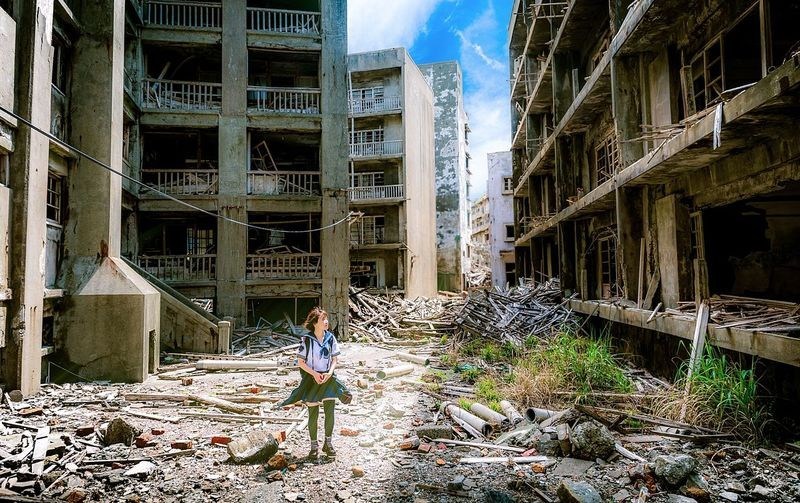
In terms of abandonment, ghost towns get all the love — there are a spooky 160 of them on Atlas Obscura as of this writing. These gaping remains of human activity departed are both unnerving and often beautiful, but what about ghost islands? Around the world whole island communities have been evacuated and deserted, leaving the landmasses to nature and the atrophy of time. Here are eight of these ominous places on the water, and the details on why people left, and if you can visit the isolated ruins.

On the one seen above – Hashima Island, Japan:

Abandoned: 1974

Eerie Elements: Derelict, fortress-like compounds on Hashima Island once housed workers for a coal mining facility. The island was nicknamed “battleship” (“gunkanjima”) for its typhoon-resilient architecture that’s now crumbling like a dystopic wasteland.

Can You Go? Yes, tours have been operating since 2009. You can also explore it digitally through the ominous Hashima Island: A Forgotten World interactive project.

(Photo of Hashima Island by Jordy Meow/Wikimedia)

Turning Green After Death

Shannon Palus investigates eco-alternatives to traditional burial:

There all kinds of green practices and products available these days on the so-called “death care” market. So many, in fact, that in 2005 Joe Sehee founded the Green Burial Council—a non-profit that keeps tabs on the green funeral industry, offering certifications for products and cemeteries. Sehee saw a need to prevent meaningless greenwashing in the green burial world. “It is a social movement. It’s also a business opportunity,” he said. So what’s the most environmentally friendly way to dispose of a body? It all depends on your preferences.

For those who still want to be be buried, a greener approach may include switching out the standard embalming fluids made of a combination of formaldehyde and rubbing alcohol, with ones made of essential oils. And instead of a heavy wood and metal box that will take years to degrade and leave behind toxic residue, there are now Green Burial Council-certified biodegradable cedar caskets.

Others are choosing to forgo the casket completely and opt for what’s called a “natural burial,” involving only a burlap sack buried in the woods. If you don’t have a forest handy, in some cities bodies may soon be placed in an industrial sized compost bin, and turned over to create fertile soil.

A Rare Bleed

Penny Bailey profiles a man with an extremely rare, “precious, life-saving” blood type – one shared by only 43 people since it was discovered in 1961:

Rare negative blood is so sought after for research that even though all samples stored in blood banks are anonymised, there have been cases where scientists have tried to track down and approach individual donors directly to ask for blood. And because Rhnull blood can be considered ‘universal’ blood for anyone with rare blood types within the Rh system, its life-saving capability is enormous. As such, it’s also highly prized by doctors – although it will be given to patients only in extreme circumstances, and after very careful consideration, because it may be nigh on impossible to replace. “It’s the golden blood,” says Dr Thierry Peyrard, the current Director of the National Immunohematology Reference Laboratory in Paris.

And it’s a priceless gold, in most countries at least:

The first urgent request came a few years after Thomas began donating, when he got a phone call asking if he would mind taking, and paying for, a taxi to the blood centre in Geneva to donate for a newborn baby. That moment brought it starkly home to him how valuable his blood was. It was perhaps also the first intimation that the costs of donating would ultimately be his. Some countries do pay donors (and some pay more for rare blood) to encourage donations. But the majority of national blood services don’t pay, to deter donors with infections such as HIV.

Ouagadoucoup d’Etat

Burkina Faso’s president, Blaise Compaoré, stepped down today after 27 years in power, in the face of widespread protests – and the ablaze of parliament – against his plans to change the constitution and allow himself to run for yet another five-year term:

The announcement from Mr. Compaoré came on the fourth day of turmoil in Ouagadougou, the capital, as military commanders met behind closed doors and demonstrators urged them to oust the president. His departure was the culmination of 24 hours of frantic maneuvering. Mr. Compaoré declared martial law for a few hours on Thursday, then seemed to relent, offering negotiations on a transitional government and rescinding his martial law decree. …

Opposition to the president’s plans for another term had been building for weeks. Anger exploded Thursday as protesters stormed the Parliament building, bursting past police lines to prevent lawmakers from voting on a draft law that would have allowed Mr. Compaoré to run again next year. Thousands rampaged through Ouagadougou, burning the homes of presidential aides and relatives and looting state broadcasting facilities. Social media sites showed images of demonstrators toppling a statue of Mr. Compaoré.

Adam Taylor gauges whether Compaoré’s ouster “could ultimately be the spark for something bigger”, spreading to other African countries with long-entrenched autocrats:

“In Burkina Faso now it looks like citizens are making forceful demands for respect of democratic rules,” Pierre Englebert, a Professor of African Politics and Development at Pomona College explained in an e-mail. “That would be an unusual degree of political ownership. And it might well give hope to movements elsewhere, first of all in the Democratic Republic of Congo where things have also been coming to a boil.”

Notably, Vital Kamerhe, leader of Congo’s Union pour la Nation Congolaise, has tweeted a message of solidarity for Burkina Faso’s protesters, saying they are in the “same struggle.” And while many analysts are hesitant to make the comparison, some Burkinabè protesters have likened the protest to the Arab uprisings that began in 2010. … Either way, the comparison with the Arab Spring might not be a good thing: Like the protests in the Arab world, even if Burkina Faso’s protests end up being successful in their immediate aim, they may also carry with them a lot of risks and uncertainty.

Paul Melly’s analysis, written before Compaoré stepped down, focused on the possibility that other African leaders might try to relax their own term limits, even though such schemes have not always worked out well for those who tried them:

In Niger, a third term bid by former president Mamadou Tandja provoked his removal by the army in 2010, followed by a transition to new elections. In Senegal, President Abdoulaye Wade did manage to change the rules, only to be punished by the voters with crushing defeat in the subsequent election in 2012. However, political culture in central Africa and the Great Lakes is rather different and authoritarian traditions are still influential in some countries. Few would bet against [Rwanda’s Paul] Kagame or Congo-Brazzaville’s Denis Sassou-Nguesso successfully pushing through a rule change to open their way to further terms of office. Burundi’s Pierre Nkurunziza and Joseph Kabila of the Democratic Republic of Congo might also be tempted to follow suit – although for them it could be a higher risk exercise, governing countries with vocal civil society and state machines of limited establishment power.

The Downgrading Of Our Economic Potential

GDP

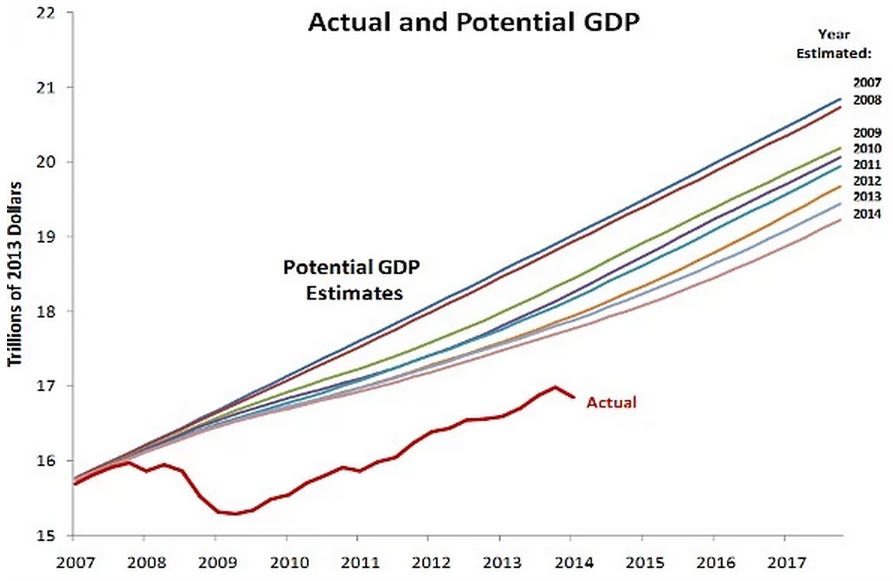
Matt O’Brien is disheartened by the above chart, which was created by Larry Summers:

It shows how much more pessimistic the Congressional Budget Office (CBO) has become about the economy, revising its estimate of potential economic down in each of the last seven years. The economy, in other words, has grown so little that the CBO doesn’t think it can grow quite as much anymore. Although, of course, GDP has still fallen far short of even these diminished expectations.

This is scary stuff. Much more than a series of descending lines can really convey. If it’s right, it means that the Great Recession has made us permanently poorer. That the economy will never get back to its pre-crisis trend. Instead, it will stay stuck in a “new normal” of slow growth that feels like a slump—forever.

O’Brien also throws cold water on last quarter’s seemingly-impressive 3.5% GDP growth:

So how good is the economy, really?

Well, we can get a better picture if we strip out the noisy inventory and net export numbers to leave us with something that goes by the catchy name of final sales to domestic purchasers. Then we can look at growth over the past year to smooth out, for example, the polar vortex-induced dip at the start of the year. This shows us the economy’s underlying strength, basically how much of today’s growth we can expect to continue tomorrow. And … it’s pretty much the same now as it’s been throughout the recovery: growing 2.4 percent a year. Now it might, just might, be picking up ever-so-slightly right now. Or it might just be ticking up. We’ll see. But in any case, it’s not that much different from what it’s been: a recovery that’s given us plenty of head fakes, but has really just been chugging along at the same speed the whole time.

Jared Bernstein is more upbeat:

[T]here’s a lot of momentum in these trends and my expectation is that the steady recovery remains on track. That’s not the express track, to be sure. We never had the needed bounce-back after the Great Recession and we settled into trend growth before repairing enough of the damage. There’s still a lot of slack in the job market and that’s why most households’ real wages and incomes have been pretty flat.

So I’m definitely not saying all’s well. Instead my point is that it will take a lot more quarters and years of this slow and steady improvement to squeeze the remaining slack out of the job market and get back to full employment. And only then do I expect to see many more people benefiting from the growth …

Chico Harlan compares the US to Europe:

That [3.5% GDP] figure came amid growing fears that Europe is sliding into its third recession since 2008. And while the United Kingdom is faring well, too, economists predict that by 2015 the United States will be the rich world’s standout economy.

“GDP growth of 3.5 percent?” said Jay Bryson, a global economist at Wells Fargo. “If you said that to a European right now, they’d start to cry tears of joy.”

Kickstarter Of The Day

This embed is invalid


And in the holiday spirit:

Sam & Mattie are teenagers from Rhode Island. They are BEST friends. They met at Special Olympics while they were in grade school and have been pretty much inseparable since. For the most part, they’re normal teenage dudes. They like to skate and play video games and talk about girls and stuff, but the one thing they both LOVE is cinema. They love to go to the movies, talk about movies, brainstorm movie ideas, and act out their favorite scenes.

Three years ago, they started brainstorming their own Teen Zombie Movie (a favorite genre). This was nothing out of the ordinary — they are constantly hatching zany schemes to “launch their careers.” But something about this zombie movie has stuck with them. For three years. Honestly, they won’t shut up about it.

Every time they get together, they draw up storyboards, practice fight scenes, film with their iPhones (then pair those scenes with dream soundtracks), and endlessly debate celebrity cameos.  They have been so passionate about this film for so long, that their friends and family decided it was time to help them make it happen FOR REAL.

You can help here.

The State Of The Race In Massachusetts

A reader sums up a “bizarre race” in one district:

The race in Massachusetts’s 6th Congressional District is getting strange. The National Organization for Marriage, which opposes same-sex marriage, is urging supporters to vote for Democrat Seth Moulton rather than an openly gay Republican, Richard Tisei. Meanwhile, the Human Rights Campaign is staying out of the race completely, despite having previously endorsed in the district.

From one article cited by our reader:

Asked whether Moulton would welcome or reject votes cast in his favor by NOM supporters, a spokesperson for Moulton responded, “Reject.” “Seth Moulton fundamentally disagrees with everything NOM stands for and has long said that equality is the civil rights fight of our generation,” said Carrie Rankin, Moulton’s communications director. “Fighting against groups, like NOM, that deny equality as a basic human right will be a priority of Seth’s in Congress.” Rankin noted that Moulton has a gay brother and Moulton has said, “It’s fundamentally wrong that he and I don’t share the same rights just because of who he is.”

From another piece:

The nation’s largest LGBT-rights organization is not expected to get involved in the Massachusetts congressional race between openly gay Republican Richard Tisei and pro-LGBT Democrat Seth Moulton, Metro Weekly has learned. …

HRC, which has a policy of endorsing pro-LGBT incumbents, previously endorsed Rep. John Tierney (D) in Massachusetts’s 6th Congressional District. In September, Tierney suffered a surprising primary defeat to Moulton, a young Marine veteran vowing to keep the seat in Democratic control. Two years prior, Tisei lost narrowly to Tierney 47.1 percent to 48.3 percent. Many credited the win by a vulnerable Tierney, whose wife was mired in a federal tax scandal, to President Barack Obama and Senate candidate Elizabeth Warren being at the top of the 2012 ballot. In that race HRC also endorsed Tierney.

The Gay & Lesbian Victory Fund, which seeks to increase LGBT representation, has endorsed Tisei the past two election cycles.

Tisei is one of two men seeking to become the first openly gay Republican elected to Congress. In California, Carl DeMaio is attempting to unseat Democratic Rep. Scott Peters for the state’s 52nd Congressional District. HRC has endorsed Peters in that race and representatives of the organization have been critical of DeMaio’s commitment to LGBT issues.

Previous reader dispatches from Texas here and South Dakota here.

Operation Strategic Trolling

NATO reported an “unusual burst of activity” by Russia’s nuclear-capable strategic bombers on its borders this week. While none of the flights violated NATO airspace, they are emblematic of the increasing tensions in Europe over the conflict in Ukraine:

In all, Nato said, its jets intercepted four groups of Russian aircraft in about 24 hours since Tuesday and some were still on manoeuvres late on Wednesday afternoon. “These sizeable Russian flights represent an unusual level of air activity over European air space,” the alliance said. A spokesman stressed there had been no violation of Nato air space, unlike a week earlier when a Russian spy plane briefly crossed Estonia’s border. But so many sorties in one day was unusual compared with recent years. … Nato said it had conducted more than 100 such intercepts of Russian aircraft this year so far, about three times as many as in 2013 before the confrontation with Moscow over separatist revolts in Ukraine soured relations.

Elias Groll adds:

Last month, Estonia accused Russia of kidnapping an Estonian intelligence agent. Swedish defense officials now speak of a fundamentally altered security paradigm in the Baltic after Russian planes carried out a mock bombing of Stockholm and violated Swedish airspace in the region.

Groll says such actions “bring relations between Moscow and the West to their lowest point since the end of the Cold War.” Marc Champion also finds that “a version of the Cold War is returning, but its rules and parameters aren’t clear”:

A defining aspect of the Cold War was that, for the most part, deterrence kept each side from meddling in the other’s sphere: The U.S. and NATO stood by during the uprisings in Hungary in 1956 and Czechoslovakia in 1968. Putin wants a similar kind of tacit agreement with the U.S. now. … So Putin may see testing NATO as a form of shoe-banging. The danger of this new Cold War is that there is complete disagreement between Russia on one side and the U.S. and European Union on the other as to the dividing lines are and the rules of the game.

Dave Majumdar solicits the opinions of some military experts, who see the Kremlin pushing NATO’s buttons but probably not rehearsing a nuclear attack:

Analyst Rebecca Grant, president of IRIS Independent Research, said that the recent display of Russian air power was just another provocation in a long line of similar antagonistic moves by Russia. The Russian strategic bomber foray into the Atlantic is also reminiscent of a September incident where two nuclear-capable Tu-95s bombers, two Il-78 tankers and two MiG-31 Foxhound fighters were intercepted near Alaska.

“This reminds me of the exercises Russia has been flying in the Pacific for a few years now, just transferred to the European theater,” Grant said. “I don’t read this as a specific nuclear or conventional scenario practice, rather an exercise in long-range navigation and provocation. It’s clearly designed to annoy NATO but from a purely tactical perspective, this was still a pretty small display of airpower.”

In these circumstances, Keating worries less about deliberate acts of war and more about accidents:

This doesn’t necessarily mean Russia is preparing for war, and open conflict between Russia and NATO countries still seems pretty unlikely. It probably has more to do with Russia seeing how much it can get away with, and making it clear that it disapproves of Europe’s pro-Ukraine stance. But as June’s shootdown of a Malaysian airliner demonstrated, tragedies can happen when there are itchy fingers on the triggers of anti-aircraft missiles.