How Did The Ferguson Shooting Really Go Down?

Activists March In Ferguson On Nat'l Day Of Action Against Police Brutality

The WaP0 reports on the autopsy of Michael Brown. It “suggests that the 18-year-old may not have had his hands raised when he was fatally shot”:

Experts told the newspaper that Brown was first shot at close range and may have been reaching for Wilson’s weapon while the officer was still in his vehicle and Brown was standing at the driver’s side window. The autopsy found material “consistent with products that are discharged from the barrel of a firearm” in a wound on Brown’s thumb, the autopsy says.

Another key piece of evidence:

Seven or eight African American eyewitnesses have provided testimony consistent with Wilson’s account, but none have spoken publicly out of fear for their safety, The Post’s sources said.

But Trymaine Lee relays some pushback on the WaPo’s reporting. He writes that “one of the experts whose analysis was central to those claims told msnbc that her analysis of the findings had been taken out of context”:

“You cannot interpret autopsy reports in a vacuum. You need to do it in the context of the scene, the investigation and the witness statements,” Dr. Judy Melinek said. “Sometimes when you take things out of context they can be more inflammatory.”

Danny Vinik analyzes the news:

How much stock you put in these results depends, in part, on how much you trust the county medical examiner’s office and the sources who spoke to the Post. The Brown family didn’t trust local authorities at allthat’s why they asked for a private autopsy in the first place. “The family has not believed anything the police or this medical examiner has said,” a lawyer for the family told The Washington Post. “They have their witnesses. We have seven witnesses that we know about that say the opposite.”

In addition, we don’t know much of the evidence that has been presented to the grand jury. These leaks are only part of the story. The Department of Justice, for its part, also condemned the leaks Wednesday, saying, “There seems to be an inappropriate effort to influence public opinion about this case.”

John Cole argues that the “leaks are about one thing, and one thing only- prepping the field for no indictment”:

I think my favorite part was the reefer madness bullshit, in which it was stated he had enough THC in his system to cause hallucinations. Reminded me of the DARE days when cops with straight faces told kids that if they smoked pot they would jump out of windows thinking they could fly.

Jonathan Cohn adds that a “decision to charge Wilson was never that likely, given the broad leeway that Missouri law gives to police who say they are acting in self-defense”:

If these new reports are correct, an indictment is even more improbable. That’s unlikely to sit well with Ferguson residents, whose grievances reflect long-simmering resentment over the treatment of a largely black population by a largely white police force. Brown’s killing instigated protests and, eventually, confrontations with police. But the problems existed long beforehand.

Allahpundit wonders what happens next:

[Benjamin L. Crump, a lawyer for the Brown family] says he has seven witnesses who’ll say that Wilson gunned Brown down unjustifiably. Great, says the defense, we have seven witnesses who say the opposite plus a pile of forensic evidence that shows Brown, who’d just committed a robbery at the local convenience store, not only assaulted a police officer but attempted to seize his firearm. There’s little doubt, barring some bombshell evidence that the public doesn’t know about, that Wilson’s not going to be convicted. The question now is whether he’ll be charged. One theory for all the leaks lately is that law enforcement is trying to prepare the public for the fact that grand jury is unlikely to return an indictment, but I don’t know: Given what Crump said in the excerpt above plus protesters vowing that “it’s going to be a war” if Wilson isn’t charged, sounds like releasing the evidence early isn’t going to calm anyone down. On the contrary, it may be that this is being leaked because Wilson supporters fear that he’ll be unfairly indicted anyway for political reasons, even though there’s no probable cause to think he murdered Brown. That’s probably the outcome city leaders would prefer — indictment followed by acquittal so that they can say the system took the incident seriously enough to force Wilson to defend his actions in open court. Think that result would calm people down? Me neither.

(Photo: Josh Williams walks beside a memorial built on the spot in Ferguson, Missouri where 18-year-old Michael Brown was shot to death by police officer Darren Wilson. The photo was taken on October 22, 2014. By Scott Olson/Getty Images)

Many Genetic Roads, One Destination?

Emily Singer introduces the innovative research of Harvard biologist Michael Desai, who “has created hundreds of identical worlds in order to watch evolution at work”:

Each of his meticulously controlled environments is home to a separate strain of baker’s yeast. Every 12 hours, Desai’s robot assistants pluck out the fastest-growing yeast in each world — selecting the fittest to live on — and discard the rest. Desai then monitors the strains as they evolve over the course of 500 generations. His experiment, which other scientists say is unprecedented in scale, seeks to gain insight into a question that has long bedeviled biologists: If we could start the world over again, would life evolve the same way?

Many biologists argue that it would not, that chance mutations early in the evolutionary journey of a species will profoundly influence its fate. “If you replay the tape of life, you might have one initial mutation that takes you in a totally different direction,” Desai said, paraphrasing an idea first put forth by the biologist Stephen Jay Gould in the 1980s. Desai’s yeast cells call this belief into question. According to results published in Science in June, all of Desai’s yeast varieties arrived at roughly the same evolutionary endpoint (as measured by their ability to grow under specific lab conditions) regardless of which precise genetic path each strain took. It’s as if 100 New York City taxis agreed to take separate highways in a race to the Pacific Ocean, and 50 hours later they all converged at the Santa Monica pier.

Where The Laws Of Supply And Demand Evaporate

Screen_Shot_2014-10-17_at_1.59.15_PM.0

As the West suffers from an ongoing drought, Brad Plumer flags a sobering chart from The Hamilton Project’s “Nine Economic Facts about Water in the United States“:

What’s interesting is that many cities in dry areas – Denver, El Paso, Phoenix, Las Vegas – have some of the lowest water bills around, whereas a wet city like Seattle has much higher bills. Some of that can be explained by provisions in the Clean Water Act that required cities like Boston to upgrade their sewage-treatment systems. Still, the disparity is notable. Other surveys have also found that there’s little relationship between the price of water and how scarce it is.

The report notes that some cities, like Phoenix and Los Angeles, have begun to reform their pricing schemes so that heavier water users get charged more. But this is hardly universal. In most parts of the United States, the price of water doesn’t reflect the infrastructure costs of delivering that water or the environmental damage that excessive water withdrawals can cause. As long as that’s the case, there are few market incentives to conserve or allocate water more efficiently.

A Diploma Wrapped In Red Tape

Albert H. Teich urges legislators to chuck a part of the student visa process:

The United States is in a worldwide competition for the best scientific and engineering talent. But its regulations and procedures have failed to keep pace with today’s increasingly globalized science and technology. Rather than facilitating international commerce in talent and ideas, they too often inhibit it, discouraging talented scientific visitors, students, and potential immigrants from coming to and remaining in the United States.

Many elements of the visa and immigration system need attention, as I discuss at length in an article for Issues in Science & Technology. But one critical reform involves reconsidering the requirement that STEM students demonstrate intent to return home.

Under section 214(b) of the Immigration and Nationality Act, all persons applying for a U.S. visa are presumed to be intending to immigrate. In practice, this means that a person being interviewed for a student visa must persuade the consular officer that he or she does not intend to remain permanently in the United States. Simply stating the intent to return home after completion of one’s educational program is not enough. The applicant must present evidence of strong ties to the home country, such as connections to family members, a bank account, a job or other steady source of income, or a house or other property.

Teich explains why this requirement poses a problem for the US economy:

Foreign graduate students and postdocs, especially in STEM fields, make up a large and increasingly essential element of U.S. higher education. According to recent data from the National Science Foundation, for example, more than 70 percent of full-time graduate students in electrical engineering and 63 percent in computer science in U.S. universities are international students. …

What is needed is a more flexible policy that provides the opportunity for qualified international students who graduate with bachelor’s, master’s, or Ph.D. STEM degrees to remain in the United States if they choose to do so, without allowing the student visa to become an easy way to subvert regulations on permanent immigration. It makes no sense to try to make such distinctions by denying the fact that people who are applying to study in the United States may be uncertain about their plans four (or more) years later.

The Best Of The Dish Today

B0krpTDIgAAXOu6

A reader sends the above screenshot:

You might note the contrast between American and Canadian reporting on the Ottawa shooting.  I listened to CBC on my drive in to work (I live in Los Angeles), and I was impressed by just how measured the reporting was, even with the crisis still ongoing.  The attached picture probably goes a long way to explaining why Americans are terrified that tomorrow ISIS will be invading and imposing Sharia, and that we’re all going to die of Ebola, even though the chance of that actually happening is about 1/100th the chance of getting hit by lightning.

Meanwhile, there is a truly disturbing blog-post out there by Chicago Sun-Times reporter, Dave McKinney. It’s simply his letter of resignation to the chairman of the paper, Michael Ferro, after his reporting of a tough story on the GOP candidate for governor, Bruce Rauner. According to McKinney, the Rauner campaign was furious at the story – it detailed an ugly dispute with a business associate, Christine Kirk, in which Rauner allegedly threatened to “bury her”. The editor of the paper defended the story and McKinney in the strongest terms, but McKinney subsequently found his beat curtailed, and some of his reporting excised from the paper:

I was told to go on leave, a kind of house arrest that lasted almost a week. It was pure hell. Kirk told me that his bosses were considering taking me away permanently from the political and Springfield beats. He offered up other potential jobs at the paper, all of which I considered demotions. Because of my unexplained absence from my beat, colleagues started calling, asking if I had been suspended. Or fired.

Eventually, he was allowed back – but then told not to pursue the story any further, as he was intending to. He asks the chairman of the paper, Michael Ferro:

Was all this retaliation for breaking an important news story that had the blessing of the paper’s editor and publisher, the company’s lawyer and our NBC5 partners? Does part of the answer lie in what Kirk told me – that you couldn’t understand why the LeapSource story was even in the paper? Days later, the newspaper reversed its three-year, no-endorsement policy and unequivocally embraced the very campaign that had unleashed what Sun-Times management had declared a defamatory attack on me.

Readers of the Sun-Times need to be able to trust the paper. They need to know a wall exists between owners and the newsroom to preserve the integrity of what is published. A breach in that wall exists at the Sun-Times.

The race between Rauner and the Democratic governor, Pat Quinn, is currently too close to call. Stay tuned.

Today, we published both a riposte to our readers’ defense of #gamergate and an apologia of sorts by a self-described nerd. This topic clearly touches a whole bunch of nerves all round, judging by the avalanche in the in-tray.

So too did my citation of the inebriated tale of Bristol Palin in the now-famous brawl in Alaska. I’m sorry of some of you thought I was belittling a woman claiming she was attacked; my point was merely the sorry, Springer-style language and general mayhem of the moment, captured by one quote. I could have used others. But I have to say I’ve tried mighty hard to restrain myself with respect to the fantasist and fabulist whom John McCain thought could be president at a moment’s notice. I treat the Palins these days a little like an alcoholic would treat a Jäger shot. I sip. And put it down. Don’t I get any props for that? Or do you secretly want me to get all obsessed again?

Four other posts: the growing evidence that the Obama administration is going to bat for the CIA on torture; the news – surprise! – that intervening in Syria can sometimes help the people we’re trying to defeat; an homage to Shia LaBoeuf of viral proportions; and a stunning fall view from St Paul, Minnesota.

The most popular post of the day was Bristol Palin’s quote and John McCain’s shame; the runner up was Vengeance of the Nerds, Ctd.

Many of today’s posts were updated with your emails – read them all here.  You can always leave your unfiltered comments at our Facebook page and @sullydish. 22 more readers became subscribers today. You can join them here – and get access to all the readons and Deep Dish – for a little as $1.99 month. Gift subscriptions are available here. Dish t-shirts are for sale here, including the new “Know Dope” shirts, which are detailed here. One reader really wants one:

Please keep up the “Know Dope” shirts for sale as long as possible. I’m broke right now, but I know I’ll have some money around tax season (Jan-Feb) so I can re-new (for the second time!) and buy one of these shirts. I know supplies are limited, but I just wanted to say that IF they are still available then, I will cop one, so I hope you don’t take them down once November 4th passes.

Also, I’m looking forward to the November 2016 California versions!

Know hope. And see you in the morning.

(Photo: A sign is displayed at the Ottawa City Hall, 4 blocks away from National War Memorial where a soldier was shot earlier in the day in Ottawa, Canada on October 22, 2014. By Mike Carroccetto/Getty Images.)

Those Regressive Scandinavians, Ctd

Mike Konczal lets the air out of Cathie Jo Martin and Alexander Hertel-Fernandez’s claim that the US has a more progressive tax system than Sweden:

They are measuring how much of tax revenue comes from the top decile (or, alternatively, the concentration coefficient of tax revenue), and calling that the progressivity of taxation (“how much more (or less) of the tax burden falls on the wealthiest households”). The fact that the United States gets so much more of its tax revenue from the rich when compared to Sweden means we have a much more progressive tax policy, one of the most progressive in the world. Congratulations?

The problem is, of course, that we get so much of our tax revenue from the rich because we have one of the highest rates of inequality across peer nations. How unequal a country is will be just as much of a driver of the progressivity of taxation as the actual tax polices. In order to understand how absurd this is, even flat taxes on a very unequal income distribution will mean that taxes are “progressive” as more income will come from the top of the income distribution, just because that’s where all the money is. Yet how would that be progressive taxation?

Giving Gray Some Shade

The political philosopher John Gray is known, among other things, for his iconoclastic and often brilliant review essays (we recently featured his takedown of Richard Dawkins here). Anthony McCarthy returns the favor by panning Gray’s recent book, The Silence of Animals, quipping that it “could equally well have been called The Silence of Turnips:

Things take a downward turn towards the end of the first part of the book, where at least the examples are engaging and concern recognisable human travails. At the end of this first section, there is the statement: ‘When truth is at odds with meaning, it is meaning that wins.’ What is this supposed to mean?

And is it true? Is it true but meaningless, or meaningful but untrue? Is it a statement whose truth could be ‘defeated’ by meaning? The relationship the book has with reality is tenuous at this point. Like Captain Ahab hunting the whale of progress, Gray ends up detaching himself from reality, and becomes far more unreal than those he sets out to confound.

This assertion comes after an excursus into the nature of myth and is followed by several pages of praise for Sigmund Freud who, Gray says, taught us to live without consolation, be it religious or a quasi-religious faith in ‘progress’. It is difficult to know what to make of this section in light of the words which end it, seemingly influenced by the poet Wallace Stephens: ‘Knowing there is nothing of substance in our world may seem to rob that world of value. But this nothingness may be our most precious possession, since it opens to us the world that exists beyond ourselves.’

Knowing there is nothing opens us up to… that same nothing? One does not have to hold that hope is a virtue – for some indeed, one of the great theological virtues – to see this as perverse. The idea that in our lives we can make rational choices which fulfil our nature and allow us to flourish as the kind of beings we are helps us to understand that we can also make choices which gradually reduce who we are and move us towards emptiness and nothingness –  evil choices, if you will. In the above passage, nothingness is embraced, being rejected, truth discarded.

Walt Whitman, Shameless Self-Promoter

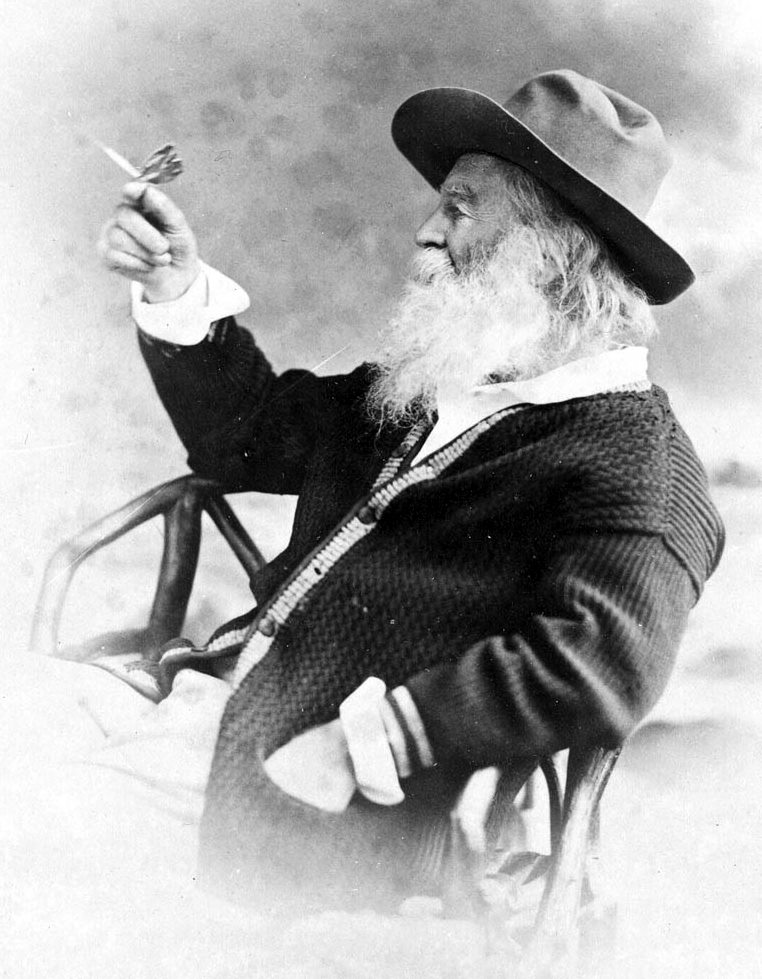
Although the poet’s famed 1882 meeting with Oscar Wilde is now perhaps best known for alleged sexual shenanigans, David M. Friedman, the author of Wilde in America: Oscar Wilde and the Invention of Modern Celebrityemphasizes the role their confab played in the development of celebrity culture. Friedman writes, “the real subject of Whitman’s conversation [with Wilde] was how to build a career in public, with all the display that self-glorifying achievement requires”:

Whitman_with_butterflyWe can deduce that with confidence because the first thing Whitman did when he reached his den was to give his guest [Wilde] a photograph of himself. … The portrait Whitman gave Wilde in 1882 appeared on his next book, Specimen Days & Collect, an assemblage of travel diaries, nature writing, and Civil War reminiscences. (Whitman had spent the war years in Washington, working as a government clerk and volunteering as a hospital visitor.) He is in profile in the photograph, sitting in a wicker chair wearing a wide-brimmed hat, an open-necked shirt, and a cardigan. A butterfly is perched on his index finger, held in front of his face. “I’ve always had the knack of attracting birds and butterflies,” Whitman once told a friend. Years later Whitman’s “butterfly” was found in the Library of Congress. It was made of cardboard; it had been tied to his finger with string.

By handing Wilde that photo Whitman was teaching him that fame as a writer is only partly about literature. It is also about committing oneself to a performance. Such role-playing isn’t the act of a phony; in Whitman’s mind every pose he struck was authentic. This type of authenticity – the fashioning of an image one would be faithful to in public – Wilde had experienced on a small scale playing the aesthete on the campus of Oxford’s Magdalen College and at parties in London. It was instructive to have its truth verified by a literary star who had proved its efficacy on an international scale. Wilde had always believed there was nothing inglorious about seeking glory. By handing Wilde his portrait, Whitman was confirming that instinct.

(Image via Wikimedia Commons)

Losing The Opium War

141391921233342

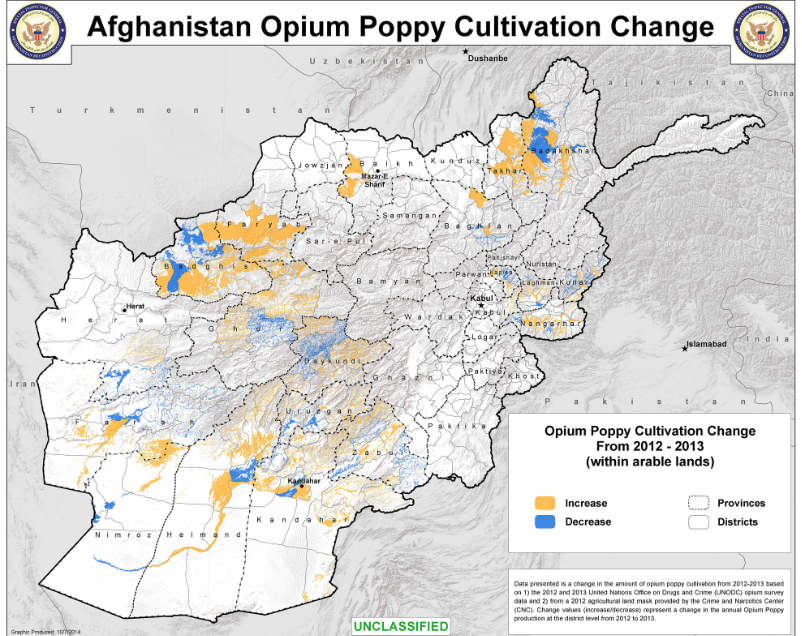
A new report (pdf) from the office of John Sopko, the Special Inspector General for Afghanistan Reconstruction, reveals that poppy production in Afghanistan hit a record high of 209,000 hectares last year, despite a $7.6 billion eradication effort:

“In past years, surges in opium poppy cultivation have been met by a coordinated response from the U.S. government and coalition partners, which has led to a temporary decline in levels of opium production,” Sopko said in a letter to Secretary of State John Kerry, Defense Secretary Chuck Hagel and other top U.S. officials. “The recent record-high level of poppy cultivation calls into question the long-term effectiveness and sustainability of those prior efforts,” he said.

No shit, Sherlock. Keating notes that poppy production “actually fell dramatically from 2007 to 2009, and has been climbing steadily ever since”:

The drop in cultivation prior to 2009 probably had less to do with military efforts than with economic factors. Thanks to drought and a global spike in food prices during that period, the gross income ratio of poppies relative to wheat fell from 10-to-1 in 2007 to 3-to-1 in 2008. Since then, global wheat prices have eased—they’re pretty low at the moment—and the price of poppies has increased, and farmers have gone back to the harder stuff. Eastern Nangahar province, which was declared opium-free and touted as a counternarcotics success story in 2008, saw a fourfold increase in cultivation last year.

Farmers may also be hedging their bets in anticipation of the departure of NATO forces—the majority are pulling out at the end of this year, leaving behind a smaller contingent of U.S. troops to train Afghan security forces. The majority of Afghanistan’s poppies are still grown in the Taliban-dominated Kandahar and Helmand provinces, but cultivation has been increasing around government-controlled Kabul as well.

Jason Koebler compares Afghanistan to South America:

Though the situation is a little different because the US has been engaged in an all out war-war in Afghanistan and not just a war-on-drugs war as it has been in South America with cocaine, the failures and patterns appear to be very similar to what has happened there. In South America, for instance, when Colombia or Peru (backed with US money) has tried to curb coca cultivation by applying aerial herbicide, farmers have simply gone to more remote areas or started growing coca plants in between other crops in order to disguise what they were doing.

In the short term, prices go up when supply temporarily falls, then stabilize once the already skilled farmers relocate and get supply back up to normal or record levels. The overall profits flowing into potentially dangerous coffers (in South America, drug cartels; in Afghanistan, the Taliban or local warlords) don’t really change all that much.

So where did all that money go? Ryan Devereaux answers:

While U.S. efforts have failed to effectively diminish drug trafficking in Afghanistan, they have succeeded in making a handful of private security companies increasingly rich, a point that is not addressed in the inspector general’s report. In 2009, official responsibility for training Afghan police forces was shifted from the State Department to an obscure branch of the Pentagon known as Counter Narco-Terrorism Program Office (CNTPO), which took over the roughly $1 billion contract. In waging the privatized war on drugs, CNTPO has partnered with such corporate security giants as Raytheon, Lockheed Martin, ARINC, DynCorp and U.S. Training Center, a subsidiary of the firm formerly known as Blackwater.

AJ Vicens reminds us why this matters:

Drug addiction is a major problem in Afghanistan, with as many 1 million people addicted to opium, heroin, and other drugs—including children as young as four. In a joint statement that prefaced the release of the 2013 data, Din Mohammad Mobariz Rashidi, Afghanistan’s acting minister of counternarcotics, and Yury Fedotov, the executive director of the UNODC, said that Afghan and American officials are making progress, and that authorities seize roughly 10 percent of Afghan poppy production. But, they continued, not enough “powerful figures” are being prosecuted. That could be a reference to former Afghan president Hamid Karzai’s brother, who was accused of having strong connections to the Afghan heroin trade.

Also, as James Weir and Hekmatullah Azamy’s research indicates, access to the lucrative drug trade and other illicit activities is the main draw for Afghans who join up with the Taliban:

In early 2014 we conducted research that examined violent extremism and Taliban networks with the hope of bridging differences between insurgent groups, community elders, and the Afghan government. In interviews with active, former, and imprisoned Taliban, tribal leaders, and government officials in Helmand and Herat provinces of Afghanistan a consensus emerged: joining the insurgency pays well, especially in a countryside marked by insecurity and economic stagnation. And more important than an insurgent salary, — Taliban rarely mentioned, and most emphatically denied, ideological or political inspiration — being associated with the Taliban enables quasi-independent profiteering from a diverse array of illegal activities.