The Best Of The Dish Today

by Dish Staff

Andrew is still on his speech circuit in California, so he’s not able to wrap up the Dish tonight. But if you missed his longer posts, Andrew, above all, laid into the president and various members of his administration for covering up alleged torture at Gitmo. He also took aim at the NYT’s sponsored content guru, Meredith Kopit Levienat, for spreading more “re-purposed bovine waste”, and then blasted Roger Cohen for playing the Godwin card with ISIS. But Andrew himself caught shit from readers over his incessant whining about NYC. More importantly, another reader shared a long and heartbreaking story of child abuse – a post that’s already getting a lot of feedback from readers, so stay tuned for followups.

Many of today’s posts were updated with your emails – read them all here.  You can always leave your unfiltered comments at our Facebook page and @sullydish. 21 more readers became subscribers today. You can join them here – and get access to all the readons and Deep Dish – for a little as $1.99 month. One writes:

I finally subscribed. Despite some gripes, your coverage of Obama’s war on ISIS finally did it. Excellent debate.

(If I may put in a small gripe/request on the side: can we please do without horse-race speculation of the “Hillary vs X” type until we actually have declared candidates? Please? Honestly don’t give a hoot about hypotheticals. It’s just noise. Let’s focus on actual events.)

Much more Dish in the morning.

Marijuana Is Good Medicine

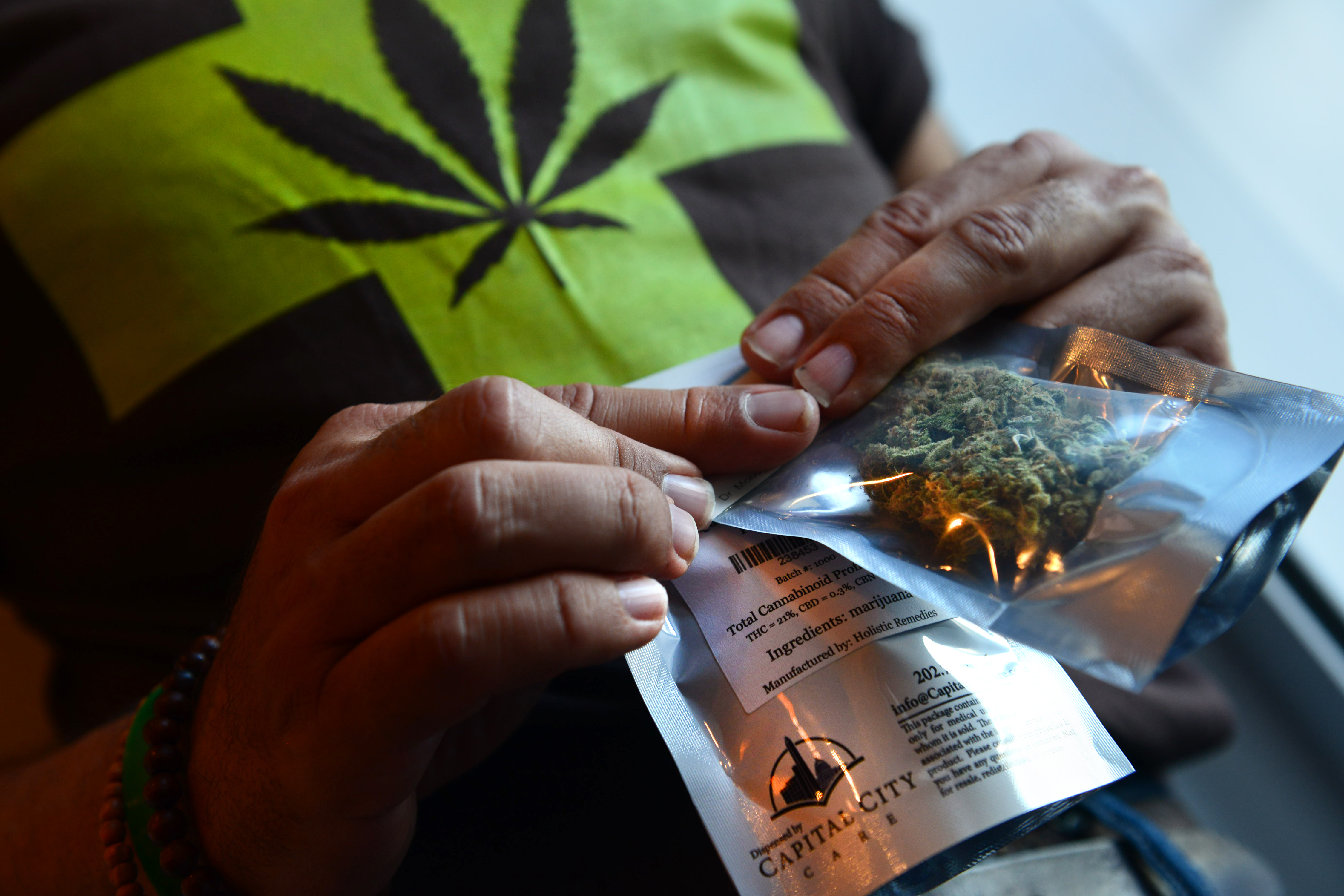
WASHINGTON, DC - JULY 29:   A man purchases medical marijuana,

In a survey, 92 percent of medical marijuana patients said it “alleviated symptoms of their serious medical conditions, including chronic pain, arthritis, migraine, and cancer”:

“Our study contradicts commonly held beliefs that medical marijuana is being overused by healthy individuals,” the authors write. “The most common reasons for use include medical conditions for which mainstream treatments may not exist, such as for migraines, or may not be effective, including for chronic pain and cancer.”

In considering the efficacy of any kind of medical treatment, we should listen first and foremost to the patients. The debate over medical marijuana has largely been dominated by vested interests and advocacy groups on either side – patients’ voices have been either silent or ignored completely.

This study provides a helpful corrective, and in this case the patients are speaking loud and clear in near-unanimity: medical marijuana works.

(Photo: A man purchases medical marijuana, the first legal sale, at Capital City Care in Washington, DC on July 29, 2013. By Linda Davidson / The Washington Post via Getty Images)

Obama’s War Budget

Jessica Schulberg reads a new report that attempts to tally the cost of the ISIS war so far:

Due to the vaguely defined scope of the conflictPresident Barack Obama has vowed not to deploy U.S. combat troopsit has been hard to put a dollar amount on the operation. But a Center for Strategic and Budgetary Assessments (CSBA) report released Monday estimates that the U.S. has already spent between $780-$930 million in Iraq and Syria. In just the past month, the cost was $250-$400 million, or $9-$14 million per day. …

Because Obama has yet outline any long-term plan for U.S. efforts in Iraq and Syria, CSBA’s long-term cost estimates are based on likely hypothetical levels of warfare. If the U.S. draws down airstrikes to approximately 100 targets a month (there have been 200 targets this month, but air campaigns usually peak early because targets learn to hide) and caps U.S. personnel at 2,000, the cost is estimated to be between $2.4 and $3.8 billion a year. But if the administration follows recommendations to deploy 25,000 ground forces and raises the number of air strikes to 200 a month, it will be closer to $13-$22 billion annually.

“To put this in perspective,” she adds, “the U.S. spent approximately $1.1 billion in total direct expenditures in the 2011 NATO-led intervention in Libya.” But  notes that these estimates are “far less than the roughly $150 billion the U.S. spent during the peak years of the Afghan (2011) and Iraq (2008) wars.” Business Insider looks at where the money to fight ISIS is coming from:

The Pentagon has said that financing for the ISIS fight will come from the Overseas Contingency Operation fund, an account exempt from budget caps that was created for the wars in both Afghanistan and Iraq last decade.

Earlier this year, Obama sought to dwindle the budget for that account down to about $59 billion from $85 billion, reflecting the decline of operations in Afghanistan. But the spending bill passed by Congress last month continues to fund the OCO at the $85 billion level.

Meanwhile, Kate Brannen tries to see through the fog over the $5 billion counterterrorism fund the White House proposed in June, including the $500 million Congress has already approved to arm the Syrian rebels:

According to multiple sources — both inside the military and on Capitol Hill — the fund’s purpose is murky because it was mostly conceived by National Security Council staff within the White House with little input from budget or policy experts at either the Pentagon or Foggy Bottom. A few days after the West Point speech, while visiting Poland, Obama announced another new fund. This one was $1 billion for a European Reassurance Initiative, again taking Pentagon officials by surprise, Defense Department and congressional sources told Foreign Policy.

In both instances, the Pentagon was given pots of money and was basically told to figure out how to spend the money, rather than asked what it really needed, one Pentagon official said. If the Pentagon had proposed the counterterrorism fund, it would have been “dead on arrival” at the White House, a former senior Defense Department official said.

The Father Of Three Faiths

800px-Sacrifice_of_Isaac-Caravaggio_(Uffizi)

Sajjad Rizvi suggests the “very notion of Abrahamic religions is arguably Islamic” – and explains how he sees the relationship between Judaism, Christian, and Islam:

The Quran presents Abraham as an adherent of Islam, but here “Islam” means the primordial faith that connects humanity to one God and leads in turn to Judaism, Christianity and then historical Islam as proclaimed by Muhammad. There are some who view Islam as a faith that supersedes the two earlier monotheistic religions. But I think it’s more useful to understand Islam as a religion that is self-conscious about its relationship to Judaism and Christianity and explicitly takes account of their scriptures and traditions. Almost all the prophets of the Quran will be familiar to those who know the Bible, and the Quran explicitly refers to parables, ideas and stories from the Bible.

The common roots — and inheritances — of the three faiths make it useful for us to think seriously in terms of a Judeo-Christian-Islamic civilization and heritage that we all share. The development of philosophy in Islam also shows a common tradition of rationality. Anyone with a basic understanding of the categories of Aristotle’s thought employed by Christian and Jewish thinkers would find many of the arguments of Islamic philosophers and theologians familiar. The great Islamic philosopher Avicenna (10th-11th century) developed a metaphysical notion of God that had a tremendous impact on the Latin west: the idea that God is the necessary being required to explain the existence of every contingent being.

(Image: Caravaggio’s The Sacrifice of Isaac, 1603, via Wikimedia Commons)

Face Of The Day

SAUDI-RELIGION-ISLAM-HAJJ

A Syrian Muslim pilgrim poses for a picture outside a hotel near Mecca’s Grand Mosque on October 1, 2014. Hundreds of thousands of Muslim worshipers started pouring into the holy city for the annual Hajj pilgrimage. The hajj is one of the five pillars of Islam and is mandatory once in a lifetime for all Muslims provided they are physically fit and financially capable. By Mohammed Al-Shaikh/AFP/Getty Images.

Global Business Boosters

Neil Irwin flags a new survey showing that “where big business has the least power and capitalist economies are the least developed, optimism and support for the corporate sector is highest”:

When it comes to business exerting power over the economy, Americans have mixed views but are generally comfortable. But when it comes to business exerting power over government, they are much more exercised. Americans aren’t antibusiness, in other words. They’re just against business having what they see as too much power in Washington.

Compare that with China, where citizens seem to view businesses as less powerful in terms of lobbying (only 19 percent seeing a lot of influence by corporate lobbyists, a full 40 percentage points lower than in the United States) but are more likely to believe it is good for companies to be strong and influential. One might imagine that Chinese citizens see less a phenomenon in which business overly influences government and one more in which government overly influences businesses. … In Communist Party-led China, 74 percent of respondents agreed with the statement that “it is a good thing when corporations are strong and influential, because they are engines of innovation and economic growth.” That is around three times the level of support found in capitalist paradises like Britain, the United States and Australia.

A Climate Polemic Against Capitalism

Naomi Klein’s new book, This Changes Everything, argues that capitalism is largely to blame for our climate crisis. How Klein describes her book in an interview:

Changes EverythingWhat I’m arguing in this book is that we need to return to the progressive tradition of responding to deep crisis by trying to get at the root causes of the crisis. And the best example of that is the way in which the progressive movement responded to the Great Depression. It became an opportunity to change the way we organized our economies, to regulate banks, to launch social programs that got at the roots of inequality.

If we really believed that climate change is an existential crisis, if we believed climate change is a weapon of mass destruction, as John Kerry said, why on Earth would you leave it to the vagaries of the market?

In another interview, Klein clarifies her position:

I’m not saying that markets have no role in combatting climate change. I think the right market incentives can play a huge role—we can point to all kinds of companies doing great stuff. The issue is not to say the market has no role. It’s the idea of leaving this to the market. We can mint solar and wind millionaires and still not get there because we have these hard targets we have to meet. There will have to be a strong role for the public sector, a strong role for regulations and, yes, incentives. But the idea of just leaving our collective fate to the market is madness. You wouldn’t treat any other existential crisis in that way.

Zachary Karabell strongly disagrees with Klein’s thesis. He fears that “rhetoric risks obscuring just how much is being done by large companies around the world to reduce their carbon emissions and environmental footprint”:

None of us should lose sight of working toward a less resource-intensive future. Getting there requires massive investment of trillions of dollars and concerted effort at multiple levels of society. Dismissing a key element of that change—the multinationals and global NGOs that are trying to make these changes in spite of the sclerosis and opposition of so many governments and in the face of powerful lobbies—may galvanize some activists. But barring a synchronous overthrow of the entire global capitalist system, we need the assiduous efforts of multinationals that simultaneously strive to make heaps of money and to reduce their environmental impact. Without them, we would be many steps closer to the environmental Armageddon that Klein and so many of us fear is nigh.

Rebecca Henderson argues along the same lines:

We need to build a social movement that can insist that our leaders put in place the policies that will enable us to deal with the threat of climate change. And while we may struggle with longer-term priorities, we’re also a species that will do almost anything to ensure the welfare of our children. We need to rediscover the old idea that responsive, democratically controlled government has a central role to play in ensuring that the rules of the game are fair, and in dealing with problems like climate change: tough, long-term collective action problems that can only be addressed by the state.

But that doesn’t mean that we should abandon capitalism. With the right policies, capitalism properly understood is perfectly well equipped to prepare us to face the risk of large scale climate change. In fact, it’s the only thing that can.

And Will Boisvert calls the book “a garbled mess stumbling endlessly over its own contradictions”:

Her understanding of the technical aspects of energy policy — indispensable for any serious discussion of sustainability — is weak and biased, marked by a myopic boosterism of renewables and an unthinking rejection of nuclear power and other low-carbon energy sources. Having declared climate change an “existential crisis for the human species,” [15] she rules out some of the most effective means of dealing with it.

Her attack on globalization and trade sometimes clashes with rather than supports her goal of rapid decarbonization. Her abhorrence of industrial civilization misconstrues its complex, sometimes positive impact on the environment. Her politics veer between calls for massive government initiatives and celebrations of an extreme localism and populism that are likely to hobble state action. And her rhapsodic ideal of a society that stands in “humility before nature” [267] glosses over the inherent tension between natural limits and human aspiration — and what that implies for her goals of development and liberation.

John Gray is much more sympathetic. He calls Klein’s latest “a powerful and urgent book that anyone who cares about climate change will want to read.” But he finds it “hard to resist the conclusion that she shrinks from facing the true scale of the problem”

When I read The Shock Doctrine (Guardian review headline: “The end of the world as we know it”), I was unconvinced that corporate and political elites understood what they were doing in promoting the wildly leveraged capitalism of that time, which was already beginning to implode. The idea that corporate elites are in charge of the world is even less convincing today. …

Another problem with pinning all the blame for climate crisis on corporate elites is that humanly caused environmental destruction long predates the rise of capitalism. As Klein herself observes in an interesting chapter on what she calls “extractivism” – the economic model that treats the Earth as a bundle of resources waiting to be exploited – human activity was already changing the climate centuries ago. “We started treating the atmosphere as a waste dump when we began using coal on a commercial scale in the late 1700s and engaged in similarly reckless ecological practices well before that.” Moreover, though Klein doesn’t explore the fact, it’s worth bearing in mind that the extractive model was applied on a vast scale in the centrally planned economies of the former Soviet Union and Mao’s China, where some of the largest and worst 20th-century environmental catastrophes occurred.

However, Chris Bentley is against dismissing Klein out of hand:

We haven’t made significant progress, Klein argues, because we’ve been expecting solutions from the very same institutions that created the problem in the first place.

As for who should be the agents of this change, Klein reports on the front lines of grassroots movements from Montana to Greece — an unofficial coalition of shared interests that she dubs “Blockadia.” Klein says the answer is to empower the communities that stand to lose the most: among them, indigenous peoples threatened by mining and drilling operations, the world’s developing nations, and activists resisting austerity amid widening socioeconomic inequality.

While “power to the people” may seem an uninspired way to change the world’s dominating socioeconomic systems, Klein’s sharp analysis makes a compelling case that a mass awakening is part of the answer.

Would You Eat A Black Bun?

https://twitter.com/Creative_Boom/status/516994707751047169

Tiffanie Wen discusses the reception of a black burger in Burger King restaurants in Japan:

Americans have been both intrigued and repulsed by the images. “Finally #BurgerKing makes a burger the way your body sees it … disgusting and cancer-causing,” one Twitter user wrote. Another tweeted: “It’s the black cheese that freaks me out the most. It looks like the kind of rubber they use to make gimp masks.”

But the burger is enjoying a “favorable reception” in Japan, according to the Guardian—so why do Americans have such a negative response to it?

She offers an answer:

McDonald’s and other international chains have long adjusted their recipes and menus to cater to local tastes. Last year Thrillist dedicated a post to the best foreign McDonald’s products from around the world. (I’d personally love to try the deep-fried Camembert “cheese melt dippers” from branches in Ireland.)

With regards to the KURO burgers, Garber says, “Black in the U.S. simply doesn’t convey a favorable food meaning. It means charred or burnt or moldy or spoiled or inedible.” But in Japan, black is positively associated with food. Eva Hyatt, a professor of marketing at Appalachian State University, told New York Magazine that people in Japan are exposed to more black foods, including seaweed, bean paste-based foods, black walnut powder, squid ink, and other grey foods.”

Clint Rainey notes that McDonalds has followed suit with a black burger of its own, “and the limited-edition burger is now available at three Tokyo branches”:

Critical Thinking On The Job

Tara Mohr flags startling new research on the criticism men and women receive in the workplace:

Across 248 reviews from 28 companies, managers, whether male or female, gave female employees more negative feedback than they gave male employees. Second, 76 percent of the negative feedback given to women included some kind of personality criticism, such as comments that the woman was “abrasive,” “judgmental” or “strident.” Only 2 percent of men’s critical reviews included negative personality comments.

She offers some practical advice:

In my coaching practice and training courses for women, I often encounter women who don’t voice their ideas or pursue their most important work because of dependence on praise or fears of criticism. …

I’ve found that the fundamental shift for women happens when we internalize the fact that all substantive work brings both praise and criticism. Many women carry the unconscious belief that good work will be met mostly — if not exclusively — with praise. Yet in our careers, the terrain is very different: Distinctive work, innovative thinking and controversial decisions garner supporters and critics, especially for women. We need to retrain our minds to expect and accept this.

There are a number of effective ways to do this. A woman can identify another woman whose response to criticism she admires. In challenging situations, she can imagine how the admired woman might respond, and thereby see some new possible responses for herself. It can be helpful to read the most negative and positive reviews of favorite female authors, to remind ourselves of the divergent reactions that powerful work inspires.

For more on Mohr’s work, check out her new book Playing Big: Find Your Voice, Your Mission, Your Message.