In Which The Democrats Finally Get A Clue, Ctd

A reader doesn’t pull punches:

Democrats are spineless cowards who did not dare to make this the theme of the last few election cycles. They would have won big. But instead they hid behind their Wall St donors and sat still.

Another is more even-handed:

Odd thing, isn’t it?  Since the midterms, Obama has been following his instincts, not the Congressional leadership that wanted to try to save Senate seats in deep red States, or the inside-the-Beltway CW that still thinks it’s 1984, that winning legacy media cycles is everything, and that Democrats must act like Republicans.  Would have been interesting to see what would have happened if he’d done this a year ago.

On the other hand, to move like this, maybe he needed an improving economy and a GOP hopelessly tied to its hardcore base.  Either the Republicans approve this basic plan, in which case Obama gets yet another major accomplishment, which will kill them with their Obama-hating base, or they stop it, which clearly puts them on the side of the super rich at the expense of every single middle-class American.  Maybe even the tools and lackeys who populate the panels of the Sunday talk shows will be able to understand just how shrewd this move us.

A few more readers sound off:

I think it’s important to note that this is not a Democratic redistribution of the wealth. This is a correction of 35 years of Republican redistribution policies.

For decades, the middle- and lower-classes have paid for the ever-shrinking percentage of taxes the wealthy pay with increases in state income and sales taxes (due to reduced federal outlays to states), increased fees for government services along with cuts to those same services. The GOP now wants to take the axe to Medicare and Social Security in the name of debt reduction, even though those programs are self-funded and do not affect the national debt. Future insolvencies in those programs can be easily corrected by raising the cap and making the super-wealthy pay their fair share, instead of just paying on the first $105,000 in income. If the super-wealthy cannot acquiesce to paying what is, for them, an easily manageable increase in taxes, they will end up losing more when economic unrest makes indulging their greed politically unpalatable and there is nothing left to steal from the 99%.

Another:

Can we dispense with the “meep, meep” comments?  This idea that the president has this grand diabolical plan, patiently laying in wait, scheming to overcome the opposition, and then striking out, grabbing the initiative, is an interesting one.  Perhaps he was laying in wait and biding his time when his policies caused the Democrats to get their asses handed to them in 2010.  Yes, losing all the state houses and governerships must be in this equation along with losing the Senate.  Next week President Obama will take out Tattalgia, Barzini, Strazi … all the heads of the Five Families.  Right after Connie’s kid gets baptised.

For all the talk about the Democratic Party’s demographic destiny, or the Republican presidential candidate to take 50%+ of the popular vote once over the past twenty years, the electoral success of the president is tied to timing and the complete and utter ineptitude of the opposition, not any Frank Underwood-like grand plan.  Despite six years in office, nearly five years of continued GDP growth, decreases in the unemployment rate, and so-called populist ideas, the president finds it nearly impossible to break the 50% approval rating barrier.

The US of A is still a right-of-center country, and culturally the president does not connect with the majority of Americans (I’ve always believed race is not the defining characteristic that the electorate finds divisive … name the last president to come from an urban/metropolitan area?), and the electorate doesn’t want overtly redistributive economic policies.

However, it is these cultural issues that hold the Republican Party back.  Every presidential primary it seems as if the Republican candidates are vying for the Forsythe County, Georgia school board instead of the Oval Office.  When the Republicans do nominate a relative social moderate, that candidate fits the stereotype of rich, out-of-touch white guy who is unable to draw sufficient votes from any of the Democrats’ core constituencies.  The Democratic party is still a coalition of competing interests, and if the Republicans would pull their heads out of their asses long enough to pluck just enough of those votes away they would be assured of victory.

The Hispanic-American population is more culturally conservative than the Democratic Party base.  The Asian-American population is more culturally and economically conservative than the Democratic Party base. One of George W. Bush’s lasting legacies, other than propelling the country into an avoidable war and being fiscally irresponsible, might be to undermine the ability of the party to grab those votes for the next several years by tainting his brother Jeb’s name and inhibiting him from carrying enough Hispanic-American and Asian-American votes to get into office.  Jeb was always the chosen one – to use the Godfather analogy, Michael to George’s Santino.

As for President Obama, his approval rating will probably creep up a few more points as gas prices stay low and the economy limps along.  Presidential approval ratings correlate to gas prices.  Now that the consumer has deleveraged from the household debt hangover, they have more disposable income.  Whoever is voted into office in 2016, Democrat or Republican, will find themselves in trouble in 2020 as the debt cycle sends us back into another recession after Americans once again charge up those credit cards, take out those HELOCs, and the federal government has to drastically reduce spending to cope with the federal debt.  Then we can start all over with inane arguments over how that president then in office “caused” that Recession.
Face Of The Day

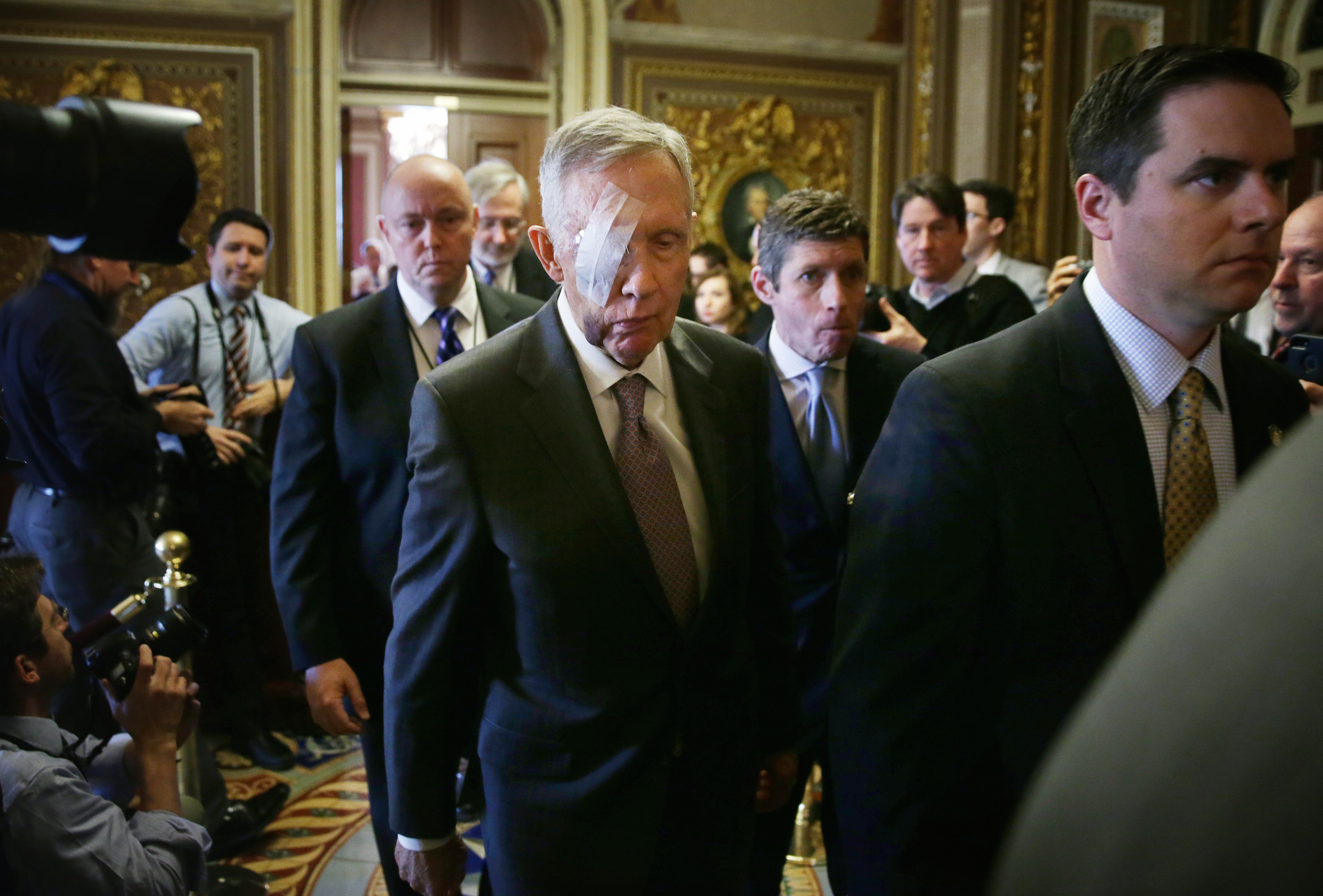
Harry Reid Returns To Capitol Hill After Sports Injury

U.S. Senate Minority Leader Senator Harry Reid (D-NV) leaves after the Senate Democratic weekly policy luncheon at the U.S. Capitol on January 20, 2015. Reid returned to work today after he was injured from a New Years Day exercise accident, which caused broken bones and temporary loss of vision in his right eye. By Alex Wong/Getty Images.

Obama’s Proposals Are Pretty Modest

That’s Jordan Weissman take:

Combined, Obama’s hikes would raise $320 billion over a decade, or $32 billion per year. That’s just a smidge more than 1 percent of last year’s federal tax revenue—more than a rounding error, but not much more. Obama isn’t looking to soak the rich at this point so much as lightly spritz them.

Christopher Flavelle declares that Obama’s “prescriptions mostly demonstrate the timidity of the ideas that Democrats are willing to offer”:

At some point, I hope a leading Democratic politician offers prescriptions that challenge the status quo — if only to remind Americans that what now seem like the outer bounds of policy choices actually represent a narrow range of options, at least by the standards of other developed countries.

Daniel Gross points to a tax loophole Obama hasn’t targeted:

[C]apping IRA amounts does little to address the way Romney really made his money—and that represents one of the most egregious, income-inequality-inducing wrinkles in our tax code. It’s the factor that has really allowed hedge-fund titans and private-equity barons to routinely mint Rockefeller-size fortunes. It’s called the carried interest rule, and Obama doesn’t look like he’s ready to do away with it yet.

Drum sees this as part of a larger strategy:

This actually fits with everything Obama has been doing lately: neither his legislative proposals nor his executive actions have been world shaking. It’s all small-ball stuff, designed as much to make a point as it is to actually make a difference. If you put them all together, Obama’s actions are a way of showing that (a) Democrats are reasonable folks, (b) they’re on the side of the middle class, and (c) Republicans continue to be the party of plutocrats, adamantly opposed to even modest proposals that would tax the rich ever so slightly more.

Book Club: Should Even Heroin Be Legal?

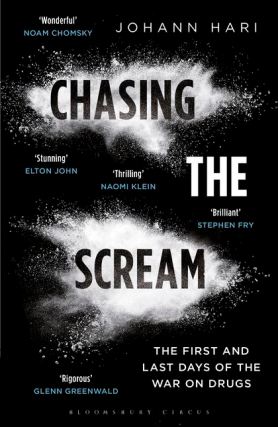
It’s time for our first selection of 2015: Johann Hari’s new book, Chasing the Scream: The First and Last Days of the War on Drugs, which you can buy here in hardcover and here for the e-version. From the publisher’s description:

It is now 100 years since drugs were first banned [in the US by the Harrison Act]. On the eve of this centenary, journalist chasing-screamJohann Hari set off on an epic three-year, 30,000-mile journey into the war on drugs to uncover its secrets – and he found that there is a startling gap between what we have been told and what is really going on. As strange as it may seem at first, drugs are not what we have been told they are; addiction is not what we think it is; and the drug war has very different motives to the ones we have seen on our TV screens.

In Chasing the Scream, Hari reveals his startling discoveries entirely through the true and shocking stories of people across the world whose lives have been transformed by this war. They range from a transsexual crack dealer in Brooklyn searching for her mother, to a teenage hit-man in Mexico searching for a way out. It begins with Hari’s discovery that at the birth of the drug war, Billie Holiday was stalked and killed by the man who launched this crusade – while it ends with the story of a brave doctor [in Portugal] who has led his country to decriminalize every drug, from cannabis to crack, with remarkable results.

Miranda Collinge of Esquire calls the book a “fascinating, extensively researched and heartfelt contribution to a debate over drugs policy that continues to rage today”:

It’s a pattern Hari observes again and again through the decades: a zealous, misguided or sometimes deeply prejudiced person in power decides to eradicate the social blight of drugs, forcing, even offering, the drugs trade to criminals, while the hopeless and the helpless are caught in the crossfire. He meets scientists, counsellors, addicts and dealers who point out the folly of this approach, which he backs up with studies of murder rates, the workings of the human brain and, particularly memorably, self-fellating rats.

bookclub-beagle-trJohann has a hard time writing a bad sentence. I’ll be up-front bout my friendship with him, which is deep. He made some mistakes in the past, for which I think this book is by far the best atonement. It’s very hard to put down, and it offers a series of gripping narratives about this blight on our world – not of drugs, but of the failed “war” on them.

By the way, Johann will be in DC talking about his book at Politics and Prose on January 29, then in NYC at the 92nd Street Y on the 30th, then in Baltimore at Red Emma’s on the 4th of February. He’s even more engaging in person than in prose.

Pete Guither of DrugWarRant “highly recommends” Chasing the Scream:

… I’ve read so much about the war on drugs that it’s hard to get excited about reading a book about it. But less than halfway through the first chapter, I couldn’t put it down – it’s an amazing read. … For drug policy experts like me, it’s a great read with some fascinating personal perspectives, while filling in a few historical knowledge gaps.

Decca Aitkenhead is also impressed by the book:

[Johann] has never spoken publicly about [his plagiarism scandal from 2011] until now. My other worry was whether johann-hari-680x1024anyone would want to read yet another polemic about drugs. I wouldn’t, and I’m quite interested in the subject. The prohibition-versus-legalisation debate tends to be interminably dreary, chiefly because neither side ever seems to change anybody’s mind.

“I think that’s totally right,” Hari agrees. “I did not want to write a 400-page polemic about the drug war. I didn’t want to have an argument about it, I wanted to understand it.” For that matter, he admits, “It’s struck me that, actually, polemic very rarely changes people’s minds about anything.” He says so as a former columnist? “A recovering former columnist, yes.” He laughs. “It’s not just that polemic doesn’t change people’s minds. It says nothing about the texture of lived experience. People are complex and nuanced, they don’t live polemically.”

Hari’s book turns out to be a page-turner, full of astonishing revelations.

I had no idea that the war on drugs was single-handedly invented by a racist ex-prohibition agent [in the US], who needed to find a new problem big enough to protect his departmental budget. One of the first victims of his ambition was Billie Holiday, whose heroin addiction enraged him to the point where he hounded her to death. After he’d had the singer jailed for drugs, she was stripped of her performing licence, and as she unravelled into destitution and despair, his agents continued to harass her, even summoning a grand jury to indict her as she lay dying under police guard in a hospital bed.

Politico published a long passage of the chapter on Holiday:

Narcotics agents were sent to her hospital bed and said they had found less than one-eighth of an ounce of heroin in a tinfoil envelope. They claimed it was hanging on a nail on the wall, six feet from the bottom of her bed—a spot Billie was incapable of reaching. They summoned a grand jury to indict her, telling her that unless she disclosed her dealer, they would take her straight to prison. They confiscated her comic books, radio, record player, flowers, chocolates and magazines, handcuffed her to the bed and stationed two policemen at the door. They had orders to forbid any visitors from coming in without a written permit, and her friends were told there was no way to see her. Her friend Maely Dufty screamed at them that it was against the law to arrest somebody who was on the critical list. They explained that the problem had been solved: they had taken her off the critical list.

So now, on top of the cirrhosis of the liver, Billie went into heroin withdrawal, alone.

Her NYT obituary from July 1959 is here. As far as Johann’s credibility with the book, Malcolm Forbes is more than assured:

Given that he devotes his last 70 pages to detailed notes with sources and a lengthy bibliography, it seems a safe bet to say we can [trust the book]. (There is even a link to audio recordings of the quotes that appear within the book, along with the invitation to email Hari with any errors found.)

Meanwhile, The Guardian‘s Ed Vulliamy scrutinizes the book from the far left:

Legalisation would no doubt suit places such as Vancouver, New York or Liverpool. But how would it work in wretched barrios around the cities of central and South America, townships of Africa and eventually dormitory towns of China and Bangladesh? Hari insists that “responsible drug use is the norm, not the exception”. He reports a UN statistic that “only 10% of drug users have a problem with their substance. Some 90% of people who use a drug – the overwhelming majority – are not harmed by it.” But this is not the whole story in the desperately poor, wider world that services the countries where Hari’s book is set. …

Because if hard drugs are legal, who is going to make them? Presumably the experts who already do, working not for narco syndicates but Big Pharma, another kind of cartel. And do we really trust Big Pharma to manufacture methamphetamine and process crack or heroin in order to sell as little as possible in the developing world? That’s not how Big Pharma works; that’s not how capitalism works.

And from the right-wing Spectator, Duncan Fallowell:

Hari also blames Washington for the horrific battles between drug gangs in Latin America and the Caribbean. But non-prohibition is no guarantee of peace and harmony. Look at the merciless gang wars in central Africa over precious stones and metals. And prohibition can be a vital tool: against illegal logging in the Amazon for example, or the slaughter of elephants.

He says the war against drugs has been going on for a century and is still not won, so it’s been pointless. Some wars are eternal and to expect otherwise is utopianism — the war against weeds, for example, which is called gardening. The war on drugs can be called public health. One of Hari’s own informers raises this: ‘We need to approach drug addiction not as a criminal justice situation but as a public health situation.’

That indeed is how it is regarded. Criminal prohibition was never considered enough in itself, even to the most rigorous Washington hardliner. It should be noted that liberalisation has already begun in some US states and that the world’s harshest anti-drug laws — by far — are in Muslim and Asian countries, which Hari ignores.

John Harris calls the book “important and largely convincing” but still had mixed feelings about it:

Chasing the Scream is a powerful contribution to an urgent debate, but this is its central problem: in contrast to the often brutal realities it describes, it uses the gauche journalistic equivalent of the narrative voice found in Mills & Boon novels. Amid Mexican sand dunes, he tells us, Hari thought about the drug wars’ endless downsides as he “ran my fingers through the prickly hot white sand” and crassly imagined the joyous lives of local teenagers in a world free of gangsters (“Juan, stripped of his angel wings, is chatting with Rosalio about World of Warcraft”).

Barbara Spindel points to the personal nature of the book:

Hari notes at the outset that he has been close to several addicts — that they “feel like my tribe, my group, my people” — and he confesses that, while not narcoleptic, he for years took “fistfuls” of narcolepsy pills because they enabled him to write for weeks without rest. He structures the book as a personal journey, weighing the pros and cons of legalization himself as he presents them to his readers. … “Chasing the Scream” is a riveting book, and Hari is an effective storyteller; he would have been better off keeping the focus off of himself and entirely on Chino, Rosalio and the others.

David Robinson credits Johann for “talk[ing] to some truly amazing people in the three years he spent researching this book,” but Robinson had qualms about its conclusions:

[Johann’s] ex is an addict. So when Hari points out that “the opposite of addiction isn’t sobriety. It’s connection,” it comes straight from the heart: his ex is passed out on his spare bed as he writes. “If you are alone,” he adds, “you cannot escape addiction. If you are loved, you have a chance.”

I’m sure that’s true. But am I going to vote to legalise crack, and have children smoking their father’s legally held crack stash just as, in my day, they used to smoke their dad’s cigarettes? I think not.

The Dish will be debating such questions starting in mid-February. To join the conversation, buy the book at this link (if you’d like to help out the Dish with a little affiliate revenue) and email your thoughts to bookclub@andrewsullivan.com.

The Politics Of “Fertility Fog” Ctd

A reader summarizes his email upfront:

Testosterone doesn’t boost sperm count like your one reader hinted.  It’s quite the opposite  (see here). At the very least, please clear that issue up so others aren’t misled.

Also, below is my story of how testosterone replacement made me sterile and almost left my wife and me needlessly childless.  It’s a story worth sharing so others aren’t disappointed when they decide to have kids.  Testosterone is given way too freely without mention of the fertility side effects and without dealing with underlying conditions.

I have read with interest your posts on fertility, especially the recent comments from men.  Regarding the 42-year-old fellow with low sperm count, he noted the issues of stress and other factors that impacted sperm quality – this is all very true.  He also mentioned that the doc said “to keep trying and come back in 8 months…If we weren’t pregnant, he’d give me a shot of testosterone to boost my system as another step in fixing my sperm count issues. “  Testosterone does NOT boost sperm count – it can actually reduce it.  In fact, testosterone is a prime candidate for what some hope will be the first male-oriented hormonal contraceptive. He’s probably thinking HCG or human chorionic gonadotropin, which is used to boost male fertility.  Why do I know this?  I was given testosterone but never told the impact it could have on fertility – until it was almost too late.

About 5 years ago I presented to my doctor with erection and low energy problems.  He tested and found I had low testosterone and prescribed testosterone gel, which I used for a few years.  After grad school and at the ripe old age of 40, we decided it was time.  After a few months of trying I tested my sperm with a home test kit.  It’s pretty cool; it comes with a microscope, slides, and everything else you need to do a basic test.

There was nothing moving on the slide.  A visit to a fertility clinic confirmed that I was 100% sterile.  It was then that I did some research and discovered that a side effect of testosterone replacement is infertility.  An endocrinologist switched me to HCG, which has the dual benefit of boosting testosterone AND sperm production.  Today I am 43 and have a 12-week-old daughter at home.

Turns out doctors prescribe testosterone all the time without considering the root cause and without explaining the fertility impact.  In my case, I actually had sleep apnea that was only discovered after yet another endocrinologist insisted I check it to rule it out before continuing HCG after my wife got pregnant.  I’m fit and otherwise healthy – sub 1:50 half marathoner – and yet I still have sleep apnea.

Bottom line, if a man wants to get his significant other pregnant, stay away from testosterone.  And if a doctor suggests testosterone, insist on a full workup to rule out apnea, pituitary problems, and other issues before taking the stuff.  You might find yourself infertile otherwise and, perhaps, overlooking a more serious medical condition.

How To Tell When Time Is Up

Chrissie Giles investigates how medical professionals deliver diagnoses of terminal illness:

Individual words matter. Professor Elena Semino and colleagues at Lancaster University have been conducting a study of how certain kinds of language are used in communication about the end of life. They’ve created a set of over 1.5 million words, collected from interviews and online forums, where patients, carers or healthcare professionals meet to talk with their peers.

Violence or war metaphors (“battling my disease”, “keep up the fight!”) can be disempowering or disheartening for people with cancer, potentially demanding constant effort or implying that a turn for the worse is a personal failure. But in other contexts, they can empower people, helping someone express determination or solidarity, or bringing a sense of meaning, pride and identity. “You don’t need to be a linguist to realise what metaphors a patient’s using,” says Semino. Doctors should ask: are those metaphors working for the patient at that point? Are they helpful, giving them a sense of meaning, identity, purpose? Or are they increasing anxiety?

Heads Up

I’ll be live-blogging the SOTU at 9 pm tonight, and we’ll be covering other reactions among the blogs and tweets thereafter. Tune in.

Update from a reader:

Know that I’ll be drinking IPA out of my sweet new Dish mug during the State of the Union tonight. One healthy chug every time the camera focuses on a scowling Republican.

The Flu Shot Is Still Worth Getting

Aaron Carroll begs everyone to get some perspective:

I see headlines telling people the vaccine is “only 23% effective”. I’d like a list of all medicines people take, diets they go on, behaviors they change, devices they employ, and procedures they undergo which are better than 23% effective. I’m willing to wager the number is quite low.

In other flu news, Kaleigh Rogers covers research on a “universal” flu vaccine:

If clinical trials go well, a new u​niversal flu vaccine that would treat all strains of flu with a single shot could be just five years away. That would mean a future where nearly 20,000 p​eople won’t die due to a pandemic of the virus. A future where we wouldn’t have to spend a week in bed in misery even though we got​ a fucking flu shot this year.

Researchers at the Icahn School of Medicine at Mount Sinai and at Canada’s McMaster University began developing the vaccine three years ago after the discovery of a subclass of antibodies. When the body encounters influenza, it naturally produces these antibodies, which are able to recognize all strains of flu and mutations of the virus.

Until such a vaccine becomes a reality, Meeta Shah warns that emergency departments (EDs) are being overrun:

When interviewing emergency department directors regarding their experiences with this year’s flu season, I was shocked to hear the numbers.  Some EDs reported volume increases 15 to 25 percent higher in December compared to November or when compared to last December.  One director I interviewed joked that this epidemic was so significant he had colleagues who had coined it “The Flunami.”

Why is this important? Well, increased volumes like this don’t make it easy for an ED to function normally, and puts a strain on resources and staff. You or your loved one may need treatment from an overcrowded ED that is struggling to be efficient amongst this chaos.