War Without End

That’s what Jack Shafer fears Obama has launched:

A war with a conclusion that its participants can’t see or can’t imagine is a war without end. None of the dig-in parties in Syria and Iraq look like pushovers, but neither do any of them look like sure bets. Without American intervention, the current war will likely rage on. With regard to American intervention, not even the Pentagon dares to predict an end.

For Americans, at least so far, this war is rumbling on like background noise. The usual markers of military victory—body-counts tabulated, territories seized and banked, no-fly zones established, governments-in-waiting imposed, and elections supervised—don’t apply to the Syria war. The borders, combatants, allegiances, and military objectives in the Syrian war are too fluid to conform to our usual expectations. Nor do the usual markers of peace seem to exist. There are no peace talks taking shape, no shuttle diplomacy, no evidence of a dominant power about to exert its might to create a lasting peace by flattening everybody.

One way of looking at this is to ask: what should we call this war? Is it, as the Obama administration ludicrously argues, merely an extension of the war against al Qaeda, begin in 2001? Is it a new war on Syria – a sovereign state we have now bombed with no UN authorization? Is it a continuation of the 2003 Iraq War? Or was the 2003 war effectively a continuation of the Gulf War in 1991? I cannot decide. When you have so many over-lapping wars, most without any understanding of “victory”, and when the CIA launches covert wars all over the world all the time anyway, and when a conservative Republican president and his liberal Democratic successor both agree on the necessity of an endless war that creates the terrorism that justifies more war, it’s bewildering. One is reduced to quoting the Onion:

Declaring that the terrorist organization’s actions can no longer be ignored, President Obama vowed Wednesday that the United States would use precision airstrikes for as long as needed to ensure that ISIS is divided into dozens of extremist splinter groups. “ISIS poses a significant threat to U.S. interests both overseas and at home, and that is why we are committed to a limited military engagement that will fracture the terrorist network’s leadership and consequently create a myriad of smaller cells, each with its own violent, radical agenda,” said Obama during a primetime address to the nation.

Gitmo remains open; we are still at war in Afghanistan; we are still at war in Iraq; and all this is true despite a president elected explicitly and clearly to end the failed wars he inherited. This comes perilously close to proving that our democracy doesn’t really have much of a say in whether this perpetual war should continue or not. The public just wants “something to be done” in response to videos of beheadings, and seems to have little interest in carefully processing the pros and cons or unintended consequences – even after the catastrophe of the Iraq War under Bush! And here’s what happened when the Senate “debated” the authorization for military force against ISIS … and it’s not from the Onion:

The Senate debate did not fill up the allotted time, so at one point a senator devoted time to praising the Baltimore Orioles for their successful baseball season.

Those who argue that the US is in terminal decline, its democracy attenuated, its leaders interchangeable in a perpetual war based on no threats to the United States, have some more evidence on their side from the last couple of months. We are told, in response, that we live in a new world, in which these amorphous threats really do require a forever war to pre-empt and forestall them. But we can never know exactly what those threats really are – because it’s all classified.

I feel, I have to confess, helpless in the face of this – and my job requires me to understand these issues as well as anyone. What of other Americans, going on with their lives, struggling to make ends meet much of the time, barely able to digest what’s left of the news? It’s a recipe for passivity and acceptance, as the CIA and the Pentagon and their myriad lobbyists and fear-mongers do what they want – with no accountability even for war crimes, let alone policy mistakes.

I listened to the president yesterday – unrecognizable from the past. His embrace of the forever war paradigm is a real moment in American history. It is the moment when we must come to the realization that there really is no going back now. This is for ever.
The Long, Twilight Struggle For Independent Journalism, Ctd

The comments that got Bill Simmons suspended:


My take is here. VanDerWerff considers the places of ESPN and the NFL in the controversy:

While it seems unlikely Goodell asked ESPN to suspend one of its employees for calling him a liar, the situation speaks to how much power the NFL has in the modern media environment. With football increasingly seeming like the only consistent ratings draw in a splintered TV landscape — and the NFL attracting more and more suitors every time rights to games become available — the league can essentially ask for whatever concessions it likes in broadcast coverage.

Vinik assesses Simmons’ claim:

Is [Goodell] a liar? That’s still unclear, but there is strong evidence that might be the case. Goodell has adamantly denied that the NFL knew the contents of the tape before TMZ released it on September 8. But last week, Don Van Natta and Keith Van Valkenburg reported for ESPN that “Rice told Goodell that he hit her and knocked her out, according to four sources.” It’s of course possible that those four sources are either lying or have the story wrong. But Simmons was just saying what the evidence seems to indicate. Is that really in violation of ESPN’s standards? In fact, on Tuesday, ESPN’s ombudsman praised Simmons for his comments, including it in part of the “strong coverage and commentary” from the network.

Richard Deitsch tries to understand ESPN’s rationale:

Someone familiar with ESPN’s management’s thinking said the combination of the nature of the personal attack on Goodell and the challenge to his bosses were the key elements in the decision and the length of the suspension. It should be noted that Simmons has been very critical of Goodell in the past and was not reprimanded. So have others at the network, including NFL analyst Tedy Bruschi and Keith Olbermann.

There is also something else likely at play here. ESPN management is looking to become more decisive with suspensions when its employees go off the rails.

But Linda Holmes suspects the suspension has done more harm than good for ESPN and Goodell:

In all honesty, had he not been suspended, these comments from Simmons, who has all kinds of opinions about all kinds of things, might have passed largely unnoticed. It’s entirely possible that by suspending him for three weeks, ESPN guaranteed that the comments would reach many, many more people than they ordinarily would have.

Margaret Hartmann has more:

ESPN has a $15.2 billion deal with the NFL to air Monday Night Football through 2021, and it’s believed that the network cut its ties to the Frontline documentary League of Denial last year due to pressure from the NFL. A few people agree that there should be consequences for publicly taunting your employer, but … the Twitter reaction has been overwhelmingly negative. If ESPN cares about the backlash they can always follow the NFL’s example and reconsider Simmons’ punishment. On the other hand, $15.2 billion is a lot of money.

A couple weeks ago, Stefan Fatsis spelled out how the NFL manipulates the media:

The league’s financial muscle allows it to create its own quasi-journalistic outlets and to exert soft power over the media partners that pay it billions of dollars annually to televise its games. Last week, New England Patriots owner Robert Kraft went on a CBS morning news show to promote the network’s new Thursday night football broadcasts. After a few questions about Ray Rice, in which Kraft criticized Rice and defended Goodell, the hosts moved on. “We’re so proud to be partnered with CBS,” Kraft declared as a countdown clock to Thursday’s game flashed onscreen. The chyron labeled him “Master Kraftsman.”

On CBS’s pregame show that night, anchor James Brown delivered what Slate’s Allison Benedikt called “a powerful speech about male responsibility, not just for domestic violence, but also for our collective devaluation of women.” It absolutely was. But it also was devoid of criticism of Goodell or the NFL. That wasn’t surprising. John Ourand of Sports Business Journal reported that CBS Sports chairman Sean McManus said he instructed on-air talent to refrain from criticizing “individuals involved in the story, whether it be team ownership, whether it be NFL management.” According to Ourand, McManus said the talent was encouraged to “express opinions about the situation, to express opinions about domestic abuse, to express opinions on how the NFL has handled this.”

The Clintons Remain The Clintons

And they still hate the press. Wemple’s jaw drops:

For the latest on how Clinton Inc. views the Fourth Estate, go no further than Amy Chozick’s update on how the media is moving around at the ongoing Clinton Global Initiative conference in New York. The highlights:

  • Reporters must be escorted to the restrooms. Chozick reports that her minder “waited outside the stall in the ladies’ room at the Sheraton Hotel, where the conference is held each year.”
  • “Hordes of journalists,” notes Chozick, have ended up “cloistered” in a Sheraton basement.
  • Barricades separate journalists from the lobby, where “actual guests enter.”
  • Escorts are required “wherever we go, lest one of us with our yellow press badges wind up somewhere where attendants with an esteemed blue badge are milling around.”

This bush-league totalitarianism appears somewhat recent: Though there were “always” tight security measures, Chozick writes, “reporters could roam relatively freely until last year, when interest in and scrutiny of the Bill, Hillary & Chelsea Clinton Foundation spiked amid speculation that Mrs. Clinton would run for president in 2016.”

Cillizza shares his own experience:

Regardless of who was to blame, by the end of the [2008] campaign, reporters — including me — and the Clinton operation were at each others’ throats daily and often more than daily. In the wake of that campaign — particularly as it became clear that Clinton was, in fact, interested in running again — some of those in Clintonworld promised a different approach to the press in 2016. No, Clinton would never be John McCain in the back of the straight Talk Express in 2000 but neither would she or her campaign repeat the mistakes of their dealings with the press in 2008. They understood, they insisted, that while Clinton was very well defined to most voters, there was an entire generation of younger people — who, not for nothing, were a pillar of Obama’s electoral success — who knew little about the former Secretary of State other than her famous name and would use the media coverage of her to form their opinions.

The early returns on those pledges don’t look promising.

Drum somewhat sympathizes with the Clintons:

Nobody should take this as a defense of the Clintons. High-profile politicians have always been gotten klieg-light treatment, and they have to be able to handle it. At the same time, there ought to be at least a few mainstream reporters who also recognize some of the pathologies on their own side—those specific to the Clintons as well as those that affect presidential candidates of all stripes. How about an honest appraisal—complete with biting anecdotes—of how the political press has evolved over the past few decades and how storyline reporting has poisoned practically everything they do?

I take Kevin’s point. The 1990s got way out of hand (and I played my part). But what you have to grasp is how the Clintons’ own fathomless paranoia actually enables this cycle, and perpetuates it. The kind of reporter-control the CGI imposes – even in the bathroom – is exactly the kind of thing that would make any journalist want to find out what the Clintons want to hide. In other words, I think the problem isn’t simply the press or the Clintons. It’s the toxic combination of the two that seems to bring out the worst in both.

Dissents Of The Day I

A reader quotes from the Lincoln quote I quoted:

This our Convention understood to be the most oppressive of all Kingly oppressions; and they resolved to so frame the Constitution that no one man should hold the power of bringing this oppression upon us. But your view destroys the whole matter, and places our President where kings have always stood.

Except that now we have a volunteer army and the draft doesn’t exist. So the “Kingly oppression” only falls on those who choose to put themselves at the mercy of a dysfunctional executive branch.  Bring back the draft and I suspect we will suddenly find this argument rather ubiquitous.

Another notes:

The quote you printed was not from Lincoln when he was Commander-In-Chief; it was a letter to William Herndon regarding the Mexican war … when Lincoln was a congressman. Lincoln actually felt a little different later when he was president. This evolution happens to eventual presidents, as you know.

(As an aside, Herndon, Lincoln’s closest confidant, was my great, great, great uncle, and was always known as “Uncle Billy” in my family.)

Another remarks on that evolution:

Certainly this Congressman Lincoln should be more rightly compared to a Senator Obama – a much more liberal man who denounced the Cuban embargo and then goes on as president to renew it for the sixth time in a row; or a man who can denounce the very concept of the Iraq war and then as President go on to bomb Libya, Iraq, and Syria. So maybe Obama has a little more Lincoln in him than at first glance.

More readers reassert the parallels between Obama and Lincoln:

You know, of course, that Lincoln‘s Congress never declared war on the Confederates in order to weasel around international law. For the Union to declare war would have meant recognition of the Confederate States of America as a sovereign nation. In the fight against ISIL, who are we to declare war against?

Also, in an earlier post, you stated that Bush “procured a clear declaration of war from the Congress” – that didn’t happen! Also, back to the Lincoln quote, there is no invasion of Syria!

Your sky-is-falling reaction to these airstrikes (quagmire! mission creep! Bush-like!) is really disappointing.

Another gets into more detail over Lincoln’s war:

You cited Lincoln for his statement of constitutional restraint.  Have you read his history?  Lincoln stands as one of our great presidents (I put only Washington above him) because of his capacity to wrestle with moral and civic complexity and almost always come out right.  But keep in mind what he unilaterally determined as necessary in order to deal with the tick-tock of an existential crisis, from the suspension of habeas corpus (find me something more constitutionally fundamental than that) to the imposition of martial law in unaligned border states (the state of Missouri was still under martial law when Lincoln died.)

On balance, though, we are deeply grateful to Lincoln for doing what had to be done.  He was willing to personally commit the sins necessary for the nation’s salvation.

In the present crisis, we have the president confronted with a rapidly growing force of genocidal malevolence with genuinely global implications – and this time around it’s indeed a crisis that is open and actual.  We also have a Congress that may well have buried itself to a new depth of partisan triviality.  In the meanwhile, in lieu of any other nation or entity that is capable, we are the world’s last resort against the horrors that the worst angels of our nature are capable of.

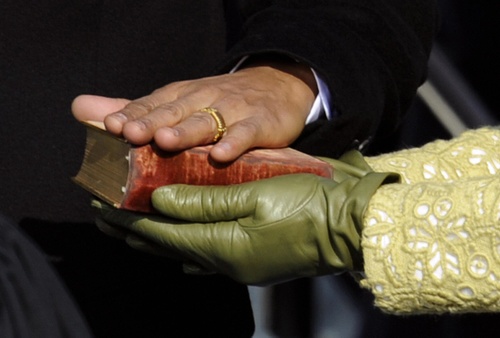
(Photo: Barack Obama’s hand lies on a Bible owned by President Abraham Lincoln as he is sworn in as the 44th US president on January 20, 2009. By Timothy A. Clary/AFP/Getty Images)

Holder Out

tumblr_m8cvlmGWtZ1rahfz9o1_500

https://twitter.com/jetpack/status/515166901866336256

Jim Webb Flirts With A Run, Ctd

Jason Zengerle doesn’t think Webb’s presidential run is gonna happen:

While it’s possible that the Obama administration’s military campaign in the Middle East will continue to escalate, it’s hard to envision it turning into a catastrophe on the scale of Vietnam or the second Iraq Warand it’s equally hard to imagine Hillary Clinton, hawkish as she may be, morphing into a figure as loathsome, in Webb’s mind, as a draft-dodging Georgetown law student or George W. Bush. Absent those motivating factors, I just don’t see Webbthe rare politician who doesn’t crave the spotlightsustaining a presidential campaign. After all, he’d been in the Senate for only a couple months when he complained to GQ’s Ryan Lizza that “To me, government is a cage.” If Webb felt cooped up in the Senate, wait until he gets to spend a couple days on a campaign bus barreling across Iowa.

Ed Kilgore responds:

If [Zengerle’s] right, [Webb’s] anger with Obama over national security policy will burn out before 2016 votes are cast, and those who want a real challenger to Hillary Clinton could be disappointed. But on the other hand, for those who simply want to “keep Hillary honest” without denying her the nomination, maybe Webb is just the fiery tonic the doctor ordered.

But PM Carpenter argues that “if anybody has a shot at defeating Hillary, Webb does. The problem, though, is of course money”:

Yesterday, a Jim Webb-“intrigued” reader sent me a video of the former senator’s address to the National Press Club, and asked what I thought of his possible candidacy. My answer was that, in my opinion, “” Hillary will have a lock on it, and if Webb begins to threaten her in Iowa or elsewhere, she’ll unleash it on him with the ethical care of a Mitt Romney.  But, on occasion we do witness the impotence of big money. Lord knows Hillary’s head start in 2007’s graft-chase never did her much good, since as a presidential candidate, her irrepressible negatives outweighed her positive cash flow.

Jennifer Rubin feels Webb has a real shot:

Dems love a veteran who turns dove. (“John Kerry reporting for duty!” And don’t forget how they swooned over Chuck Hagel.) And he certainly will fulfill the left’s anti-interventionist yearnings.

Previous speculation here.

The Long, Twilight Struggle For Independent Journalism

Bill Simmons has about as much clout as an individual journalist as anyone out there. Immensely popular, he is one of the few individuals who managed to get a big media company – ESPN – to give him his own sandbox, Grantland, centered around his personality and style. Of all the writers/bloggers/podcasters out there, he has an enviable degree of independence. But that independence only goes so far:

Every employee must be accountable to ESPN and those engaged in our editorial operations must also operate within ESPN’s journalistic standards. We have worked hard to ensure that our recent NFL coverage has met that criteria. Bill Simmons did not meet those obligations in a recent podcast, and as a result we have suspended him for three weeks.

That suspension is one week more than the NFL originally gave Ray Rice for knocking his fiancée unconscious. Simmons’ transgression was to call the NFL chief, Roger Goodell, a liar, on his podcast, and then to dare ESPN to come discipline him for saying so:

I really hope somebody calls me or emails me and says I’m in trouble for anything I say about Roger Goodell. Because if one person says that to me, I’m going public. You leave me alone. The commissioner’s a liar, and I get to talk about that on my podcast … Please, call me and say I’m in trouble. I dare you.

Tony Manfred notes that Simmons has been suspended twice before:

In 2013 he got suspended from Twitter for calling a “First Take” segment “awful and embarrassing to everyone involved.” In 2009 he got a two-week Twitter ban for calling the ESPN radio affiliate in Boston “deceitful scumbags.”

But the notion that Simmons only got suspended because he was tough on ESPN doesn’t quite hack it.

Maybe Simmons is a little paranoid, but his quote assumes that there is indeed a close relationship between ESPN and the NFL, and there is subtle pressure not to rock the boat too wildly. ESPN’s statement also cites a failure to meet “ESPN’s journalistic standards,” –  presumably because Simmons out-and-out named Goodell as a liar – without proof. But it was clearly an impromptu remark on a podcast and well within the contours of the kind of trash talk common in sports radio. I see the whole thing as a reminder that Simmons is not actually completely independent – even as he has an amount of freedom most sports hacks would die for.

And this much is true: as journalism, including sports journalism, faces a truly tough and continuing transition, as its bottom line keeps going down, as “sponsored content” dominates everything, and as media entities charge over $100 grand for a piece of native advertising, the whole idea of writers being truly able to say whatever they think is under increasing pressure. You need enormous clout and independence to get away with it – which is why South Park remains such a vital part of our public discourse.

For myself, I remain simply immensely grateful for the support of reader-subscribers. Every day, I remain aware of the privilege you grant me and my colleagues in trying to figure out the world without these kind of pressures or threats hanging over us. But every day, I look around and see how many fewer writers can still say the same.

Chart Of The Day

enhanced-10738-1411482032-2

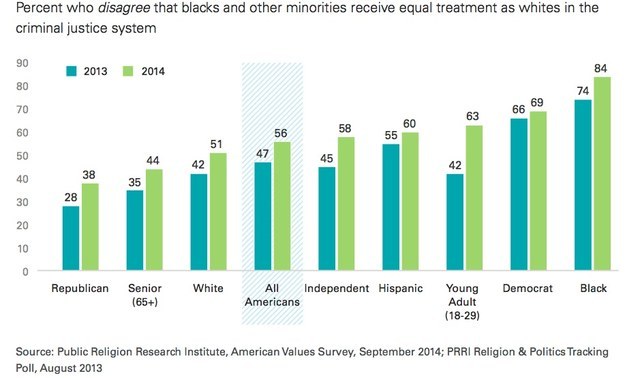
A new survey shows that a majority of Americans – including, for the first time, a majority of white Americans – believe the justice system is unfair to black people. Adam Serwer notes that opinions have shifted substantially across all demographic groups surveyed. German Lopez believes Ferguson changed the debate:

While young adults saw the most dramatic shift toward acknowledging racial disparities in the criminal justice system, everyone else — seniors and Republicans included — saw a significant change as well. Notably, a majority (51 percent) of white Americans now appear to agree that there are some racial disparities in the criminal justice system, up from 42 percent just one year ago. It’s possible that this is a temporary blip, especially since the survey was conducted a month after the events in Ferguson. But since some studies suggest it’s difficult to get white Americans to see and care about racial disparities in the criminal justice system, the survey could indicate the beginnings of a big change in public perspectives.

What Syrian Moderates?

Omar Kaddour searches in vain for them:

Opposition fighters are not moderate. By the same standards, they are not extremists, and it must be noted that the standard used to distinguish between them is Islamic in the first place. These fighters are in very harsh conditions, and their attempt to survive and overthrow the regime that has targeted them is more important than any ideological luxury that the majority of them possess.

In many instances, the members of moderate groups have fled to better-armed groups and more effective groups under the pressure of necessity. Entire groups have also become extremist to ensure their share of foreign funding. But the most important development that has happened is that tens of thousands of officers and soldiers who have defected from the regime’s army have been taken away and they have been placed in conditions resembling house-arrest in neighboring states. They have not been trained to become the kernels of an organized army independent of ideological projects.

In the real meaning of the phrase, there is no moderate armed opposition.

What Obama Said At The UN

UN-GENERAL-ASSEMBLY-US-OBAMA

Ed Krayewski heard echoes of Bush:

President Obama called ISIS a “network of death,” arguing that “there can be no reasoning,  no negotiation, with this brand of evil.” In making the case for the anti-ISIS campaign President Obama has adopted the language George W. Bush deployed when first formulating the war on terror. “We face a brand of evil, the likes of which we haven’t seen in a long time in the world,” President Bush told airline employees on September 27, 2001. Later, he would place Iraq, Iran, and North Korea in an “axis of evil,” a term that coud’ve been ripped from a comic book.

Bush was a fan of using the word “evil” to describe Islamist terrorists, and it shouldn’t be surprising that President Obama has found the strong, unequivocal, and emotional word useful in defending the anti-ISIS campaign.

Zack Beauchamp’s take on the speech:

[I]t was perhaps the clearest articulation yet of what he actually believes and how he sees the world, and yet it also showed how his policies do not line up with those beliefs. The UN address — purportedly written by the president himself— laid out Obama’s fundamental worldview in especially clear terms. He’s an inveterate optimist, deeply believing that we’ve built a world with a bright future. But he’s also willing to take aggressive, even cynical actions to secure that future. That’s why his rhetoric and policy so often feel at odds.

Cassidy considers the political calculus:

On Monday night, American forces bombed ISIS targets inside Syria and also blasted buildings and installations associated with another extremist group. On Wednesday, the Gallup tracker showed that Obama’s approval rating had risen to forty-four per cent.

“It’s certainly possible the president will get a bump from this and it looks like it may be happening because his rating is a bit higher than we’ve seen before,” Gallup’s Jeff Jones told the Fiscal Times. “We want to let it play out a few more days and see if it sustains itself, as opposed to being something really temporary.” I should stress again that I am not suggesting that President Obama consciously responded to the polls by deciding to expand the campaign against ISIS. He is, though, operating in an environment that rewards certain actions and punishes others.

Jeffrey Goldberg doesn’t think politics is playing a big role:

Obama’s critics will say that he has shed his public diffidence on matters related to the conflicts of the Middle East because pollsters have been telling him that Americans want a less professorial president. But my impression from watching him in recent weeks, and from talking to people who know him well, is that two sets of recent events in particular have actually shifted his thinking about the relative importance of “soft power”; about the nature of America’s adversaries; and consequently about the role the U.S. must play in the world, in order to keep these adversaries at bay.

Thomas Wright agrees the president’s perspective has changed:

Obama’s worldview has always allowed for this shift. Influenced by Niebuhr, he believes that malevolent forces exist in the world, including within ourselves. He believes that the United States must act on occasion to stop them. But, for the past few years he has not agreed that we are at such a moment in history. He has not agreed that the international order is facing fundamental challenges that require extraordinary action. Throughout the course of the past year, which has been full of destabilizing developments, he has resisted the notion that we are at a tipping point. Until now. Today, he told a world audience that he too is worried the international order is falling apart. Today, he sees the chasm ahead. Today, he agrees that without an American push, history may be headed in a tragic direction.

And David Rothkopf puts Obama’s remarks in context:

In short, if well-turned phrases defined history’s outcomes, we might be heading to a much better, safer Middle East. But if the men and women who are working behind the scenes to make that happen are to be believed, it is even more likely that further unrest and danger are on the horizon. We may enjoy early victories in the war against IS, we may even turn them back in the months ahead, but absent a commitment to address the broader, strategic issues with the same sense of urgency we are bringing to that fight — to battle for political gains as intently as we do those on the battlefield, or for leaders like Obama and Rouhani to devote as much of their attention to the work of the back room as they do to that at the podium — it looks like in the current Middle East there may be, in the famous words of the old song by Creedence Clearwater Revival, a bad moon rising.

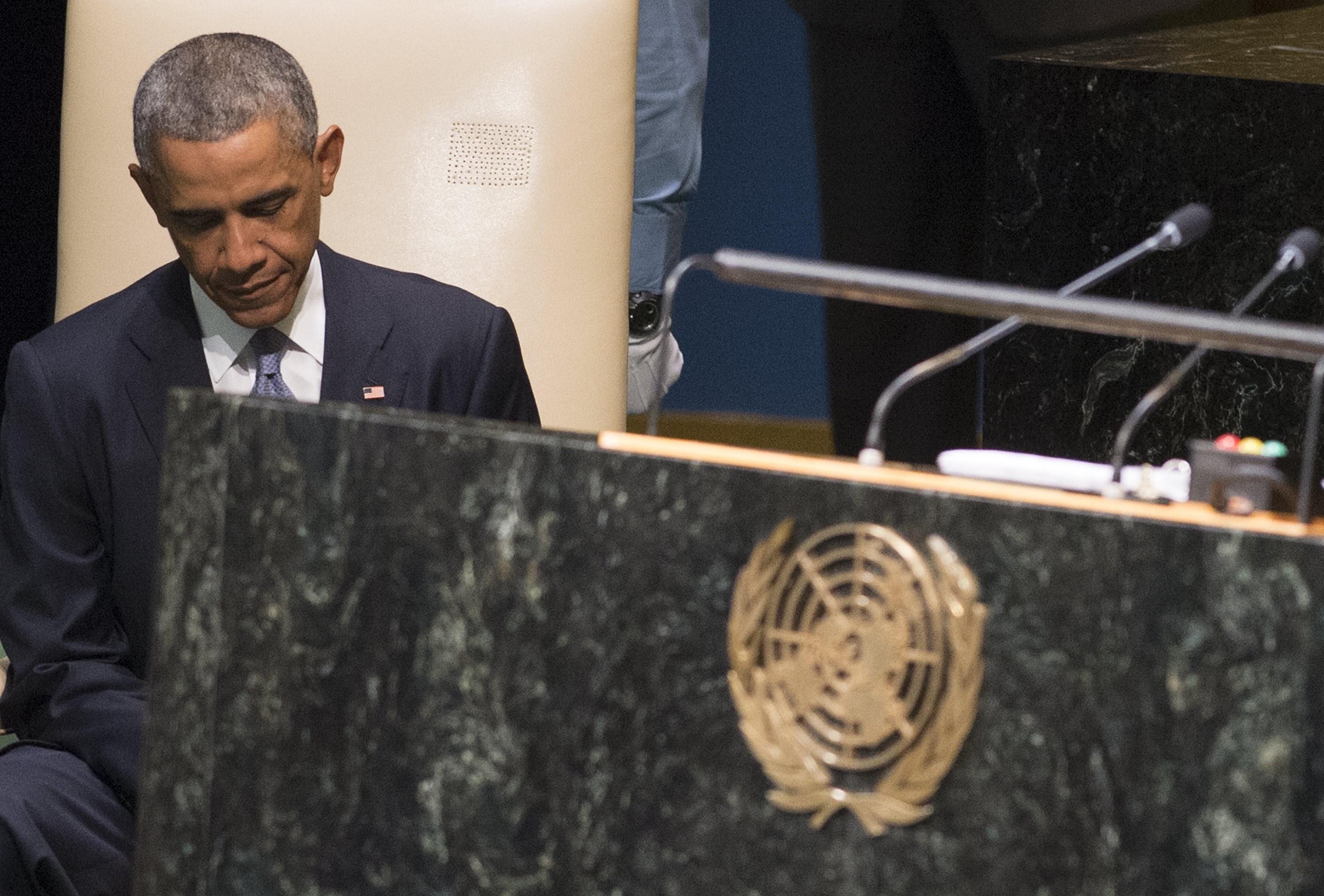
(Photo: US President Barack Obama sits after speaking during the 69th Session of the UN General Assembly at the United Nations in New York, September 24, 2014. By Saul Loeb/Getty Images)