The President’s Approval Hits 50 Percent

Obama Bump

Obama’s numbers are on the upswing:

His approval rating has risen nine percentage points in the past month alone, while his disapproval has dropped by 10 points. The gains are pretty even across the board, but the biggest are among Democrats (10 points), moderates (10), Hispanics (22), and even white evangelical Christians (10), who generally tilt heavily toward the GOP. Obama also has gained 19 points among adults younger than 30.

Sargent cautions that it’s “too early to say whether Obama is really in the midst of a sustained recovery”:

But one thing that will be worth watching is whether positive feelings about the economy — and about Obama — boost support for his individual initiatives, particularly those which Republicans are criticizing most bitterly, and whether they scramble the political landscape more generally.

Josh Marshall doesn’t want to read too much into recent polls:

Just as we should probably all resist the urge to write doomsaying chin-scratchers on the end of the Obama dream when the President’s numbers are soft, we should probably equally resist the urge when they’re more robust. The economy is by no means everything. The President won reelection solidly with a still anemic economy. But it’s always the place to start when the numbers move.

Something Harry Enten will be keeping in mind:

The approval rating at which an incumbent president running for re-election goes from an underdog to a favorite is in the high 40s. Obama can’t run again, and the relationship between his approval rating and the eventual 2016 Democratic nominee’s chances is a bit messier. But if Obama’s popularity inches up a bit more, he may go from being a drag on the nominee to an asset.

Nate Cohn comments along those lines in today’s NYT:

The balance of evidence suggests that the break-even point for the presidential party’s odds of victory is at or nearly 50 percent approval. If the only thing you knew about the 2016 election was Mr. Obama’s approval rating on Election Day, you might guess that the Democrats had a 37 percent chance of holding the White House with a 46 percent rating — rather than a 23 percent chance with a 41 percent rating. The difference between 41 and 46 might be worth between one and two percentage points to the Democratic candidate in 2016 — the difference between a close race and a modest but clear Republican victory.

Making It Harder For Cops To Take Your Stuff

That’s what Eric Holder did last week. Drum is pleased:

It’s bad enough that civil asset forfeiture even exists as a legal doctrine, but it’s beyond comprehension that the feds would actively encourage abuse of forfeiture laws by creating a program that allows police departments to keep most of the money they seize. This is practically an invitation to steal money from innocent people. So good for Holder for ending this program. If cops are going to be allowed to seize property from people they merely suspect of crimes—or, in some cases, pretend to suspect of crimes, wink wink nudge nudge—they sure as hell shouldn’t be allowed to keep the stuff and sell it in order to buy themselves a bunch of shiny new toys.

McArdle also welcomes the news:

Libertarians like to say that the nearest thing to immortality on this earth is a government program. Programs change their names or get absorbed into bigger programs, but they rarely just die. I’m pleased to see that there’s an exception to this rule, and it’s one that really matters. We’re all a little bit more free today.

Balko insists that “this new policy is one conservatives should love”:

First and most obvious, civil asset forfeiture is a major affront to property rights, a principle conservatives hold dear. The idea that the government can take your property without ever even charging you with a crime, much less convicting you of one, is a pretty appalling abuse of power. And sure enough, much of the effort to reform these laws over the years has come from the right. (Although to be fair, the laws themselves were pushed heavily by the Reagan administration as part of the 1980s drug war — albeit with little-to-no resistance from Democrats).

The other reason the right should cheer this move is that it’s basically a nod to federalism. Several state legislatures saw civil asset forfeiture as unfair and moved to make it fairer. The suitable sharing program thwarted their efforts. Holder’s move ends that interference. It returns policymaking on this issue to the states. Personally, I think there’s a Fifth Amendment argument to be made that the federal government should actually prevent the states from engaging in the practice. But allowing state legislatures with a conscience to end the practice on their own is a good first step.

Kleiman hopes the new policy has a big impact:

The order excludes federal-state-local task forces, but – if I read it correctly – does include the multi-jurisdictional local task forces where much of the worst mischief has been done; some of those agencies are entirely dependent on forfeiture funds (plus Byrne Grant money) and thus under no control whatever from civilian authorities. There’s more to be done to rein in the forfeiture system, but this is a terrific start.

Jacob Sullum is more skeptical:

Holder’s policy explicitly exempts “seizures by state and local authorities working together with federal authorities in a joint task force,” “seizures by state and local authorities that are the result of joint federal-state investigations or that are coordinated with federal authorities as part of ongoing federal investigations,” and “seizures pursuant to federal seizure warrants, obtained from federal courts to take custody of assets originally seized under state law.”

Since there are hundreds of federally funded “multijurisdictional task forces” across the country, that first exception could prove to be very significant. Holder’s order “does not prohibit the worst uses of the equitable sharing asset forfeiture program, particularly excepting seizures in which there is federal task force participation or direction,” says Eapen Thampy, executive director of Americans for Forfeiture Reform. “As virtually every drug task force I know of has a federal liaison on call, this means business as usual by local law enforcement using civil asset forfeiture through the Equitable Sharing Program to enforce the Controlled Substances Act and other federal statutes. In other words, the exception swallows the rule.”

Even if the new policy ends up having teeth, Leon Neyfakh expects civil asset forfeiture to continue “because the majority of America’s 50 states—42, to be exact—still have laws on the books providing huge incentives for police departments to keep doing it”:

According to Louis S. Rulli, a professor at the University of Pennsylvania Law School who has studied civil forfeiture closely, no fewer than 26 states allow police to keep 100 percent of the assets they seize. And Scott Bullock, a senior attorney at the Institute for Justice—the libertarian public interest law farm—says there are 16 others where police keep 50 percent or more.

“The law has to be changed in the states too,” said Bullock. “This closes one window, but you’ve got to close all the windows.”

The First Legislature To Legalize Pot

Vermont

It could be Vermont’s:

It’s far too early in the process to gauge whether the legislature will approve marijuana legalization. But Gov. Peter Shumlin previously said he’s not opposed to it, although he would like to see more data from Colorado and Washington, the first two states to legalize, before Vermont follows through.

Last week, RAND released a study on the legalization options for the Green Mountain State. Niraj Chokshi reads through it:

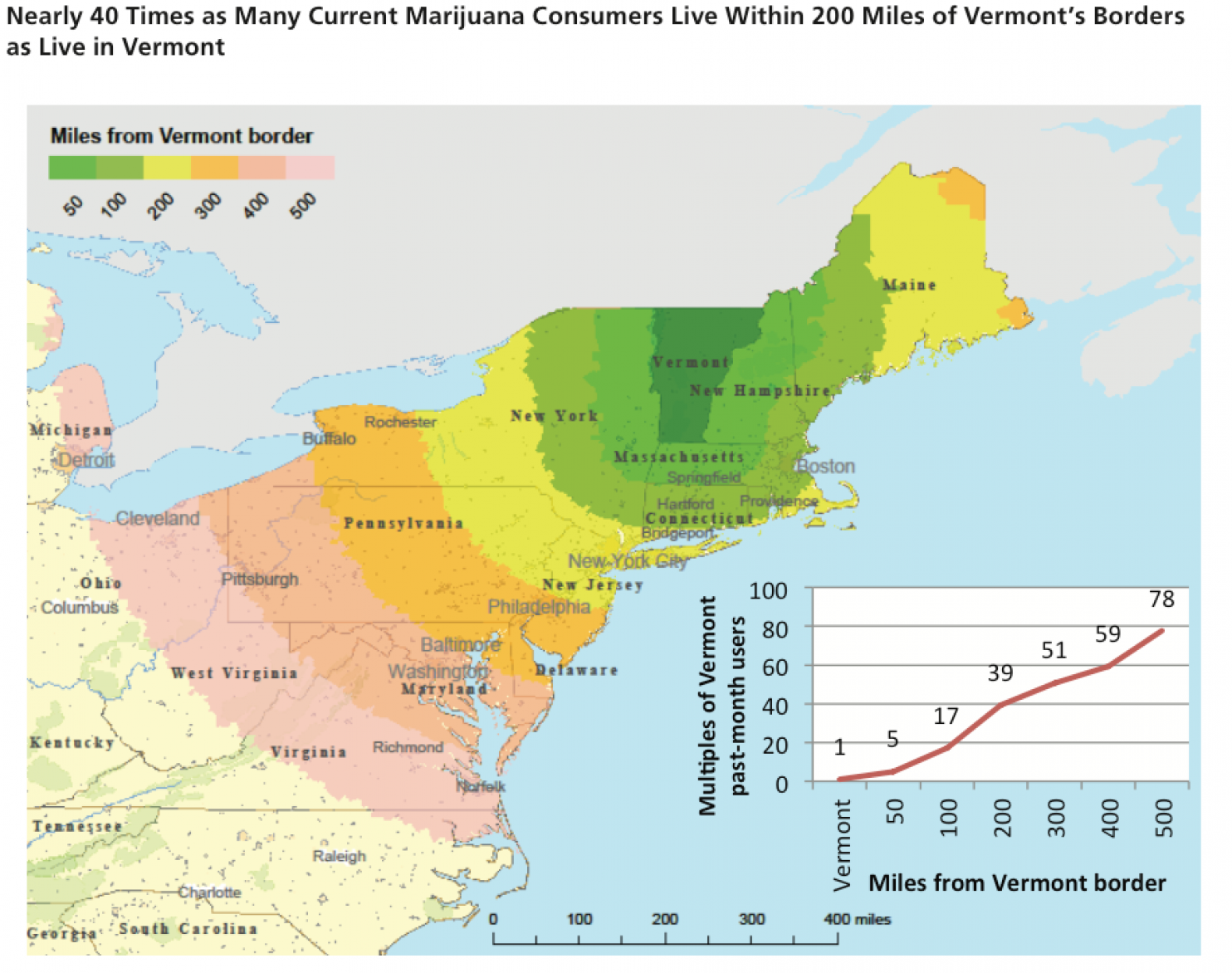
If passed, legalization could have big implications for the region. There are nearly 40 times the number of regular marijuana users within 200 miles of Vermont’s border as there are within its borders, RAND estimates. That means the state could see a huge boost in tourism by legalizing, unless of course other states legalize.

Kleiman, who contributed to the RAND report, is excited:

The Vermont process holds out great promise, because the normal legislative process – ugly as it can be – has the possibility of producing a result much more nuanced and more carefully considered from multiple viewpoints than the initiative process, under which propositions are drawn up by advocates with the advice of pollsters, no one ever holds a hearing, and any idea that can’t be explained in a 30-second TV spot has to be dropped. The key point of the RAND report is that there are legalization options other than full commercialization.

But Josh Voorhees makes clear that full commercialization is working out pretty well for Colorado thus far:

Retail and medical weed generated more than $60 million in tax and licensing revenue for the state in 2014, the lion’s share of which is helping to pay for school construction and the regulatory system that legalization requires. Opponents looking to nitpick can—and do—point to the fact that the total is a far cry from the $100 million windfall that state officials predicted at the start of last year. But even though legalization advocates hyped a major influx in tax revenue as a selling point, evaluating legal weed on a metric tied so tightly with consumption has always been an awkward proposition. The goal, after all, was never to encourage more people to light up a joint or gobble down a brownie. More revenue would be better, but too much more would represent its own type of problem.

A Sneak Peek At Hillarynomics

A report released last week by The Center For American Progress is being touted as “the potential seed of [Clinton’s] economic agenda”:

It tackles the issues Americans consistently list as their top priority in polls – jobs and the economy – but in a way that’s less likely to alienate the business community and financial sector, or appear inauthentic to her own identity. The report’s international focus also plays to the former secretary of state’s strengths, and it would allow her to promote lessons she’s learned from her many travels abroad.

Yglesias calls the report “the best guide to what Hillarynomics is likely to look like”:

In some ways, it defies stereotypes of the Clintons as standard-bearers for neoliberal centrism by endorsing fiscal stimulus and a strong pro-labor union agenda while downplaying the strong education-reform streak of the Obama administration. But it’s also notable for the Obama-era liberal ambitions it pushes aside. In the main recommendations for the United States, there’s no cap-and-trade or carbon tax in here, no public option for health care, and no effort to break up or shrink the largest banks. Nor is there an ambitious agenda to tackle poverty.

Instead, you get a multi-pronged push to boost middle-class incomes. After an extended period in which Democratic Party politics has been dominated by health care for the poor, environmental regulation, and internecine fights about Wall Street, Hillarynomics looks like back-to-basics middle-class populism.

However, Frum believes that, with actions like his SOTU address, Obama is trying to force Hillary to adopt his agenda:

Almost as much as a Republican victory, a Clinton succession would punctuate the Obama presidency with a question mark. Obama’s highest priority over the next two years seems to be to convert that question mark into an exclamation point, to force Hillary Clinton to campaign and govern on his terms. Whatever happens after that, he can at least say that it was his kind of Democratic Party—not Bill Clinton’s—that won a third consecutive mandate, after having twice done what Clinton never did: win an outright majority of the presidential ballots cast.

Of course, Hillary Clinton can see all this, too. So can Bill Clinton, perhaps even more acutely. The next fascinating question is: what will they do about it?

In Which The Democrats Finally Get A Clue, Ctd

Among other assessments of the Obama strategy for the next two years (mine here), Cassidy unpacks Obama’s new tax proposal:

On Tuesday night, for once, the policy contents of the speech may well dominate things. Over the weekend, White House aides let it be known that President Obama will propose raising taxes on the very rich, to pay for tax breaks for the middle class. More specifically, he wants to increase the tax rate on capital gains for high earners, from 23.5 per cent to twenty-eight per cent, and he also wants to remove the so-called “step up in basis” loophole, which allows rich families to reduce, often greatly, the amount of taxes they pay on their estates. The money generated by these changes would be used for a variety of purposes, including a modest tax cut for middle-class married couples, an expansion in wage subsidies to low-paid workers, and an expansion of tax credits for students in higher education.

Khimm notes that the “proposal is specifically targeted at the wealth gap, which is actually far greater than the income gap”:

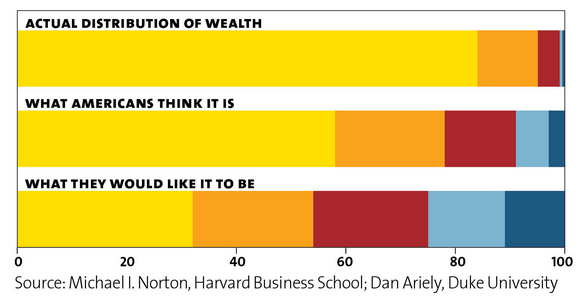
Over the last 30 years, top 1% by earnings received one-fifth of all income; by comparison, the top 1% by net worth owned one-third of the country’s wealth — and in recent years, it’s risen to 42%. That’s because wealth compounds itself over time and is taxed at lower rates than income for rich Americans. And it’s also because many ordinary Americans don’t save enough, and barely half are invested at all in the stock market. (The wealthiest 5% of Americans own more than two-thirds of stocks.)

Neil Irwin remarks that “one way to read President Obama’s plan is that it is a first try at what a post-Obama economic policy vision for the Democratic Party might be”:

It is elegantly sculpted to avoid some of the pitfalls of Obama-era partisan warfare. The president’s first term was an extended battle over stimulus, deficits and the role of government. The administration’s first, polarizing political battle was to enact a fiscal stimulus. Next was to expand the role of government in the health care system. Then, battles over deficit reduction that began when a Republican House took office in 2011 were really proxy fights for both parties, with those on the left pushing for continued stimulus and those on the right using the high deficits as a reason to reshape the scale of America’s social welfare state.

The new plan may stand little chance of passage, but it signals that we are moving into a different phase of the nation’s debates over how the government taxes and spends. As Ezra Klein of Vox tweeted Saturday night, this is the first big proposal of the “post-recession, post deficit panic era.”

Leonhardt declares that “the key to understanding President Obama’s new plan to cut taxes for the middle class is the great wage slowdown of the 21st century“:

The wage slowdown is the dominant force in American politics and will continue to be as long as it exists. Nothing drives the national mood — and, by extension, national politics — the way that the country’s economic mood does, as political scientists havedemonstrated. And nothing drives the economic mood as much as wages and incomes, which are the main determinant of material living standards for most households.

Matt O’Brien calls Obama’s plan “Piketty with an American accent”:

Okay, that’s a little bit of an exaggeration, but not a huge one. Obama’s State of the Union, you see, will call for $320 billion of new taxes on rentiers, their heirs, and the big banks to pay for $175 billion of tax credits that will reward work. In other words, it’s fighting a two-front war against a Piketty-style oligarchy where today’s hedge funders become tomorrow’s trust funders. First, it’s trying to slow the seemingly endless accumulation of wealth among the top 1, and really the top 0.1, no actually the top 0.001, percent by raising capital gains taxes on them while they’re living and raising them on their heirs when they’re dead. And second, it’s trying to help the middle help itself by subsidizing work, child care, and education.

Andrew Sprung is amazed by “the extent to which Thomas Piketty’s tome Capital in the 21st Century, published in the U.S. in January 2014, has focused the U.S. policy debate on income inequality”:

Democrats’ willingness to credit core conservative tenets — that raising taxes on high incomes and investment gains always inhibits growth, that deregulation always spurs it — are melting away. Fresh from their November drubbing, Democrats are beginning to heighten rather than soft-pedal the policy contrasts between the parties. Wounded politically by perceptions that the Affordable Care Act helps the poor at the expense of working people, they are looking for proposals obviously attractive to the middle class. Emboldened by accelerating growth and employment gains, they are perhaps shedding inhibitions about leveling the playing field between workers and management.

Derek Thompson glances at the big picture:

The United States has been, and will quite surely remain in the foreseeable future, the best place in the world for the very rich and an increasingly difficult place to earn a rising inflation-adjusted salary for the country’s bottom half. The road out is not hopeless, and the CAP paper on how the U.S. can learn from the rest of the world offers fine solutions across education, infrastructure, and working with cities to develop talent clusters. But this sort of ambitious policy landscaping is purely fanciful with today’s Congress. In this government, all big ideas are rain dances.

Yglesias agrees:

The White House is at pains to note that most of the individual middle- and working-class tax benefits they are proposing enjoy some measure of bipartisan support. But Obama is proposing to pay for them with what amounts to a series of tax increases on rich people. Republicans have made it very clear over the years that they do not believe that rich people should pay higher tax rates. To embrace this plan would entail not just a spirit of compromise that is generally lacking on Capitol Hill, but for the GOP to totally abandon one of its core economic principles.

Paula Dwyer points out that some of Obama’s proposals have Republican roots. But she argues that Obama just made tax reform less likely:

[A]ll of these details are obscured by Obama’s soak-the-rich message, one that Republicans won’t sign on to, despite their desire to help the middle class. In the past, they would have proposed government spending cuts, yet all the easy trims (and even some tough ones) have been made, and the declining deficit has put them in a tough spot on this issue. That’s a tough spot Obama could have exploited for compromise had he not rhetorically boxed in Republicans.

Regardless, Waldman hopes that Obama will spark a real debate:

You can argue — and many will — that it’s pointless for Obama to introduce significant policy proposals like this when he knows they couldn’t make it through the Republican Congress. But what alternative does he have? He could suggest only Republican ideas, but he wouldn’t be much of a Democratic president if he did that. Or he could offer nothing at all, and then everyone would criticize him for giving up on achieving anything in his last two years. If nothing else, putting these proposals forward can start a discussion that might bear legislative fruit later on. Major policy changes sometimes take years to accomplish, so it’s never too early to start. And if Republicans have better ideas, let’s hear them.

Francis vs The Theocons, Round II

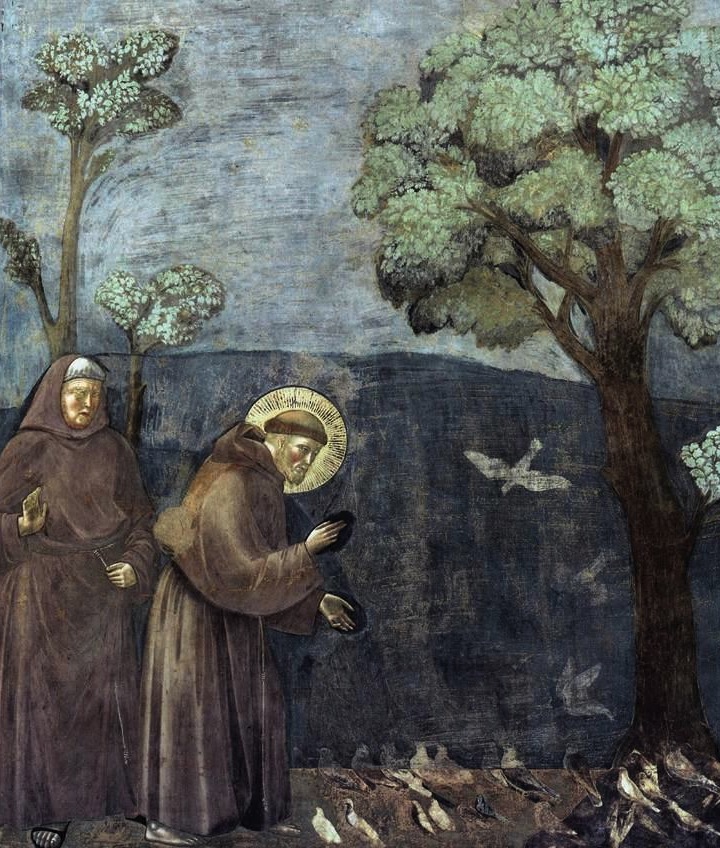
saint-francis-birds

For the far right, the recent Synod on the Family was bad enough, with its gestures of decency towards gay Catholics. But the impending encyclical on climate change seems to have sparked a new level of mania. At First Things, Maureen Mullarkey calls the Pope “an ideologue and a meddlesome egoist”. Robbie George notes that Francis “has no special knowledge, insight, or teaching authority pertaining to matters of empirical fact of the sort investigated by, for example, physicists and biologists,” and that his views on climate change “could be wrong”. And Steve Moore, writing in Forbes, claims that the Pope has adopted “the language of the radical green movement that is at its core anti-Christian, anti-people, and anti-progress”. I find this all preposterous. We have just discovered that last year was the hottest on record, eclipsing 2010. Whole eco-systems are being wiped out; our oceans may be heading toward the point of no return; and the rape – rather than conservation – of our natural habitat is not even faintly defensible in Catholic or Christian terms.

And he’s Pope Francis, if you’ll recall. He took as his namesake a Christian mystic and ascetic who burrowed into nature and Creation as the great mysteries and beauties there are, who looked at animals and saw something precious to be treasured rather than material merely to be eaten. He preached to the birds, legend has it. He tamed wolves, folklore tells us. And he composed one of the more beautiful canticles in literature in praise of Creation:

Praised be You, my Lord, through Brothers Wind and Air,
And fair and stormy, all weather’s moods,
by which You cherish all that You have made.

Praised be You my Lord through Sister Water,
So useful, humble, precious and pure.

Praised be You my Lord through Brother Fire,
through whom You light the night and he is beautiful and playful and robust and strong.

Praised be You my Lord through our Sister,
Mother Earth
who sustains and governs us,
producing varied fruits with coloured flowers and herbs.

If you believe that is an anti-Christian canticle, as Stephen Moore does, then you need to re-check your understanding of Christianity. Damon Linker analyzes the revolt:

The problem is simply that Francis has broken from too many elements in the Republican Party platform.

First there were affirming statements about homosexuality. Then harsh words for capitalism and trickle-down economics. And now climate change. That, it seems, is a bridge too far. Francis has put conservative American Catholics in the position of having to choose between the pope and the GOP. It should surprise no one that they’re siding with the Republicans.

Under Popes John Paul II and Benedict XVI, a number of neoconservative Catholics (or theocons) went out of their way to make the case for the deep compatibility between Catholicism and the GOP. But not just compatibility: more like symbiosis. For Richard John Neuhaus, Michael Novak, George Weigel, and their allies, the GOP would serve as a vehicle for injecting Catholic moral and social ideas into American political culture — while those Catholics ideas, in turn, would galvanize the Republican Party, lending theological gravity and purpose to its agenda and priorities.

In the hands of the theocons, the Republican platform became more than a parochially American mishmash of positions thrown haphazardly together for contingent historical reasons. Rather, it was a unified statement of High Moral Truth rooted in Thomas Aquinas’ medieval theology of natural law — the most highly developed outgrowth of Christian civilization.

And one that, in many respects, simply falls apart through the prism of modern science. The theocons created an abstract fusion of GOP policy and an unrecognizable form of Christianity that saw money as a virtue, the earth as disposable, and the poor as invisible. It couldn’t last, given the weight of Christian theology and tradition marshaled against it. And it hasn’t. Francis is, moreover, indistinguishable on this issue from Benedict XVI and even John Paul II. As in so many areas, it’s the American far right whose bluff is finally being called.

Previous Dish on the far-right opposition to Francis here and here.

The View From Your Window Contest: Winner #239

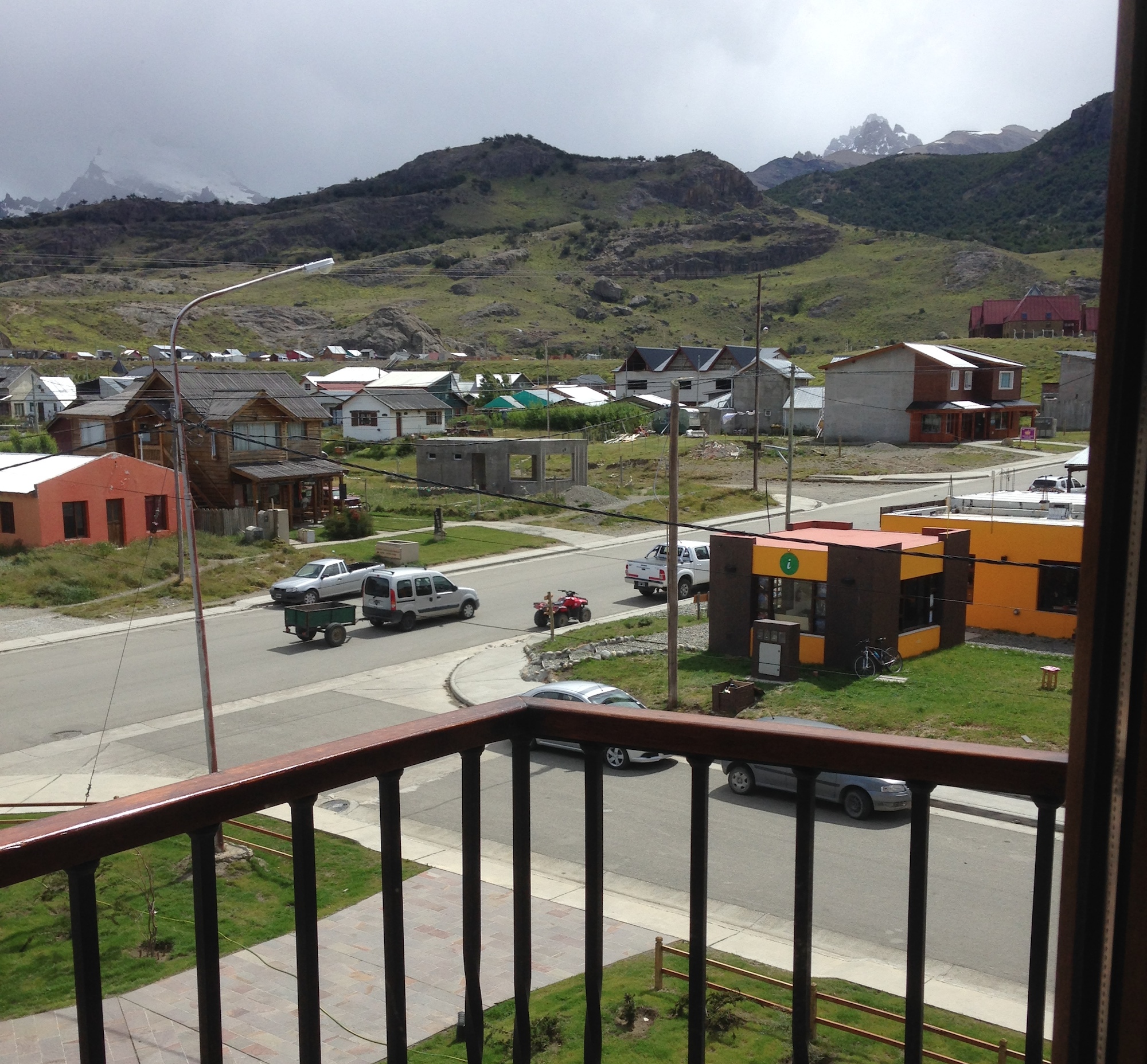
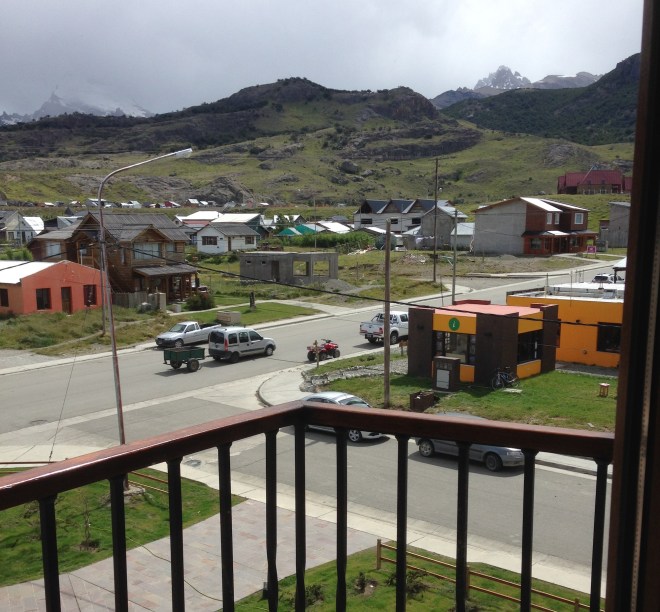
VFYWC-239

A reader gives it a shot:

Based off of substantial research – those look like funny cars! / green / mountains / Google: “towns in Iceland near mountains” – I believe this is Seyðisfjörður, Iceland. I don’t actually think I’m right, but Seyðisfjörður is probably the coolest name of a town ever.

Já. Another reader shivers:

I’m not sure if it’s an educated guess or a wishful thinking to get away from the snow and cold of a Michigan winter, but either way, I feel like it’s a street I have driven down in Cancun. Or maybe I’m just wishing I could.

Or maybe this charming locale?

Bumblefuck, Idaho

This contestant gets to the right hemisphere:

New Zealand. I’ve read the Dish for year and this is my first time writing in. I gasped when I saw this week’s VFYW. I travelled around North and South Island for six weeks this past summer and I miss it terribly. It’s an incredible country. The trip marked my first time backpacking and that that green encircled “i” was a constant source of help. It is a sign for an i-SITE, NZ’s immensely helpful network of information centers that even the smallest towns seem to have. After five minutes of searching I decided to give up- looking for pictures of all the notable mountains would take forever… Oh the NZ mountains!

Spinning the globe, this reader hits the right continent:

The construction techniques, vehicles, and topography all look like the Andes to me, and are particularly reminiscent of Cajas National Park, so let’s go with Cuenca, Ecuador.

Another gets the right country:

Could it be we’ve gone literally to the end of the earth this week? I’ve been Google-wandering Latin America today, and Ushuaia, Argentina is where I’ve landed. The mountains are tall, jagged and young, and the terrain is green in January: it’s either near the equator or somewhere in the Southern Hemisphere. Too mountainous and too snowy to be Hawaiian volcanos. The cars are left-hand drive, so it’s not New Zealand. License plates are shaped like North American plates, unlike Chile’s, Peru’s or Brazil’s. They’re light-colored with what seems to be a horizontal black streak: Argentina. So—Patagonia? And pretty far south: last exit before Antarctica, in fact. Google Street View seems to confirm matching architecture (vibrant colors on walls and peaked roofs) and sidewalks. I can’t get quite to the right street today…but for kicks, I’m going to guess I’m somewhere near the corner of Neuquén and Islas del Atlántico Sur. Unless I’m on the wrong continent. Either way, Ushuaia looks amazing, and I’ve now discovered a new town to put at the very top of my wish list. Thanks, as always, for this challenge.

To far south on the guess though. Here’s the right one:

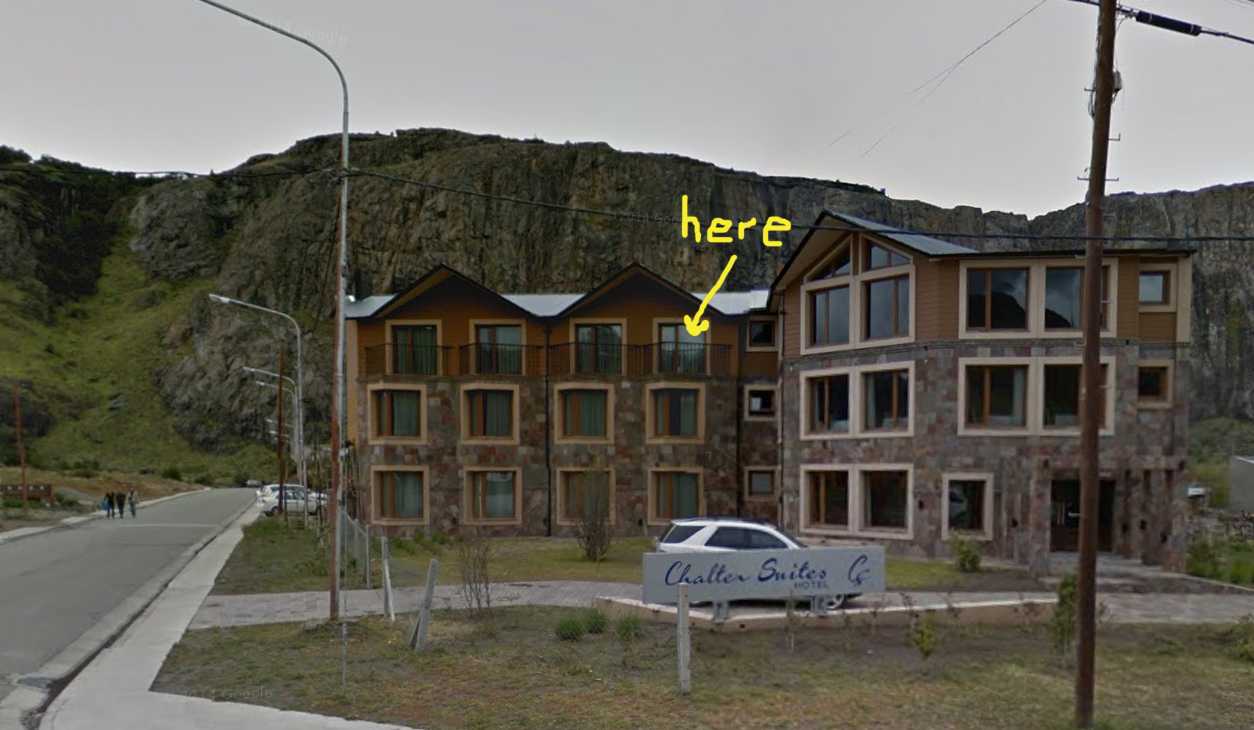
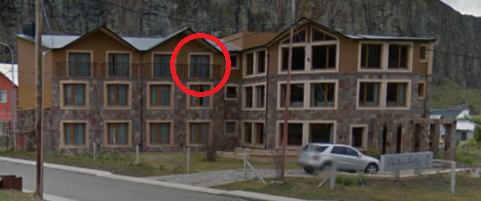
Oh my fucking god, I got it! I’m not the type of person who gets these things, so I think you’ll have thousands of correct answers this week. Something said “Patagonia,” I Googled “patagonia argentina village” and got pics of El Chalten that looked right, decided to look around on Street View and dropped the little man right next to the hotel. The triangulation to find the right window (see pic), figuring out how to draw an arrow on the picture and export it, and composing this email took way, way longer than finding the location. Cleverly, I scribbled a superfluous “here” on the picture in an attempt to get featured:

ChaltenSuites

That’s the right window too. Another reader adds, “what an welcome change”:

A view where I’m not on wild goose chases researching page after page of minarets. I think, being from Minnesota, I’m better at finding cold places than warm. I can sniff out Nunavut or Halifax no problem, but Dakar or Turkey leaves me bewildered. This week is no different. This week’s view shouted high Andes at me. Don’t know why, never been there. A really good hunch. This looked like the kind of place that outdoor adventure seekers would flock to, as evidenced by the mountain bike leaning on the building in the foreground. A Google search for “Andes mountain hostel” led in short order El Chalten, Argentina. With the aid of Street View and I found our hotel, The Chalten Suites Hotel.

Indeed, no one seemed to mind looking through Patagonian imagery this week, as summed up by this former winner:

Those mountains! If you told me that was a painted background I’d believe you.

Another sets the scene with a digital background:

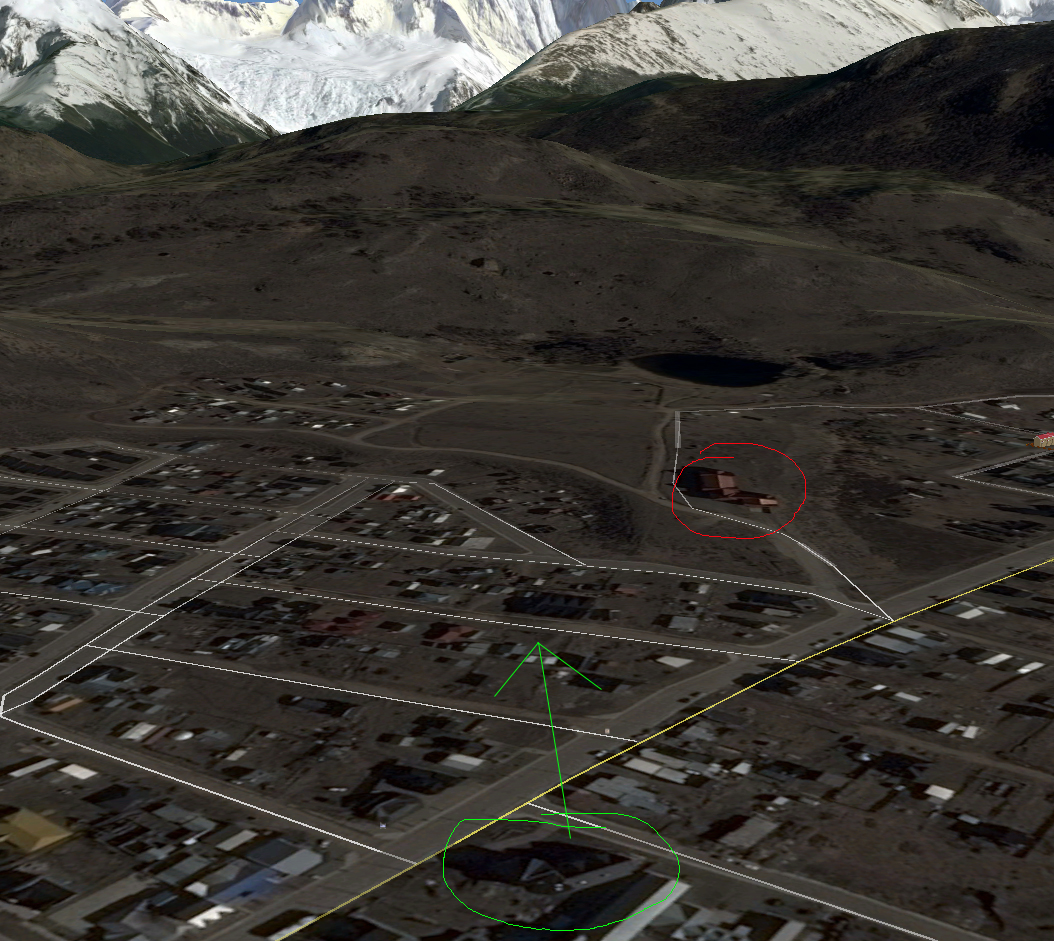
Hotel Los Cerros is circled in red and the Chalten Suites is circled in green with an arrow indicating the direction of the view:
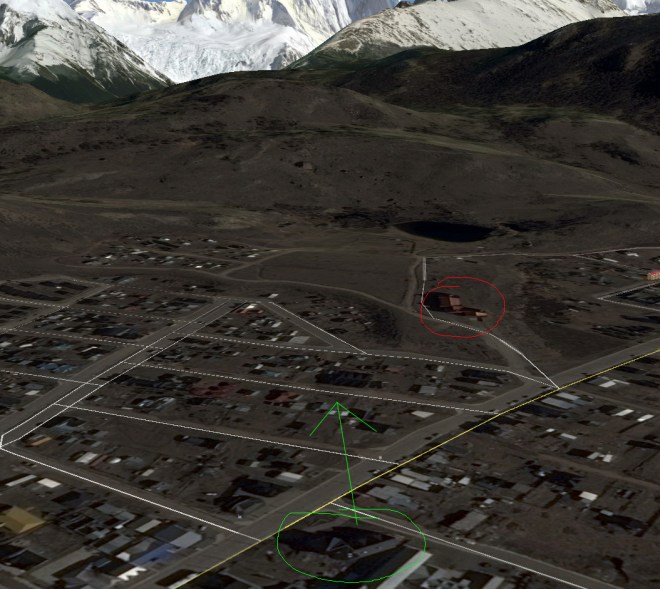
view 2

And a rookie gets his first ID with this impressive entry:

Okay, I’m new to the contest. But I narrowed this one down to four windows. I couldn’t read any of the signs, but I could see that they were written in the roman alphabet. And it was probably a language in which “i” stands for information.

First, I ruled out countries that drive on the left side, so it couldn’t be New Zealand or South Africa. Next, I ruled out real northern mountains (Canada, Alaska, Norway), because of the lack of evergreen trees, and the lack of snow. Right now, it’s winter here in the Northern Hemisphere. A place at this altitude would be covered in snow and ice. So I figured it was South America.  My first hunch was Chile. So I started looking at Chilean license plates, but they didn’t look right. The license plate in the picture looks like it has a black spot in the middle. I googled photos of traffic in Argentina. Cars in the distance, ones whose plates are too far to read, appear to have a black spot in the middle (because the plates are black with white letters, and there’s a large black space between the letters on the left, and the numbers on the right). So I googled Patagonian mountain town images. One of the first towns I found was El Chaltén. Everything looked right: the snowcapped mountain, the greenery, the architecture. I confirmed it when I kept seeing photos of the building with the huge red roof (in the top right corner of the VFYW photo).

In the view, there’s a sign that sticks up over the larger yellow building that looked like it said “coffee.” So I googled “El Chaltén Coffee Shops,” and found a guy’s Twitter photo of him sitting in a hammock outside of Mathilda, a coffee shop, in El Chaltén. Mathilda is the yellow building next to the information center. You can see the information center in his photo, and I knew I was there. It was scintillating stuff. Then I used Google’s satellite map, found the roofs I was looking for – it’s not a large town – and used Street View (lucky) to put myself on that corner. I was staring at El Chaltén Suites Hotel.
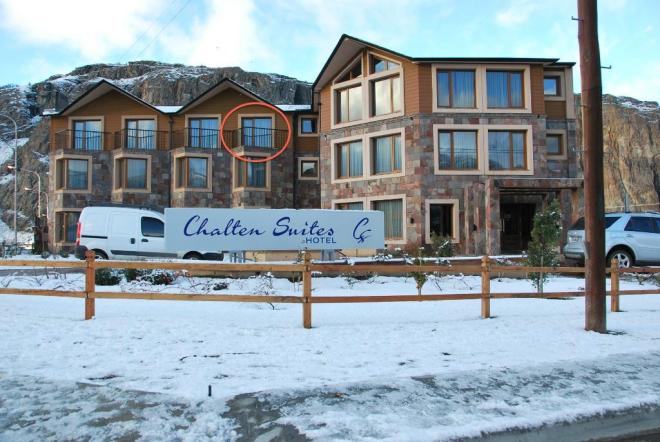
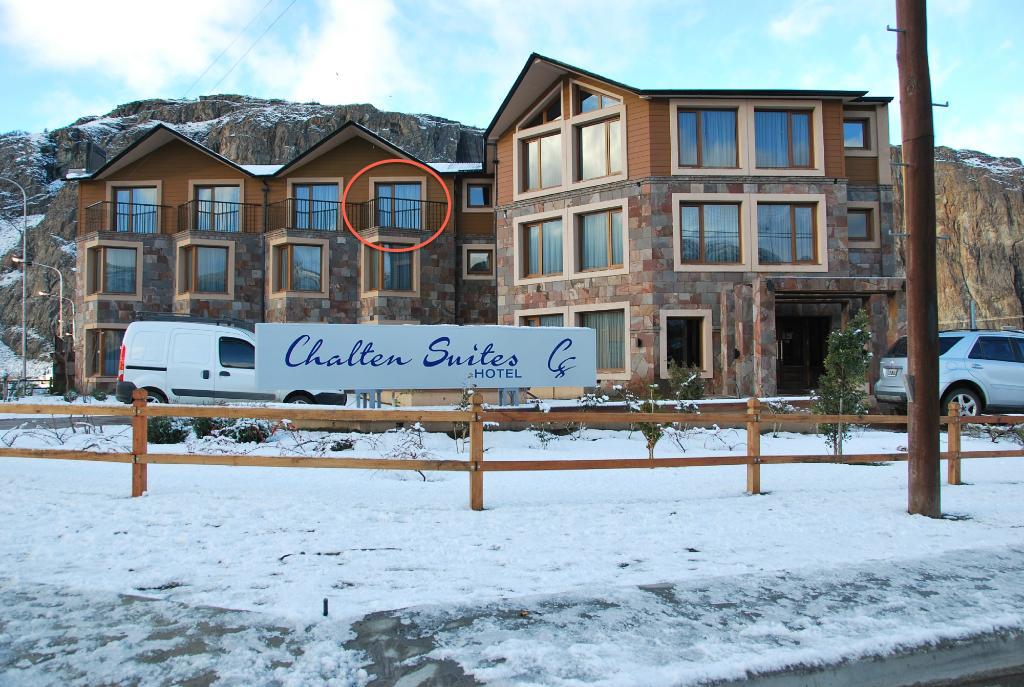
chalten-suites-hotel

There are four rooms with balconies like the one in the photo. I tried to do some kind of geometric voodoo to figure out which one it was. I think it’s one of the two closer to the center of the building. I’ll go with the furthest right of the balconied windows.

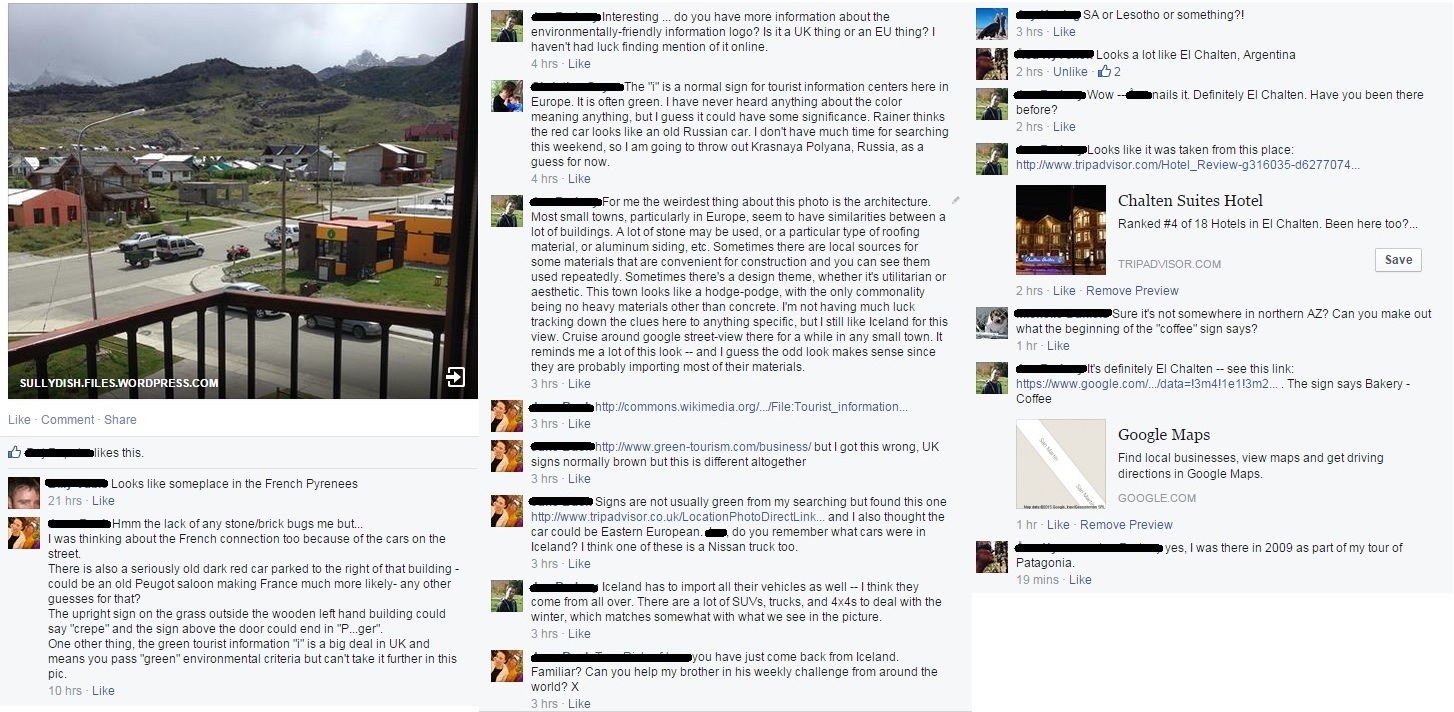
Team Facebook is back as well:

I was fixated on Iceland until someone set me straight … the moral of the story is: have well-travelled friends who can recognize Patagonia at a glance:

facebook-el-chalten

More on El Chatlen:

Argentina founded the village of El Chaltén in 1985 to solidify its sovereignty in the area amid a continuing border dispute with Chile over this part of Patagonia and the Southern Patagonian Ice Field to the west.  Although Chile and Argentina made progress in defining their border in the 1990’s, tensions rose over the undefined border in 2009 when Néstor Kirchner’s government unilaterally issued maps displaying Argentina’s claims.

BTW, the donuts at the nearby Panaderia Que Rika look amazing.

Also:

It’s proximity to Los Glaciares National Park as well as the Cerro Torre and Cerro Fitz Roy mountains explain why it’s known as the region’s “capital of trekking”. The town operates primarily as a tourist destination for climbers, hikers and adventures. Your reader must have sent you the photo after they returned to a more travelled location. The cell phone service is so poor that it warranted mentioning on Wikipedia’s entry for the town. How are you supposed to Instagram your morning hike if you can’t get a signal?

Another Dish contest, another new destination on my “I want to go to there” list. Thanks!

Just like every week and every place, other readers have already been there:

I’m a Dish reader, so of course I have visited Torre del Paine, but only from the Chilean side, by bicycle, many years ago now. You only have to do this contest a few times to scoff at the TV shows and movies where the intelligence agencies zoom in on a tiny area of a low-res photo, hit the mysterious “enhance” button that I can’t seem to find on my keyboard, and voila: the image resolves to show paint flecks on a license plate. Chumps.

Heh. Another reader:

It’s a neat little town with amazing hiking and other mountain activities in the area, but this picture doesn’t do it much justice.  As one of my friends and traveling companions said, “I don’t think they could have taken an uglier picture of a beautiful place.”

It was actually submitted and chosen for exactly that reason. We’re tricky devils. And don’t worry, another reader sent in a more traditional photo of the area:
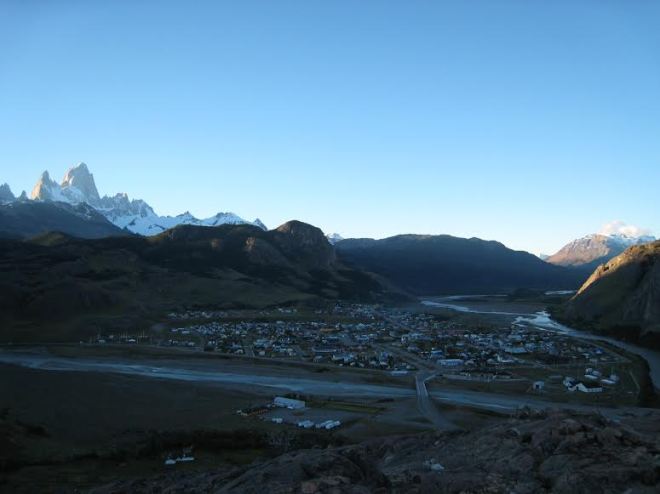
FitzRoy

This reader is pretty excited:

Oh my God! Oh my God! Oh my God! I know this one!!! I’ve been there!

My personal rule when I play VFYW is that if I don’t have a gut reaction or an intuition when I first see the picture, I don’t play (but I still check in on Tuesday to find out where the picture was taken.) But when I saw this picture this morning it reminded me of Patagonia, and I felt I had been on this street before. In 2011 my partner and I went on a hiking trip there as a reward for losing weight and getting in shape. It looked to me like the VFYW was taken in one of the small towns we stayed in on this trip. But one of the towns that was on the edge of the Andes. A quick review of our photos from the trip brought me to El Chalten!

We stayed a few nights in El Chalten so we could go hiking around Monte Fitz Roy and Cerro Torre in Parque Nacional Los Glaciares. Turns out even in a windswept town this small and remote, Google street view has driven around a few of the main streets. So I went for a “drive” starting from the west edge of town on San Martin and found where this picture was taken! Because of the railing in the bottom of the picture, it appears to have been taken from a third floor balcony of a room at the Chalten Suites Hotel. Judging by the angle of the shot I think it is probably from the third or fourth room in from the corner of the building on Trevisan Street.

BTW windswept doesn’t even begin to describe this little town. More like wind blasted! On one short afternoon hike along De La Cascada (there is a lovely waterfall in a protected canyon at the end of the hike so it is worth being scoured by the wind to get there), it was blowing so hard we started jumping up in the air just to see how far the wind would push us when we were airborne. The wind NEVER lets up! Here is a link to a short video I shot of this unceasing wind Patagonian Wind (I had to hunker down behind a pallet of bricks just so I could hold the camera steady enough):

[vimeo https://vimeo.com/32890263 w=540]

Another memory:

The weather was always overcast when I was there. In fact, it rained and/or snowed all seven days. On the final day there was heavy snow, and I had been putting off the main hike to get a view of Fitz Roy and the three lakes in the area. I was bummed that I wouldn’t be able to do it, but at noon I said “screw it” and hiked in the snow. I hustled because it was late, and was falling all over the place, slipping and sliding up the mountain. I was the only one on the trail. When I got near the top the snow stopped and the clouds parted, revealing perfect views of the three lakes. It was an amazing day.

The view hit this Dishhead in the heart:

I’ve been reading The Dish ever since I moved as an Australian expat to Peru in January 2008, just in time to follow your coverage of President Obama’s campaign and win minute-by-minute from my tiny flat in Lima. In all that time I’ve never even got the country right in the View From Your Window Contest. But I know exactly where this one is. Argentina is close to my heart.

I worked as a tour guide and travel book writer in South America for two years, and visited El Chalten twice, once while writing Patagonia chapters for that rapidly shrinking field of publishing. The other time I was travelling with my geography-teaching girlfriend where I spurned a golden chance to pop the question at a waterfall off the Fitzroy Glacier not far from where this picture was taken. Could there be a better spot to ask a geographer to marry you?

Turns out there was. I found my bravery in the stunning high-altitude desert city of Mendoza a month later (my wife is also a sucker for great urban planning) and we now have two beautiful girls who have never seen mountains or snow. We live in Darwin in the Northern Territory, about the furthest point on the planet you can get from Argentinian Patagonia without crossing the Equator.

This week’s winner is going to pleased with his last-ditch effort:

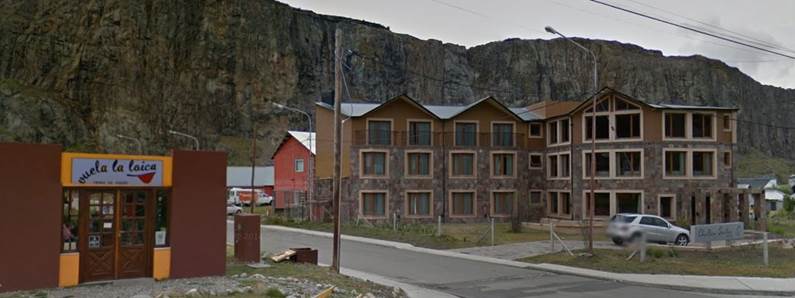
Oh man, I simply got lucky on this one.  I almost gave up, but I really hate losing so I had to try one last time. And while making one last-ditch Google search for “school with red roof and skylight”, I ran across a travel page with a picture of the Los Cerros Hotel on it.  Not a school after all. Before that, I had been looking around the Grand Tetons and western Colorado. I mean, what could be more American than an old travel trailer sitting up on blocks in your back yard?
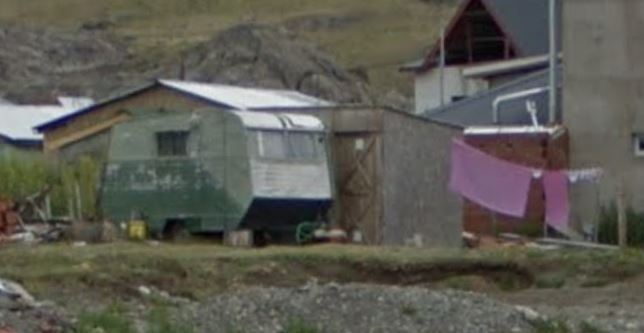
image003

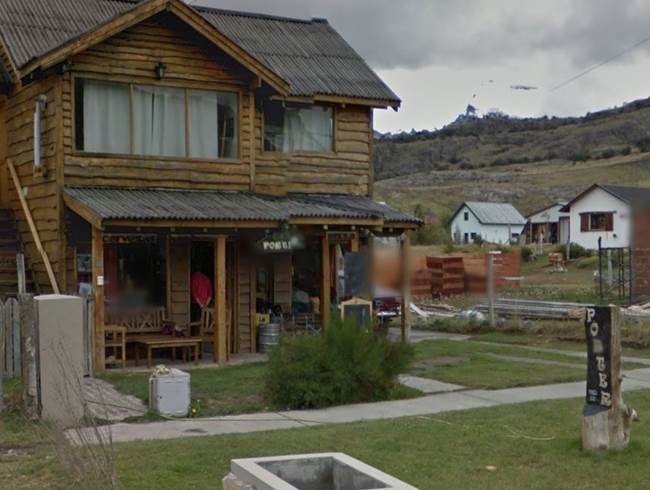
Then there is “Porter”. The sign across the street both in front of and on the rustic log building.  I was wishing I had that “zoom in and enhance” feature from Bladerunner.  Would have saved me a lot of time.  It’s “guide” in the US.

image005

So the picture was taken from the Chalten Suites Hotel, street address San Martín 27.   Google street view shows it under construction:
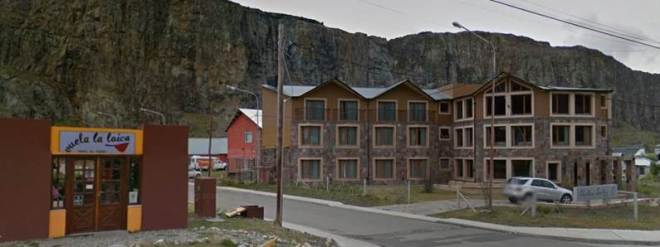
image007

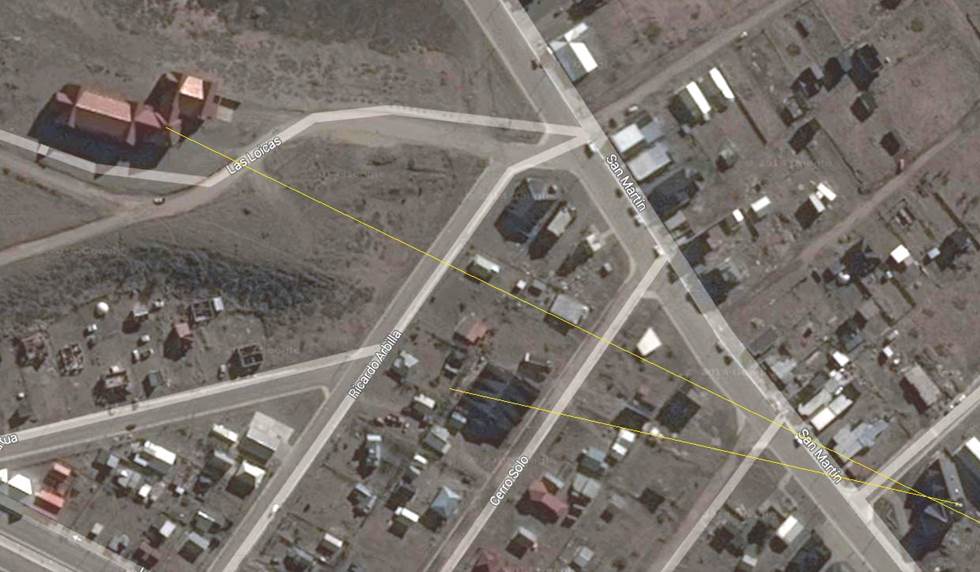
So which window?  Obviously one of the balconies, so a little triangulation:

image014

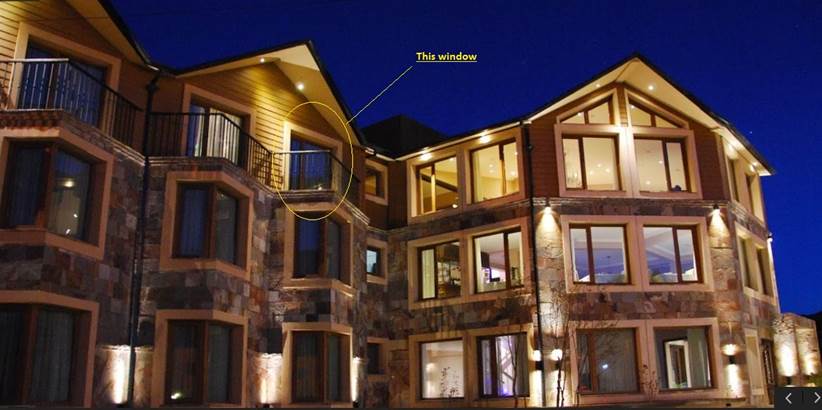
Looks like this one to me. Hotel looks a lot nicer completed too.
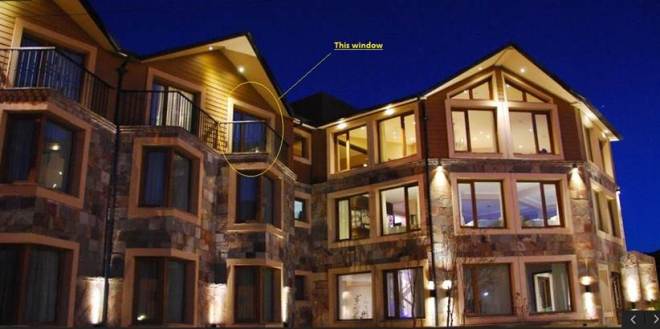
image015

Thanks for the challenge.  I’ve come to really look forward to this game.

And it can even get better after you win, as our submitter attests:

I was surprised to find that I was more excited to have my picture selected than I was when I had my one contest win a year ago. Now I have to find a new goal!

My stepson and I visited Patagonia over the New Year to do some backpacking and hiking. Our first stop was in El Chalten, Argentina, where we spent one night in town before backpacking up to the South Patagonia Icefield for four days, to climb a peak called Gorra Blanca (incredible experience, for those considering a trip). El Chalten only came into existence in 1985, solely because Argentina wanted to keep an eye on the disputed border with Chile that lies just to the west. It is now a tourist town catering to the many trekkers and climbers making the pilgrimage to the Fitz Roy massif. We were staying at the relatively new (less than a year old) Chalten Suites Hotel. Our view was spectacular except for the clouds on the first day, without which this view would have been easily identifiable. When we returned from our icefield trip, the clouds were gone and I snapped this picture from the same window, and you can see the spectacular view of Mount Fitz Roy on the far right, and Cerro Torre on the far left:
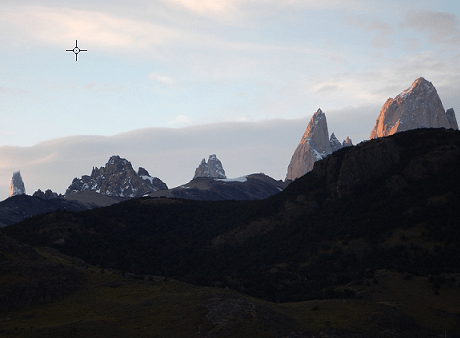
image002

I’m hoping this was a semi-challenging contest, though the unique Argentinian license plates surely helped to solve this. For those venturing a guess, our room number was 304, and the specific window is highlighted in the picture here:

image001

And if Chini is in form, perhaps he guessed that it was taken at 3:30 pm on December 29 (though don’t ask me the heading). Love the VFYW contest and the Dish – keep up the great work!

Thanks so much. For the record, Chini didn’t get the timestamp, but he did get the heading. He also submitted a Poem for Contest Tuesday:

HANDS, do what you’re bid;
Bring the balloon of the mind
That bellies and drags in the wind
Into its narrow shed.

-W.B. Yeats, The Wild Swans at Coole

An appropriate poem for a small milestone I’ve been closing in on. But to get there, I had to summit one final climb and find this week’s view. A climb that began in…Canada. My first guess was Canada. AGAIN. Seriously subconscious, you need help. So yeah, when that didn’t work, I ran off to Wyoming, again. Which also didn’t work, because, Wyoming? On and on it went like that, fruitless step after fruitless step. In the end, the secret lay with…Djupivogur, Iceland? Well, whatever works baby, whatever works.
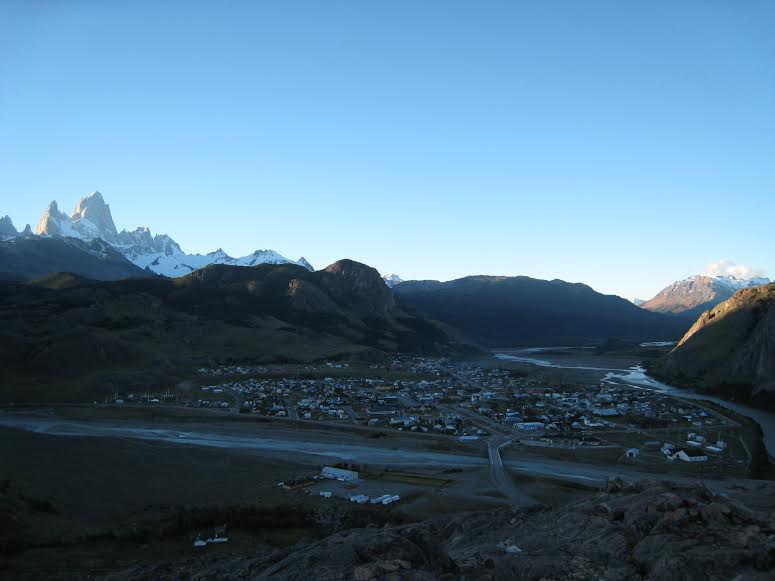
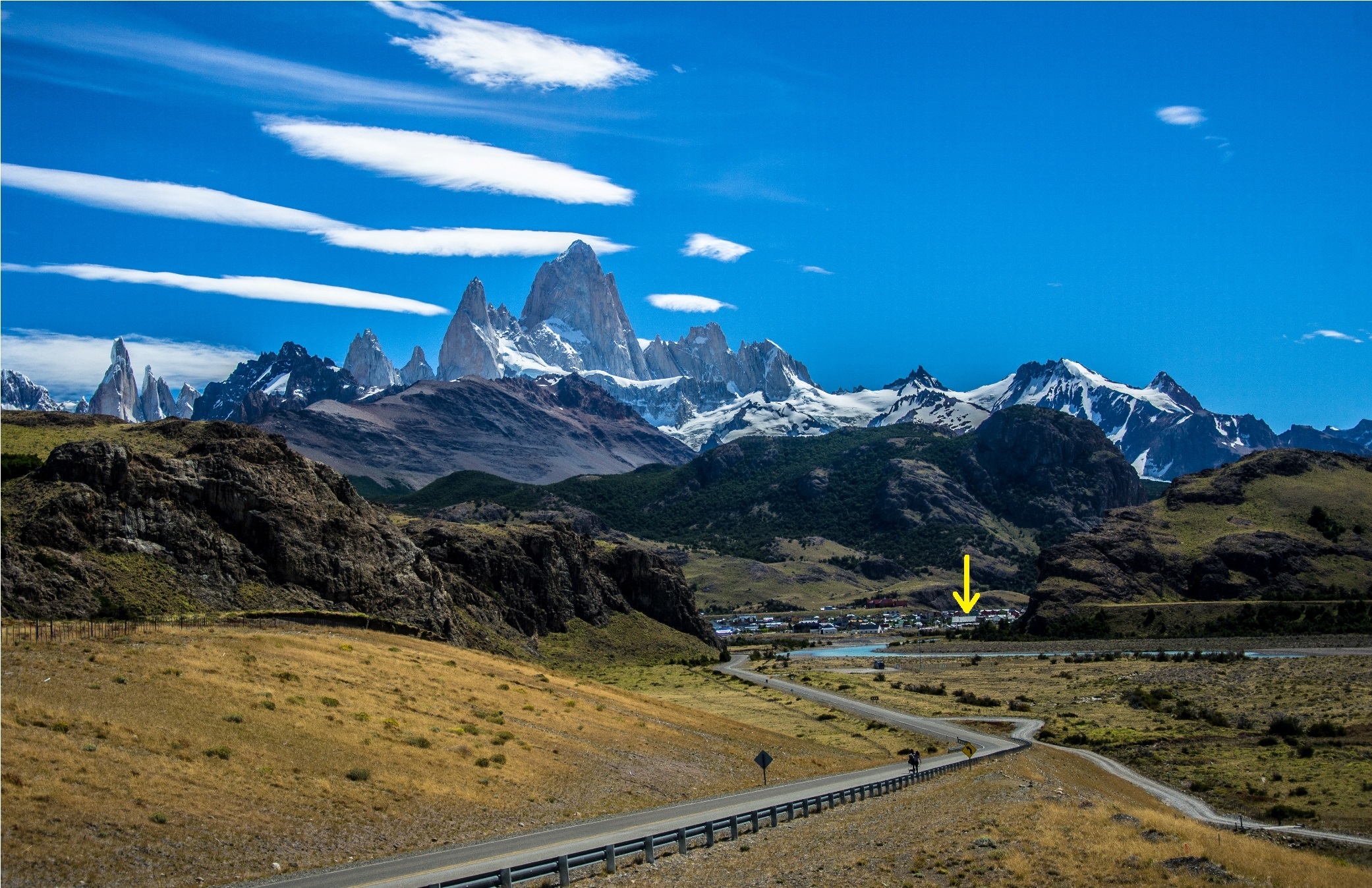
VFYW Chalten Panorama Far Marked - Copy

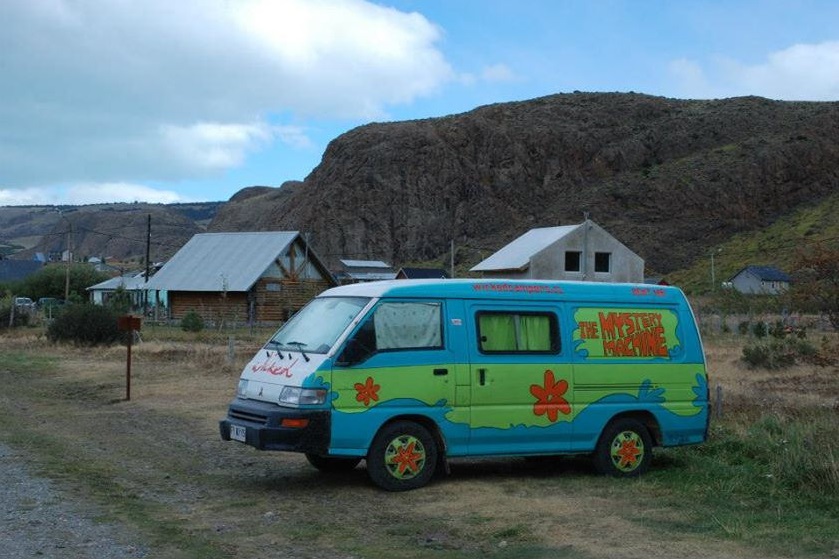
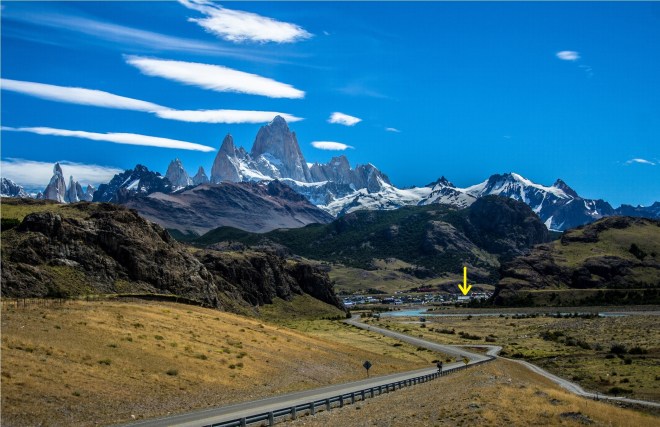
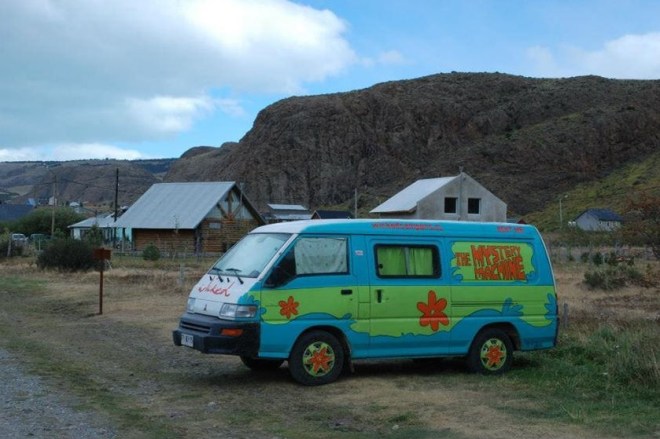
This week’s view comes from El Chalten, in Patagonia, Argentina. The picture was snapped from a top floor room of the Chalten Suites Hotel and looks almost due west along a heading of 276.95 degrees. Amusingly, the iconic peak of Cerro Fitz Roy is hidden just out of view at right. Bird’s eye, panoramic and marked window views are attached, along with one of El Chalten’s very own Mystery Machine:
VFYW El Chalten Mystery Machine Awesome Sauce - Copy

Oh, and as for the milestone? Well, let’s just say when it comes to Van Halen, I went one louder.

We hope everyone else has a milestone week as well. Until Saturday …

In Which The Democrats Finally Get A Clue

Screen Shot 2015-01-20 at 11.41.29 AM

I have to say that, as rumors and reports came in last week that Obama was going to propose a straightforward redistribution from the mega-mega-rich to the struggling middle classes, I could scarcely believe it. I mean: how often does the Democratic party actually exercise solid pro-active political judgment? How often do they seize the policy initiative from Republicans? How often do they propose things thay passionately believe in and unabashedly direct the message to the vast majority of Americans treading water in rougher and rougher seas? How often does a winning Congressional party get effectively marginalized in the public debate just after a stunning mid-term win?

Screen Shot 2015-01-20 at 11.48.40 AMThe proposal will no doubt be tossed around, as it should. But I see it as narrowly targeted in precisely the right way. It’s aimed at the way in which the super-rich avoid paying the same rates as middle class Americans, via a low capital gains rate; and in which they avoid taxes – the “step up in basis” loophole – which allows inherited wealth to be a much bigger factor in social and economic equality than is in any way justifiable in a democracy that values work over inheritance. It’s nicely targeted at the super-rich, super-shameless 1 percent, now busily taking even more sunlight away from Manhattan. And all this $320 billion would be redirected to the middle class – a tax cut for married couples; free community college; bigger tax credits for higher education; and wage subsidies for the working poor.

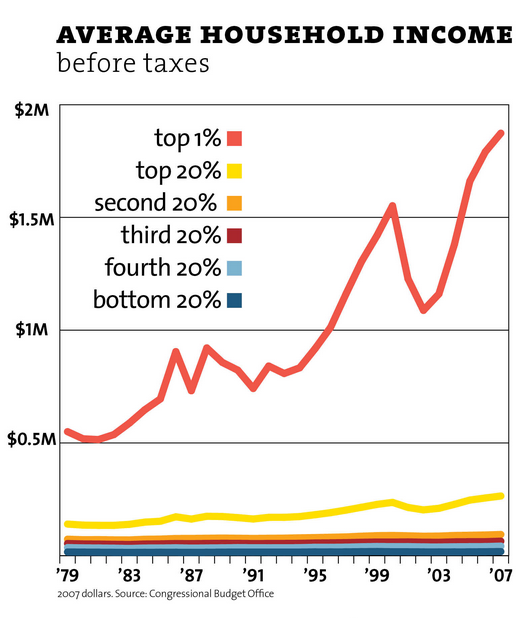
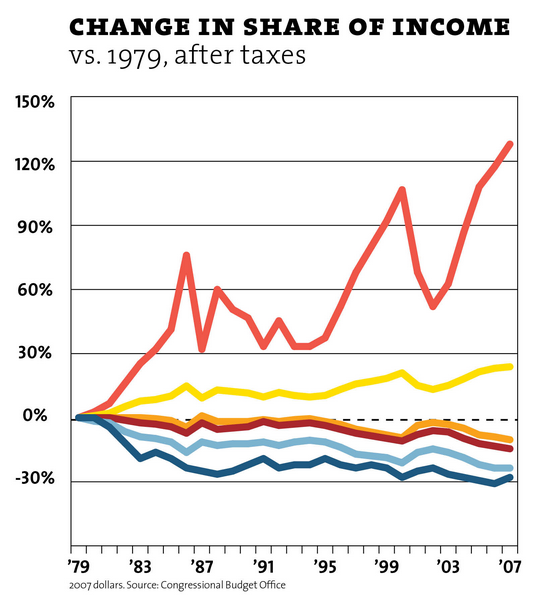
The term “populist” has been used to define this kind of package. I don’t quite buy that. Sure, it’s a piece of major redistribution. But that has to be seen in the context of the post-Reagan decades. Inequality now is far, far higher than it was in the 1970s and even the 1990s. If one tiny sector of society has seen its income (let alone wealth) go up by 120 percent in 35 years, while the vast majority have seen their incomes flat for the same thirty years, this is not populism. It’s an attempt at rescuing the basic social compact at the heart of any functioning and healthy democracy.

The wealth imbalance is at century-level highs. And socially, we are, it seems to me, at that Tocquevillean danger point, at which expectations as the economy recovers are getting higher. Dash those expectations with continuing minimal gains for the 99 percent – and continued enrichment of the very, very rich, and you have, to this conservative, a deeply unstable society, one teetering Screen Shot 2015-01-20 at 11.42.30 AMon the edge of serious unrest. That unrest never seems likely to come until it does. And so I see Obama’s redistribution from the mega-rich toward those who are not part of the rentier class of the finance sector as a balancing, rather than a revolution; as actually concerned with social stability and the sense of fairness that underlies the very legitimacy of a democracy, rather than the abstract theories of those Republicans still stuck in the 1970s (if you’re lucky) and the 1870s (if you’re not).

Some are claiming that this is “pure politics” because with a GOP-controlled Congress, none of it stands a chance of passing. You could say the same thing of much of what the GOP is proposing and has proposed for the last six years. And politics is made by bold moves like this that seem to read the signs of the times. They force the opposition to fashion a response to the same set of problems. And, in the recovery, they insist that the struggles of the middle class can indeed be ameliorated a little by government. What’s the GOP alternative? Giving the most reckless and culpable part of our economy – the finance sector – what it wants to unraveling Dodd-Frank bit by bit.

Torture defender Marc Thiessen suggests the following response to Obama’s sudden move:

Last July, Rep. Paul Ryan (R-Wis.) — now the chairman of the House Ways and Means Committee — laid out serious anti-poverty initiatives, including “opportunity grants” that would allow states to test different ways of fighting poverty and an expansion of the earned-income tax credit for childless workers, paid for by eliminating ineffective programs and corporate welfare. Other good ideas include my American Enterprise Institute colleague Michael Strain’s proposals to create relocation vouchers for the long-term unemployed, which would help those in high-unemployment areas move to states where jobs are abundant, as well as a lower minimum wage that would encourage firms to hire the long-term unemployed while supplementing their income with an EITC-like payment.

Those ideas are all worth exploring, but can they actually match the sheer appeal of a more direct lifeline to the middle class? But lowering the minimum wage at a time like this – even with an expanded EITC? Helping people to move to states with more growth? And the costs will be borne not by the top 0.1 percent, still making out like bandits on a bender – but by “eliminating ineffective programs and corporate welfare”. Let’s see them spell that out. But if the debate is about helping a middle class left in the dust of globalization and technological change and financial sector recklessness, you think that’ll work?

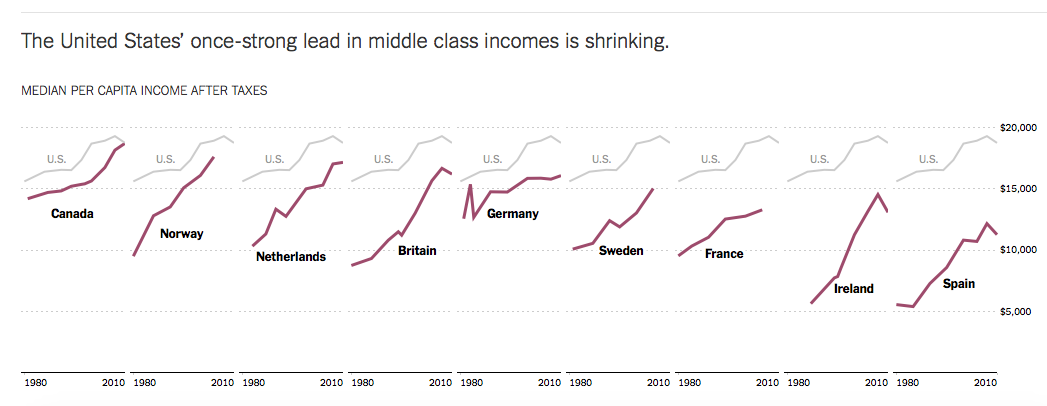
And this debate will take place, it now seems likely, at a time of rising growth rates, tumbling unemployment, unprecedented energy independence and an American economy now out-stripping all its developed country peers – even as the US middle class has stagnated, as Andrew Ross Sorkin notes today with a link to this graph:

Screen Shot 2015-01-20 at 11.25.39 AM

There is something truly odd about the wealthiest country no longer with the wealthiest middle class, and in which every major competitor’s middle class is converging with ours’ in standards of living. This is the real end of American exceptionalism, in which working hard in the middle class is like being on a treadmill rather than a track.

Or to put it in another way: nothing Obama is proposing does more than spit in the wind of the soaring inequality of the last three decades. He would not even begin to preside over a society as equal as when Ronald Reagan was president. He’s just trying to use government to nudge us back toward that sane, middle-class, democratic middle so essential to a functioning and health democracy. I’d love to see the Republicans counter with something – but their ideology still prevents them from using government as a real tool in combating the dangerous trends of social and economic inequality.

So Obama’s next term begins today, in effect, because it will chart the future of Democratic priorities and offer them a clear and popular set of policies that address majority concerns in ways that the GOP has yet to figure out. My suspicion is that Jeb Bush gets this – and his position will strengthen as the appeal of the Democratic proposals sink in – for once, they’re easy to explain). Can Hillary Clinton channel her inner populist? She’d channel her inner anything if it meant winning the presidency. Can Jeb Bush persuade his Fox-addled base that only he can successfully counter the appeal of this populist agenda with a kinder to bankers, gentler to plutocrats version of the same? I don’t know.

What I do know is that the pattern we’ve observed with Obama from the get-go is reasserting itself yet again. Hang on the ropes; get pummeled; get shellacked; then punch suddenly back. What we’re seeing from Obama now is an attempt to shape the future of the Democrats for the next decade or so. And he’s kinda forcing Clinton’s hand in this. If she’s smart – and she is – she’ll grasp it tightly and go on the offensive.

Meep meep motherfuckers.

(Charts via Mother Jones here and here)

Why Cuba Needs The US

Joshua Jelly-Schapiro focuses on the island’s troubled economy:

A big part of the calculus informing Cuba’s new openness to the U.S., though, is about economic necessity. With Cuba’s birth rate having fallen below replacement level as far back as 1980 (partly thanks to Cuban women’s universal access to reproductive health and abortions), and its work force shrinking, the country’s vaunted health system faces pressing concerns about how it will care for the huge number of citizens readying to retire. Simply put, Cuba’s economic planners realized long ago that their socialist system couldn’t survive without more sources of foreign cash.

Francisco Toro connects the US-Cuba deal to falling oil prices:

The reason is that the considerable help Venezuela sends Cuba is in the form of barrels, not dollars. As oil prices fall, the value of Venezuela’s aid falls. In the final quarter of last year, Cuba’s state finances began to look worse and worse.

He calculates that it would “take some 480,000 extra tourists next year to make up the fiscal hit just from the recent drop in oil prices”:

The only other plausible source of extra revenue on this scale is remittances from the Cuban exile community in Miami and beyond. This is a dicier proposition, as the money relatives send creates a space for independence from state control that Havana’s old-line Stalinist leaders clearly fear. But in an economy that’s still as thoroughly state-controlled as Cuba’s, there’s little doubt that remittance money “trickles up” from individual pockets to the state, as people spend their foreign currency in the state-owned “convertible peso” shops that have a monopoly on the sale of a whole range of consumer goods, from PCs to refrigerators.

Which is why Havana negotiated for — and got — much looser rules for remittances from stateside Cubans. The new limit quadrupled to $2,000 per year and the licensing regime was greatly simplified.

Reviewing a new paper on remittances, Drezner considers how that money might change Cuba:

Multiparty elections are the key mechanism through which remittances can affect democratization. It doesn’t matter if these elections are neither free nor fair, just that they happen, and the dominant party can be surprised by weak electoral support. So, a key U.S. foreign policy goal should be for Cuba to allow for multiparty elections, even if they seem like sham elections at the outset.

Should You Ask For A Raise?

dish_raises

Bourree Lam looks at research on who asks for raises – and who’s successful:

A recent study by Payscale surveyed over 30,000 workers about their experiences asking for a raise. They found that 43 percent had asked for one, but only 44 percent of those who asked got the amount they wanted, with 25 percent not getting a raise at all. Among the 57 percent who didn’t ask for a raise, the top reasons were that they got a raise without asking (38 percent) or that they would be uncomfortable asking (28 percent). Only eight percent reported that they were satisfied with their salary. Those surveyed who didn’t ask for a raise tended to be at the lower end of the income spectrum, working in the service or public sectors.

Compared to other workers, CEOs were the most likely to get a raise. That might be because the cost of replacing an employee is about 20 percent of a position’s annual salary—so companies have to expend more resources to replace senior employees than junior ones.