The magic of acrobats:
Does Terrorism Have Its Roots In Religion?
CJ Werleman fisks Sam Harris over his recent post emphasizing the connection between Islamic doctrine and jihadist violence, noting that “maturing counter-terrorism analysis has brought new information to light.” He uses the example of Anwar al-Awlaki to show the limits of Harris’ approach:
Harris’ contention that terrorists are motivated more by the writings of the Koran, rather than by economic, political, social, and military oppression, is based on feeling rather than fact. Harris is unable to explain the transformation of U.S.-born terrorist Anwar al-Awlaki’s views in the decades before his death, because there is no evidence to suggest that a religious awakening led to his adoption of a radically different theology. When the 9/11 attacks occurred, al-Awlaki told journalists: “There is no way that the people who did this could be Muslim, and if they claim to be Muslim, then they have perverted their religion.” Explaining the concept of Jihad, he said, “If there is an invading force from outside, then we would, too, struggle to defend ourselves, and that is where armed combat occurs. So actually, fighting is only part of a jihad, and it’s considered to be a defensive force in order to protect the religion.”
The U.S. government had determined al-Awlaki to be a moderate, and he even spoke at a lunch event at the Pentagon. By 2010, however, he had become increasingly disillusioned with U.S. foreign policy…. Al-Awlaki’s radicalization is consistent with the historical pattern of political activists adopting a belief in terrorism when political action fails to bring about change. “From the French anarchists who began bombing campaigns after the defeat of the Paris Commune, to the Algerian FLN struggling to end French colonialism, to the Weather Underground’s declaration of a state of war following state representation of student campaigns against the Vietnam war,” terrorism is nearly always rooted in political and economic oppression says NYU adjunct professor Arun Kundani.
Christopher Massie, however, points to others who think more like Harris:
[T]here are journalists and scholars who present compelling cases that ISIS’s actions are at least partly grounded in the teachings of Islam. In a September 1 story in The New Republic, Graeme Wood traced [ISIS leader Abu Bakr] al-Baghdadi’s appointment of himself as caliph, as well as the group’s “taste for beheadings, stonings, crucifixions, slavery, and dhimmitude, the practice of taxing those who refuse to convert to Islam,” to its “almost pedantic adherence to its own interpretation of Islamic law.” In an interview, Wood said that while he considers the political factors behind the group’s ascent “at least as important,” it is clear that “their beliefs are central to their self-conception” and are therefore vital to grasping the differences between ISIS and other jihadist groups. He observed that journalists who do not understand the way ISIS thinks “are missing a part of the story.”
David Cook, an associate professor at Rice University who studies Islam, is more emphatic: “To say that ISIS doesn’t have anything to do with Islam is just the statement of an ignoramus or an apologist. There is support for the things that ISIS does inside the Koran. There’s support for things like beheading and different exemplary punishments that you can easily find.”
Harris’ new book Waking Up is our latest Book Club selection, introduced here. Buy it here and join the discussion at bookclub@andrewsullivan.com.
The Things They Carried

Thom Atkinson photographed the battle kits of British soldiers over the course of 1,000 years:
The series, appropriately titled Soldiers’ Inventories, starts with the Battle of Hastings in 1066 and chronicles the gear soldiers carried into 12 other battles, from the battle of Waterloo to the war in Afghanistan. “Britain spends a lot of its time fighting people,” says Atkinson.
Each photograph is like a wartime version of Things Organised Neatly. Of course, the kits include things designed to kill people in ever more efficient ways. But they provide a glimpse into what the boredom and monotony of war, with things like playing cards, checkerboards, and iPads. To gather the objects, Atkinson visited living history communities, whose members collect such things for for reenactments. He would spend hours organizing the gear just so, beginning with bigger pieces like a musket or a jacket and filling in the holes with smaller objects. “It’s a lot like Tetris,” he says.
The above kit was fit for a knight during the siege of Jerusalem in 1244. See more of Atkinson’s work here.
Faith That Aches
This month saw the publication a new volume of poetry from Christian Wiman, Once in the West. Paul Otembra notices “the spiritual ache” coursing through the book:
The poems are continually looking for ways to make something of the frustrations and doubt. This is not the same as trying to make sense of them, and it is uncertain whether these poems believe that is even possible, let alone advisable. Instead, Wiman suggests “to make of the ache of inwardness— // something, / music maybe.” Everything here hinges on that qualifying “maybe.” It is not a shrug of surrender. It is recognition that the singing, while perhaps helpful, is not abundant compensation for suffering. All these poems can claim is to “sing a little nonce // curse / for the curse // of consciousness.” The songs are not plaintive. There is too much edge to the voice for that.
Putting these latest poems in the context of Wiman’s previous writing, Joe Winkler observes the way violence is a preoccupation of his theology:
He finds countless ways, metaphors from all sides of existence, to describe the violence of faith and the faith brought about by violence. Whether the physical violence common in his childhood town: shooting accidents, dead snakes, and birds he kills with a pellet gun, or the violence of “finding Jesus” in front of his church as a youth, or the wounds of belief, the scars of cancers, all of these varied forms of violence cohere into the ultimate wound, for Wiman, the wound God’s presence or nonpresence leaves behind. For Wiman the violence of the whole of life can’t help but be meaningful, the way a scar is meaningful, a meaning only known to this person through the pain involved. For a few years now, this has been Wiman’s central obsession, a central viewpoint, this “holy flu” of God, the antinomy in which you cannot separate what we turn into opposite categories of evil and good or holy and secular.
You can read one of Wiman’s new poems, “The Preacher Addresses the Seminarians,” here. Literary Editor Matthew Sitman’s Deep Dish essay on Wiman is here, and our Ask Anything podcast with him is here.
Reading Into Your Self
Roxane Gay, who calls herself “the product of endless books,” shares the ones that shaped her the most:
The sweetest, most wide-eyed parts of me are made from the Little House on the Prairie books by Laura Ingalls Wilder. They were some of the first books I read, and as a young girl in Nebraska, I loved knowing there were interesting stories to be told about life on the plains. This is also where my imagination began to swell. I imagined making candy with snow and maple syrup. I could hear the timbre of Pa’s voice as he teased Half-Pint. I envied Mary’s grace under pressure. I loved Almanzo Wilder. I loved him fiercely, that country boy. When he began courting Laura, I imagined what it would be like to ride in his sleigh with him, my face chilled against the brisk winter air, the rest of me warmed beneath heavy blankets and the rushing blood of Almanzo next to me, the thrill of his hand in mine.
The sweetest, most wide-eyed parts of me are made from Anne of Green Gables and Anne of Avonlea, Lucy Maude Montgomery and Little Women, Louisa May Alcott.
I was a shy girl, but when I read, I was adventurous. Books made me bolder. I read stories, the titles of which I can no longer remember, about young girls embarking on thrilling adventures on wagon trains and fending for themselves, panning for gold. The Chronicles of Narnia made me believe I could slip into a wardrobe and emerge in a completely different world. Madeleine L’Engle’s A Wrinkle in Time helped me embrace my intelligence, showed me how I was not merely bound to this world, not at all. Charlie and the Chocolate Factory made me believe anything was possible if I allowed myself to believe.
The First Responders Of Syria
Matthieu Aikins captured the above footage in Aleppo last June, when he spent a week accompanying the Hanano Civil Defense team to sites of death and destruction. He recounts how the volunteer rescue team responded after a helicopter dropped two barrel bombs on civilian land:
A rebel shouted from the road: “There are children in that car.” Annas ran over to a little blue sedan that lay crumpled near the site of the second bomb; it looked as if it too had fallen from the sky. He started prying frantically with a crowbar at the rear door; a mother and her children were still in the back seat. The mother had been decapitated by the blast, and the children were pale and immobile. As he hefted their small bodies out, he saw why. The little boy was missing his right leg below the knee, and had bled to death. His sister had taken a fatal piece of shrapnel through her chest.
The site was close to several hospitals, and the wounded — including the driver of the sedan, the children’s father — had already been carted away. The team realized they were just recovering bodies from the wrecks. But they worked urgently; the site was wide open and exposed and the helicopter might return at any minute. It was hot and there was a sharp stench in the air, more acrid than blood. Someone yelled that a plane was coming, and the crowd broke and ran in a panicked herd. But it was a false alarm. When the last body was out, the team climbed back into the truck and headed toward the old station; the whole affair had taken 15 minutes.
Keep reading Aikins’ harrowing account here.
The View From Your Window
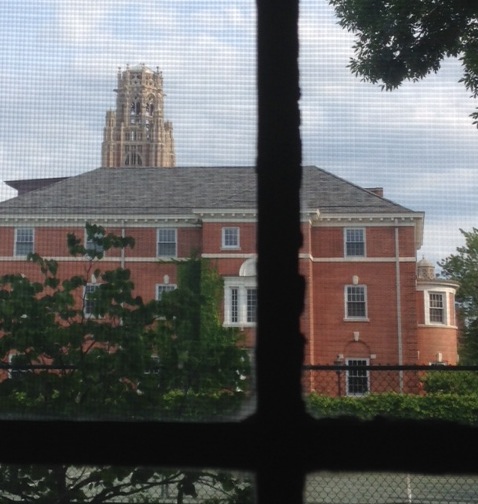
Chicago, Illinois, 2.29 pm
A Congress Representing The Rich
K. Sabeel Rahman unpacks Nicholas Carnes’ White Collar Government, which documents “the dominance of upper class individuals in the composition of legislatures”:
The intuition that class skews politics is mainstream by now, but Carnes provides a novel account of the mechanics of class identity in public policy. The issue for Carnes is not income levels so much as occupational background—the ways in which policymakers have earned their living in the past. Work, in his view, is what most centrally shapes daily life, and as a result, political attitudes. Carnes shows that working-class backgrounds—having the experience of working in occupations that provide little material security and generally require less formal education—characterizes 65 percent of American families, but are vastly underrepresented in Congress. This has major repercussions for Congress’ political views and outcomes. Even when controlling for differences in party affiliation, constituencies, campaign contribution sources, and demographic factors, legislators with working-class backgrounds are systematically more liberal on economics—in both their individual voting records and political attitudes towards issues like the role of government and the importance of social safety net policies. …
In real-world terms, turning the tables would have a major impact. If Congress’s class composition reflected the country as a whole, Carnes estimates it would be more labor-friendly and less business-friendly—enough to flip approximately six major legislative policy issues per term. If we were to reweight the last few Congresses to reflect the country’s actual class composition (while retaining other partisan and geographic features), a host of corporate-friendly liability shields and tax incentives would have failed, as would the Bush tax cuts of 2001 and 2003 and the financial bailout.
Thinking Like A Conservative, Ctd
Last weekend we flagged philosopher Roger Scruton’s new book, How to Be a Conservative. In an interview he expands on his distinctive style of conservatism:
Q: It struck me that the empirical side of your conservatism is also underpinned by what might be call a metaphysics of personhood, a conception of the nature of the human person.
RS: That’s absolutely true. I think it’s what conservatism—my kind of conservatism, at least—shares with liberalism: an attempt to found things ultimately on a vision of what the human person is. Of course, it is the case that conservatism as I envisage it distances itself always from abstract conceptions and tries to find the concrete reality… the good in the present.
Related to this is the emphasis you place on what you call the “first-person plural,” a phrase that occurs several times in the book.
Yes. Ultimately, political order does not generate itself. For that reason, social contract theories are suspended in mid-air, so to speak. All political order presupposes a pre-political order, a sense that people belong together. And then, of course, they might seek a contract that embodies their togetherness. But the togetherness has to be there.
With Oakeshott’s remarks about conservatism as a “disposition” in mind, I was very struck by something you say about the tone of voice in which this book is written. You say: “The case for conservatism does not have to be presented in elegiac accents.” What do you mean by that?
So much of modern political conservatism—and you see this in America, which has a quite articulate conservative movement compared with us—is phrased in elegiac terms. [It’s about] what we’ve lost—we’ve lost the traditional working-class family, the black family or whatever it might be. Now, all that is perfectly reasonable. But the most important question is what have we got, rather than what we’ve lost, and how do we keep it?
Dreher applies Scruton’s insights to his interest in the “Benedict Option” as a “way forward for religious conservatives in this rapidly changing social order”:
We must give up on the hope of restoring the past in this culture. It’s not that some aspects of the past shouldn’t be reclaimed, but rather that doing so, at least at a society-wide level, is not feasible at this point in time. The more we act as if it were so, the greater our losses will be once we definitively lose an unwinnable battle. This “take back America” stuff is self-deluding nostalgia, and the more conservatives believe it, the worse off they will be.
There are times when you have to fade into the forest and retrench. I’ve called this call for retrenchment the Benedict Option, because it strikes me as the most sensible strategy by which religious conservatives can engage the world as it is now and is to come. The Benedictines were ordinarily not completely cloistered; they engaged with the people in the areas where their monasteries were. But they established walls and habits that set them apart from the secular world, and gave them the means to preserve their identity over generations. This is what I’m talking about: how to preserve the core of our identity in a post-Christian culture?
Recent Dish on Dreher’s arguments for the Benedict Option here, here, and here.
Quote For The Day

“The pretensions of human cultures and civilizations are the natural consequence of a profound and ineradicable difficulty in all human spirituality. Man is mortal. That is his fate. Man pretends not to be mortal. That is his sin. Man is a creature of time and place, whose perspectives and insights are invariably conditioned by his immediate circumstances. But man is not merely the prisoner of time and place. He touches the fringes of the eternal. He is not content to be merely American man, or Chinese man, or bourgeois man, or man of the twentieth century. He wants to be man. He is not content with his truth. He seeks the truth. His memory spans the ages in order that he may transcend his age. His restless mind seeks to comprehend the meaning of all cultures so that he may not be caught within the limitations of his own.
Thus man builds towers of the spirit from which he may survey larger horizons than those of his class, race and nation. This is a necessary human enterprise. Without it man could not come to his full estate. But it is also inevitable that these towers should be Towers of Babel, that they should pretend to reach higher than their real height; and should claim a finality which they cannot possess. The truth man finds and speaks is, for all of his efforts to transcend himself, still his truth. The ‘good’ which he discovers is, for all of his efforts to disassociate it from this own interest and interests, still his ‘good.’ The higher the tower is built to escape unnecessary limitations of the human imagination, the more certain it will be to defy necessary and inevitable limitations. Thus sin corrupts the highest as well as the lowest achievements of human life. Human pride is greatest when it is based upon solid achievements; but the achievements are never great enough to to justify its pretensions. This pride is at least one aspect of what Christian orthodoxy means by ‘original sin.’ It is not so much an inherited corruption as an inevitable taint upon the spirituality of a finite creature, always enslaved to time and place, never completely enslaved and always the illusion that the measure of his emancipation is greater than it really is,” – Reinhold Niebuhr, “The Tower of Babel,” in Beyond Tragedy: Essays on the Christian Interpretation of History.
(Image: The Tower of Babel by Pieter Bruegel the Elder, 1563, via Wikimedia Commons)
 The Dish
