Clicking Our Way To Cliché

Philosopher Evan Selinger worries that improved predictive technology “could transform us into what I call personalised cliches”:

[B]y encouraging us not to think too deeply about our words, predictive technology may subtly change how we interact with one another. As communication becomes less of an intentional act, we give others more algorithm and less of ourselves. This is why I argued in Wired last year that automation can be bad for us; it can stop us thinking.

When predictive technology learns how we communicate, finds patterns specific to what we’re inclined to say, and drills down into the essence of our idiosyncrasies, the result is incessantly generated boilerplate. As the artist Salvador Dali famously quipped:

The first man to compare the cheeks of a young woman to a rose was obviously a poet; the first to repeat it was possibly an idiot.” Yet here, the repetition is of ourselves. When algorithms study our conscientious communication and subsequently repeat us back to ourselves, they don’t identify the point at which recycling becomes degrading and one-dimensional. (And perversely, frequency of word use seems likely to be given positive weight when algorithms calculate relevance.)

Of course, we have already experienced techno-panic about texting before. Early worries about texting focused on whether conversing by shorthand would weaken our linguistic abilities, and it turned out to be unfounded. The next stage of autocorrect, I would argue, is different. Predictive texting won’t make our abilities atrophy, but if we over-used a highly functioning version of it, it’s possible that we submit to something dehumanising.

Being There For A Stranger

Craig Lambert considers our propensity to make confidantes of outsiders:

Sociologists call the set of friends and family members people turn to when they want to talk out important matters the “core discussion network.” Its size averages about three people, and for 20 percent of the population, this network, sadly, includes no one. For nearly 30 years, social-network researchers have argued that each person’s closest, strongest ties comprise the core discussion network, but no one has empirically tested that assumption.

[Researcher Mario Luis] Small analyzed data from an online survey of 2,000 adults selected to represent the national U.S. population. Half the respondents were asked to identify their core discussion partners, but the other half were asked to “recall the last time they discussed a matter that was important to them. They were then asked to report on the topic they talked about and the person they talked to,” writes Small. They were also asked to report whom they were close to. These data produced the finding that 45 percent of confidants were people whom the respondents did not consider personally important; they were often not the family and close friends social scientists thought them to be.

Instead, a confidant might well be a barber or beauty-salon employee, a bartender, a therapist (either physical or psychological), or a trainer at the gym; they are priests, rabbis, doctors, and financial advisers. …

“In fact, we often avoid using people who are close to us as confidants,” Small explains, “exactly because they are important to us.” For one thing, a troublesome issue might concern that potential listener directly: one classic case is an extramarital affair. Another obstacle can arise if the discussion would worry the confidant: “A graduate student running short of money might not talk about this with his parents, out of fear of worrying them,” says Small. Third, people have more at stake in how important others see them. “If you are close to your sister, you don’t want to talk with her about some borderline-unethical action you are considering,” he explains. “You care a lot about her opinion of you.” And fourth, people avoid confiding in others because, inevitably, word gets around to someone else: in Small’s formulation, “Amy won’t talk to Bob about this, because then it will get to Charles.”

The Ruling We’ve Been Waiting For?

US-JUSTICE-GAY-MARRIAGE

News broke on Friday that SCOTUS will rule once again on marriage equality. Orin Kerr predicts a historic victory:

The briefing schedule indicates that the Court will hear oral argument and decide the cases by the end of June — this Term rather than next Term. I don’t think there’s a lot of uncertainty as to how the Court will rule. Justice Ginsburg’s extrajudicial statements are usually a reliable guide, and her past comments suggest that there are already five votes for a right to SSM.

Garrett Epps considers the possibility of a mixed decision:

[E]ven if Justice Anthony Kennedy’s vote seems foreordained, he must choose between the rights of gays and lesbians—an issue on which he has fashioned a historic legacy—and the prerogatives of the states, about whose “dignity” and honor he has often rhapsodized. He might be tempted to split the baby by holding for the states on the “celebration” issue but for the challengers on “recognition.” (The Court’s grant of review was careful to split the two questions.) That is, he might say, a state could refuse to perform marriages itself, but could not refuse those legally married out of state the benefits of marriage under state law.

But, in a later post, Epps downplays the chances of such a scenario:

Some justices (I name no names) seem to enjoy writing like patent-medicine pitchmen. But even those most critical of Kennedy must admit that his written opinions are achingly, crushingly sincere. He is never just President of Hair Club for Men; he is always a member too. “Recognition” and “celebration” go together like a horse and carriage. I don’t see a way to split them that would allow the Court—or its key justice—to escape this term’s rendezvous with destiny.

David B. Cruz also imagines possible rulings:

It is unthinkable to me that the Court would now turn around and tell the people who married only after it cleared the way for them to do so that the Court was wrong to do that and their marriages were void.  I suppose the Court could say, okay, couples already married are protected but other couples in any state where marriage equality exists due to court decree would henceforth not be able to marry.  …

Far more likely it is that the Court will issue a decision holding that the Constitution protects same-sex couples’ right to marry – probably by a five-to-four vote judging from the Justices’ positions in the Windsor decision (unless Chief Justice Roberts flip-flops and decides that although his Windsor dissent argued that state marriage exclusions were distinguishable from the federal law partially invalidated in Windsor, on reflection he’s concluded that’s wrong and so, accepting Windsor as precedent, the same-sex couples here win).

Brianne Gorod and Judith E. Schaeffer likewise wonder if Roberts’ vote is gettable:

Roberts has seen what a watershed decision Windsor has been, and he must surely recognize that if the Windsor majority takes the final step to recognize full marriage equality (as it should), that decision will be even more historic and undoubtedly one of the greatest legacies of the Roberts Court. Will Chief Justice Roberts be content to have such a momentous ruling be issued over his dissent, or will John Roberts want to be part of one of the greatest legacies of the Roberts Court?

Ilya Somin thinks the “prospects look good for the pro-same-sex marriage side”:

Thanks to a combination of judicial decisions and legislative changes, there are now 36 states that recognize same-sex marriage. That creates a very different situation than existed even a few years ago, when same-sex marriage was only legal in a small minority of jurisdictions.

Furthermore, both elite and public opinion have moved strongly in a pro-gay marriage direction in recent years. Even some conservative evangelicals have begun to step back from opposing same-sex marriage. The Court certainly does not always follow public opinion. But if a majority of justices are inclined to endorse a constitutional right to same-sex marriage, they are now unlikely to be deterred from doing so by fear of a massive political backlash, of the sort that would have greeted such a ruling a decade ago.

Dale Carpenter agrees that marriage equality is likely to prevail. He emphasizes that “how the Court decides to reach that result is also important”:

Nationwide legalization of same-sex marriage would be a huge victory for gay couples and their children, but it won’t immediately end discrimination against them or against gay people in general. What the Court signals in its decision about the constitutionality of other anti-gay legislation will have substantial legal effects down the road, just as the Court’s decision in Romer v. Evans put an end to growing state-wide efforts to repeal all civil rights law protecting gay people.

One of the court’s options:

The Supreme Court could clear up any remaining doubt by squarely holding that classifications based on sexual orientation are subject to heightened (or close or searching or intermediate) scrutiny. The analysis would be: first, laws denying marriage licenses to same-sex couples are a form of sexual-orientation discrimination because of the close connection between the classification and sexual orientation (like the connection between yarmulke-wearing and Jewishness); second, laws discriminating against gay people raise the usual concerns that justify heightened scrutiny; and third, the state can’t justify the discrimination under the heightened standard.

A suspect-classification decision would logically dispose of proposals like MARFA, the Virginia anti-gay licensing bill, and the anti-gay government-workers bill in Texas. Laws like that would then either be declared unconstitutional as written or would have to be written so as not to target same-sex couples, in which case they might be subject to other constitutional attacks.

Steve Sanders expects that the “question of animus will be prominent – perhaps pivotal – in this final phase of marriage litigation”:

So far, the arguments made by plaintiffs have been remarkably sterile, emphasizing formal equal protection and due process arguments and failing to say much about how the mini-DOMAs actually came into being. But such a picture is incomplete. To fully consider the constitutionality of the remaining anti-marriage laws, we must lift up these proverbial rocks to see what was festering underneath them.

And Richard Socarides looks beyond the ruling:

It’s not unreasonable to expect that the Supreme Court will make same-sex marriage legal in all fifty states. The question, for longtime marriage-equality activists, is what exactly will this achieve, and what will happen next? Will nationwide marriage equality lead in time to full nationwide acceptance, or will they discover, like many civil-rights activists before them, that there is a big gap between legal rights and true equality? This is a big moment for the gay-rights movement, and an important one in which to remember that there is likely more struggle ahead.

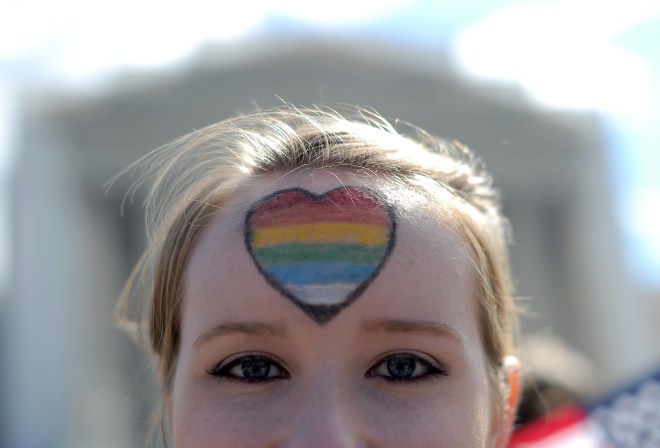
(Photo: A same-sex marriage supporter has her forehead painted with rainbow colors as she joins demonstration in front of the Supreme Court on March 27, 2013 in Washington, DC. By Jewel Samad/AFP/Getty Images)


Our Driverless Future

Google expects the public will be using their driverless cars within two to five years. And there appears to be high demand:

According to a study, as many as 12 million driverless cars—that’s 10% of annual sales of new vehicles—could hit the world’s roads just twenty years from now.

But Emily Badger is unsure how driverless technology will change the auto market:

Here are just two competing theories: Autonomous cars will reduce car ownership, because we’ll simply be able to order them when we need them, and they’ll come to function as shared assets akin to public transit. Alternatively: Autonomous cars will increase car ownership because, as the utility of each vehicles rises (now you can send your 7-year-old to ballet alone!), people will want to own even more of them. These hypotheses are equally plausible and mutually exclusive.

So are a lot of other theories around how autonomous cars will change our travel behavior. If they make travel easier, perhaps autonomous cars will induce new trips that we aren’t making today. You’ll never have to say to yourself on a Friday night, “I think I’ll stay home because I can’t find parking/don’t want to deal with traffic/don’t want to drive home drunk.” As a result, the number of trips and the number of miles we collectively travel could increase.

Or, maybe, autonomous cars will create new efficiencies, enabling better carpooling, less idling in traffic, and smarter route-planning. Computers won’t waste gas getting lost or circling for parking spots. And, as a result, total miles traveled and greenhouse gases will decline.

Stephen L. Carter dismisses some common concerns about the cars:

The most common worry seems to be that the computers that run the cars might be hacked. And there are larger fears. Last summer, the Guardian quoted a restricted report from the Federal Bureau of Investigation warning that criminals or terrorists might use driverless cars to their advantage. Imagine a car bomb whose builder doesn’t need to go to the trouble of recruiting a sufficiently fanatical driver.

These warnings, however, may be less dire than they seem. Yes, there might be harm if the cars were hacked, but that risk would likely be offset by a sharp reduction in drivers operating under the influence of drugs or alcohol. And, yes, terrorists would most certainly find a way to turn autonomous cars to their advantage. But terrorists will find a way to turn every new technology to their advantage. That’s a reason to fight a war on terror, not a war on technology.

Built To Thrill

dish_hanegipark

On a trip to Japan’s Hanegi Playpark, or “Savage Park,” Amy Fusselman found herself surrounded by “structures that looked like what remained when my sons decided to build an airport out of Legos and then abandoned the project halfway through.” She reflects on the history of such free-wheeling “adventure parks”:

A very good resource for someone who is interested in going to a playpark and picking up a hammer and nails and pounding away at scraps of crap to make something is the work of the 19th-century British writer John Ruskin. In Ruskin’s On Art andLife, a contemporary repackaging of two of his essays, “The Nature of Gothic” and “The Work of Iron, in Nature, Art, and Policy,” he offers a moving plea for allowing men—in particular, the men who built the Gothic cathedrals of the age—to be, as he says, “fully men” and not mere tools of the architect; to be allowed to use their imaginations in their work, to be allowed to make mistakes.

Let him but begin to imagine, to think, to try and do anything worth doing; and the engine-turned precision is lost at once. Out come all his roughness, all his dullness, all his incapability; shame upon shame, failure upon failure, pause after pause: But out comes the whole majesty of him also; and we know the height of it only when we see the clouds settling upon him. And whether the clouds be bright or dark, there will be transfiguration behind and within them.

In this, written more than a 150 years ago, he articulated why my modern-day love of Savage Park was so immediate. It wasn’t just that the children were flying in the air there, it wasn’t just that they were making insanely great structures, it wasn’t just that the playpark hut was a junk lover’s dream. It was because the place existed at all for just this reason: the full and complete allowance of a self, including all the ineptness, failure, and possibility of death—because it is understood that only with this allowance do we have the capacity to be great.

(Photo of Hanegi Park’s “Play at your own risk” area by Driscoll Reid & Bonnie McElfresh)

Was Selma Really Snubbed? Ctd

An insider joins the debate, quoting a reader:

A qualified film not receiving “enough” nominations is no reflection of the quality of the film. Instead, it’s simply a failure of the film’s PR hacks’ effectiveness at marketing directly to the Academy voters. It’s not the film’s fault, nor is it the Academy’s fault; it’s the film’s publicists’ fault. In the case of Selma, I’ve seen more publicity for Paddington.

I’ll call bullshit on that one. To say Paramount’s failure to get a screener to guild members on time is the reason for Selma‘s failure to nominate director Ava Duvernay is condescending to those members that vote on said nomination. As a Producers Guild member, almost every member I know sees it as their responsibility to see all the major potential nominees and they take that responsibility seriously. Aside from screeners, you’ll notice at the bottom of your local paper advertisements for the prestige films a notice that guild members are accepted free at all the major multiplexes. Combine that with the screenings the studios hold before and after a film’s release in not only New York and L.A., but also San Francisco, Atlanta and Chicago, there are plenty of opportunities for guild members to see all of the pictures. Being in the Academy especially is a big honor (besides being an organization that’s very difficult to join) and Academy members treat the nominations period like the High Holidays.

And it may just be that Duvernay’s lack of a nomination has nothing to do with the color of skin but rather the fact that Selma is, frankly, a good but not great movie.

While her approach is refreshingly unsentimental in its portrait of not only King but other heroes of the Civil Rights movement, from a nominating standpoint, historically the Academy likes movies that make the heart ache. Selma‘s exacting and serviceable portrayal of the political minefield Dr. King and his fellow activists had to wade through didn’t strike that nerve – at least among the Academy folks I saw the movie with. Of course, one can say, well then, by that logic Steven Spielberg shouldn’t have gotten a nomination for Lincoln. But the latter film had an artistry that Duvernay lacked.

Of course, that’s just my opinion – but apparently a lot of other guild members agree with me. But Duvernay can take heart that Christopher Nolan was also snubbed as Best Director and I guarantee we’ll still be talking about Interstellar ten years from now. But that’s the Oscars for ya.

Two cents from another reader:

What’s intriguing about this snub is that Selma is exactly the type of movie the academy generally loves. It’s historical, ostensibly a biopic, liberal, and most crucially, “important.” It’s an issue-driven film.

My main take away from the nominations is that four of the films – Boyhood, Birdman, The Grand Budapest Hotel, and Whiplash – are all quirky, independent, character-driven films. Basically, they are movies that don’t usually get a lot of love from the Academy. Think about it: Richard Linklater – Linklater! – is the front runner for best director. For film buffs (er, snobs) like myself, that is a huge thing.

Another:

I am with your reader who wonders why the only “people of color” who seem to matter when people are counting heads (or faces, as it were) are African-Americans, not Hispanic or Asian artists. (I also agree that the first issue is who is writing, directing, and starring in the movies, which necessarily determines the pool of potential nominees.) Last year, people were up in arms that Saturday Night Live didn’t have any black women (but did have two black men), but no one seems to mind that the only Hispanic cast member in recent memory is Horatio Sanz (and I can’t think of another one in its 40-year history).  And I don’t think they’ve ever had an Asian cast member, unlike the Daily Show.  (Asian-Americans have become a significant force in the comedy world – Mindy Kaling, Aziz Ansari, Aasif Mandvi, not to mention Margaret Cho – yet they are nowhere on SNL.)

The show “ER” had a similar track with Hispanic characters.  I watched the show for its entire run and can recall one Hispanic doctor – John Leguizamo, whose character was an irresponsible drug user who crashed and burned.  In contrast, there were many, many African-American doctors, including one of the main characters in the original cast.  (And plenty of Hispanic nurses and patients.)  They also reflected a diverse population in other ways – several gay or lesbian doctors and one with a physical disability.

In short, it’s time for people to realize that we are not just a country of black and white people, that we are a multicultural country with many different nationalities and ethnic groups, and that any discussion of diversity needs to look beyond these two categories.

Update from another reader:

I have to call bullshit on your “insider” calling bullshit. My partner is a member of the Academy and STILL hasn’t received his screener of Selma … and neither have many people he’s talked to. We were invited to a screening for Academy members in LA that took place on the Sunday night before Christmas. Since it was my partner’s first day off in many months and we had relatives coming in town the next day, we declined to attend, assuming a screener would arrive in the mail any day. It’s true that members can watch the films at most theaters for free, but the time between Selma‘s release and the nominations was a very small window during the holidays. If Al Sharpton wants to have an “emergency meeting” in Hollywood about the supposed snub, perhaps he should start with the marketing department at Paramount. They clearly failed to do their job.

Shining Light On The Underground Railroad

dish_darknesstolight

In a review of Eric Foner’s new history of the Underground Railroad, Gateway to Freedom, Jennifer Schuessler reflects on the various ways scholars have understood the way slaves escaped north to freedom:

The first scholarly study of the Underground Railroad, published by Wilbur Siebert in 1898, named some 3,200 “agents,” virtually all of them white men, who presided over an elaborate network of fixed routes, illustrated with maps that looked much like those of an ordinary railroad. That view largely held among scholars until 1961, when the historian Larry Gara published “The Liberty Line,” a slashing revisionist study that dismissed the Underground Railroad as a myth and argued that most fugitive slaves escaped at their own initiative, with little help from organized abolitionists. Scholarship on the topic all but dried up, as historians more generally emphasized the agency of African-Americans in claiming their own freedom.

But over the past 15 years, aided by newly digitized records of obscure abolitionist newspapers and local archives, scholars have constructed a new picture of the Underground Railroad as a collection of loosely interlocking local networks of activists, both black and white, that waxed and waned over time but nevertheless helped a significant number reach freedom.

Wendy Smith notes that Foner “gets his detailed information about the workings of the underground railroad during this fraught period from two invaluable contemporary documents”:

The first is a Record of Fugitives compiled in 1855-56 by Sydney Howard Gay, white editor of the National Anti-Slavery Standard, who recounted the journeys of more than 200 runaways who passed through his Manhattan offices. The second is the journal of William Still, son of a fugitive slave and leader of the Philadelphia Vigilance Committee, which played a vital role because of southern Pennsylvania’s proximity to Delaware, Virginia and Maryland, sources of most fugitive slaves.

Using these documents and others, Foner puts names and faces to activists less famous than Harriet Tubman (who makes a brief appearance) but more important to the functioning of the underground railroad. While Tubman rescued some 70 slaves, Jermain W. Loguen of Syracuse was credited with assisting 1,500 fugitives; Thomas Garrett, one of the many Quakers active in the underground railroad, helped more than 2,200 people cross the Delaware border to freedom.

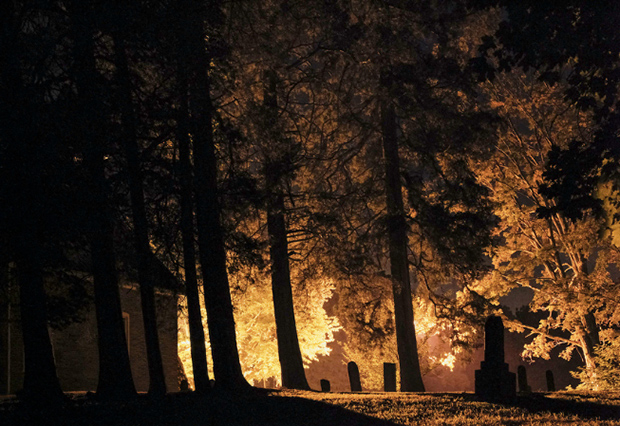
(Image courtesy of Jeanine Michna-Bales, whose photography project Through Darkness to Light retraces the Underground Railroad)

Dissent By Design

Cassie Packard reviews Disobedient Objects, an exhibition at London’s Victoria and Albert Museum devoted to examining “the powerful role of objects in movements for social change”:

The disobedient objects in the exhibition range from the more tactically frivolous, like the [inflatable] cobblestones [from a 2012 May Day demonstration in Berlin-Kreuzberg], to the blindingly necessary, like DIY tear gas masks. They are largely the products of various left-wing grassroots social movements, though a few objects made in service of paramilitaries — but questionably dressed in the show’s glamorizing rhetoric of left-wing activism — make it into the mix. On the whole, the exhibition is right on trend, combining a growing public interest in design activism with a recent popularization of “object”-centered museum exhibitions and publications. …

In one section of the exhibition is a collection of handmade “book blocs,” a functional riff on the riot shield in which Plexiglas and cardboard are made to resemble oversized book covers. Wielded by groups protesting tuition hikes and budget cuts to education programs, these blocs put police in the bizarre position of physically assaulting oversize books when they attack protestors. It’s a memorable image, and one that certainly drums up attention for its causes as it’s disseminated on the web. Another standout is the Spanish-born “flone” [see above video], an economical marriage of laser-cut plywood and open-source software. “Reinventing airspace as public space” in an age of insidious drone warfare, the flone allows the user to fly his or her smartphone for the purpose of filming police and demonstrations. Of all the items on display, it is the flone whose revolutionary potential feel the most formidable.

In an earlier review, Alice Bell also praised the exhibit:

Entering the gallery, you are greeted with rows of metal poles holding up the displays. An allusion to the bars of prison walls, they also offer the basis for one of the best exhibits: a history of the “lock-on” technique used by activists to attach themselves to each other and/or objects. … [A] history of lock-ons and the Capitalism is Crisis banner [made for the 2009 Blackheath Climate Camp] are as much part of modernity as a gallery of wedding dresses. Their arguments are part of the hard tissue of our world, even if we don’t always recognise it. As are the history of the pink triangle, a collection of anti-apartheid badges and a simple poster-paint-and-cardboard banner that declares “I wish my boyfriend was as dirty as your policies”, all also displayed in the gallery. It’s not complete – there are many protest movements missing – but it’s diverse and engaging.

In another earlier review, Victoria Sadler noted that she “found this a very emotive exhibition, one that drives up a lot of anger and frustration”:

Supporting the exhibits is a number of video clips, including footage from protests such as Tiananmen, the Middle East, Seoul and Japan. The level of violent resistance from the state in almost all instances is incredibly depressing. And the disproportionate use of that violence can be harrowing to watch.

Watching again the tanks of the Chinese Army toppling over the 30ft Goddess of Democracy in Tiananmen Square was quite distressing, as it was to see the footage from Palestine of kids throwing stones with their slingshots, only for their pebbles to be met with gunfire. The V&A has managed to obtain one of these slingshots, a makeshift item created from the tongue of a child’s trainer, and alongside this VT this really had an impact. Included in the video clips is commentary and observation from those that have been active in protest movements, or who have studied them.

It’s eye-opening to listen to how these movements do bring in the egalitarian principles and community consciousness they want to see in the world, but how they also struggle with gender and class structures within their own ranks. But it was easy to agree with these commentators that change has only come about from direct action, from challenges to property and power, rather than negotiation and dialogue.

The exhibition runs through February 1st.

The Second American Revolution?

1024px-Contrabands_at_Headquarters_of_General_Lafayette_by_Mathew_Brady

Allen Guelzo walks us through the various ways the Civil War has been thought of as marking a break from the past, from military affairs to law and politics, before asserting that “certainly we should say that the Civil War was revolutionary in one overwhelming respect, and that was the emancipation of 3.9 million black slaves.” But that argument is more complicated than you might think:

Here, we do strike a genuinely discontinuous, revolutionary note, for the Civil War not only violently excised all legal traces of slavery from the Constitution, but practically destroyed all the wealth invested in it, to the tune of nearly $3 billion. But was the overall goal of emancipation actually a revolutionary one? We tend to think of slavery today almost purely in terms of race, as a racial offense and a racial injustice, to be remedied only by full social and political equality. And in that sense, emancipation was a revolution, for in the long history of Western society, it was without precedent for a slave population of such magnitude to be absolutely and immediately emancipated, without compensation to its owners, and then boosted at once into the realm of citizenship.

But in the eyes of the emancipationists, racial redemption was not, in fact, the principal goal.

The fundamental offense posed by slavery in their eyes was that it represented a step away from a democratic political order, and its replacement with the kind of Romantic aristocracy that reestablished itself in Europe after the French Revolution. What Lincoln hated in slavery was not just its racial injustice, but the reemergence in America of the old demon of monarchy, where some people were born with uncalloused hands, booted and spurred and ready to ride on the backs of everyone else, who had to work. Owning slaves, Lincoln complained, “betokened not only the possession of wealth but indicated the gentleman of leisure who was above and scorned labour,” and it appealed to “thoughtless and giddy headed young men who looked upon work as vulgar and ungentlemanly.” Slavery’s tendency to promote aristocratic habits and attitudes made Lincoln regard it as “the one retrograde institution in America”—not because it was racially unenlightened, but because it was “fatally violating the noblest political system the world ever saw.”

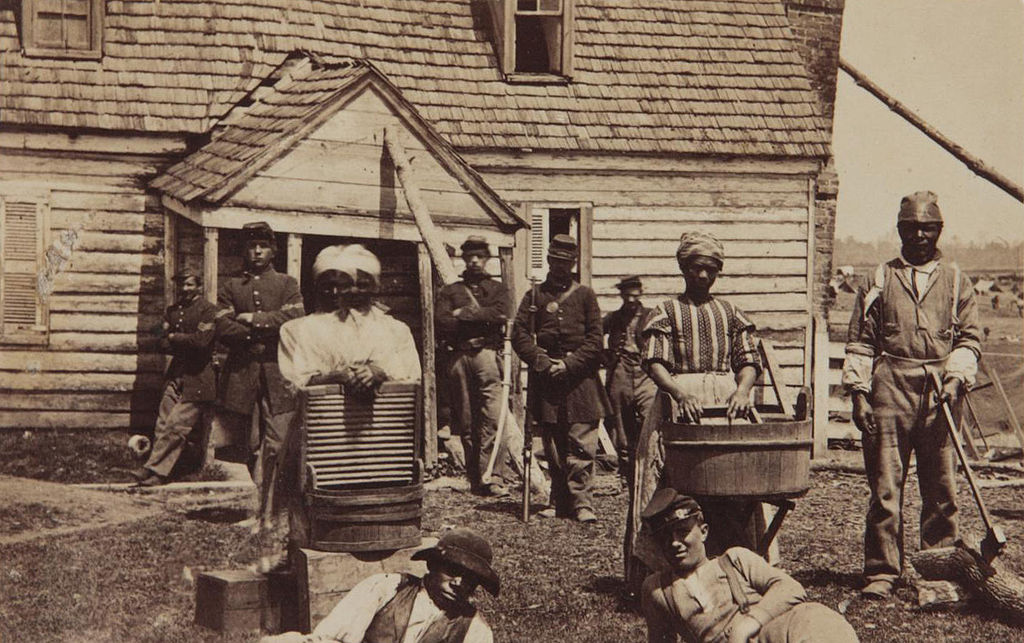
(Image: Fugitive slaves who had fled to the Union Army in 1862, just a year before the Emancipation Proclamation, via Wikimedia Commons)

MLK’s “Other America”

King delivers a speech, “The Other America,” before an audience at Stanford University on April 14, 1967:

Eugene Robinson looks back at how King, in the final weeks of his life, increasingly turned his focus to Americans plagued by poverty – “the other America”:

King explained the shift in his focus: “Now our struggle is for genuine equality, which means economic equality. For we know that it isn’t enough to integrate lunch counters. What does it profit a man to be able to eat at an integrated lunch counter if he doesn’t earn enough money to buy a hamburger and a cup of coffee?”

Robinson continues:

[W]hat King saw in 1968 — and what we all should recognize today — is that it is useless to try to address race without also taking on the larger issue of inequality. He was planning a poor people’s march on Washington that would include not only African-Americans but also Latinos, Native Americans and poor Appalachian whites. He envisioned a rainbow of the dispossessed, assembled to demand not just an end to discrimination but a change in the way the economy doles out its spoils.

King did not live to lead that demonstration, which ended up becoming the “Resurrection City” tent encampment on the National Mall. Protesters never won passage of the “economic bill of rights” they had sought.

Today, our society is much more affluent overall — and much more unequal. Since King’s death, the share of total U.S. income earned by the top 1 percent has more than doubled. Studies indicate there is less economic mobility in the United States than in most other developed countries. The American dream is in danger of becoming a distant memory. … Paying homage to King as one of our nation’s greatest leaders means remembering not just his soaring oratory about racial justice but his pointed words about economic justice as well. Inequality, he told us, threatens the well-being of the nation. Extending a hand to those in need makes us stronger.

Max Ehrenfreud, citing Robinson’s article, remarks that “persistent economic inequality has arguably undermined some of the most important achievements of the civil rights movement”:

Legally, our schools are integrated, but in practice, research suggests they’re becoming more segregated. White and black children in kindergarten and younger are much more likely to be separated from each other than whites and blacks in the population at large, which is largely because black families still can’t afford to live in the neighborhoods with the best schools, as Emily Badger has explained. And while segregation between neighborhoods has been steadily decreasing, there are still many places like Ferguson, Mo. where the economic ramifications of decades of racially biased business practices and government policies keep low-income blacks from finding a way out.

It’s often said on Martin Luther King Day that the civil rights movement still has unfinished business, but somehow, the events of the past year seem to have made that fact especially clear.

Read the text of the speech above here.