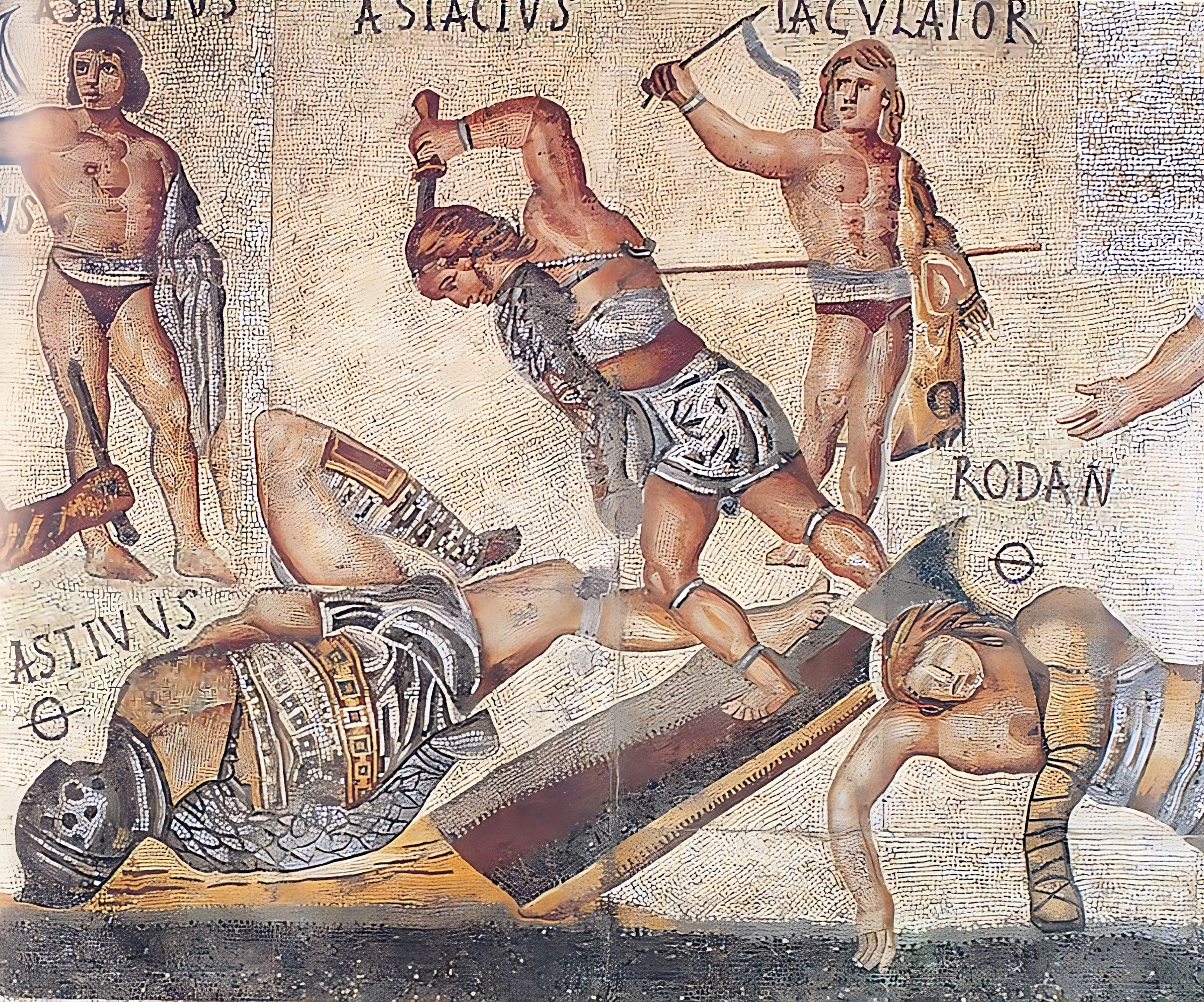
A Poem For Thursday

Retiarius_vs_secutor_from_Borghese_mosaic

“Colosseum” by Jericho Brown:

I don’t remember how I hurt myself,
The pain mine
Long enough for me
To lose the wound that invented it
As none of us knows the beauty
Of our own eyes
Until a man tells us they are
Why God made brown. Then
That same man says he lives to touch
The smoothest parts, suggesting our
Surface area can be understood
By degrees of satin. Him I will
Follow until I am as rough outside
As I am within. I cannot locate the origin
Of slaughter, but I know
How my own feels, that I live with it
And sometimes use it
To get the living done,
Because I am what gladiators call
A man in love—love
Being any reminder we survived.

Previous poems from Brown here and here.

(From The New Testament © 2014 by Jericho Brown. Used by permission of Copper Canyon Press. Detail of the Gladiator Mosaic, 4th century CE, via Wikimedia Commons)

The Other American Expansionism

Julia Belluz flags new research showing that American waistlines continue to grow:

Overweight peopleResearchers looked at waist circumference measurements taken from over 32,000 adults in 1999 and 2012. During that period, participants’ waists grew nearly a whole pants size, from 37.6 inches to 38.8 inches. Some groups gained an even more significant amount of abdominal girth. White women, aged 40 to 49, experienced a 2.6-inch expansion; the waists of black men, aged 30 to 39, got padded with 3.2 extra inches; Mexican-American men, aged 20 to 29, added 3.4 inches to their frames; Mexican-American women over the age of 70 packed on 4.4 inches; and black women between the ages of 30 to 39 increased their waists by 4.6 inches. (Abdominal obesity was defined as a waist circumference greater than 40 inches in men and 35 inches in women.) That racial minorities are experiencing greater gains maps on to the fact that they’re also disproportionately struggling with obesity compared to white people in the US.

Interestingly, Americans’ average body mass index has held relatively steady over the past decade. Or as Alison Bruzek puts it, “People haven’t been getting fatter, but their waistlines are still increasing”:

“We’re a little bit puzzled for explanations,” Dr. Earl Ford, a medical epidemiologist at the Centers for Disease Control and Prevention and lead author of the study, tells Shots. The two measures are closely related: While body mass index or BMI measures fat overall, waist circumference helps measure fat distribution. Stress, hormonal imbalances, environmental pollutants, poor sleep or medications that help pack on abdominal weight are possible causes, health and nutrition researchers speculate. And older adults typically lose muscle as they age, while fat continues to increase.

(Photo by myLoupe/Universal Images Group via Getty Images)

When Cannabis Is No Longer A Crime

Sam Kamin and Joel Warner expect that, “as marijuana prohibitions continue to weaken and an increasing number of states reconsider stringent drug sentencing rules, people could begin to lobby to remove more serious pot convictions from their rap sheets or even get out of prison”:

However, if either the courts or clemency boards take up the work of reviewing past marijuana convictions, they will have to tackle a very thorny issue: Convictions don’t always match the crime that was committed. Many of the low-level offenders who might seek clemency struck plea deals with prosecutors, and those negotiations can obscure the underlying crimes. UCLA drug policy expert Mark Kleiman offers an example: “It’s entirely possible that a guy was charged with possession with intent to distribute cocaine and cannabis, and the plea bargain he pled to was just the cannabis charge.” So how do you determine, sometimes many years later, whether a given conviction actually corresponds to a defendant’s true criminal culpability? And even if a marijuana conviction does in fact correspond to a marijuana offense, are all marijuana offenses created equal? Should it matter whether the 12 ounces of pot someone was busted with came from small-scale farms in Humboldt County, California, or were imported from Mexico by drug cartels?

Fascinating. At some point in the future, if and when cannabis is seen as the simple plant and medicine that it is, those behind bars – some for life – for non-violent offenses involving cannabis are going to seem awful victims of a regime long since discredited. Some relief will surely have to be granted – but I can sure see the complexities.

The North Profited From Slavery Too

Slave_Market-Atlanta_Georgia_1864

In his new book, The Half Has Never Been Told: Slavery and the Making of American Capitalism, Edward E. Baptist details how “the commodification and suffering and forced labor of African Americans is what made the United States powerful and rich.” Excerpt from the book here. Yglesias puts Baptist’s approach in context, explaining that he is countering “a tradition which views slavery as a kind of archaic institution … a New World form of feudalism that was doomed by the growing tide of industrialization”:

First, he shows that the slave economy was as modern as any other aspect of the mid-19th Century. There were, for example, slave-backed mortgages and other sophisticated financial products. So the genre of social history which pits old-timey southern agrarianism against modernizing northern industrialism is simply mistaken — major proprietors on both sides of the Mason-Dixon line participated in the rise of modern financial institutions.

Second, he argues that the slave economy’s success was critical to the larger success of what we call the Industrial Revolution. This is commonly portrayed as a question of technology — spinning jenny, mechanical loom, etc. — but developing the modern textile industry also required an enormous amount of fiber as inputs. All that technology would have run into fundamental ecological limits if you’d tried to fuel the factories with British wool. There isn’t nearly enough space for all the sheep.

Riding to the rescue was American cotton. In the 70 years between the adoption of the Constitution and the outbreak of the Civil War, US production rose 2,000-fold from 1.2 million pounds to 2.1 billion pounds.

Update from a reader:

The North absolutely profited from slavery, but the United States as a whole became a whole lot richer by ending it. This post from Scott Sumner is a good summary for all the reasons why.

(Photo of a slave market in Atlanta, Georgia, 1864, via Wikimedia Commons)

A Lesbian Genius To Watch Out For II

Cartoonist and 2014 MacArthur fellow Alison Bechdel may be best known for her eponymous sexism screening tool, but Alyssa Rosenberg believes more people should be familiar with the comic strip that put her on the map:

“Dykes to Watch Out For” dives deep into a fictional lesbian community, considering the impact of transgender politics, marriage and even the death of independent bookstores on her characters. Pop culture as a whole has had an unfortunate tendency, upon telling the stories of white, affluent gay men (and, less often, lipstick lesbians), to consider its task of diversification complete. “Dykes to Watch Out For,” which ran from 1983 to 2008, when Bechdel put it on hiatus, is a testament to just how much material other projects and other media have left on the table.

Her characters were multi-generational, multiracial and in all sorts of relationships, including marriages to gay men and house-sharing arrangements. They also ranged up and down the class spectrum: Mo Testa, the main character, started out as a bookstore clerk and ended up as a reference librarian, Toni Ortiz was a certified public accountant and several other characters were academics.

I always enjoyed the strip – a dykey Doonesbury that also managed to convey the complexity and nuance of lesbian life. Tim Teeman takes the opportunity to revisit a 2012 conversation he had with Bechdel about “Dykes”:

She secretly nursed ambitions that Dykes would become a crossover success: “It never did, but it’s been absorbed, grandfatherly, into the canon.” The strip ran from 1983 to 2008, though Bechdel told me in 2012 she was planning to reunite the women for more adventures. She says she had fun “playing them all off against each other,” debating the political issues of the day—and as this was the 1980s and 1990s, far from the relatively sunny uplands of today’s increasing climate of lesbian and gay equality and acceptance, there was much to debate, laugh mordantly, and grizzle over.

The advance of lesbians and gay men in pop culture has a depressing price, Bechdel said. “When I see what’s on television, it’s sad that queerness has become as commodified as heterosexuality,” she said. “The rough edges have gone. I have nostalgia for the bad old days.”

Alex Abad-Santos praises her graphic memoirs, Fun Home: A Family Tragicomic and Are You My Mother?: A Comic Drama:

Bechdel’s works are introspective and personal. They are examples of how graphic novels and comic books can tackle serious themes and explore complex, chewy topics. In 2006, she published Fun Home, a graphic memoir about her turbulent relationship with her father … Bechdel was fearless in telling her story in Fun Home. The book interweaves timelines and characters before building to a devastating emotional climax. It’s as much a story of her own coming of age and coming to terms with her homosexuality as it is a story about how her father was unable to leave the closet — instead living a life as an ostensibly straight funeral home director.

Fun Home is also a smart take on how women learn to define themselves and create their identities as they grow up in a patriarchal society — and how all of that does and doesn’t differ for lesbians. And on top of all of that, it’s a story of coming to terms with one’s homosexuality in a world where such topics aren’t often discussed openly. Fun Home is Bechdel’s most significant work, and it’s where those who are curious about her comics should start.

Meanwhile, Dylan Matthews considers the MacArthur Foundation’s track record:

“The MacArthur Fellowship is not a lifetime achievement award,” the foundation writes. “We are looking for individuals on the precipice of great discovery or a game-changing idea.” The list of past grantees suggests this happens sometimes – and when it does, the Foundation’s prescience is striking. Cormac McCarthy had written four novels before receiving the grant, but the ones that would make his name — Blood MeridianAll the Pretty HorsesThe Road — all came after. Henry Louis Gates was an assistant professor at Yale when he got the award, and went on to become a massively important public intellectual. Michael Woodford — now the world’s greatest monetary economist — got the grant while 26 and still in grad school. Stephen Wolfram, inventor of Mathematica and Wolfram Alpha, got the award at 21.

But far more common in the fellowship, in 1981 and afterward, are established academics, activists, and writers whose best work was already behind them. Robert Penn Warren wrote All the King’s Men a full 35 years before his grant. Stephen Jay Gould had already developed his theories of evolutionary spandrels and punctuated equilibrium, and become a prominent public intellectual through his war on sociobiology and his column in Natural History. Richard Rorty had become perhaps the most famous philosopher in America two years prior to his grant, with his Philosophy & the Mirror of Nature. David Foster Wallace wrote Infinite Jest the year before his grant. Tim Berners-Lee invented the World Wide Web eight years before his. Andrew Wiles proved Fermat’s last theorem four years before his. Marion Wright Edelman was perhaps the major outside player in debate over national child care in the early 1970s – more than a decade before her award.

You can’t really defend these kinds of grants on “investing in potential” grounds. These people had already made it.

It’s worth noting also that the list has long had a left-liberal bias – almost no conservatives are even considered, it seems to me. To some, it’s self-evident that a non-liberal could actually be a genius.

Why Do Doctors Kill Themselves So Much?

Alexandra Sowa McPartland describes a crisis in the medical profession:

Doctors commit suicide at a rate more than twice the national average. Every year approximately 400 physicians take their own lives. That is roughly one per day, or the equivalent of two entire graduating medical classes each year.

As a recent graduate of an internal-medicine residency, I know that physician depression and suicide are not routinely discussed in medical school or training. Significant time is given in medical education on how to recognize depression and suicidal thoughts in patients, but never once did I hear of my own increased risk of suicide.

One might expect that older physicians, after years in an emotionally and often physically taxing profession, bear the burden of an increased suicide risk. But it is really a phenomenon of young physicians. Suicide accounts for 26 percent of deaths among physicians aged 25 to 39, as compared to 11 percent of deaths in the same age group in the general population.

Whither Now, Ukraine?

Michael Weiss’s overview of the situation in Ukraine today touches on several salient topics—corruption, nationalism, the economy, Russia—and is worth a full read. Here, he addresses the law the Ukrainian parliament passed this week granting a measure of autonomy to the country’s eastern regions:

There are already signs that Ukraine and Russia will interpret it differently. The Russian Foreign Ministry, for instance, said in a statement that the law grants the “development in certain regional districts of cross-border cooperation designed to deepen good-neighborly relations with the Russian Federation’s administrative and territorial units,” which is a pretty way of describing a breakaway autonomous zone removed in all but name from the central authority in Kiev. … For their part, the Ukrainians who elected Poroshenko largely on his campaign promise to ensure the territorial integrity of their country fear that this deal is another kind of sellout: the de facto ceding of the Donbass to Russia, or the perpetuation of an occupation in all but name. This is why protests objecting to the special status law have recently erupted outside the Rada.

“The mood at the ministry, specifically with the new foreign minister and his team, is to get it over with,” a Ukrainian diplomat told me, referring to a then-nascent cease-fire agreement. “There is one fear that we will have a new Transnistria. The other is that [the war] goes on indefinitely. The first is more awful.”

Alexander Motyl, however, argues that a frozen conflict “will actually be to Ukraine’s benefit”:

The [Donbas] enclave, which is where much of the region’s population and industry were concentrated, is in ruins. Hundreds of thousands of middle-class professionals have fled and will not return. Industry is shrinking. Infrastructure has collapsed. All these negative tendencies will accelerate, as Putin’s terrorist proxies, remnants of the (formerly ruling) Party of Regions and the Communist Party, the Kremlin, the Donbas oligarch Rinat Akhmetov, and the Russian Orthodox Church duke it out over influence. In a word, the Donbas enclave is finished, and, as deindustrialization continues, depopulation will proceed apace. Whoever inherits the mess caused by Putin and his proxies will have a ball and chain on his leg. Fortunately for Ukraine, it doesn’t—and in all likelihood will not anytime soon—control the enclave. Rightly or wrongly, justly or unjustly, legally or illegally, the burden of control, and the burden of governance, will fall on Putin. Bully for him. The day is not far off when the economic disaster that is the Crimea and the Donbas will burden Putin, and he will be hard-pressed to claim that his imperialism has served Russia well.

Chrystia Freedland warns against complacency now that the conflict has been, as it were, settled. After all, she writes, we still don’t know what Putin’s endgame is:

[W]e need to be careful not to confuse what we want with what we have. If Poroshenko’s wager pays out, we will be tempted to forget about Ukraine, as we forgot about Georgia after the hot summer of 2008. That would be a mistake. Putin won’t forget. And even if this compromise holds, his actions have shattered the European security order. With the annexation of Crimea and the invasion of eastern Ukraine, Putin has unilaterally declared himself to be above the rules of the post-1991 international system. He hasn’t yet told us what new rules he considers himself bound by. The post-Soviet peace is over: Whatever happens next week, next month or next year in the Donbass—the densely populated area of eastern Ukraine that Putin is seeking to dominate—this fundamental question will remain open.

Adrian Karatnycky argues that Mitt Romney was right in the 2012 presidential debate when he called Russia our greatest geopolitical threat:

A Russian occupation of large parts of Ukraine would clearly threaten the stability and security of our NATO allies on Ukraine’s western border. Further, Ukraine is home to three gigantic nuclear power plant complexes, which could become dangerous battlegrounds with unpredictable consequences for nuclear safety. War could disrupt or destroy Ukraine’s energy pipeline network, which is the central mechanism through which more than half of Russia’s exports of gas and oil to Europe travels. Successful Russian expansion into Ukraine would increase the chances of further adventurism in energy-rich Kazakhstan, where an elderly President will soon physically fade from power. And Russia would be emboldened to exert even stronger influence over the policies of energy-rich Turkmenistan. Would these developments not be as significant in impact as the fate of Saudi, Iraqi, and Qatari oil and gas reserves?

And what of recent, aggressive Russian canards about the alleged mistreatment of ethnic Russians in the Baltic NATO states? Would an aggressive and expansionist Russia not be more be willing to launch new efforts to threaten those states, engaging our Article 5 NATO treaty obligations to directly enter into military operations?

Ukrainian President Petro Poroshenko certainly encouraged that kind of thinking in his address to the US Congress this morning:

To roaring applause and whooping cheers, the Ukrainian candy mogul-turned politician likened Ukraine’s struggle against Moscow to a global battle for the preservation of the post-World War II international order. “Democracies must support each other,” he said. “Otherwise they will be eliminated, one by one.” … Poroshenko, clearly afraid that the Russian aid has already decisively turned the tide, implored politicians to stand up to Russia.

“Blankets and night-vision goggles are important. But one cannot win a war with blankets!” Poroshenko said, raising his voice for emphasis. “I understand that American citizens and taxpayers want peace, not war … However, there are moments in history, whose importance cannot be measured solely in percentages of GDP growth.”

The Racial Divide On Spanking Kids

In the wake of the Adrian Peterson case, various threads are emerging. Josh Voorhees investigates the race angle:

The perception that black parents are more likely to employ corporal punishment than their nonblack counterparts is borne out by academic research. In one study that examined 20,000 kindergartners and their parents, researchers at the University of Texas at Austin found that 89 percent of black parents had spanked their children, compared with 79 percent of white parents, 80 percent of Hispanic parents, and 73 percent of Asian parents. There is no single reason why blacks are more likely to turn to the rod for discipline, but the numbers are correlated with factors that include socio-economic status, religious upbringing, and even the heartbreaking feeling that, as it’s often put, “I’d rather my child get a beating from me than from police.”

Still, it’s important to note that while black parents might be more likely to spank their kids, they’re not alone in raising a hand to administer punishment—the rates for white, Hispanic, and Asian parents in that University of Texas study are all above 70 percent.

Michael Eric Dyson had a deeply moving piece today – on the roots of such violence in the slavery era. I learned a lot. Money quote:

The lash of the plantation overseer fell heavily on children to whip them into fear of white authority. Terror in the field often gave way to parents beating black children in the shack, or at times in the presence of the slave owner in forced cooperation to break a rebellious child’s spirit. Black parents beat their children to keep them from misbehaving in the eyes of whites who had the power to send black youth to their deaths for the slightest offense. Today, many black parents fear that a loose tongue or flash of temper could get their child killed by a trigger-happy cop. They would rather beat their offspring than bury them.

But the rates are not that much higher than for whites. Maybe it’s another function of the greater levels of and tolerance for physical violence in Jacksonian America. Aaron Blake has some data to back that up:

[A] funny thing happens when you look at race within the South. Then, you find, the gap between black and white is smaller. Here’s the eastern/Atlantic portion of the South:

charts-4

Clarence Page brings a personal perspective:

Regardless of how much some of us look back with wistful nostalgia on our own spankings — as my Alabama cousins and I jovially recalled at a recent family reunion — corporal punishment poses more hazards than it is worth when compared to many nonviolent alternatives. …

I tried spanking our son in his preschool years, but he’s too much like me. He only grew more angry and defiant. But the kid was terrified of timeouts. The prospect of spending more than 10 seconds in solitary confinement — away from friends, TV, books, computer or video games — brought instant compliance.

I have to say that what surprises me is the joviality about it. Maybe that says something about the lack of permanent psychological scars; or maybe it’s a way of coping with them.

The Battle Lines Of The Culture Wars

Ramesh Ponnuru makes plain how they have and haven’t shifted:

On same-sex marriage and legalized marijuana, public attitudes have, in fact, changed. A majority has gone from opposing to supporting both of them. That doesn’t necessarily mean that opposing them is going to hurt Republicans: It depends on, among other things, whether there’s a large pool of voters who would be open to Republican candidates if only they supported gay marriage. It does, however, mean that Republicans are going to talk less about these issues.

On the other hand, the public has not shifted on abortion, which has been a politically important social issue for much longer than same-sex marriage or legal pot have been. When pollsters for CBS ask people whether abortion should be “generally available,” or Gallup asks whether it should be “legal only under certain circumstances,” the answers look nearly identical to what they were a decade ago. The same is true when Gallup asks whether people consider themselves “pro-life” or “pro-choice.”

Isn’t it obvious why? Marriage equality and legal cannabis cannot plausibly be described as harming anyone. They’re both classically libertarian, live-and-let-live initiatives. But abortion touches on something very different. Many people believe (and I am one of them) that abortion doesn’t just affect another human life, but ends it. The individual liberty argument – so potent with marriage and cannabis – is checked by a legitimate concern for the unborn child. That’s why the younger generation is close to unanimous on cannabis and marriage but still divided over abortion. Kevin Williamson is in agreement:

What conservatives often fail to emphasize, I think, is that abortion is simply in a different category of issues than is gay marriage or marijuana legalization.

Not that those latter issues are not important — they certainly are — but they are not life-and-death issues. The marijuana debate is about how much we think it is worth intervening in other people’s lives to police the use of a relatively mild intoxicant; the abortion debate is about what it means to be a human being. To that extent, the entire idea of “the social issues” is probably more harmful than helpful. Abortion and gay marriage are not even roughly comparable.

Putting abortion aside, Reihan argues “that Republicans are, in theory at least, in a stronger position than Democrats on a variety of other social issues.” For instance, he urges conservatives to take the lead on drug policy:

One can easily imagine conservatives arguing that the chief federal concern in regulating cannabis and other controlled substances is in containing the negative interstate spillovers associated with their use, and so if states succeed in containing these spillovers, they ought to be given wide berth to craft their own regulatory regimes — an argument I’ve gleaned from Mark Kleiman of UCLA and Will Baude of the University of Chicago Law School, in somewhat different forms. Similarly, conservatives might try experimenting with, say, empowering states to lower the drinking age, provided (again) they make a convincing case that they can contain negative spillovers. For example, a state might lower its drinking age while also increasing its taxes on alcohol in an effort to control binge use.

I can’t confidently say that being the first mover on one of these issues would necessarily redound to the GOP’s advantage. But it would certainly change the conversation, and break the GOP out of its defensive crouch.

I can’t say I’m very hopeful on that score. The Puritans remain very strong in the base of that party.