Rocking the workout:
Why Orwell Still Matters
Charles Paul Freund traces the reputation and influence of George Orwell’s 1984, noting the way it’s been rediscovered by the Left after Communism’s decline:
No Stalin, no USSR, no Cold War. The technology of surveillance, suppression, and control is wholly different from what the book imagines. Even the book’s
eponymous year has long since become a matter of literal and figurative nostalgia. Yet the book retains its power, if indeed its power has not grown as its contemporary concerns have faded. The more immediate the state’s threat to readers and their vulnerable technology, perhaps the more compelling Orwell’s message.
In his 2002’s Why Orwell Matters, the late Christopher Hitchens presented a string of examples from leftist British thinkers of “the sheer ill will and bad faith and intellectual confusion that appear to ignite spontaneously when Orwell’s name is mentioned.” But most left-leaning readers have “reclaimed” Orwell—a committed socialist—and long ago learned to love re-imagining Big Brother in terms of Margaret Thatcher, George W. Bush, Dick Cheney, and similar figures. (Of course, it’s not only left-leaning readers who do so.)
Certainly, the reaction from readers within tyrannies has never changed. In the early 1950s, the Polish writer Czeslaw Milosz described how Communist Party members throughout Eastern Europe became fascinated by 1984, which they could only acquire surreptitiously. “Even those who know Orwell only by hearsay,” he wrote in The Captive Mind, “are amazed that a writer who never lived in Russia should have so keen a perception into its life.”

Maajid Nawaz, however, claims a different Orwell novel – Animal Farm – led him away from radical Islam:
It was while in prison, surrounded by several prominent jihadist leaders, that Nawaz realized he wanted to take a different path. He was reading George Orwell’s Animal Farm and came to a new understanding of “what happens when somebody tries to create a utopia.”
“I began to join the dots and think, ‘My god, if these guys that I’m here with ever came to power, they would be the Islamist equivalent of Animal Farm,” Nawaz says. He says he began to see that it’s “impossible to create a utopia.”
“I’m living up close and seeing [the radicals’] everyday habits and lifestyle, I thought, ‘My god, I wouldn’t trust these guys in power,’ because when I called it, back then, and said, ‘If this caliphate, this theocratic caliphate, was ever established, it would be a nightmare on earth,'” Nawaz says.
(Image of Orwell in 1941 via Wikimedia Commons)
The View From Your Window

Boston, Massachusetts, 3.37 pm
What’s In A Black Name? Ctd
Claude S. Fischer reflects on research on racial discrimination and hiring practices, noting a recent study that found “applications with typically white names were notably likelier to get responses [from employers] than those with typically black ones.” He considers a recent study by sociologist S. Michael Gaddis that “explicitly looks at whether racial discrimination is mitigated when job candidates clearly have sterling credentials. The answer is no”:
Gaddis targeted online job listings, analyzing employer responses to about 1800 realistic job applications that he e-mailed. For example, Gaddis used actual home addresses. He systematically varied several candidate attributes. One was race, indicated by first names that tend to be more common among blacks versus whites—e.g., Lamar v. Charlie; Nia v. Aubrey. The key innovation he introduced was the prestige of the college that the applicant had presumably graduated from (with honors)—Harvard v. U. Mass., Amherst; Stanford v. the University of California, Riverside; and Duke v. UNC, Greensboro.
“Applicants” from the elite colleges received an answer 1.7 times more often than those from less elite colleges (15 percent versus 9 percent). White-named “applicants” received an answer 1.5 times as often as black-named ones (15 percent versus 10 percent). The results suggest that having a typically white rather than a typically black name is worth about as much as graduating from an elite rather than a good college. Importantly, the racial factor is probably underestimated, given that employers have to read those names as racially distinctive for them to matter, a reading which is not as obvious as college prestige. Even among the elite-college “applicants,” race made a substantial difference. Looked at another way, black-named “applicants” from elite colleges were about as likely to get a follow-up as white-named “applicants” from non-elite colleges.
Previous Dish on attitudes toward black names here.
Face Of The Day

For his series Colloses, Fabrice Fouillet photographed some of the world’s most massive statues:
“I was first intrigued by the human need or desire to built gigantic declarations,” said Fouillet. “I was not especially looking for the ‘spectacular’ in the series—even if the dimensions of the statues are—but I wanted to explore how such huge monuments fit in the landscape despite their traditional social, political, or religious functions.”
Fouillet frames these sites from the sidelines, capturing the perspective you don’t see in postcards. He frames Dai Kanon in Sendai, Japan, from a few blocks away, for example. Christ the King in Świebodzin, Poland, is framed from behind. In some cases, he shoots wide enough to include mundane details of life and the people living in the shadow of these looming monoliths. Laundry flaps in the breeze beneath the imposing facade of Ataturk Mask in Izmir, Turkey, and a Coca-Cola machine sits just down the hill from Grand Byakue Kannon in Takazaki, Japan. Fouillet appears to be toying with our notions of the sacred and profane.
“It was important to me to extract the monument from its formal touristic and religious surroundings,” said Fouillet. “It is not about a description of monumental symbol but more to observe how and where it takes places.”
See more of Fouillet’s work here.
(Image: Grand Byakue. Takazaki, Japan, 42 m (137 ft). Built in 1936.)
Not So Much At Home On The Range
Jonathon Sturgeon, praising Ben Metcalf’s Against The Country as “one of the more necessary — and most eloquent — expressions of a distinctly American, provincial rage in some years,” names the book the “first good novel of 2015”:
Ben Metcalf’s Against the Country is a strange, essayistic, and autofictional novel that reads like a series of grievances against family, state, soil, dog, snake, chicken, corn, trash heap, school bus, and, well, nearly every thinkable trapping of life in rural America. The book is nothing short of an encyclopedia of American provincial rage in all its irrepressible hideousness. This makes it a thing of beauty.
Metcalf, who was once the literary editor at Harper’s, cultivates an archaic, idiom-damaged style that meshes two regionalisms: the clarity of Midwestern sentences (he was born in Illinois) and the unabashedly cadence-drunk prose of the American South. This makes sense, given that the book’s target is Virginia, and, more specifically, Goochland, the hilarious but honest-to-God actual name for a town where Thomas Jefferson went to school and where the author was raised.
Jason Sheehan also has rapturous praise for the novel, calling it “a book that is like a test-to-failure experiment on modern literature as a whole”:
Against the Country is a supremely challenging book — eschewing plot or, you know, anything in the goddamn world happening, and not made for relaxing with but, rather, for obsession. I read it sometimes out of ecstasy at Metcalf’s virtuoso sprays of words, working his keyboard like Horowitz at the piano (and sometimes, oftentimes, more like Errol Garner playing stride), and sometimes out of rage at its author for being so clever and persnickety and in love with the sound of his own voice and trickeries.
But regardless, it is absolutely and completely worth all investment of time and effort, because it is an undeniably beautiful object, sharp as a new razor, its wandering and deliberate plotlessness, by the end of things, congealing into something better: a story.
Bronwen Dickey also praises the novel, but remarks that “there comes a point when virtuosity, even at its most entertaining, simply isn’t enough”:
Unmoored from larger themes, the once-amusing winks and nudges start to grate, the footnoted asides nested within other asides become exhausting, and you just get tired of being grabbed by the lapels so forcefully and so often. Even the most devout admirer can begin to feel, after too many pages of plotless pétit allegro, stuck in some as-yet-undiscovered circle of hell with Yngwie Malmsteen or Joe Satriani: The good news is that every note in every solo is sounded with exquisite perfection. The bad news is that every note is part of a solo.
In Against the Country, that point of derailment happens in Book 5, almost 200 pages in, when the narrator abandons his social critique and focuses on his abusive father, devoting several incomprehensible chapters to the man’s middling appraisal of Salinger. … That abrupt shift wouldn’t have been so disappointing had the rest of the book not been so promising and so ferociously original, and had it not been written with such obvious, even obsessive, care. It’s possible that the final chapters are, in a nimble-smarty way that is most definitely beyond my patience, part of a prank that only Metcalf and a small clique of eccentric geniuses are in on (“Better to hate at the end of a book, I say, than to love,” Metcalf tells us at novel’s conclusion), or that fans of ultra-trippy metafiction will see these sections as a triumphant rebuke of the reader’s expectations. Oh, you want an ending? I’m sorry. Have some oddball vignettes about family dogs instead.
Adam Rosen offers a mixed review:
Life is different, we learn, in “town,” the narrator’s term for those places with a population density to rival Mayberry. Town is consistently deployed without an article or any identifiable referent, as much a state of mind as a physical location. Its civilizing nature, however, saps its power to haunt. Town may be a refuge from horror, but it is also boring. It was the country that gave us Thomas Jefferson, and corn, and the Carter Family, as the book reminds us.
At least, I think so. Themes are in here, buried beneath the thickets of prose, but Lord if you don’t have to work to find them. Against the Country presents a challenge many may relish. It offers a strange, imaginative take on our national mythology. Still, the story takes so much effort to comprehend that exhaustion sets in long before its merits can be appreciated. What we’re left with is a sense of heavy atmosphere, a vague feeling that all is far from well.
A Poem For Monday

“Old Black Lady Next Door, Walking” by Wanda Coleman (1946-2013):
she walks walking
walked
all thru life
walks
restless like her people
waiting to see
what happens
knowing it will never happen
until after she’s deadold lady
there are so many things
i want to ask you
but I have no voiceshe walks walking
up and down the sidewalk
nylons knotted below her kneesat times my loneliness hers
she is the me
i meet in nightmares
(From Heavy Daughter Blues: Poems and Stories, 1968-1986 by Wanda Coleman © 1987 by Wanda Coleman. Reprinted by kind permission of Black Sparrow Books and David R. Godine, Inc. Photo by Deb Stgo)
Signs Of The (End) Times
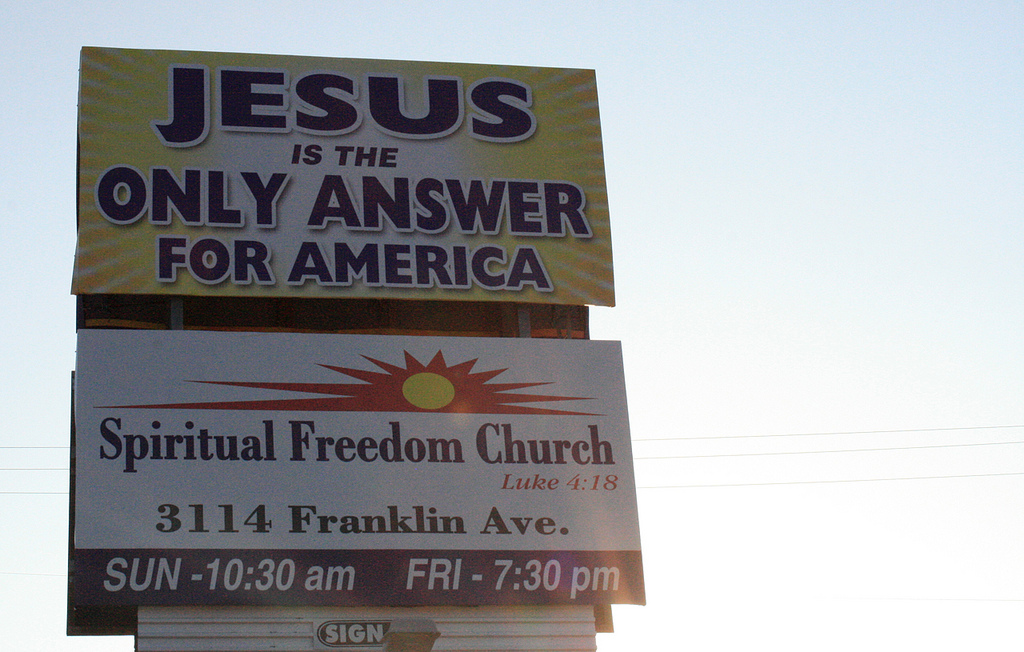
Samantha Allen notices that “in the South, rural billboards have become a bizarre battleground for tired culture wars” and that the region “is where the irrepressible subconscious of white America waves to you from the side of the road”:
But why does it manifest itself in the form of billboards, flags, and crosses? And why is the roadside such prime real estate for incendiary rhetoric in the first place? Billboards remain relatively effective forms of commercial advertising in cities with a large commuter presence but billboards with social messages are not advertising a product, nor are they typically placed in urban areas where ad space would be more expensive. Driving past a loud billboard in the middle of nowhere feels a little bit like watching someone shout impotently into the void. As for flags and crosses, well, they’re just sort of there, aren’t they? What is anyone who rents a cheap billboard or who snatches up land on an access road hoping to accomplish?
The driving factor behind these ads, flags, and attractions seems to be the simple urge to be seen. The Southern Party of Georgia, for example, brags that the Confederate flag outside Tifton is “highly visible to traffic from both directions.” The Sons of Confederate Veterans similarly note that the flag has been “strategically placed” so that it can “be easily seen by the millions who travel Georgia’s main interstate back and forth to Florida.” Cross Ministries, the church affiliated with the Texas cross, claims that “10 million people pass by [the cross] every year” and that it “can be seen from 20 miles away.” The farmer and welder who bought the land for the Confederate flag outside of Tampa was looking for a “high-profile site” that he could still afford. But these roadside sights are nothing more than last-gasp bids for cultural relevance in a world that is, quite literally, passing them by. The people who buy them are playing a no-stakes game of “made you look” with a dogmatic twist.
(Photo by Flickr user me and sysop)
How We Got Modern Political Parties

Reviewing Julian E. Zelizer’s The Fierce Urgency of Now, an account of Lyndon Johnson and the Great Society, Sam Tanenhaus traces our ideologically-sorted political parties to a 1950 report by the American Political Science Association, “Toward a More Responsible Two-Party System”:
This report grew out of a project supervised by E. E. Schattschneider, a professor at Wesleyan and a leading exponent of Wilsonian party government. A political party that “does not capitalize on its successes by mobilizing the whole power of the government is a monstrosity reflecting the stupidity of professional politicians who are more interested in the petty spoils of office than they are in the control of the richest and most powerful government in the world,” Schattschneider had written.
This argument became the overriding theme of the 1950 report. Schattschneider’s team of fifteen scholars and policy experts had talked to congressional leaders, to officials in the Truman Administration, and to state and local politicians. It concluded that the two major parties were “probably the most archaic institutions in the United States”—scarcely more than “loose associations of state and local organizations, with very little national machinery and very little national cohesion.”
The Republican or Democrat sent to Congress was seldom screened by the national party and so felt no obligation to support the party’s program, if he even knew what it was. Once in office, he delivered patronage and pork to his constituents back home. He operated free of a coherent agenda and belonged to no “binding” caucus. The parties, in other words, were failing because they weren’t sufficiently ideological, partisan, and polarizing.
The solution was a “responsible party system”—centralized, idea-driven, serious-minded. Each party needed stronger central “councils” that met regularly, not just in Convention years, to establish principles and programs. Candidates should be expected to campaign on these platforms and then to carry them out, with dissidents punished or expelled. The party in power would enact its program, and the minority party would provide strong criticism and develop alternatives to present at election time.
(Image: President Johnson endeavors to give “The Treatment” to Senator Richard Russell in 1963, via Wikimedia Commons)
Quote For The Day
“The meaning of love is not to be confused with some sentimental outpouring. Love is something much deeper that emotional bosh. Perhaps the Greek language can clear our confusion at this point. In the Greek New Testament are three words for love. The word eros is sort of aesthetic or romantic love. In the Platonic dialogues eros is the yearning of the soul for the realm of the divine. The second word is philia, a reciprocal of love and the intimate affection and friendship between friends. We love those whom we like, and we love because we are loved. The third word is agape, understanding and creative, redemptive goodwill for all men. An overflowing love which seek nothing in return, agape is the love of God operating in the human heart. At this level, we love men not because we like them, nor because they possess some type of divine spark; we love every man because God loves him. At this level, we love the person who does an evil deed, although we hate the deed that he does.
Now we can see what Jesus meant when he said, ‘Love your enemies.’ We should be happy that he did not say, ‘Like your enemies.’ It is almost impossible to like some people. ‘Like’ is a sentimental and affectionate word. How can we be affectionate toward a person whose avowed aim is to crush our very being and place innumerable stumbling blocks in our path? How can we like a person who is threatening our children and bombing our homes? This is impossible. But Jesus recognized that love is greater than like,” – Martin Luther King, Jr., “Loving Your Enemies.”
 The Dish

