The ISIS Fearmongers

oreilly3crop

Elias Groll and Simon Engler round up some of the worst offenders, like Oklahoma Senator James Inhofe:

“ISIS, they are really bad terrorists, they’re so bad even al Qaeda is afraid of them,” Inhofe told a local Fox station last month. “They’re crazy out there and they’re rapidly developing a method of blowing up a major U.S. city and people just can’t believe that’s happening.”

Perhaps Inhofe is right, [counterterrorism chief Matthew] Olsen is wrong, and Islamic State militants are indeed plotting an attack right now inside America’s borders. American intelligence officials have certainly been wrong before about the threat posed by terror groups, and the Islamic State has alarmingly large numbers of fighters with American passports who could return to the U.S. to carry out strikes here at home. But the phrase “rapidly developing a method of blowing up a major U.S. city” goes far beyond what experts inside and outside of government say about the group’s capabilities. There is no substance here, only speculation likely designed to inspire fear and drum up support for military action.

Weigel examines the partisan implications of threat inflation:

Here’s the current paradox. The Obama administration—most reliably Chuck Hagel and John Kerry—is describing ISIS in apocalyptic terms. According to Kerry, ISIS is “an ambitious, avowed genocidal, territorial-grabbing, Caliphate-desiring quasi-state.” Their goal is not really to downplay what ISIS can actually achieve, or to reflect the intelligence analysis that ISIS poses little threat to (ugh, this term) “the homeland.” It’s to avoid a Syria-style rebellion in Congress and assemble a coalition of Arab partners in the Levant.

But Democrats do not benefit, domestically, from the hype. Just today, New Hampshire U.S. Senate candidate Scott Brown challenged Democratic Sen. Jeanne Shaheen to secure the border and sign on to legislation that would revoke the citizenship of American ISIS fighters. “If anyone (including ISIS) can cross our borders at any time, with anything in their possession, then Washington has no control over our nation’s security from terrorist attack,” said Brown. That statement sounds like incoherent heebie-jeebie-ism if you listen to intelligence assessments. Current estimates peg the total number of Americans who might have gone to Iraq and Syria for ISIS at fewer than 100. The threat of such an American, if he returned, is not that he’d cross an unprotected border with a knife between his teeth and jihadism on his mind. It’s that he’d use his American passport at a normal TSA checkpoint.

Poseur Alert

“As a friend put it to me: A tattoo isn’t the Word made flesh, but the flesh made word. It may strike old-fashioned types as pedestrian narcissism and adolescent conformity, and sometimes it surely is. But in a deeper and more troubling way, it is canny and subversive artifice, spiced with a moralistic claim to personal liberation. A tattoo is a personal statement but also an anthropological position that accords with the prevailing transvaluations of our time. It’s a wholly successful one, too, judging from the entertainment and sports worlds, and youth culture. With the mainstreaming of tattoos, another factor in the natural order falls away, yet one more inversion of nature and culture, natural law and human desire. That’s not an outcome the rationalizer’s regret. It’s precisely the point,” – Mark Bauerlein.

The Other NFL Abuse Scandal

Vikings running back Adrian Peterson has been accused of beating his kid. Amy Davidson runs through what appears to have happened:

This preschooler wasn’t paddled or, as Peterson put it to police, “swatted”; he was whipped with a stick and left with open wounds on his body. It’s also not obvious that Peterson has been at all straightforward. (This is something a jury or judge will work out.) In his statement, Peterson said, “I have to live with the fact that when I disciplined my son the way I was disciplined as a child, I caused an injury that I never intended or thought would happen.” This is apparently a reference to the specific wound to the child’s scrotum and a particularly ugly one to the leg. (In another text message, he told the boy’s mother the same thing, adding, “Got him in nuts once I noticed. But I felt so bad, n I’m all tearing that butt up when needed!” He also wrote that she would probably get “mad at me about his leg. I got kinda good wit the tail end of the switch.”) Peterson claimed to the police that he hadn’t noticed that the “tip of the switch and the ridges of the switch were wrapping around” the boy’s thigh.

Amanda Hess, who strongly disapproves of such punishments, notes:

Reactions from around the NFL imply that “love” is a valid reason for beating a child. “I got a ass whippn at 5 with a switch that’s lasted about 40mins and couldn’t sit for 2days. It’s was all love though,” Arizona Cardinals defensive end Darnell Dockett tweeted in Peterson’s defense. Added New Orleans Saints running back Mark Ingram Jr.: “When I was kid I got so many whoopins I can’t even count! I love both my parents they just wanted me to be the best human possible!”

Khadijah Costley White asks for less emphasis on race:

[I]f you think the media coverage of men like Ray Rice or Adrian Peterson make black people look bad, then just think what it looks like when you defend and justify their abuse. …

More than 1,500 children died from abuse and neglect in 2012 alone, most of them younger than four. So, all of those folks upholding Peterson as a symbol of black male oppression or denigration need to take a step back. The bruises on that little boy’s body are not symbolic. His fear and trauma are not due to some grand media conspiracy. And hiding and rationalizing violence against weak and helpless people represents the very worst of humankind.

Louis CK says that better than anyone:

Jazz Shaw defends Peterson, with some limits:

Assuming that Peterson is sincere in his recognition of having taken the punishment with the switch too far and has learned from the experience, perhaps he and his son can move forward with the understanding that improper behavior will still bring a punishment, but it will be scaled to a reasonable degree. Absent more evidence, it doesn’t seem to be our place – at least in my opinion – to deem him an unfit parent or to lock him up and throw away the key. (Though some reasonable degree of punishment for the father may still be in order. That’s for a court to decide.)

We should note, however, that another report has surfaced at Deadspin claiming that he causes a facial scar on a different son. You may assign whatever level of credibility to Deadspin that you wish, but some other sources are picking it up as well. If this turns out to be a recurring situation, the picture changes.

Regardless, Jonathan Cohn thinks the NFL is going to have to pay. He suggests “setting up a foundation whose mission was to fund domestic violence research and services”:

League owners could pay into the fund, at first with a one-time endowment gift and subsequently with ongoing contributions. In the future, when players commit acts of domestic violence and serve suspensions, the wages they relinquish could supplement the funds.

Will Saletan was hit by teachers as a kid:

Corporal punishment teaches itself. Peterson thought he was teaching the opposite. According to reports, he was punishing his son for pushing and scratching another child. He says he explained this to the boy. “Anytime I spank my kids, I talk to them before, let them know what they did, and of course after,” he told investigators.

But when you hit a child for hitting another child, the hitting does all the talking. That’s the upshot of a recent study of more than 100 children and their parents. Every parent who approved of spanking a child for hitting a sibling passed this belief on to their kids. And 79 percent of kids who came from homes with lots of spanking said they’d hit a sibling for trying to watch a different TV show—almost the same scenario that led to Peterson’s beating of his son. According to the researchers, “Not one child from a no-spanking home chose to resolve these conflicts by hitting.” The kids absorbed the model, not the lecture.

Zooming out, Freddie questions the left’s response to abuse cases:

The recent scandals involving NFL players Ray Rice and Adrian Peterson, for me, have revealed again this central contradiction in contemporary left-of-center thought. We have broad consensus on the left wing that we imprison too many people in America and that our police forces, in general, are overly aggressive and overly protected from punishment when they are guilty of abuse or corruption. And yet there’s also a constant impatience with any advocacy of due process, the presumption of innocence, or rights of the accused. I encounter this personally most when I am looking at Facebook or comments on websites like Gawker. People that I know to be self-identified as left-wing, or online groups that tend to be left-wing like the commenters at Gawker, are nonetheless convinced that every celebrity defendant is guilty, before the process has been given the chance to play out. Yet that due process is one of the only checks we have against the aggressive policing that, after Ferguson, we are trying to fix.

Update from a reader:

Whatever the merits of Freddie’s comments in other contexts, it’s hard to see why the presumption of innocence, due process, and “innocent until proven guilty” have much application to Rice and Peterson. For one thing, Rice has apparently escaped prosecution through the diversion program; for another, the existence of the tape, coupled with his admissions, leaves very little doubt indeed about what actually happened.

Peterson hasn’t escaped prosecution yet, but there’s still not much reason to withhold judgment as to the facts of what happened: between his own statements, the text messages, and the photos (the authenticity of which has not, as far as I know, been challenged).

So aside from a reflexive need to attack the “left,” it’s not clear that these two situations have any relevance at all to his professed concern about “aggressive policing,” or Ferguson either. If Freddie wants to complain about the left’s supposed tendency to assume that every celebrity is guilty “before the process has been given the chance to play out,” perhaps he should find better examples?

Searching For A Defense Of Obama’s “Strategy”

US-POLITICS-CLINTON

Yishai Schwartz offers up one, arguing that the president’s approach to ISIS has been perfectly coherent, and not just a reaction to the beheading videos or polls:

Obama began ramping up interventions in Iraq well before these murders, and he did so in response to substantive strategic realities. It was in mid-June that Islamic State militants routed the far larger and better-equipped units of the Iraqi army. Only days later, reports began to surface that President Obama had offered air strikes in support of the Iraqi military, but made them conditional on Prime Minister Nouri al Maliki’s resignation. On August 7, IS militants seized the crucial Mosul Dam.

The same day, profound humanitarian and strategic considerations forced President Obama to compromise somewhat on pressuring Maliki, as he authorized his first air strikes to protect the besieged Yezidi population and to bolster buckling Kurdish forces. Around the same time, the U.S. began to build the international coalition against IS that would emerge weeks later. On August 15, Maliki finally caved to international and internal pressure and stepped aside, and on August 17, American forces helped the Kurds retake the Mosul dam. All of this occurred well before the video of Foley’s murder went online.

This chain of events does not look like a sudden reversal after pressure from post-beheading opinion polls. It looks like a roadmap to war …

I guess you can take this to be reassuring – if you believe in a sustained, perpetual US war in Iraq (currently a war that has lasted from 1990 – 2014). Schwartz’s reading of the chronology is also problematic:

a steadily deteriorating strategic situation, an expressed American willingness to strike predicated on the meeting of a condition, the fulfilment of the condition …

But a clear-eyed assessment of the actual situation does not lead many to believe that IS was about to take over all of Iraq. If it were, do you think Turkey would be hanging back? In fact, its capture of Mosul may well have been its high watermark – unless Americanizing the war  gives IS a new lease on life. Then “the meeting of a condition”. I think that refers to getting rid of Maliki. But that was not the condition. The condition was a unified, multi-sectarian government in Iraq – which was the point of the “surge” as well. It never happened under the surge – which is why it failed; and it hasn’t happened even as these loons have come close to Baghdad.

Today, the Iraqi parliament could not confirm the new prime minister’s nominations for the defense and interior ministries – the two that really count, and the two that are still a function of Iraq’s permanent sectarian divides. So as the US president commits this country to war in defense of “Iraq”, the same “Iraq” is so divided it cannot form the government that Obama explicitly said was a prerequisite. Which means it was not a prerequisite. It was more bullshit for an open-ended war with no Plan B that had already been decided upon.

To me, that does not seem something that we elected Obama to do. Au contraire. I will add a couple more points: General Dempsey today filled in the blanks for what happens after the current “strategy” fails:

“My view at this point is that this coalition is the appropriate way forward. I believe that will prove true,” he said. “But if it fails to be true, and if there are threats to the United States, then I of course would go back to the president and make a recommendation that may include the use of U.S. military ground forces.”

You heard that right. And the neocon chorus will continue to fight for another invasion of Iraq – and why not Syria? – as you can see from this classic disingenuous editorial from the Washington Post. Or check out John Boehner, who wants to relive 2003 – 20011 all over again:

“I just think that if our goal here is to destroy ISIL, we’ve got to do more than train a few folks in Syria and train a few folks in Iraq and drop some bombs,” Boehner told reporters Tuesday morning in the Capitol. “I just don’t know that it’s enough to achieve the objective the president announced.”

Neither John Boehner nor the neocons at the Washington Post actually call for ground troops – Obama has allowed them to cavil and complain from the sidelines, without getting them to vote for a new war – but you can see the general drift. The Beltway never truly believed it had screwed up in Iraq – bloviators like McCain actually believe the Iraq war was a success! – and so the notion that a new Iraq War would be obviously a terrible thing does not truly occur to them. This is the price we pay for there being no accountability in Washington – the very war criminals and ideologues that gave us that catastrophe now want to repeat the entire thing, by fanning the flames of panic and hysteria.

Steven Cook gets it right:

[Last Wednesday’s] speech, which was clearly intended to alter the perception of helpless incompetence, merely reiterated the ad hoc approach to Iraq that his administration has pursued since early June. There may be good reasons to go to war against ISIS, but no one has actually articulated them.  Are we protecting Erbil and American personnel? Undertaking a humanitarian mission? Fighting evil? Helping the Free Syrian Army? Assisting Washington’s regional allies against the ISIS threat? No one knows, but we are nevertheless turning the aircraft carriers into the wind.  This is no way to go to war.

The disheartening aspect of this episode is that the White House’s instincts were initially correct: Foley’s beheading, that of Steven Sotloff, and most recently the murder of David Haines may be horrible, but they are not very good reasons to commit the United States to the conflict in Iraq and inevitably, Syria—two countries that are likely to be at war with themselves for decades. That may be unavoidable, but before the United States leaps in, policymakers should actually develop a strategy.  In other words, identify realistic national goals and determine what resources are necessary to achieve those aims.  I am not sure anyone has articulated those goals yet, which means that we are still at step one.

I know many of you disagree. But I fear this is Obama repealing a core pillar of his candidacy and presidency. And there is nothing we can do about it. The Congress has effectively abdicated its democratic responsibility – and Obama is happy about that. So sit back, get some popcorn, and watch successive emperors extend that AUMF into perpetuity. And if you think the Iraq Wars from 1990 – 2014 have been a great success, what’s not to love about that?

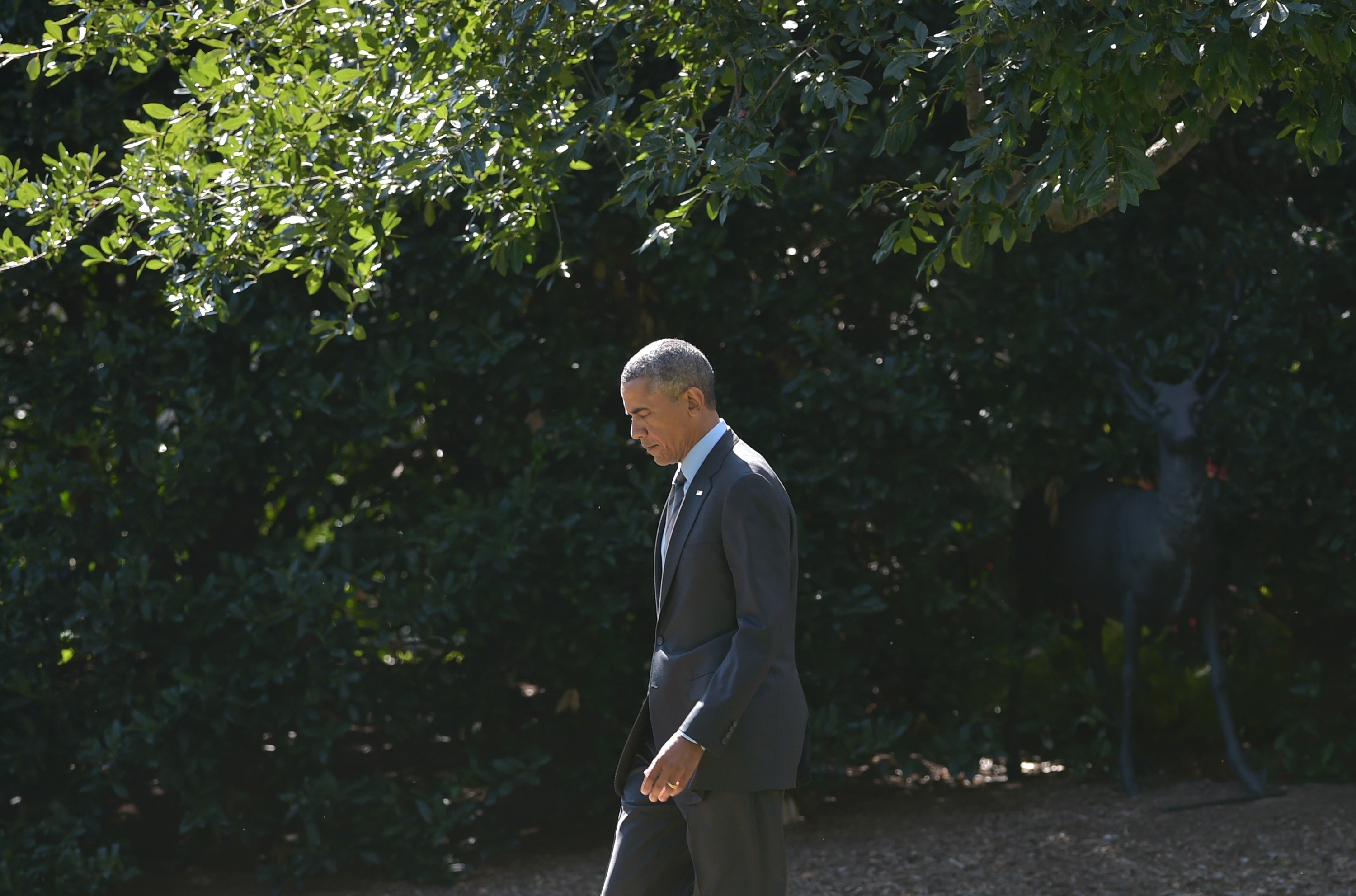
(Photo: US President Barack Obama makes his way to board Marine One on the South Lawn of the White House on September 12, 2014, in Washington, DC. Obama is heading to Baltimore, Maryland to visit Fort McHenry and to attend a fundraiser. By Mandel Ngan AFP/Getty Images.)

Busted With An Eggcorn

Well this is embarrassing. I’ve been righteously hauled in front of the language observers for the following boo-boo:

But it could give the neocons a new leash on life, a way to invigorate their exhausted ideological engines. (Andrew Sullivan, The Daily Dish, July 9, 2007)

Of course, I should have written lease on life. But for some reason, the sound of the word in my head came out as “leash” on the screen. This is what is called an “eggcorn”, a term new to me but a lovely neologism. An “eggcorn” is essentially a malapropism that apes the sound of a word: so someone once wrote the term “eggcorn” to mean “acorn”. Among some other examples:

When all was set and done, the missed shot didn’t mean anything but the impact from the opposing crowd was felt throughout every inch of Crisler Arena. (The Michigan Daily, Feb. 11, 2010)

First it was the far right, which signaled out “Spongebob” for promoting a gay and global-warming agendas. (Daniel Frankel, Reuters/The Wrap, Sep. 11, 2011)

I found an eggcorn at brunch yesterday! My boyfriend asked me if I liked the holiday sauce on my poached eggs. I asked him to repeat himself so I could be sure of what I’d heard. Once I told him the actual name of the sauce, he said that he’d always wondered what holiday the sauce was originally from.

The United States is a country with a prosperous past, but also one straddled with an uncommonly uncertain future. (Philip Mooney, Daily Princetonian, Nov. 28, 2011)

My personal fave:

Without addressing these issues, NOW and others have nothing to offer the average Jane and in consequence, have allowed Sarah Palin and her elk to define women’s issues. (New York Times Opinionator blog comment, Dec 4, 2009)

It’s particularly common when you’re not used to using the word in writing, but only in speech. And we all have our blind spots. Jeannette Winterson:

I laboured long into adult life really believing that there was such a thing as a “damp squid”, which of course there is, and when things go wrong they do feel very like a damp squid to me, sort of squidgy and suckery and slippery and misshapen. Is a faulty firework really a better description of disappointment?

Are there any you have coined recently? Points for maximal embarrassment.

(Thumbnail image by Edd Prince)

Desperately Seeking Moderates, Ctd

The House is working on an authorization to arm the “moderate” Syrian rebels:

The House Armed Services Committee has drafted an amendment to grant authorization to the President to arm and train Syrian rebels opposed to the Islamic State of Iraq and Greater Syria (ISIS). There are some strings attached, including requiring that the Pentagon report to Congress 15 days before it plans to train and equip the rebels, and provide subsequent updates to relevant committees every 90 days. The language will be included as an amendment to a government funding bill that needs to pass Congress by the end of the month to avert a partial government shut down. Rep. Patrick McHenry (R-N.C.), a key member of the House GOP whip team, said the amendment will pass this week.

But these “moderates” we’re supposed to be counting on seem to be on their last legs, to the point that a major American support group for them disbanded last month:

On August 19, the Syrian Support Group, which had previously arranged a few shipments of nonlethal aid to the Free Syrian Army, sent a letter to donors explaining why the group was shutting its doors. “Over the last year, the political winds have changed,” the letter read. “The rise of ISIS and Jabhat al-Nusra [an Al Qaeda-affiliated opposition force in Syria] and the internal divisions among rebel forces on the ground have complicated our efforts to provide direct support.”

The letter noted that “more significant support” was heading to the FSA from Saudi Arabia, Qatar, the United States, and other governments. But rivalries and rifts within the opposition had impeded the overall effort. “It was difficult to keep things going with the changes in the FSA and its Supreme Military Council and the advent of ISIS,” says Majd Abbar, who was a member of the Syrian Support Group’s board of directors. “It made our operations extremely difficult.”

Then there’s this:

Syrian rebels and jihadists from the Islamic State have agreed a non-aggression pact for the first time in a suburb of the capital Damascus, a monitoring group said on Friday. The Syrian Observatory for Human Rights said the ceasefire deal was agreed between IS and moderate and Islamist rebels in Hajar al-Aswad, south of the capital. Under the deal, “the two parties will respect a truce until a final solution is found and they promise not to attack each other because they consider the principal enemy to be the Nussayri regime.” Nussayri is a pejorative term for the Alawite sect, an offshoot of Shiite Islam to which President Bashar al-Assad belongs.

To which Ed Kilgore, who flagged it, remarks:

Perhaps this was all anticipated by the Obama administration and others—indeed, it does help explain the apparent desire of John McCain and Lindsay Graham to go to war with the entire region. But it doesn’t speak well for the idea that anyone who encounters IS understands immediately the organization must be destroyed at any cost lest or the world will come to an abrupt end.

And Allahpundit predicts that our de facto role as Assad’s air force will bring ISIS and Syrian rebel militias closer together, not drive them apart:

If ISIS’s grip begins to loosen in Sunni areas of Syria as the U.S. pounds them from the air, what are “moderates” more likely to do? Join with their hated enemy, the Shiite Assad, in stamping out ISIS, at which point Assad might turn around and attack the “moderates”? Or join with ISIS and fend off Assad in the name of keeping Iran’s Shiite death squads from cleansing those Sunni areas? Arguably, the more effective we are in damaging ISIS, the greater the risk that our “moderate” partner will turn on us and join the battle against the de facto U.S./Assad alliance. [Richard] Engel sees it coming. Does the White House?

It would appear not. Even though it’s bleeding obvious.

Ukraine Splits The Difference

The Ukrainian parliament had two big items on its agenda today:

In a vote synchronized with the European Parliament in Strasbourg, Ukrainian lawmakers unanimously approved the association pact over objections from Russia, which fears the loss of a market for its goods and damage to its economy from an influx of European products through Ukraine. … Earlier Tuesday, legislators voted behind closed doors to approve two bills granting amnesty to rebels and greater autonomy for eastern regions as part of an effort to consolidate a tenuous Sept. 5 cease-fire and end the fighting in eastern Ukraine. The decision on Tuesday to enshrine in law an amnesty and a framework for self-rule in the east represented a major concession to Russia that in many ways gave the Kremlin what it had been seeking since early in the conflict, long before the violence broadened and thousands died.

Bershidsky doubts Ukrainians will thank Poroshenko for this:

That, in effect, is Ukraine’s signature under the creation of a frozen conflict area.

For Russia, that kind of buffer is the best: It’s not an unrecognized state with a murky status, but an officially recognized enclave within Ukraine. Kiev takes responsibility for it, but has little or no influence on what happens there. The law will probably stand for now, as long as Poroshenko and Putin manage to make the shaky cease-fire in eastern Ukraine stick.

This is a bitter pill for Ukrainians to swallow. “I wouldn’t have voted for this bill if I had been a legislator,” journalist Mustafa Nayyem, who is running for a parliament seat as part of Poroshenko’s electoral bloc,wrote on Facebook. “I see no value in compromises that can lead to another political split in Kiev, mutual accusations of treachery and a show-off patriotism contest.”

Linda Kinstler is despondent:

A frozen conflict, when the Kremlin is involved, is what happens when, as the BBC put it, “a bloody, territorial conflict with no obvious solution is put on hold, with Russia stepping in to keep the peace on its own terms.” On Tuesday, the self-declared Donetsk and Luhansk People’s Republicsannounced they are merging their militias into a single force, the United Army of Novorossiya, which will liberate Ukraine from “Nazi scum.” These are the people who will be ruling the populations of Donetsk and Luhansk for the next three years. It’s hard to look at all this and not get the feeling that those who died fighting for Ukraine gave their lives for naught.

Walter Russell Mead is aghast:

Make no mistake about this. The settlement is a deeply damaging blow to our values, to our prestige and to our geopolitical interests. The foolish and distracted Western policies that encouraged Ukraine into a confrontation with Russia in which the West was unwilling to back it; the shameful and feckless mix of triumphalist rhetoric and minimalist action; the cluelessness in the face of Putin’s skillful mastery of Western psychology and divisions; the miserable consequences of all this for the Ukrainian state: every country, every leader in the world has been paying close attention. Historians, by the way, will also pay attention; the Obama legacy has been permanently tarnished. Unless some real changes take place, neither this President nor his close associates will cut an impressive figure when the accounts are drawn up.

And Jan Techau is skeptical that the EU will be able to act as “the de facto guarantee power for another entity’s political success against the declared intentions of a regional rival”:

There is already a sense creeping into the foreign policy crowd that Europeans may have bitten off more than they can chew. Unity among 28 member states is extremely fragile. The remodeling of the European Neighborhood Policy—the instrument that guides EU relations with Ukraine and other Eastern neighbors—will be tedious and fraught with institutional infighting in Brussels. And money is scarce. More significantly, there are severe doubts that the EU has the political will and the diplomatic toughness to insist on conditionality, the core piece of the neighborhood policy. But without a swift, watertight, and potentially brutal sanctions mechanism for neighbors that do not adhere to an agreed reform process, the transformative power of any new policy will be exactly what it was under the old one: close to zero.

On the other hand, the recent US-EU sanctions on Russia really do seem to be biting, with the Russian ruble falling and state-owned industries like Rosneft asking the government for aid:

Economist Alexei Kudrin, who served as finance minister under President Vladimir Putin for 11 years until 2011, said Tuesday that the sanctions could send Russia into a long recession. “The sanctions that have been imposed are going to have an effect (on the economy) for the next one or two years because they have limited opportunities for investment in this uncertain environment,” Russian news agency Interfax quoted him as saying. … The rouble is this year’s biggest-declining major emerging currency, having lost more than 15 percent in value to hit a new low against the US dollar on Tuesday.

Zenon Evans sees signs that tensions are de-escalating:

Russian state-owned media has made a “drastic change” lately by softening its anti-Ukrainian rhetoric, according to the independent Moscow Times. This may be a positive sign of Russia winding down its war. For its part, the U.S. is also speaking somewhat more softly about Russia. President Barack Obama admitted that Crimea “is gone,” and Secretary of State John Kerry last week called upon Moscow to help America fight the Islamic State, which has personally threatened Putin.

But Katie Zavadski catches a Russian official talking about Russians in the Baltics in a manner eerily reminiscent of the lead-up to the Crimea invasion:

Konstantin Dolgov — Russia’s foreign minister on issues of human rights, democracy, and rule of law — voiced concern Saturday over the treatment of Russian citizens in the Baltic states. Consider that a warning. According to the text of a speech published on the Russian foreign ministry’s website (and evidently given at the Regional Conference of Russian Compatriots of Latvia, Lithuania, and Estonia in Riga), the “protection of the rights and lawful interests of our compatriots abroad is one of the prioritized actions” of the foreign ministry. The speech’s inflammatory language echoed the precursors of Russia’s annexation of Crimea, citing concerns for the well-being and rights of Russians in the territory.

NATO is hip to this threat, Eli Lake reports, and is warning the Kremlin against trying to pull off a stealth invasion of a Baltic state:

[NATO Commander Gen. Philip] Breedlove, speaking at the Atlantic Council on Monday, said if the Kremlin tried that in one of the NATO allies that border Russia—like the former Soviet republics in the Batlics, for example—it would risk triggering Article Five of NATO’s charter which is the section that calls on the alliance to come to the defense of a member state being attacked. … Breedlove added that the issue was discussed this month at Wales at the head of state summit. “We had great acceptance among the NATO allies though that if you attribute this ‘little green men’ issue to an aggressor nation, it is an Article Five action and then all of the assets of NATO come to bear.”