The Christian Case For Fighting Climate Change

Francis wants to make it with a new encyclical:

Its message will be spread to congregations around the world by Catholic clergy, mobilising grassroots pressure for action ahead of the key UN climate summit in December in Paris. The encyclical may be published as early as March, and may be couched in terms of the biblical parable of the Good Samaritan, which teaches that we have responsibilities to our fellow humans.

It will be the first encyclical to address concerns about a global environmental issue, and will provide “important orientation” to all Catholics to support action on climate change, says Bishop Marcelo Sánchez Sorondo, chancellor of the Pontifical Academy of Sciences and Social Sciences in Vatican City. Last May, he organised a workshop there discussing the science and impact of climate change. Participants issued a hard-hitting statement, which laid the groundwork and set the tone for the encyclical.

The most likely thrust of the pope’s appeal will be that failure to combat climate change will condemn the world’s poorest people to disproportionate harm. “The sad part is that the poorest three billion will be the worst affected by the impacts of climate change, such as sea level rise and drought, but have had least to do with causing it,” says Veerabhadran Ramanathan, a climatologist at the Scripps Institution of Oceanography in San Diego, California, and a scientific adviser to the Vatican on the encyclical.

Thursday, when asked if he thought mankind was mostly to blame for global warming, the Pope responded:

“I don’t know if it is all (man’s fault) but the majority is, for the most part, it is man who continuously slaps down nature,” he said. The words were his clearest to date on climate change, which has sparked worldwide debate and even divided conservative and liberal Catholics, particularly in the United States. “We have, in a sense, lorded it over nature, over Sister Earth, over Mother Earth … I think man has gone too far.”

When the encyclical was originally previewed late last month, Catholic Climate Covenant’s Dan Misleh put the move in context:

“It is the first time ever an encyclical letter has been written just on the environment,” Misleh said. “The faithful, including bishops, and all of us who adhere to the Catholic faith, are supposed to read it and examine our own consciences.”

Mobilizing believers to embrace climate action could be a very big deal, given the sheer number of people who identify as Catholic in the US—around 75 million—he said. “If we had just a fraction of those acting on climate change, it would be bigger than the networks of some of the biggest environmental groups in the US,” he said. “That could help change the way we live our lives, and impact our views on public policy.”

Plumer has more:

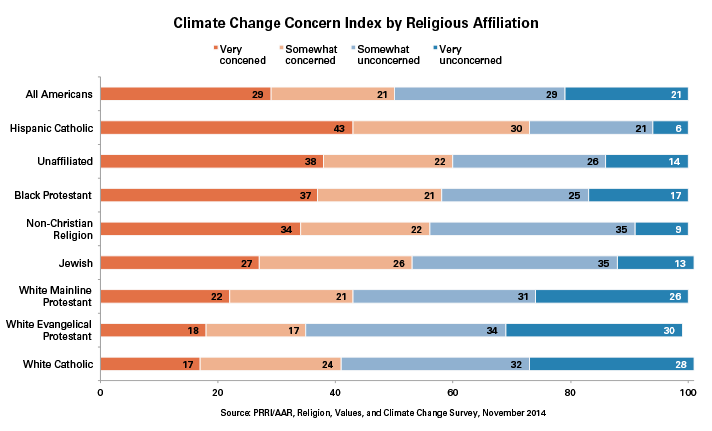
For what it’s worth, surveys in the US have found that white Catholics tend to be among the least concerned groups about climate change, whereas Hispanic Catholics are some of the most concerned. Here’s a PRRI poll from November 2014:

Figure3.0

But, of course, Catholics don’t just automatically follow the pope’s lead on every last political question. (Gay marriage is a perfect example.)
And of course with the Pope’s high approval rating around the world, he might also be able to influence Evangelicals, who, as Chris Mooney noted last month, are already moving toward more environmental action:

The biblically based stewardship or “Creation Care” message — which went very, very mainstream [last] year in the blockbuster film Noah — may not have won out with a majority of these believers. But it appears to have made substantial inroads. And evangelicals leaders like the climate scientist Katharine Hayhoe are working every day to convince more believers, by making theologically (and politically) resonant arguments for why they need to take climate science seriously.

He’s cautiously optimistic:

There’s no doubt that many religious people around the world cling to their beliefs (or, to what they think their beliefs require) in the face of evidence, and history shows science-religion conflicts popping up at regular intervals. But it also shows something else: Believers who find a way to reconcile faith and science.

If Pope Francis continues on his current course, he has the power to make this latter group a whole lot more prominent than it already is.

But seeking more than just rhetoric, Leber challenges Francis to pony up the Vatican’s fossil fuel investments as well:

There are two main arguments for divestment from fossil fuels, on moral and financial grounds. The former is that we have responsibility not to aid companies that imperil the planetGod’s creation, according to Catholicsespecially when it particularly impacts the poor. And while some financial experts claim divestment is impossible to detangle fossil fuels from a portfolio and retain balanced, stable growth, others argue that in a low-carbon world, fossil fuel stocks become worthless, risking ruin for those who retain too much faith in oil, gas, and coal. The head of England’s central bank, for instance, has already warned investors that their focus on short-term profits in the fossil fuel market may be foolish in the long-term. (Rolling Stone’s Tim Dickinson has a worthwhile read on the economics of divestment.)

One can see how the Vatican, which has an estimated $8 billion portfolio, could make wavessymbolically and financiallyif it were to divest from fossil fuels. Environmental group 350.org is pushing the Church to do exactly that, and claimed Wednesday that hundreds of protesters attended a divestment vigil just before Francis arrived in Manila. Now it’s time for the Pope to put his words into action. What better way to show the world that 2015 is the year for global climate action than to lead by example?

Regardless, the editors of New Scientist are nonetheless pleased to have the Vatican as an ally:

For all the railing of secularists against the idea that the church has any special claim over morality, and despite its influence being [on the wane], many people heed religious authority more readily than any scientific or economic argument. And the pope’s case is one that leaders of rich, carbon-intensive nations are reluctant to put forward: that they owe it to the world’s poor to cut emissions.

Not every churchgoer will be swayed. Evangelicals are among the staunchest of climate sceptics; even those who accept the reality often view it as God’s will. It remains to be seen if the pope can appeal to these recalcitrants – or if the jeering of denialists will take on a theological, rather than scientific, tone (to which we can only say: god help us).

It was 350 years before a pope admitted that the church had wronged Galileo, whose reputed parting shot was to say of the Earth: “eppur si muove”– “and yet it moves”. In contrast, it has taken the Vatican hardly any time to accept that Earth is warming. It helps that the Bible contains precious few verses pertinent to carbon emissions. Perhaps we will start to see evidence reshaping the Vatican’s views on other issues where scripture still holds sway: the role of contraception in tackling population growth, say. One can only pray it will.

A God Of Liberation

John Schad profiles the literary critic Terry Eagleton, noting the way his Catholic upbringing mingles with his radical politics:

There was a time, mainly in the 1980s, when Catholicism was all but invisible in Eagleton’s writing. For some time now, it has been very evident; nevertheless, to date, Christianity has seemed to be primarily a language for Eagleton’s Marxism, or communism, with the crucifixion being a way of unearthing what Eagleton seemed to think of as a tragic vision otherwise buried within communism. However, what I am hearing now, as he speaks, is not so much communism-via-Christianity but rather communism-and-Christianity, a genuinely double act.

Is Eagleton, then, back where he was 50 years ago when he would often refer to himself as a Christian? I am tempted to ask this rather dumb, card-carrying question but resist. I do, though, summon the stupidity to ask the “afterlife” question, the heaven question. Given that he makes so much of the crucifixion, what, I ask, should we make of the biblical account of resurrection? What, if anything, is its significance and does that in any sense include an afterlife? “No,” he says, “the after-life is not a Judaeo-Christian belief. As Wittgenstein says somewhere, ‘How strange that people believe that when you die eternity starts.’ The Christian belief is in an eternity that is here and now.” “But,” I ask, “is eternity limited to here and now?” To which he replies that “eternity does not mean we will live on and on – that would be hell”.

In a recent review of Eagleton’s latest book, Culture and the Death of God, Eugene McCarraher also emphasizes the theological views that undergird his politics:

The itinerant and crucified Jesus, not his Dad, is the apotheosis of Eagleton’s political theology. To the curer of leprosy and blindness, pain and disease are “unacceptable”; misery and despair are not “enviable opportunities to flex one’s moral muscles.” Jesus mends without compensation or moral inquiry; he never tells the afflicted to learn the edifying lessons the Almighty is teaching them, however inscrutably. If there must be suffering, it comes as the price of personal and collective transfiguration; our condition is so awry that the only way out is through a turbulent journey of self-dispossession. As Eagleton explains, the Christian life as portrayed in the Gospels is not that of the pious, hard-working, familial accumulator dear to the conceits of suburban believers. It is rather “homeless, propertyless, peripatetic, celibate, socially marginal, disdainful of kinsfolk, averse to material possessions … a thorn in the side of the Establishment and a scourge of the rich and powerful.” In the life and death of Jesus—resurrection goes unmentioned—Eagleton discovers the most stringent and fundamental rebuke to capitalism, as well as the point of departure for any future revolutionary politics. It is in that crucible of downward mobility that “a new configuration of faith, culture, and politics might be born.” This is unvarnished liberation theology, and here Eagleton returns to the prophetic Marxism that animated his earlier career.

Do We Need A Literary Canon?

Arthur Krystal answers in the affirmative:

[I]n this blur of the present, when every book, every critical evaluation, is almost immediately swept aside by another, there seems little of consequence. How different this is compared with the agitation felt by the Elizabethans, Romantics, and moderns who did their best to forge something new. Those first moderns who maintained that their works rivaled in significance, if not skill, those of the Greek and Latin masters started the ball rolling and, in effect, laid the foundations for the canon. But as I look around today I can’t help wondering if the ball hasn’t finally come to a stop. Whom do our poets and novelists seek to supplant, and what aesthetic or philosophical precepts ride on the attempt?

Although serious writers continue to work in the hope that time will forgive them for writing well, the prevailing mood welcomes fiction and poetry of every stripe, as long as the reading public champions it. And this I think is a huge mistake. Literature has never just been about the public (even when the public has embraced such canonical authors as Hugo, Dickens, and Tolstoy). Literature has always been a conversation among writers who borrow, build upon, and deviate from each other’s words. Forgetting this, we forget that aesthetics is not a social invention, that democracy is not an aesthetic category; and that the dismantling of hierarchies is tantamount to an erasure of history.

Broad Humor

Lenika Cruz praises the second season of Broad City, which premiered this week:

[T]he show isn’t getting complacent, subject-wise: The first few episodes weave rape, sexual experimentation, discrimination, death, and socioeconomic privilege into their storylines, but avoid shoehorning commentary or moralizing. [Show creators and co-stars Ilana] Glazer and [Abbi] Jacobson proved in the first season that they could pull off outrageous without being tone-deaf or relying on stunt scenes—an admirable achievement for a show that centers on two self-absorbed female millennials. Sweet (flatulent) Abbi is often passive and self-doubting, given to bursts of energy and gall at the urging of Ilana, who is equal parts bullshittery and sincerity, and whose deep ignorance and irony are only sometimes redeemed by her sensitivity and good intentions.

In a profile of the two comedians, Rachel Syme appreciates that “as broad and slapstick as the comedy on the show can be, Glazer and Jacobson ultimately traffic in precision; their jokes could not be anyone else’s jokes.” She notes that “sex is a big part” of the series:

They both seek it, desire it, and talk about it constantly (in one episode, Ilana tells Abbi her detailed fantasy for a sexual position featuring them both, called the “Arc de Triomphe”). They treat sex with no judgment or sneers; Abbi and Ilana’s carnal victories are always shared. In the new season, when Abbi decides to “peg” one of her hookups with a neon-green dildo, she immediately calls Ilana (who happens to be at her grandmother’s shiva). Ilana screams, “This is the happiest day of my life!” What’s funny about the sex on Broad City is not that women are openly having it (we have Sex and the City to thank for that, as well as just about every cable show that has followed), but that when Abbi and Ilana do it, things tend to go horribly wrong. In the case of the strap-on triumph, Abbi quickly finds a way to melt the apparatus in the dishwasher and must embark on a Chaucerian quest to find a new one before the clock runs out.

Stephanie Boland compares the show to Girls:

While Girls – a frequent point of comparison – is known for its characters’ awkwardness, the cast of Broad City are framed as likeable even, or perhaps especially, when their behaviour is questionable. The shame which is one of the central emotions of Girls is almost entirely missing here. Broad City’s surrealism lets its creators play disgust for laughs while also revelling in its truth. At one moment, the girls accidentally get a sixteen-year-old high school student stoned; another scene shows Abbi using a blow-dryer on her genitals before the aforementioned heat wave sex. At no point, however, does our revulsion transmute into dislike for the protagonists – and rarely do they suffer consequences.

This is the central contradiction at the heart of the showUnlike Dunham’s wonderfully unlikable Hannah Hovarth, Broad City demands we find its women charming while they do terrible things. When Hannah quotes Missy Elliot during her break up with Donald Glover’s character Sandy, he is rightly horrified. By way of contrast, the intern Ilana pictures singing slave spirituals still seems happy enough at the end of the skit. The difference is partly one of absurdity, but also one of politics. Drugs, sex, and troubling attitudes to race and gender are part of the texture of city life, and Broad City suggests to sanitise would be remiss. It’s a winning feature for the show’s young demographic, and the programme has already been renewed for a third season.

Meanwhile, Nate Jones looks back at the web series that inspired the Comedy Central series. He highlights “VChat,” the episode above, as especially worth revisiting:

There’s one thing about friendship that the web-cam segments of Broad City get at so well: the feeling that life is just one long conversation punctuated briefly by the interruption of outsiders. “VChat” is the first of these—the format would later turn into a spinoff series, Hack Into Broad City—and it sees Ilana advising Abbi on a potential hookup. Their interactions are gold; you get the sense that the actual things that happen to the two of them are secondary to the experience of talking to each other about it.

Defining Deviancy Up

Adam Gopnik looks back at the work of the iconoclastic sociologist Howard S. Becker – who also spent many nights in clubs and strip joints as a jazz musician. Those two aspects of his life came together in his famous 1953 paper in the American Journal of Sociology, “Becoming a Marihuana User”:

Becker insists that his accomplishment in the paper was no more than the elimination of a single needless syllable: “Instead of talking about drug abuse, I talked about drug use.” “Deviance” had long been a preoccupation of sociology and its mother field, anthropology. Most “deviance theory” took it for granted that if you did weird things you were a weird person. Normal people made rules—we’ll crap over here, worship over here, have sex like so—which a few deviants in every society couldn’t keep. They clung together in small bands of misbehavior.

Becker’s work set out to show that out-groups weren’t made up of people who couldn’t keep the rules; they were made up of people who kept other kinds of rules. Marijuana smoking, too, was a set of crips, a learned activity and a social game. At a time when the general assumption was that drug use was private and compulsive, Becker argued that you had to learn how to get high.

Smoking weed, he showed, was most often strange or unpleasant at first. One of his informants (a fellow band member) reported, “I walked around the room, walking around the room trying to get off, you know; it just scared me at first, you know. I wasn’t used to that kind of feeling.” Another musician explained, “You have to just talk them out of being afraid. Keep talking to them, reassuring, telling them it’s all right. And come on with your own story, you know: ‘The same thing happened to me. You’ll get to like that after a while.’ ” In the sociologese that Becker had not yet entirely discarded, he wrote, “Given these typically frightening and unpleasant first experiences, the beginner will not continue use unless he learns to redefine the sensations as pleasurable.” He went on, “This redefinition occurs, typically, in interaction with more experienced users, who, in a number of ways, teach the novice to find pleasure in this experience, which is at first so frightening.” What looked like a deviant act by an escape-seeking individual was simply a communal practice shaped by a common enterprise: it takes a strip club to smoke a reefer.

A Short Film For Saturday

Jason Schafer captions Dick Fontaine’s 1967 jazz short, Sound??:

I’d be doing it great disservice by describing it as anything short of importantly badass. The piece, a collaboration between highly influential multi-instrumentalist musical madman, Rahsaan Roland Kirk and avant-garde sound artist John Cage, explores the very nature of sound and music itself as the piece shifts between the two pioneers. Kirk does his thing. He plays onstage with three saxophones at once, and a flute and a whistle. He hands out whistles to the audience at one point and calls for a participatory “blues in the key of W.” He plays with animals at the zoo. The footage of a performance at Ronnie Scott’s in London is incendiary. Cage, for his part, is interspersed throughout the film reading rhetorical questions in a variety of city locations about what it means to make music. If music is just noise, can anyone do it? What’s the point in making it? “Sounds are just vibrations,” says Cage, “why didn’t I mention that before? Doesn’t that stir the imagination?” The whole thing, if nothing else, certainly stirs the imagination.

In an earlier review, Eric Magnuson remarked on the “wild juxtapositions” between Cage and Kirk:

The two iconoclasts didn’t have much in common composition wise. But they did share the optimistic view that music could be derived from just about anything that made a sound, whether it was a child’s toy, a passing truck or Cage’s musical bicycle. Throughout this 27-minute film, Fontaine mixes Cage’s philosophical questions on what constitutes music with live footage of Kirk playing a lively, experimental set at Ronnie Scott’s, deftly highlighting how each man’s credo can seamlessly bounce off the other. The whistle scene is especially enlightening.

Celebrating A Century Of Sexual Neuroticism

Jonathon Sturgeon pays tribute to T.S. Eliot’s “The Love Song of J. Alfred Prufrock,” first published in 1915:

You don’t have to be sexually frustrated to enjoy “Prufrock,” although I certainly was as a young high schooler when I first encountered the poem. Only my life was an exact inversion of Eliot’s Brahminical privilege and Grand Touristry. Nevertheless, Eliot’s uneasy mixture of elitism and sexual anxiety mesmerized me. So did its allusive range and musicality, its dissected and etherized bodies. I never took for granted that the opening lines were entreating the reader (me) and a young woman at the same time. I guess Prufrock was my Virgil:

LET us go then, you and I,
When the evening is spread out against the sky
Like a patient etherized upon a table;
Let us go, through certain half-deserted streets,
The muttering retreats
Of restless nights in one-night cheap hotels
And sawdust restaurants with oyster-shells:
Streets that follow like a tedious argument
Of insidious intent
To lead you to an overwhelming question….
Oh, do not ask, “What is it?”
Let us go and make our visit.

We still broadcast on Prufrock’s frequency of selfhood today. One of the loudest and most convincing voices in contemporary poetry, for example, is Frederick Seidel’s anti-Prufrockian taunt. (It’s worth noting that Seidel’s backstory is remarkably similar to Eliot’s.) In popular culture, too — in film, television, music, whatever — sexual neurotics of every stripe owe a substantial debt to Prufrock, whether they know it or not. “Let us go and make our visit,” Prufrock says. One hundred years later: Prufrock’s world seems strange and distant, a repressed imaginary where one should tread lightly. And it’s a place we visit every day.

Dear Aunt Ayn

Mallory Ortberg digs up this amazingly horrible letter from Ayn Rand to her 17-year-old niece, who asked the famous libertarian novelist and “philosopher” if she could borrow $25. Here’s how it begins:

Dear Connie:

You are very young, so I don’t know whether you realize the seriousness of your action in writing to me for money. Since I don’t know you at all, I am going to put you to a test.

If you really want to borrow $25 from me, I will take a chance on finding out what kind of person you are. You want to borrow the money until your graduation. I will do better than that. I will make it easier for you to repay the debt, but on condition that you understand and accept it as a strict and serious business deal. Before you borrow it, I want you to think it over very carefully.

It gets even better. After proposing a repayment scheme, Aunt Ayn really turns on the charm:

I want you to understand right now that I will not accept any excuse—except a serious illness. If you become ill, then I will give you an extension of time—but for no other reason. If, when the debt becomes due, you tell me that you can’t pay me because you needed a new pair of shoes or a new coat or you gave the money to somebody in the family who needed it more than I do—then I will consider you as an embezzler. No, I won’t send a policeman after you, but I will write you off as a rotten person and I will never speak or write to you again.

Now I will tell you why I am so serious and severe about this. I despise irresponsible people. I don’t want to deal with them or help them in any way. An irresponsible person is a person who makes vague promises, then breaks his word, blames it on circumstances and expects other people to forgive it. A responsible person does not make a promise without thinking of all the consequences and being prepared to meet them.

Read the rest here. The missive also can be found in The Letters of Ayn Rand.