Is Gentrification A Myth?

Cupcakes

John Buntin challenges the conventional wisdom:

That gentrification displaces poor people of color by well-off white people is a claim so commonplace that most people accept it as a widespread fact of urban life. It’s not. Gentrification of this sort is actually exceedingly rare. The socio-economic status of most neighborhoods is strikingly stable over time. When the ethnic compositions of low-income black neighborhoods do change, it’s typically because Latinos and other immigrants move into a neighborhood—and such in-migration is probably more beneficial than harmful. As for displacement—the most objectionable feature of gentrification—there’s actually very little evidence it happens. In fact, so-called gentrifying neighborhoods appear to experience less displacement than nongentrifying neighborhoods.

He shares some research by sociologist Patrick Sharkey showing gentrification’s surprising benefits:

Sometimes these changes can be difficult, resulting as they often do in new political leaders and changes to the character of the communities. But Sharkey’s research suggests they also bring real benefits. Black residents, particularly black youth, living in more diverse neighborhoods find significantly better jobs than peers with the same skill sets who live in less diverse neighborhoods. In short, writes Sharkey, “There is strong evidence that when neighborhood disadvantage declines, the economic fortunes of black youth improve, and improve rather substantially.”

In other words, the problem isn’t so much that gentrification hurts black neighborhoods; it’s that it too often bypasses them. Harvard sociologists Robert Sampson and Jackelyn Hwang have shown that neighborhoods that are more than 40 percent black gentrify much more slowly than other neighborhoods. The apparent unwillingness of other ethnic groups to move into and invest in predominantly black communities in turn perpetuates segregation and inequality in American society.

Previous Dish on gentrification here.

(Photo by Flickr user MsSaraKelly.)

DFW, From Iconoclast To Icon

Alexander Nazaryan considers the recently released, over one-thousand page David Foster Wallace Reader, which includes everything from excerpts of Wallace’s fiction to the syllabi of classes he taught:

[D]o we need The David Foster Wallace Reader? According to Maslow’s hierarchy of needs, probably not. Though the book seems like a Christmas gift in the making, it contains almost no new work. But I think I get what [editorial adviser and Wallace’s former editor Michael] Pietsch is doing here, and I am all for it. You need evidence of miracles for sainthood; you need something only marginally more mundane to sustain a bid for lasting literary greatness, for entrance into that pantheon protected from the vicissitudes of literary taste. This is part of that effort, a reminder of how good Wallace could be, whether he was writing about Kafka or the Illinois State Fair, whether he was making stuff up or trying to see things as they actually are.

Tim Groenland posits that the Reader answers the eternal dilemma of what DFW newbies should read first:

The David Foster Wallace Reader is, essentially, an attempt to address this question by presenting as many of the answers as possible between one set of covers. Assembled with one eye firmly on the classroom (and, perhaps, the other on a world in which people are less and less likely to read 1,079-page novels), it includes selections from each of Wallace’s fictional works as well as several of his most celebrated essays with occasional commentary from writers, critics and friends.

The foreword (written jointly by Wallace’s editor, his agent and his widow) claims that “teachers will find here an ideal introduction for students”, a statement that makes the book’s main purpose clear. The Reader can be seen as a move by the Wallace estate in the emerging struggle to manage his legacy. Since his untimely and tragic death (he took his own life at the age of 46) a certain amount of romantic tortured-genius aura has accumulated around Wallace, to the dismay of friends and family. A Hollywood biopic is due shortly in which the author will be played by Jason Segel (star of The Muppets and Knocked Up, among others); the Wallace estate has already disowned the film. The Reader represents an attempt to position the writer as a serious literary figure rather than a pop icon.

Recent Dish on David Foster Wallace herehere, and here.

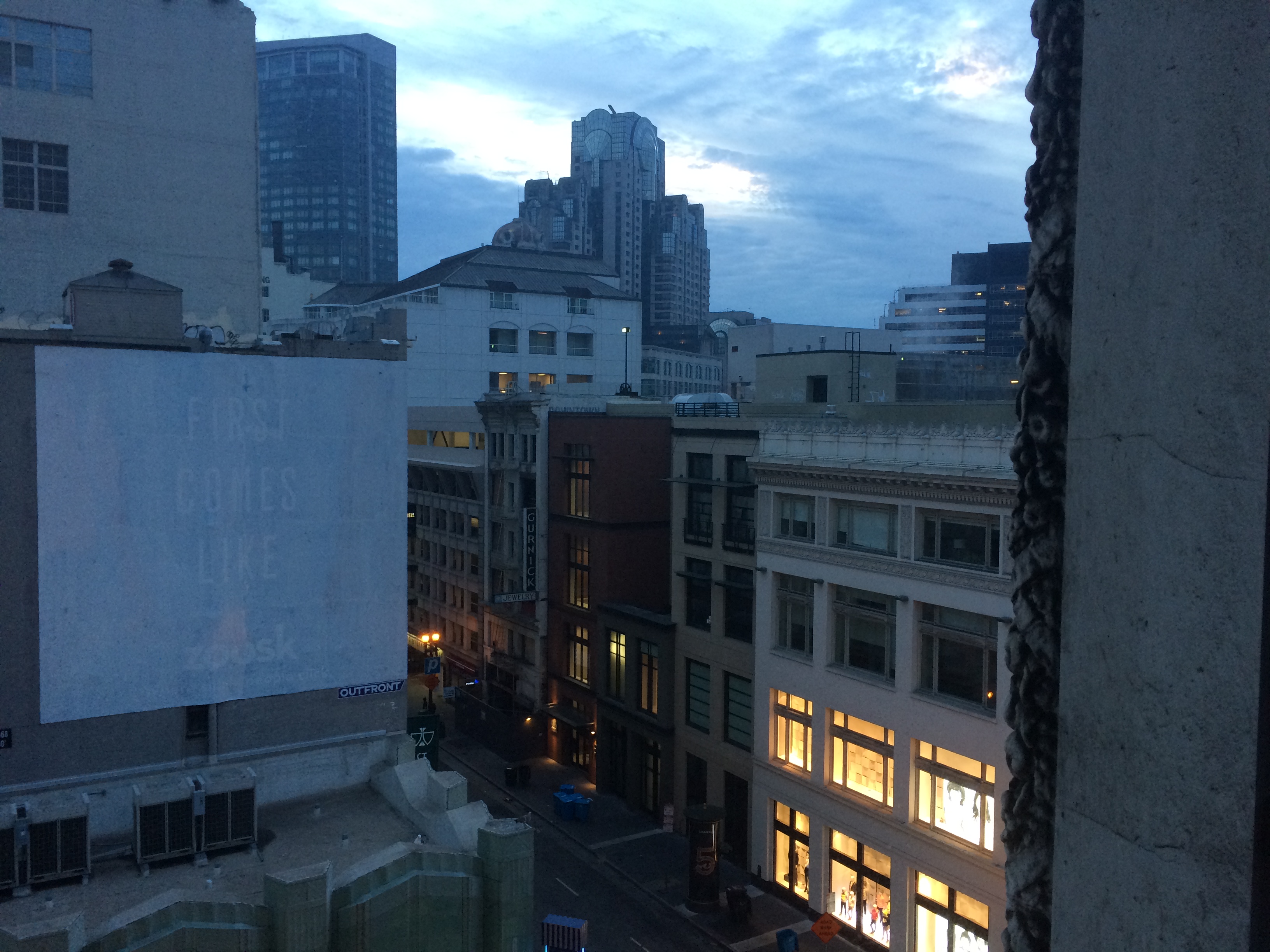
The View From Your Window Contest

VFYWC-239

You have until noon on Tuesday to guess it. City and/or state first, then country. Please put the location in the subject heading, along with any description within the email. If no one guesses the exact location, proximity counts.  Be sure to email entries to contest@andrewsullivan.com. Winner gets a free The View From Your Window book, a new Dish mug, or two free gift subscriptions to the Dish. Have at it.

Last week’s contest results are here. Browse a gallery of all our previous contests here.

A Short Story For Saturday

This weekend’s short story is Langston Hughes’ “One Friday Morning,” first published in 1941. How it begins:

The thrilling news did not come directly to Nancy Lee, but it came in little indirections that finally added themselves up to one tremendous fact: she had won the prize! But being a calm and quiet young lady, she did not say anything, although the whole high school buzzed with rumors, guesses, reportedly authentic announcements on the part of students who had no right to be making announcements at all—since no student really knew yet who had won this year’s art scholarship.

But Nancy Lee’s drawing was so good, her lines so sure, her colors so bright and harmonious, that certainly no other student in the senior art class at George Washington High was thought to have very much of a chance. Yet you never could tell. Last year nobody had expected Joe Williams to win the Artist Club scholarship with that funny modernistic water color he had done of the high-level bridge. In fact, it was hard to make out there was a bridge until you had looked at the picture a long time. Still, Joe Williams got the prize, was feted by the community’s leading painters, club women, and society folks at a big banquet at the Park-Rose Hotel, and was now an award student at the Art School—the city’s only art school.

Nancy Lee Johnson was a colored girl, a few years out of the South. But seldom did her high-school classmates think of her as colored. She was smart, pretty and brown, and fitted in well with the life of the school. She stood high in scholarship, played a swell game of basketball, had taken part in the senior musical in a soft, velvety voice, and had never seemed to intrude or stand out, except in pleasant ways so it was seldom even mentioned—her color.

Read the rest here. For more of his fiction, check out The Short Stories of Langston Hughes. Previous SSFSs here.

The Meaning Of ’90s Sitcoms

The above video, by program designers Brett Bergmann and Benajmin Roberts, allows you to “simultaneously experience every episode from Season 1 of the sitcom ‘Friends’.” Brandon Ambrosino captions:

What’s striking about the video is how carnivalesque everything appears. Once you hit play, you’re bombarded with an avalanche of blurry images scored to the sounds of comical dialogue and laughter. If you keep watching, there will come a point where you realize just how formulaic the show was.

Like all sitcoms, Friends’ scripts were written with an almost scientific precision. In every episode, Rachel and Ross would flirt and fight, Monica would be brazenly type-A, Joey would smugly pursue women, Phoebe would say something so random that it was funny, and Chandler would offer a commentary on all of it that would never be as funny as it was in his head. This formulaic approach to storytelling comes through in the episodes’ titles, each of which starts with the words “The one with/where … ” (“The One Where Joey Speaks French,” “The One With the Male Nanny”).

If you watch the video above closely enough, you might be able to make out individual frames, and recognize your favorite characters in their apartments or their favorite coffee spot. But the point of the video isn’t to pick out the 24 different shots — the point is to see them all as the same shot.

A Poem For Saturday

4422881806_04b052919d_b

Dish poetry editor Alice Quinn writes:

Michael Longley’s The Stairwell, just published by Wake Forest Press, the premier publisher of Irish poets in America, is his thirteenth collection. He has also edited 20th Century Irish Poems and selections of the work of some of his favorite poets—among them Louis MacNeice, Brendan Kennelly, and Robert Graves, and he is the author of a winning memoir, Tuppeny Stung. He is a superb elegist and his poems about birds, children, and the natural world – exquisitely delicate – are among his most enchanting, often just four lines long, or two.

We’ll start with four of these shorter poems:

“Maisie at Dawn”:

Wordless in dawnlight
She talks to herself,
Her speech-melody
A waterlily budding.

“Wild Raspberries”:

Following the ponies’ hoof-prints
And your own muddy track, I find
Sweet pink nipples, wild raspberries,
A surprise among the brambles.

“Hailstones”:

at the Memorial to the Murdered Jews of Europe, Berlin

It must have been God, or rather, Yahweh
Who scattered the granite slabs with hailstones
And threw them from His Hand so accurately
Not one Jew was uncommemorated.

“The Frost”:

They kept you refrigerated for days, my twin.
I kissed your forehead where the frost was fading.

(From The Stairwell © 2014 by Michael Longley. Used by permission of Wake Forest University Press. Photo by Jenny Downing)

Our Smartphones, Ourselves

A new study suggests the mere presence of an iPhone improves test-takers’ performance:

[P]articipants were placed in a cubicle and asked to perform word search puzzles. Researchers monitored their anxiety levels, heart rate, and blood pressure while the subjects had their iPhones with them. Then, the real experiment began. Researchers told participants that their iPhones were causing interference with the blood pressure cuff and asked them to move their phones. The phones were placed in a nearby cubicle close enough to be within eyeshot and earshot of each subject. Next, the researchers called the subjects’ phones—now placed out of reach—while they were working on the puzzle. Immediately afterwards, they collected the same data.

The results changed dramatically. Not only did the participants’ puzzle performance decline significantly while the phones were off-limits, but their anxiety levels, blood pressure and heart rates skyrocketed.

Of course, students aren’t representative of all people, but Russell Clayton, a doctoral candidate who led the study, thinks the results can tell us something about how we see our phones. “iPhones are capable of becoming an extension of selves such as that when separated, we experience a lessing of ‘self’ and a negative physiological state,” he writes. Clayton and his co-authors suggest that having phones nearby may help smartphone owners perform better during tasks that require undivided attention.

Julian Baggini expands on that last point, drawing on the “extended mind” hypothesis of philosophers David Chalmers and Andy Clark, which proposes “that the boundaries of the human mind might extend beyond the skull”:

The extended mind thesis simply points to the fact that we also use things outside of our bodies in the same way. We don’t store all our memories in our brains: we put some in phone books, photo albums and diaries. We don’t just use fingers to count: we use calculators and abacuses. If we’re trying to think things through, we may physically as well as mentally list the pros and cons to help weigh them up.

Some find our increased reliance on such mental prosthetics troubling. Will a generation that can google everything, everywhere, grow up unable to remember anything? Any gains should outweigh the losses. Brain power is a finite resource and we don’t want to use it all up on data storage and retrieval. After all, savants who remember everything often understand very little. Being able to outsource some of the grunt work of cognition frees up our brains to do the interesting, creative processing of the information. The best way of keeping our minds engaged and active might well be to let them extend far outside our skulls.

Beard Of The Week

A reader writes:

I submit as a candidate this photo of my friend, snapped by his wife, both of Northfield, Minnesota, with kittens Cosmo and Bartimaeus.  She titled this photo “things are taking a turn for the strange today”.  He and I are all among a group of folks who play Nordic Traditional music here in Northfield on Monday nights at the Contented Cow Pub.  We have been playing together for 10 years and I like to think we are the best and largest nordic traditional music jam session west of Bergen.  People have to keep warm here in Minnesota somehow when the nights are 14 below.

Previous BOTDs here.

Correction Of The Day

From a Guardian piece entitled, “132-year-old rifle found propped up against tree in Nevada desert”:

An earlier Reuters version of this story was amended on 16 January 2015 to correct the model of gun mentioned. It is a Winchester Model 1873, not a 1773, as we first said. The headline was also changed to make it clear that an old gun had been found, not a decrepit cowboy.