Face Of The Day

by Dish Staff

dish_leemississippi1935

The above is one of more than 170,000 portraits taken by the photographers of the government’s Farm Security Administration between 1935 and 1945. Alissa Walker spotlights a new project that makes the photos more accessible:

A team from Yale has collaborated on one of the most visually stunning interpretations of the era, called Photogrammar: 170,000 photos from the period, plotted on a map of the country. As part of FDR’s sweeping social policies of the New Deal, launched in 1935, photographers were dispatched to travel the nation, documenting the effects of the relief work. Most notable was the work of the Farm Security Administration—Office of War Information (FSA-OWI), which tapped now-legendary photographers to make most of the black-and-white photographs we’ve come to associate with the time. The archives were digitized and have now made accessible online by this group of historians, GIS experts, and data scientists.

Photogrammar not only allows you to easily search for all these gorgeous historic images, it places each of them on a map, color-coded by photographer. You can see how Dorothea Lange traveled throughout the rural South and then headed west to document the farmers of California’s Central Valley. I especially like how you can track Jack Delano’s path down Route 66. For historical relevance, you can add an overlay of a 1937 road map of the U.S., made by the Vico Motor Oil Company.

Explore the collection here.

(Photo: “Wife of Negro sharecropper, Lee County, Mississippi,” August, 1935, by Arthur Rothstein)

Going To The Grave Without God

by Dish Staff

Steve Holmes, a Baptist minister, shares what it was like to lead a funeral service for his grandmother, who requested that services include no religious content:

Inevitably, I looked around for help; I’ve done enough liturgical work to know that there are always riches from which to borrow. That said, the Humanist material I discovered surprised me – although on reflection the problem was predictable. Like most contemporary ‘humanism’, it all failed rather badly to be nonreligious. I looked at half-a-dozen or more published patterns for a humanist funeral; every one borrowed central Christian texts, deleted the obvious references to God, and then used the filleted remains to shape the service. (Even Scripture was not immune; Eccl. 3 was several times in evidence. John Donne’s Divine Meditation XVII was also referenced more than once.) This of course reflects the reality – and the tedious banality – of too much contemporary Western atheism: take a philosophically-rich account of things; delete surface references to the divine; and assume that what is left will be meaningful or coherent or interesting. Nietzsche, the world hath need of thee…

The experience itself was interesting; the defiant rebellious joy of a Christian funeral was of course absent (‘Where, death, thy sting? Where, grave, thy victory?’ (a phrase I recall Graham Tomlin describing as the liturgical equivalent of ‘You’re not singing, you’re not singing, you’re not singing anymore!’); ‘Thine be the glory, risen, conquering Son – endless is the victory thou o’er death hast won!’), but that did not feel like a huge problem. We came to say goodbye, and goodbye was said; if I personally could have said so much more, that was the absence of a wonderful bonus, not the presence of a yawning absence. I know the philosophical stuff on the obscenity of death, but my grandmother died old and full of years, and it did not feel like that.

The Evils Of Kitsch

by Dish Staff

Roger Kimball argues that there’s a moral component to the kind of bad taste we call “kitsch”:

[T]o say that something is kitsch is to utter a judgment that is moral as well as aesthetic. The failure of kitsch is not just an artistic failing. There is an ethical dimension dish_dogart as well. Hermann Broch identifies kitsch as “the element of evil in the value system of art” and notes that “kitsch” describes not only certain works of art but also a certain attitude towards life. … [T]he element of untruthfulness is key. “He who produces kitsch,” Broch writes, “is not someone who produces art of meager value. He is not someone of little or no talent. He is definitely not to be judged according to the standard of aesthetics but is ethically depraved; he is a criminal who wills radical evil.”

That may seem hyperbolic. We’ve certainly come a long way from corny genre scenes, paintings of puppies with big eyes, or pretentious, pseudo-classical hotel lobbies bedizened with colored lights. But Broch understands that kitsch rests on a fundamental refusal of reality, on an effort to counterfeit life, to replace reality with a species of narcissistic fantasy. The puppy with big eyes may seem innocent enough. But when extended to the whole of life and invested with the pathos of untrammeled fantasy, kitsch forms a brew that is toxic as well as infatuating. “Evil” is not too strong a word.

(Image via Flickr user Mark]

Why Be A Christian When You Can Just Be Nice?

by Matthew Sitman

640px-ChristCleansing

That seems to be the gist of Rod Dreher’s latest response to me in our ongoing exchange about Christianity’s place in the modern world. If you go on and on above love, as I tend to do, what makes such goodwill and charity different from mere “secular idealism”? Rod even breaks out an oft-quoted line from H. Richard Niebuhr, implying that how I discuss Christianity comes perilously close to the following: “A God without wrath brought men without sin into a Kingdom without judgment through the ministrations of a Christ without a Cross.” What he means is that there’s nothing particularly Christian about just being nice to each other or having a “social conscience,” so if that’s all you’re claiming for your faith, then there’s really no need to hang onto all the metaphysical claptrap and depressing talk of sin. Christianity becomes indistinguishable from vague notions of making the world a better place, which is to say it ceases to really be Christianity. If that’s what Rod thinks I’m arguing for, or even where my arguments lead, then I definitely need to clarify what I mean.

The more I’ve considered Rod’s arguments, the more I think he’s trying to pin down what makes Christianity distinctive. Consider this passage from his recent post:

If the younger generations look to the churches — liberal and conservative both — and see nothing much different from what they see elsewhere, they will rightly wonder, “Why bother?” Wouldn’t you? If being a Christian means nothing more than being a respectable conformist — conforming to a suburban conservative culture, to a liberal urban culture, or anything else — then why be a Christian at all? To comfort ourselves psychologically? Is that all there is?

I appreciate that Rod, unlike many conservative Christians, is an equal-opportunity critic of our culture. He’s against same-sex marriage, but he’ll also call out the excesses of capitalism and our idolatry of wealth. On many occasions I nod along when reading him, actually. Yet I still find myself approaching Christianity – thinking about its distinctiveness – differently than Rod.

I’ve written this before, but it’s worth reiterating: Christianity is not fundamentally about morality. It is not, finally, just a system of ethics. If Jesus were merely another guru telling us how to live better and more moral lives, with perhaps this or that original flourish, I’m not sure how compelling I’d find his message. Instead, I understand Christianity as a faith for those who can’t help but sin, one that assumes our inability to be moral. And this isn’t because we all fail to uphold certain ideals on occasion, but because we are sinners, meaning that even our supposed good works are tinged with self-interest or self-regard. Nothing pure issues forth from human hands, nothing escapes from the fallibility and brokenness in which we are inevitably implicated. Jesus didn’t just talk about our deeds, but our motives. He told us to pray in closets and not let our left hand know what our right hand is doing, such is our capacity for arrogance and self-congratulations. He didn’t just talk about adultery, but lust, and asked those of us who have never murdered someone if we’ve ever been filled with anger. I wish more churches would preach about sin this way – not as some kind of list of what not to do, but rather as the impossibility of being truly good.

What I find distinctive about Christianity is that, in the face of all this, it offers the promise of forgiveness. It holds out mercy and grace as a response, in Francis Spufford’s blunt phrase, to “the human propensity to fuck things up.” And this forgiveness comes not as a reward for getting our acts together, but despite the fact we never quite do. Christianity says you are loved unconditionally, loved before you deserve it – which you never really will, anyway. To be a Christian means most of all to perceive, however falteringly, that God forgives and loves you in the midst of your brokenness, and to then live in light of that love. As St. John put it, “We love, because He first loved us.” The order really does matter.

When Rod asks what a person might see in churches that makes them different from the surrounding culture, I hope it is what I’ve just described: people profoundly humbled by their sins who, because of the love shown to them, offer compassion and mercy to all who suffer and struggle. This does not mean churches simply should say, “I’m okay, you’re okay.” It means churches should be places where you can be honest that you are not okay, places we stumble into when we are at our worst – and yet still find we are embraced. If that’s not all there is to the Christian life, it certainly is where it starts.

This still leaves open questions about how Christians should view certain dilemmas posed by modern life, how historic Christian teachings should be brought to bear on new situations. So Rod still might find the above too vague – but, in a way, that gets to the heart of our disagreement. My claim from the start has been that Christianity assumes our moral efforts never are sufficient, meaning I can’t bring myself to say what makes Christianity different simply by pointing to the morals it might teach. Which makes me want to ask Rod why he thinks certain moral positions are what should set Christianity apart from the mainstream culture, what outsiders should see as making Christians different. If you are against same-sex marriage and critical of large swaths of modern life – well, so are many Muslims. Presumably Rod would find a fair amount of agreement between himself and many Orthodox Jews on a number of these issues. I’d even wager that some cranky, bow-tie wearing agnostic feels just as alienated from modern capitalism as Rod does. If you don’t need to be a Christian, or even religious, to make the same moral critiques of our culture as Rod, then I can’t help but wonder if I’m not the only one needing to explain why he bothers with Christianity.

(Image: Christ cleansing a leper by Jean-Marie Melchior Doze, 1864, via Wikimedia Commons)

The Problems With Political Parties

by Dish Staff

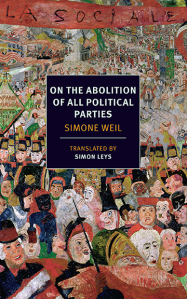
Adam Kirsch revisits Simone Weil’s 1943 essay, “On the Abolition of All Political Parties”:

“Political parties,” she writes, “are organizations that are publicly and officially designed forabolition political parties the purpose of killing in all souls the sense of truth and of justice.” The member of a party delegates his conscience to the party, accepting its verdict on all political and moral questions; a person will do “as a Communist” or “as a Nazi” things that he would never do as himself. Once again, Weil brings the discussion back to the question of truth. Independent thought, she writes, necessarily seeks the truth: “If … one acknowledges that there is one truth, one cannot think anything but the truth.” It is only when one stops searching for truth and starts calculating partisan advantage that one falls into what Weil calls “inner darkness.”

It is obvious that Weil’s argument against parties stands or falls by her definition of truth. Truth, as this deeply religious thinker sees it, is unitary and self-subsistent: it exists somewhere “out there,” and our job is to look for it. There is a right answer to every political question, which every individual, and society as a whole, would necessarily discover if we approached it with pure hearts. Parties, by intervening between the individual and the truth, frustrate this quest; they stifle the conscience and confuse the mind. “Mendacity, error,” she writes, “are the thoughts of those who do not desire truth, or those who desire truth plus something else. For instance, they desire truth, but they also desire conformity with such or such received ideas.”

But what, one might ask, is the “truth” about a question such as taxes? Is an income tax rate of 35 percent more in conformity with the truth than a rate of 40 percent? Is this the kind of question to which, as in mathematics or religion, there is only one correct answer?

Even Preachers Lust For Power

by Dish Staff

Alissa Wilkinson reflects on the Amazon pilot, Hand of God, pointing to the way the show grapples with “how the practice of religion … can be not just a place for people to meet God and seek salvation, but also a place for people to exercise corrupt power for their own ends.” Why she welcomes the realism:

There are lousy, manipulative, lazy, boneheaded portrayals of Christians on TV and in the movies—the conniving Bible-thumping vice president on Scandal springs to mind, for starters—but let’s be honest: there are many wonderful pastors and priests and ministers in the world, and there are also some real doozies out there who can cause a great deal of harm, and unfortunately they are the ones who get a lot of attention both before and after the fall.

If we have seen anything in the last year, in which a large number of formerly highly-respected celebrity pastors have taken a very public tumble (not that it’s anything new!), it’s that power is a dangerous, dangerous thing to handle. So while I hope we keep getting great portrayals of ministers who do God’s work well (here’s a few from the last ten years), let’s not be too quick to wish for these other characters to go away. Like the broader antihero type, who almost inevitably reach a gruesome end, the power-hungry minister serves as a reminder that power corrupts.

To those in positions of spiritual authority, they remind us to be careful. To Christians, they remind us that not everyone who cries “Lord, Lord” will enter the kingdom of heaven. And to those who are sitting in the pews, they remind us that things are not always what they seem.

Derrik J. Lang, talking with show’s cast and creators, emphasizes the show is about more than religion:

Despite the show’s subject matter and title, a reference to a fringe religious group led by [Julian] Morris’ smarmy soap star turned preacher, the creators of “Hand of God” are quick to note that Amazon isn’t moving into faith-based programming. The show’s conceit is more about characters grasping for power in the fictional town of San Vicente than it is about religion.

“The religion in the show is like the science in ‘Breaking Bad,’ ” said writer-producer Ben Watkins, who previously worked on “Burn Notice.” “It’s an important part, but it’s just a thread — a great one because there’s so many compelling themes to explore. For me, this is more about the contradictions of our lives and our ambivalence toward life in general.”

One Nation, Without Reference To God

by Dish Staff

A recent poll indicates that 34 percent of Americans support removing “under God” from the Pledge of Allegiance:

The study, conducted in May of 2014, responded to a 2013 poll by Lifeway Research, which stated that only 8 percent of American adults felt that “under God” should be removed from the Pledge. Unlike the Lifeway Research poll, the survey done by The Seidewitz Group included a brief description of the history of the Pledge of Allegiance, including the information that “under God” was only added as recently as 1954 in response to the Cold War and that some Americans feel that the Pledge should focus on unity rather than religion.

“The current wording of the Pledge marginalizes atheists, agnostics, humanists and other nontheists because it presents them as less patriotic, simply because they do not believe in God,” said Roy Speckhardt, executive director of the American Humanist Association. “We are encouraged by these findings, which suggest with even a small amount of education, more Americans are in favor of restoring the Pledge to its original wording.”

Noting, however, that “it’s pretty clear no court is going to rule the Pledge unconstitutional any time soon,” Ronald A. Lindsay suggests a way to accommodate those who object to the phrase “under God” – make saying it explicitly optional:

Bear in mind that the defenders of the Pledge, and many of the courts that have upheld its legality, have maintained that the Pledge is not only a patriotic exercise, but an important patriotic exercise: it’s considered a critical part of a student’s formation as a good citizen. Therefore–at least according to defenders of the Pledge–some students are being denied a critical component of their education merely because they refuse to abjure their religious beliefs. Students who want to obtain the benefit of participating in the Pledge exercise should not be denied this important aspect of their education merely because they cannot honestly affirm there is a God.

Frankly, it’s difficult to see how a request for making the religious avowal in the Pledge optional could be refused. Compare it to other situations where religious avowals were once employed as a pretext for barring atheists from participating in important civic activities. Until the mid-twentieth century, some states barred atheists from testifying, serving in public office, or serving on juries on the ground that they could not take a religious oath. All such provisions are now recognized as unconstitutional. Witnesses, for example, have the option of swearing on some sacred book to tell the truth “so help me God” or of simply making a solemn affirmation to tell the truth under penalties of perjury. If this country no longer requires witnesses, jurors, or public officials to affirm belief in God to participate in civic activities, how can a state require schoolchildren to affirm belief in God to participate in an important civic activity?

A Poem For Saturday

by Alice Quinn

2709328144_f90a8122f7_o

For many years, LuAnn Walther, editorial director of Vintage Books, Anchor Books, and Everyman’s Library has orchestrated one of the greatest poetry publishing enterprises in America, bringing out nearly one hundred anthologies in the Everyman Pocket Poets series, including single-author titles such as superb selections of the work of Emily Bronte and W.H. Auden and themed anthologies ranging from Lullabies and Poems for Children and Eat, Drink, and Be Merry: Poems About Food and Drink to Marriage Poems, Jazz Poems, Poems of the Sea, and Love Speaks Its Name: Gay and Lesbian Love Poems.

The newest in this enchanting set of books is Poems of the American South, edited by David Biespiel. We’ve drawn some gems from it for our poems this week.

From “The Ozark Odes” by C.D. Wright:

Girlhood

Mother had one. She and Bernice racing for the river
to play with their paperdolls
because they did not want any big ears
to hear what their paperdolls were fixing to say.

Dry County Bar

Bourbon not fit to put on a sore. No women enter;
their men collect in every kind of weather
with no shirts on whatsoever.

Porch

I can still see the Cuddihy’s sisters
trimming the red tufts
under one another’s arms.

Lake Return

Why I come here: need for a bottom, something to refer to;
where all things visible and invisible commence to swarm.

(From Steal Away: Selected and New Poems © 1991, 1996 by C.D.Wright. Reprinted with the permission of The Permissions Company on behalf of Copper Canyon Press. This poem also can be found in the anthology noted above, Poems of the American South, Everyman Pocket Poets. Photo of the White River in Arkansas by Thomas and Dianne Jones)

Object Lesson

by Phoebe Maltz Bovy

Arguing against feminists (but which feminists? more on that in a moment), Ann Friedman defends objectification within relationships:

Within a healthy relationship or sexual interaction, a little objectification is a good thing. Often, it’s a necessary thing. Even the most ardent feminist sometimes wants to feel physically appreciated and desired in a way that is separate from her other qualities. Without a little bit of objectification, every sexual encounter would essentially be gentle lovemaking with lots of eye contact. The sort of eye contact that’s deep and meaningful enough to convey complex messages like, “You really killed it at work this week, you make me laugh, and I love your hot bod.” It’s a nice sentiment, sure, but not exactly a headboard-banging night. Sometimes you just want to get laid.

Especially when you’re several years deep into a relationship, a bit of remove is often essential to getting it up. It can be hard to feel sexy when you’re thinking about the financial stress you’re under, or a parent’s illness, or your partner’s work, or any of the multifaceted aspects of your daily relationship. Focusing on bodies can provide a welcome disconnect. “There has to be an ‘other’ for there to be sexiness,” psychologist Marta Meana told Macleans last year.

All of that sounds reasonable enough, if not as contrarian as Friedman’s making it out to be. She opens her piece by declaring that there’s a feminist consensus that objectification is “bad.” But is there? There is, as she notes, some new research on men who “excessively” objectify their female partners. Fair enough, but who’s arguing against a sensible amount of physical admiration? There’s a feminist consensus, I suppose, that it’s bad to be treated as a sexual object in an inappropriate setting – that is, by your professor or boss, or by a man who’s traveled the length of a public bus just to let you know that he thinks you’d be prettier if you smiled.

And there’s certainly dissent among feminists when it comes to pornography. While I – a feminist, not speaking for all-the-feminists – agree with Dan Savage that the wife in the first letter here sounds… troubled, he might have at least acknowledged that there are ethical concerns about how a good amount of porn is produced, and that even a woman without tremendous “DTMFA”-worthy insecurities might be, I don’t know, miffed, if she really thought about how she stacked up, so to speak, against the women her partner looks at on the internet. But where’s the feminist who, if called beautiful or hot by her male partner, would cry sexism and run for the hills?

Friedman, then, is completely right about the value of objectification within relationships. I disagree only with her assessment of how much of an aberration that position could possibly be within feminism today.