You Never Expect To Get Dementia

by Dish Staff

Alzheimer'S Disease, Scan

Kent Russell struggles to wrap his head around stories of Alzheimer’s:

The thing about these storiescompelling as they can beis that they tend to work against themselves. They have a dampening effect. Emerging from one, you feel a little stupefied, and bone-tired, as though you yourself have just swum through six feet of cemetery dirt. The reading or viewing experience is harrowing, grievous truly scarybut also inconsequential, in a way.

Scary because dementia creates what should not be: mindless persons. Mindless, selfless, unreasonable creatures, somehow still looking like human beings. We see a metaphysical incompatibility in them, and it is deeply unsettling. They might as well be headless bodies, up and shambling around.

Inconsequential because, for all their pathos, each dementia story comes across as an individual tragedy. You read it or watch it or hear about it, and you might fear something similar happening to you, but you can’t really imagine such a thing ever happening to you. Literallydementia is unimaginable. We can’t put ourselves in the place of the demented; we can’t wrap our minds around what it must be like to lose your mind. Instead, you and me, storytelling animals that we arewe invent confident memories of our future.

And then, of course, it happens to us.

(Photo: A scan of the brain of a patient affected by Alzheimer’s Disease. By BSIP/UIG via Getty Images)

Faces Of The Day

by Dish Staff

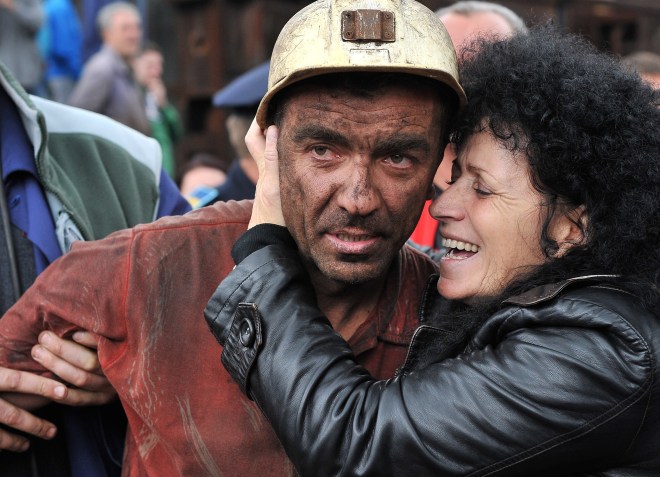
bosnian-coal-miner

A Bosnian coal miner is helped by friends and relatives as he exits the Raspotocje mine in the central town of Zenica during rescue operations on September 5, 2014. Five miners were killed after a 3.5-magnitude earthquake triggered a gas explosion and tunnel cave-in, stranding their crew for 20 hours. By Elvis Barukcic/AFP/Getty Images.

Food Quality And Inequality

by Dish Staff

James Hamblin flags new research on food and socioeconomic class:

Nutritional disparities between America’s rich and poor are growing, despite efforts to provide higher-quality food to people who most need it. So says a large study just released from the Harvard School of Public Health that examined eating habits of 29,124 Americans over the past decade. Diet quality has improved among people of high socioeconomic status but deteriorated among those at the other end of the spectrum. The gap between the two groups doubled between 2000 and 2010. That will be costly for everyone.

Meanwhile, Danielle Kurzleben responds to a report on hunger in America (pdf):

There are a few big points to draw from this report. One is that even as so many headline numbers — unemployment, GDP growth, stock market index levels — are bouncing back, the number of Americans who report they have trouble eating is holding relatively steady, at levels it first hit during the recession. So even when, for example, Friday’s unemployment report shows the economy added a projected 230,000 jobs, as Bloomberg’s consensus reflects, there are plenty of reasons (17.5 or 6.8 million, depending on how you look at it) not to celebrate.

Another thing to note is that the report mostly doesn’t cover the period after food stamp cuts went into effect. In November 2013, a temporary boost to SNAP expired, and this year, Congress passed and President Obama signed into law $8.7 billion in food stamp cuts, a reduction of around $90 per month for 850,000 households, as MSNBC’s Ned Resnikoff reported. (And $8.7 billion is a compromise amount; House Republicans initially wanted much steeper cuts.)

On the agricultural end, there’s some more pessimism. Conor Friedersdorf sees a connection between urban farms and urban inequality:

Successful urban centers are constantly changing, and those changes raise complicated issues. A growing city’s dynamism is core to what makes it attractive and useful. At the same time, cities aren’t just concrete and glass: They’re where people live. There’s a cost to pricing out families and disrupting longstanding communities. Settling on the most fair or desirable housing policies can seem impossible.

But subsidies for urban farming in one of the most dense, geographically constrained, pricey U.S. cities? That’s insanity. “It’s part of the Urban Agriculture Incentive Zones Act, a state law spearheaded by local sustainable land-use advocates and state Assemblyman Phil Ting, D-San Francisco,” the article explains. “The law encourages would-be urban farmers to turn trash-covered empty parcels into gardens with the assurance they won’t be forced out after putting in a lot of time and money.” …

San Francisco residents tend to self-describe as cosmopolitan liberals. But as a friend in the Bay Area once put it to me, they’re often reactionary conservatives when it comes to development. I am not unsympathetic to their desire to preserve such a fantastic city. But they aren’t doing any favors for those who can’t make rent.

On a more uplifting note, Susanna Bohme welcomes a proposed change to legislation regarding pesticides and labor, which would have a particular impact on the youngest workers:

For the 6 percent of farm workers who are under age eighteen, pesticide exposure is particularly dangerous. Children and adolescents’ growing bodies and age-specific behaviors mean they are at special risk for learning and developmental disabilities, asthma, cancer, genetic damage, and endocrine disorders. Despite these dangers, even young farm workers get short shrift when it comes to federal protections. The law allows children as young as twelve (and under some circumstances, even younger) to work on farms, while most other jobs have a minimum age of fourteen. Farm workers under age sixteen are prohibited from working any job deemed hazardous, including those that involve handling the most harmful pesticides. But they are allowed to handle other chemicals, including some whose active ingredients have been implicated in a high number of poisonings. In other sectors, workers aren’t allowed to enter highly hazardous jobs until they are eighteen; in agriculture that age is sixteen.

The revised Standard tightens the rules by establishing that same age, sixteen, as the minimum for handling any pesticide, not just those with the highest toxicity ratings. The new Standard would also prohibit the use of young people as early entry workers during the post-application interval. This is a meaningful change because, as the proposal notes, in one study of 531 acute poisonings among child farm workers, in cases where the toxicity category of the responsible pesticide was known, “67% of the illnesses were associated with toxicity category III pesticides, which are not currently prohibited under the hazardous order.” On the EPA’s scale of I to IV, with I the most toxic, category III can be plenty dangerous. Again the example of RoundUp is instructive. Currently there are no age restrictions for handling this category III chemical, but a 2008 study found that farmworkers exposed to it are twice as likely to develop Non-Hodgkin’s lymphoma.

The Case For Microwave Dinners

by Dish Staff

5889496675_de6b26e719_o

Amanda Marcotte makes it:

While home-cooked meals are typically healthier than restaurant food, sociologists Sarah Bowen, Sinikka Elliott, and Joslyn Brenton from North Carolina State University argue that the stress that cooking puts on people, particularly women, may not be worth the trade-off. The researchers interviewed 150 mothers from all walks of life and spent 250 hours observing 12 families in-depth, and they found “that time pressures, trade-offs to save money, and the burden of pleasing others make it difficult for mothers to enact the idealized vision of home-cooked meals advocated by foodies and public health officials.” … The researchers quote food writer Mark Bittman, who says that the goal should be “to get people to see cooking as a joy rather than a burden.” But while cooking “is at times joyful,” they argue, the main reason that people see cooking mostly as a burden is because it is a burden. It’s expensive and time-consuming and often done for a bunch of ingrates who would rather just be eating fast food anyway.

Megan McArdle offers an assent from the frozen foods aisle:

Don’t cook from scratch if you hate to cook. Cooking is a joy. So is rock climbing, or ice skating, or reading science fiction novels. That doesn’t mean it’s a joy everyone shares. There’s no reason that you should cook from scratch if you don’t like doing it. America’s supermarkets offer an ever-more-stunning variety of quick, tasty, relatively healthy frozen entrees. Virtually every grocery store has a giant freezer case devoted to making dinner time a snap, another big refrigerator case filled with things that take barely more time, and a huge prepared-foods section that is still cheaper than takeout. So is a box of pasta and a bottle of decent sauce like Rao’s. For that matter, I still remember very fondly my grandmother’s signature kid dish: hamburger meat, pasta shells and Ragu.

On a related note, Jeffrey Kluger advocates for staggered mealtimes:

It’s not that my wife and I don’t eat with our daughters sometimes. We do. It’s just that it often goes less well than one might like. For one thing, there’s the no-fly zone surrounding my younger daughter’s spot at the table, an invisible boundary my older daughter dare not cross with touch, gesture or even suspicious glance, lest a round of hostile shelling ensue.

There is too the deep world-weariness my older daughter has begun bringing with her to meals, one that, if she’s feeling especially 13-ish, squashes even the most benign conversational gambit with silence, an eye roll, or a look of disdain so piteous it could be sold as a bioterror weapon. Finally, there is the coolness they both show to the artfully prepared meal of, say, lemon sole and capers – an entrée that is really just doing its best and, at $18.99 per lb., is accustomed to better treatment.

All of this and oh so much more has always made me greatly prefer feeding the girls first, sitting with them while they eat and, with my own dinner not on the line, enjoying the time we spend together. Later, my wife and I can eat and actually take pleasure in the experience of our food.

(Photo by Michael Beck)

The Road To Democracy May Be Literal

by Dish Staff

Christian Caryl makes an interesting argument to that effect:

In Rwanda, decent roads stand for the official commitment to provide everyone with equal access to the fruits of development – concrete evidence, if you will, of the determination to overcome the ethnic divides that led the country into mass slaughter just two decades ago. Every part of the country is relatively close to a good road; no group is excluded. (Nor do you have to have a car to get around; members of Rwanda’s growing middle class can simply hop on one of the country’s ubiquitous minibuses.) Northern Malians can only dream of such conditions.

Roads don’t just enable the movements of goods; they also enable the flow of ideas. … As such, roads are also crucial ingredients of state-building.

Soon after toppling the Taliban in 2001, the U.S.-led coalition that occupied Afghanistan set out to rebuild Highway 1, the ring road linking Kabul with the country’s major urban centers (including Kandahar, the Taliban’s unofficial capital). The idea was to restore a sense of unity to a country that had virtually fallen apart during the long years of civil war. Taliban insurgents immediately vowed to sabotage the project for just the same reason. Today, the dismal story of Highway 1, which is falling apart after $4 billion of Western investment, offers a perfect microcosm of Afghanistan’s roller-coaster struggle to reinvent itself. Afghanistan isn’t unusual in this respect. Take a look at many failed states around the world and you’ll probably be struck by how many of them have bad (or no) roads.

But building too many roads means, in the words of Mark Buchanan, that “wildlife habitats will suffer huge losses and ecosystems will be destroyed, ultimately undermining Earth’s capacity to support human life as well.” Buchanan’s advice on how to minimize the harm:

New research by a group of environmental scientists suggests that better coordination could go a long way toward avoiding this disaster. The key is that vast tracts of settled land, where ecological damage is already significant and probably irreversible, still aren’t very productive. Better access to fertilizers and modern farming technologies would greatly boost the productivity of such areas, thereby reducing the need for development in more sensitive areas.

The researchers have produced a global map showing places on Earth where new roads or road upgrades could have big human benefits, and others where little benefit would be expected despite large environmental costs.

Weighty Art

by Dish Staff

A Columbia student and alleged rape survivor has come up with an powerful way to dramatize the aftermath her assault:

[Emma] Sulkowicz has devised a senior thesis rooted in performance art that will allow her to protest the fact that her rapist continues to study on campus. She has committed to carrying around a twin-size dorm mattress everywhere she goes on campus, to classes and appointments, “for as long as I attend the same school as my rapist.”

“I was raped in my own dorm bed, and since then that space has become fraught for me,” she says in a video about the piece, called Mattress Performance or Carry That Weightpublished by the Columbia Spectator. “And I feel like I’ve carried the weight of what happened there with me everywhere since then.”

Katie Van Syckle interviews Sulkowicz:

How’s it going?
Rough. I just never really anticipated how big this would be, and I thought I was prepared, but I just wasn’t.

In terms of the response?
Physically, I’m really sore. The reporter response has been really aggressive and not what I expected. It is a sensitive subject, and I can’t be accosted in the middle of campus to talk about it. One guy, while I was carrying the mattress, he just opened up my backpack and threw his business card in, which was a real violation of my space and made me really upset and triggered a lot of memories of being raped.

Update from a reader:

I was surprised that you referred to Emma Sulkowicz as a “rape survivor”. I have noticed that several other media outlets have done the same. But her alleged attacker, whose name is readily available online, has never been convicted of the rape. There were only two people in the room when the incident happened, and they are giving completely polarized versions of what occurred.

There is a lot of murkiness in the story: she didn’t report the alleged rape until months later, at the urging of friends. Her allegations are being leveled at an ex-boyfriend (of course, boyfriends can rape, but the history of an ongoing relationship complicates the objective evaluation of the two opposing versions to the story, and of the dynamic in the room that day). And finally, the people who were charged with evaluating the two versions, i.e., the administration of Columbia University, came to the conclusion that there were not grounds for pursuing the charges. I understand that law enforcement officials came to the same conclusion.

In the absence of all the facts, my emotions tell me that Ms. Sulkowicz did indeed suffer being raped, and her story makes me feel terrible. But it’s important to recognize that due process must be followed before we tag somebody a “rapist”. Only Ms. Sulkowicz and the accused know what happened in that bedroom that day; you do not. She can refer to him as a “rapist”, but you, or I, or anyone else, cannot, until due process has been followed and the accused has been found guilty of what remains an allegation.

Thanks for the context; we updated the post with “alleged”.

What’s Not On The Syllabus?

by Dish Staff

Rebecca Schuman laments the sorry state of the college course syllabus, which, she says, has swelled to “10, 15, even 20 pages of policies, rubrics, and required administrative boilerplate, some so ludicrous (‘course-specific expected learning outcomes’) that I myself have never actually read parts of my own syllabi all the way through”:

The texts? The assignments? Unsurprisingly, these are still able to fit on a page or two. The meticulous explanations of our laptop policies, or why, exactly, it’s inadvisable to begin course-related emails with “heyyyyyyyyy,” or why we will not necessarily return said emails at 3:15 a.m.? A novel’s worth. Today’s college syllabus is longer than many of the assignments it allegedly lists – and it’s about as thoroughly read as an end-user license agreement for the latest update of MS Word. …

Syllabus bloat is more than an annoyance. It’s a textual artifact of the decline and fall of American higher education. Once the symbolic one-page tickets for epistemic trips filled with wonder and possibility, course syllabi are now but exhaustive legal contracts that seek to cover every possible eventuality, from fourth instances of plagiarism to tornadoes. The syllabus now merely exists to ensure a “customer experience” wherein if every box is adequately checked, the end result – a desired grade—is inevitable and demanded, learning be damned.

“White Supremacy Ate My French Homework” Ctd

by Phoebe Maltz Bovy

In his NYT obituary of Joan Rivers, Robert D. McFadden refers to her as “the brassy Jewish-American princess from Flatbush, Brooklyn, and Larchmont, in Westchester County.” This jumped out at me, not just because “JAP” is a slur (which it is, but one could argue that it honors Rivers to violate PC), but because… Flatbush? Some of my family lived in more or less that part of Brooklyn at more or less the same time, and it seems an odd place to label “princess” country.

I made that point on Facebook, which led to a discussion about whether one must be born a “JAP” to be one, or whether one can, through scrappy hard work, deck oneself out in tasteless-but-expensive garb and become a princess in the derogatory sense. Can one ever earn unearned advantage? Is that a thing?

Which brings us back to the more general question of “privilege.” Can privilege be earned? Is the combination of talent, hard work, and luck that brings a handful of people from not-so-privileged backgrounds success enough to move such individuals into the “privileged” category? Or does the word specifically refer to advantage that’s the result of being born to the winning side of some systematic inequality?

That’s a big part of the conversation that’s emerged in the response to my earlier post, in which I took issue with Rod Dreher’s choice to call out Ta-Nehisi Coates’s “privilege” when what Coates was describing – taking a French class as a successful adult, in a situation that wouldn’t have been available to him as a kid – seemed a fairly clear-cut case of earned advantage. Freddie deBoer takes issue with that assessment:

Of course Coates has been the beneficiary of unearned advantage.

It’s an unearned advantage to be born without crippling medical ailments. It’s an unearned advantage to be born male. It’s an unearned advantage to be born in the United States rather than in Afghanistan or Somalia. And so on. Is that what most people mean when they talk about privilege? Maybe not, but then another of the central points of privilege theory is that the privileges that are most profound tend to be those we don’t acknowledge. Besides: Coates has written at length about the benefits he had growing up thanks to his parents, and to being politicized by his father, a former Black Panther. That’s a classic kind of privilege, parental privilege, and one that absolutely matters.

Such talk will inevitably piss some people off, but it shouldn’t. The fact that Coates has been the recipient of great advantages compared to many people in the world doesn’t change the fact that he has also been faced, his whole life, with the disadvantage of living in a structurally racist society, or the relative disadvantage of his own economic circumstances compared to some others. The point is that “privileged” is not a binary category, and in fact essentially all people are some combination of advantaged and disadvantaged.

Despite a tone that suggests he and I are in stark disagreement, I basically agree with him on this. And he’s right that Coates, going the 2012 article I suspect he’s at least partially referring to, probably would as well. How anyone ends up where they do in life is always going to be some incalculable mix of effort and unearned advantage. One of the great flaws of “privilege” as a concept – and as deBoer notes, I’ve held forth on this topic quite a bit; if my ending was “underwritten,” it was out of a fear of length of the holding-forth that could ensue – is that it fails to account for the myriad unearned advantages and unfair (but often invisible) obstacles that don’t fall into any particular privilege framework. Is talent “privilege”? Is growing up in a dysfunctional but upper-class family a lack thereof? It’s always going to be possible to point to individual rich people who’ve had it worse than individual poor ones, individual black people who’ve had it easier than individual white ones, and so on. We can all point to people we know who are, on paper, more privileged than we are, but have struggled more than we have, and vice versa.

But this is only a problem when one tries to apply “privilege” to individuals. The concept works much better for describing society, because it’s about all-things-equal. While unearned, idiosyncratic advantages have doubtless contributed to Coates’s success, that doesn’t somehow tell us that white privilege (or white unearned advantage) isn’t significant in some broader sense. I suppose what I’m saying is that I’d be wary of taking this critique of privilege as far as deBoer does when he describes “a world of such multivariate complexity that we can never know whose accomplishments are earned and whose aren’t.” Yes, life is complicated, but it’s not that complicated. Are we really going to say that the Harvard legacy kid has precisely the same level of unearned advantage as the kid who got in thanks to hard-work-and-dedication-privilege?

Two readers address this question of systematic inequality more eloquently than I could, so let’s end with their observations. The first:

I think the critique of Coates’ essay regarding privilege misses a key component of TNC’s entire project. When you argue: “people often round up how easy those who have it relatively easy actually have it. I’ve heard variants of this that are about class, not race – where those who didn’t grow up with college-educated parents assume that those who did spent their dinners discussing Ideas, not squabbling over nonsense, or watching bad television.” You miss the key difference, in a way that Dreher does as well. TNC’s point (and he links repeatedly to the research backing it up both on Twitter and in the Reparations essay) is not that there’s some vague privilege in having grown up in one neighborhood vs another and that if only his family had been middle class he’d be different. It’s that structurally, a black child in a family that we would call middle class is vastly more likely to grow up in a bad neighborhood, attend worse schools, and have far more contact with actual poverty than a white child with the exact same family profile. That is the access to culture we’re talking about here. It’s not a vague sense that someone reads with a child or that mom and dad talk about books or whatever. It’s that for black families, being middle class isn’t enough. They will live in worse neighborhoods, they will have greater contact with poverty (and violence, and likely the police) and their outcomes will be constrained because of it.

That’s what’s actually more galling about Dreher’s response. It’s that he hand-waves away the research TNC puts forward with anecdotes about his family, and so he never confronts the structure of the argument at all.

And the second:

I suppose this list of qualifications – senior editor a respected magazines, writing for top publications, spending a summer studying French at Middlebury – is a set of markers of class and privilege. But consider this set of qualifications: tenured professor at one of the oldest and most prestigious universities in the country, respected scholar with an international following, board member of a number of prestigious cultural institutions. Pretty upper class, right?

Of course, I’m describing Henry Louis Gates, who if we all recall was arrested in 2009 after being locked out of his house.

I’m neither a senior editor at a national magazine, nor a professor at a prestigious university, but if I’m ever locked out of my house, I don’t worry that a neighbor will call the police on me. Yet should that nonetheless happen, I’m extremely confident of my ability to explain the situation to the police and avoid arrest. And I’ll wager however much you like that Dreher is in the same position.

Here would be where I point out that this is white privilege – but I think “privilege” is not actually helpful, nor accurate. Rather, here is where I point out that this is in fact a question of class, that class has many components, and that alongside income, wealth, education, and profession, race is one of them.

Race is part of class, and I think a lot of the bitterness comes from the realization that however many achievements a black American may achieve in 2014, race often still trumps achievement as a designator.

A Foreign Policy Of Caution

by Jonah Shepp

Obamas-Crucial-Six-Months-SD

Frank Rich takes on critics of Obama’s foreign policy regarding his approach to the Iraq/Syria conflict:

You will notice that the crowd of pundits and (mostly Republican) politicians insisting that Obama “do something” about these horrors never actually say what that “something” is. They offer no strategy of their own beyond an inchoate bellicosity expressed in constructions along the lines of “we must more forcefully do whatever it is that Obama is doing.” That’s because Obama is already doing the things that can be done (and that some of his critics redundantly suggest): bombing ISIS positions wherever it is feasible; searching for allies to join action that might defeat them on the ground; trying to rally Europe to tighten the economic noose on Putin and Russia. There will surely be more actions to come when America’s ducks are in a row, and if the president were to delineate them, you can be certain he’d be condemned for tipping off our enemies in advance.

This is something I neglected to mention in yesterday’s post criticizing Shadi Hamid’s take on Obama’s “inflexibility” on Syria (Hamid has responded via Twitter, arguing mainly that the situations in Iraq and Libya were different enough from Syria that they don’t make the case against intervention). As Rich points out, Obama has already “flexed” considerably in the direction the pro-intervention crowd would prefer. I think Obama went into office hoping to soften the Bush Doctrine, fight transnational jihadism as a security challenge rather than a moral crusade, and make direct US military intervention in foreign conflicts the exception rather than the rule. He has scaled back those ambitions considerably, partly in light of events on the ground but also because the notion of America as the world cop still holds sway in Washington’s clique of foreign policy elites. I expect him to “flex” on intervention in Syria as well, but I read his reticence to commit to a specific course of action as a sign that he is doing due diligence in weighing his options, not brushing off the crisis altogether.

Unfortunately, one man’s deliberation is another man’s dithering, and the president’s caution is being spun as weakness, even though, as Dan Froomkin points out, there are scads of questions that we ought to be asking before launching a potentially lengthy military engagement but aren’t. War hawks would do well to remember how terrible we are at predicting the outcomes of such engagements: like the president himself, I’m skittish about going to war in Syria not because I disagree that ISIS is a blight on humanity, but rather because going to war has deadly, unpredictable consequences. A decision can be morally crystal clear at the moment and still cause great suffering down the line.

In one of his most insightful takes on Obama’s foreign policy, Max Fisher describes it as stemming from a broad, optimistic worldview that pays more heed to the long-term trend toward a safer and more stable world than to the bumps in the road that leads there. Fisher examines how this “professorial” approach is playing out in the Ukraine crisis:

This is a strategy that essentially abandons eastern Ukraine — and any other non-NATO eastern European country that Putin might choose to invade — to Russian aggression. Still, in the very long view, it is essentially correct: Russia’s foreign policy is dangerous today, but in the long-term it is self-defeating. On the scale of years or decades, Putin will leave Russia weaker, less powerful, and less of a threat; the US-led Western order will eventually prevail. “Eventually” does nothing to address Russian aggression now, but it will turn it back some day.

But Obama’s job is not to be an academic studying long-term trends in American foreign policy. His job is to make decisions — hard decisions — every single day for eight extremely difficult years. Parsing the arc of foreign-policy history has not given him the answers for the problems of this moment. He is steering a race car as if it were a cruise ship, and while history will likely thank him for keeping US foreign policy pointed in the right direction, it may not so easily forgive him for the damage taken along the way.

Which is why, I think, Obama is so reviled by his critics today. I doubt, though, whether history will really remember him so fondly, and whether we will ever learn from these crises. Because one can never prove or disprove a counterfactual, I fear that the argument over whether American intervention does or does not “work” will continue at least as long as the US remains the world’s sole superpower, and that the interventionists will win out most or all of the time.

In the case of Iraq and Syria, the emotional and moral arguments will probably win the day. Examining Obama and his critics through the lens of Walter Russell Mead’s taxonomy of American foreign policy traditions, Peter Beinart fears that “Jacksonian” jingoism is pushing us toward war for the wrong reasons, in the wake of the murders of James Foley and Steven Sotloff:

In narrow policy terms, the arguments for military intervention have not improved over the last two weeks. It’s still not clear if Iraq’s government is inclusive enough to take advantage of American attacks and wean Sunnis from ISIS. It’s even less clear if the U.S. can bomb ISIS in Syria without either empowering Assad or other Sunni jihadist rebel groups. But politically, that doesn’t matter. What’s causing this Jacksonian eruption is the sight of two terrified Americans, on their knees, about to be beheaded by masked fanatics. Few images could more powerfully stoke Jacksonian rage. The politicians denouncing Obama for lacking a “strategy” against ISIS may not have one either, but they have a gut-level revulsion that they can leverage for political gain. “Bomb the hell out of them!” exclaimed Illinois Senator Mark Kirk on Tuesday. “We ought to bomb them back to the Stone Age,” added Texas Senator Ted Cruz. These aren’t policy prescriptions. They are cries for revenge.

And it doesn’t help that many Americans don’t know where we’re dropping bombs but largely approve of doing so:

Less than a quarter of the public are aware that the US has recently launched strikes in Somalia, Pakistan or Yemen. 30% also say, incorrectly, that the US has recently conducted bombed Syria and only 32% of Americans know that the US has not in fact launched air or drone strikes in Syria. Most Americans support conducting air or drone strikes in Iraq (60%), Afghanistan (54%) and Syria (51%). They also tend to support the ongoing drone campaigns in Somalia (45%), Pakistan (45%) and Yemen (38%). They would also tend to approve (38%) rather than disapprove (33%) of conducting drone strikes in Iran. 29% of Americans say that they would approve of the US bombing Gaza and Ukraine.

(Photo by Chip Somodevilla/Getty Images)