Rich Californians Spur Nostalgia Reunion Tour For Eradicated Diseases

by Alex Pareene

Paloma Esquivel and Sandra Poindexter of the L.A. Times report that America’s idiot rich are bringing back measles and whooping cough, thanks to the widespread popularity of stupid conspiracy theories about the supposed dangers of vaccines, and California’s lax “personal belief” exemptions from vaccine requirements for school children. Hundreds of California schools now have vaccine exemption rates of higher than 8 percent, the level at which “herd immunity” from infectious diseases breaks down.

As Michael Hiltzik emphasizes, the rise in exemptions from vaccine requirements is driven almost entirely by wealthy parents:

A Times analysis of the state figures found that the growth in personal-belief exemptions was particularly prevalent at private schools: Nearly 1 in 4 of those kindergartens reported at least 8% of their students were exempt from at least one vaccine last fall because of personal belief. In 2007, that figure was just 1 in 10. The rate for public school kindergartners last fall also more than doubled to 11% from 5% in 2007.

And:

In Los Angeles County, the rise in personal belief exemptions is most prominent in wealthy coastal and mountain communities, The Times analysis shows. The more than 150 schools with exemption rates of 8% or higher for at least one vaccine were located in census tracts where the incomes averaged $94,500 — nearly 60% higher than the county median.

When will rich Californian community leaders finally address their endemic culture of ignorance, instead of always blaming outside forces like “pharmaceutical companies” and “doctors” and “established medical science” for their problems? The vaccine panic, like 9/11 Trutherism, is a conspiracy theory with more appeal to the left than the right.

Its villain is not Big Government but Big Pharma. Jenny McCarthy, the most prominent voice of the anti-vaccine movement, had her dangerous nonsense amplified by the explicitly liberal media (specifically, Oprah Winfrey and the Huffington Post). For American liberalism, a political movement that regularly declares itself “pro-science,” this is more than a bit embarrassing. (See also: All crunchy rich liberal discussion of “toxins” and “non-celiac gluten sensitivity,” which probably doesn’t exist, or at least which is probably caused by something other than gluten.)

Of course, if the government were to get involved – say, by eliminating the “personal belief” exemption entirely (something that should happen, to be clear) – I’m sure the right would suddenly find common cause with the deluded liberals behind the anti-vaccine movement. Indeed, Michele Bachmann already flirted with anti-vaccine rhetoric during her 2011 run for the presidency. (Maybe this is the issue Republicans can use to finally close the gender gap!)

Not vaccinating your child puts other children at risk. If there’s one situation in which I’m entirely in favor of jack-booted nanny-state government shock troops telling people what they can and can’t do with their bodies, it’s this.

Why Do We Subsidize Mansions?

by Dish Staff

benefit_homeownership

Danny Vinik wants to know:

The traditional defense of these [homeowner] tax breaks is that they promote homeownership, which has been shown to have numerous additional benefits including improved health. But there’s a big problem with this argument: these deductions don’t actually subsidize homeownership. They subsidize bigger homes and more debt instead.

Consider the mortgage interest deduction that allows homeowners to deduct their interest payments on loans up to $1 million. The larger the debt (up to $1 million), the larger the interest paymentsand the more the homeowner can deduct in taxes. As Nick Bunker, a research associate at the Center for Equitable Growth, wrote Wednesday, “The deduction gets pitched as an effort to increase homeownership, but academic research finds that really it just increases the size of homes purchased.” At the Washington Post, Catherine Rampell shows how the median house size has increased over the past 40 years. It’s at a record-high, after a slight dip post-Great Recession. Homeowners are incentivized to build larger houses thanks to the mortgage-interest deduction.

I’ve Seen Israel From Both Sides Now …

by Jonah Shepp

At one point or another in my short life so far, I think I have held every position on Israel that it is possible to hold, from militant support to equally militant opposition. But this summer, I briefly reverted to the right-wing Zionism of my teenage years, at least for the purposes of Facebook. Amid the Gaza war, my feed was suddenly inundated with denunciations of the racist, fascist, Zionazi terrorist state. There wasn’t much to love in the rants about the ZOG or conspiratorial nonsense about ISIS being an Israeli-American plot, but what really got my goat were comments like this one:

Settlers can go back to anti-semitic Europe where they came from! … Every last zionist shall be kicked out and notice the emphasis on the word zionist. Jews however are welcome to stay and woreship like they have among us for the past 1500 years. (sic)

This oft-expressed distinction between Zionists and Jews betrays a total misunderstanding of what Zionism is and what Israel means to most Jews. Palestinians who say that “the Zionists” must go but “the Jews” can stay need to come to grips with the fact that Zionism, at its core, is about creating a space where Jews do not need someone else’s permission to live. Diaspora Jews of my generation may be much less attached to Israel than our parents and grandparents, but when push comes to shove, we’d rather it exist than not, because we know that our permission to live freely and safely in any other country can be withdrawn at any moment. In our history as a people, we have seen it happen time and time again with devastating consequences. With a well-armed territorial state to our name, we no longer have to fear those consequences.

There is no question that anti-Semitism is alive and well in the world, and not only in its traditional strongholds in Europe, but is world Jewry really in such great danger as to match our insecurities? More importantly, given the imbalance of power between Israel and its enemies, can we really fear that it will cease to exist? Noah Millman took up that question the other day:

I have, myself, plenty of fears for Israel, a country with which I am deeply concerned, but essentially no fear at all that Israel will “cease to exist.” I don’t even know what that phrase means – that Israel will cease to define itself affirmatively as a “Jewish state”? That Israel will merge into a larger entity, or subdivide into smaller entities? Those would be big changes, yes, but “cease to exist” is a funny phrase to use for something could happen to the UK, or Belgium, or Canada. When I listen to both of them, what I think they mean is: that the Israeli Jewish population will cease to reside there; that Jews will move, en masse, to some other place or places, or will be physically annihilated. Does anyone really believe that kind of outcome is likely?

“Israel is not, in any meaningful sense, a provisional experiment,” he concludes, and both its supporters and its detractors ought to stop speaking of it as such. This, as I see it, really gets to the heart of the matter. Israel is a fait accompli; it is not going anywhere, no matter what Hamas feels the need to tell its constituents. We really ought to stop catastrophizing.

But Palestinian nationalism isn’t a provisional experiment, either, much though right-wing Zionists wish it to be. Netanyahu claims that there can’t be peace with the Palestinians until they get used to the idea that Israel is there to stay and stop espousing delusions of getting rid of it. But by persistently denigrating and stepping on Palestinian aspirations for fundamental rights and self-determination, his policies encourage a Palestinian discourse of resentment, fear, and hostility toward Zionism, Israel, and ultimately Jews. You can’t claim to wish for the day when Palestinians become OK with Israel while actively working to undermine that possibility. And it’s just nuts to pretend that Palestinians have no legitimate reason to feel angry and even hateful toward Israel. Until Israel grapples with the fact that its creation was indeed a nakba (catastrophe) for the Palestinians, and finds some way to make amends for that, the conflict will surely never end.

It would also behoove the Israeli right to acknowledge that Zionism has won, and how. Anti-Semitism may be rooted in the resentment of Jewish power, but the power Israel wields today is such that it really doesn’t matter what other countries think of it: nobody is going to wipe a wealthy, well-armed, nuclear power off the map. Israel’s choice isn’t between defending itself or being dismantled; it’s between continuing to exist with the support of other countries and world Jewry, or as a pariah state.

What disheartens me is that it seems to be on the latter path, as the center shifts farther to the right and the “Arab problem” takes up a shrinking segment of its public consciousness. When Tzipi Livni heads the dovish camp in the security cabinet and Netanyahu holds the center against a militantly anti-Arab right flank, it’s hard to see how this ends well. To some extent, this was inevitable: the influx of immigrants from post-Soviet countries after the fall of Communism brought a new demographic to Israel that despises the left on principle and has actually experienced persecution, so paranoid politics resonate especially strongly. The growing ultra-Orthodox population also contributes to the shift.

But Israel also made choices. Its leaders might have forced a two-state settlement at Camp David if they had taken the refugee problem seriously and proposed a bold solution to it. The Arab Peace Initiative has been on the table since 2002 and still stands, but who knows for how long? The Israeli right remains convinced that the Palestinians must learn to accept Israel before the occupation can end. That is about as convincing as someone claiming in 1960s America that the end of segregation would have to wait until black people stopped resenting white people. Peace is nearly always made between leaders before it is made between peoples. Israel is no exception to this rule; claiming otherwise just avoids the issue. And Israel must take the lead on this, precisely because the balance of power is so lopsided.

A permanent solution isn’t even necessary in the short term. Whether the parties finally opt for one state, two states, twelve states or no state, as Noam Sheizaf argues, what matters now is ending the occupation and the deep inequities it entails:

[O]nce Israeli society decides to end the occupation irrespective of the political circumstances, the power relations and various interests will determine the nature of the arrangements on the ground. That is the moment in time where we, Israelis, will need to conduct an honest conversation about the kind of arrangement we would rather negotiate (Palestinians would do the same probably). Such a debate cannot exist now because the one thing we can all agree on is prolonging the status quo.

In The Gaffe Business

by Dish Staff

Emma Roller profiles campaign trackers, individuals “employed by an opposing political party to follow a candidate on the campaign trail, documenting his or her every move, in hopes of capturing a slipup”:

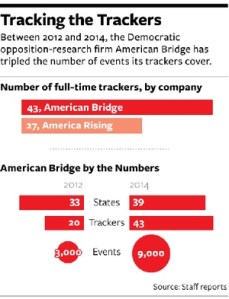
American Bridge [a Democratic organization] employs 43trackers trackers to cover 39 states. Since 2012, the organization has tripled the number of events its trackers cover. In 2012, Bridge’s 20 trackers recorded 3,000 events in 33 states. In 2014, they have tracked more than 9,000 events and traveled a cumulative 693,000 miles.

“When it’s a presidential campaign, you’re going from flight to flight to flight to event,” Farr said. “Their schedule is your schedule. So if you have a candidate that’s having eight events a day, you have eight events a day. And you’re obviously usually surrounded by people that have different opinions than you, and are definitely fighting for the exact opposite of what you are.”

Some trackers have been following the same candidate for years—around the state, around the country, on planes, on buses, in town halls, in swanky fundraisers—all on the off chance that they’ll get the candidate on tape saying something politically distasteful or flip-flopping on a position. A new “47 percent” or “Macaca,” if you will.

Good News (?) From Ukraine

by Jonah Shepp

A ceasefire was announced today:

The two sides agreed to stop fighting at 6 p.m. local time today, Heidi Tagliavini, a representative of the Organization for Security and Cooperation in Europe, which will monitor the agreement, told reporters after negotiations in Minsk, Belarus. The talks included representatives of Ukraine, Russia, the self-proclaimed people’s republics of Donetsk and Luhansk, where most of the fighting has occurred, and the OSCE. “Proceeding from President Putin’s call to leaders of illegal military formations to cease fire, and from the signing of the trilateral agreement in Minsk to implement the peace plan, I am ordering the General Staff to cease fire,” Ukrainian President Petro Poroshenko said in a statement. He canceled a summer truce on July 1 after his government cited more than 100 violations by the separatists. … The rebels, though, remained defiant, with the leader of Luhansk, Igor Plotnitskiy, telling reporters that the cease-fire doesn’t alter the goal of “splitting” from Ukraine.

In his press conference today at the NATO summit, Obama attributed the ceasefire to the success of US and EU sanctions on Russia, but the allies still approved a new rapid response force to beef up defense in Eastern Europe, among other measures. Considering the way the conflict has played out so far, I’m hopeful that the truce will hold, but not optimistic. And even if it does, Leonid Bershidsky calls it a win for Putin:

If the peace holds, people like Semenchenko will soon be returning from the front, and they may well decide that Poroshenko gave up too easily and that Ukraine should have fought on and martyred itself. Poroshenko’s plan to get a loyal parliament elected in October now faces many threats, ranging from a new escalation of fighting to a radical nationalist revolt. As for Russian President Vladimir Putin, he has secured a ringside seat and may settle down with a bowl of popcorn.

Any outcome suits him as long as Ukraine struggles to get out of its impasse alone. He will be happy to see the Lugansk and Donetsk regions turn into a frozen-conflict zone, precluding Ukraine’s further integration into NATO and the European Union, and equally pleased to have them gain broad autonomy from Kiev and a veto on major political decisions. A military solution suits him, too, since the West has refused to engage him except in the form of ineffectual sanctions.

Adam Swain notes that even a lasting ceasefire won’t address “the political problems that underpin the conflict, both within Ukraine and in Europe at large”:

As far as those deeper issues go, there are three possible outcomes. First, the ceasefire could hold, but without a diplomatic breakthrough; the conflict would effectively be frozen, and Ukraine would lose much if not all of its industrial heartland in the Donbas. Second, the ceasefire could be broken, leaving an unwinnable war to simmer in east Ukraine for years yet. Thirdly, an international peace conference could be held to map out a neutral and federal but united Ukraine, creating a buffer state between NATO/the EU and Russia. … Instead, the mostly likely upshot as things stand is a frozen conflict in a formally divided country, with a pro-Russian Donbas protectorate partitioned from a pro-Western Ukrainian rump. Of all the possible outcomes of the ceasefire deal, this is probably the worst for the ordinary people of both the Donbas in particular and Ukraine at large.

Brett LoGiurato suggests that Poroshenko was forced to call the ceasefire:

Geopolitical expert Ian Bremmer, the president of Eurasia Group, told Business Insider last week that Russia’s decision to escalate its involvement had forced Poroshenko into a corner. Bremmer said Poroshenko would most likely seek a quick cease-fire solution to prevent his country’s economy from completely collapsing. “The Ukrainian government has been in an impossible position, they gambled, and they’ve lost,” Bremmer said. “Poroshenko now needs a cease-fire so that he can try to restart negotiations, the terms of which will effectively mean freezing the conflict and ceding significant pieces of Ukrainian territory to the separatists. That’s politically perilous for him and risks counterdemonstrations against his government in Kiev. All the while his economy will be falling apart, with very limited support from the West.”

But now, Max Fisher flags another alarming development in Estonia:

It’s not clear whether or not the attack has anything to do with the Russian government — Russian organized crime is active throughout the region. But the incident comes at an extremely tense moment between Russia and Estonia, one in which the United States has publicly committed to Estonia’s military defense, meaning that a Russian invasion of Estonia would trigger war between Russia and the US, a prospect so dangerous that the world managed to avoid it throughout even the Cold War. “Unidentified persons coming from Russia took the freedom of an officer of Estonian Scurity police officer on the territory of Estonia,” Estonia’s state prosecutor’s office announced. “The officer was taken to Russia using physical force and at gunpoint.” … The Estonian state security officer is identified as working on counterintelligence and organized crime — a confusing combination, and one that does not shed much light on whether his kidnappers appear to have been Russian government or Russian organized crime.

If the Kremlin did have a hand in that abduction, it would be a very serious escalation of the tensions in Eastern Europe and make clear that Putin is acting less rationally than John Mearsheimer believes. But let’s not jump to conclusions before we have the facts.

The Anti-ISIS Coalition And Obama’s Strategy

by Jonah Shepp

At the NATO summit in Newport, Wales today, US officials announced that they had formed an international coalition to wage war on ISIS:

President Barack Obama sought to use a NATO summit in Wales to enlist allied support in a campaign to destroy the Islamist militants but as the summit drew to a close it remained unclear how many nations might join Washington in air strikes. Secretary of State John Kerry and Defense Secretary Chuck Hagel told foreign and defense ministers from 10 nations at a hastily arranged meeting that there were many ways they could help, including training and equipping the Iraqis. … Hagel told ministers from Britain, France, Germany, Canada, Australia, Turkey, Italy, Poland and Denmark that they, with the United States, formed the core group for tackling the Sunni militant group.

In his press conference, Obama stressed that the coalition-building effort isn’t over and that John Kerry would continue to seek partnerships with other countries in combating the ISIS threat. He also stressed the importance of engaging Arab states, particularly those with Sunni majorities, in countering ISIS not only militarily, but also—or even primarily—politically. He rightly pointed out that any international effort will only succeed in the long term with the support of local actors in Iraq and Syria, and compared the coming effort to “degrade and ultimately destroy” ISIS to the fight against al-Qaeda.

That fight looked very different under Bush and under Obama, so what that means is unclear. If I had to guess, I would say that he is signaling a plan to fight ISIS as he has fought other jihadist militant groups: i.e., primarily through targeted killings of its leadership from on high (cf. today’s announcement that Ahmed Abdi Godane, the leader of Somalia’s al-Shabaab, was killed in a US airstrike on Monday) and by degrading their capabilities until they are weak enough for local partners to finish them off. We could surely do this all by ourselves, but having an international coalition behind the effort enhances its legitimacy and reinforces the principle of multilateral responsibility for global security to which Obama clearly adheres.

Hayes Brown compares this coalition (which, again, won’t necessarily be limited to these ten countries) to the Multinational Force Bush formed to participate in the 2003 invasion of Iraq:

Conservatives have already begun to pan the announcement of the core coalition, drawing unfavorable comparisons to 2003. … While there are clearly some overlaps between the two groups, including the United Kingdom, Australia, Italy, Denmark and Poland, the “core” group lined up against ISIS has a few advantages over those assembled in 2003. In 2003, Germany and France were both strongly opposed to action in Iraq, depriving the U.S. of key support in Europe. Adding in those countries gives the group the support of two of the most militarily powerful states in Europe. Canada’s support adds to the cohesion among the most capable members of NATO and Ottawa’s support will also translate over into the G-7. Most strikingly, the group announced on Friday includes Turkey, which not only neighbors Iraq but serves as a Muslim-majority country that can be put forward as a defense against claims that the campaign against ISIS isn’t yet another Western invasion of a Muslim country.

But Juan Cole doubts our NATO allies are very enthusiastic about this mission:

My reading of the reporting from Wales is that most NATO states have little intention of intervening directly in Iraq and most of them have no intention to get involved in Syria. The US and Britain (and, far from Europe, Australia) are the most likely to commit to the Iraq front. The NATO country closest to ISIL territory, Turkey, seems reluctant to get involved in directly fighting ISIL (and critics of the religious Right party, AKP, which is in power, suggest that behind the scenes President Tayyip Erdogan is supporting the hard core Muslim rebels in Syria. Despite all the vehement talk, the US likely will have few allies in the air in Iraq as President Obama seems to be stampeded (by the Washington hawks and fear of losing the midterms for looking weak) into a wide-ranging new Iraq war that seems likely to spill over into Syria. The biggest problem the US faces, however, is the lack of effective allies on the ground in Iraq.

Obamacare Is Beating Expectations

by Dish Staff

Kaiser

Ezra heralds the news:

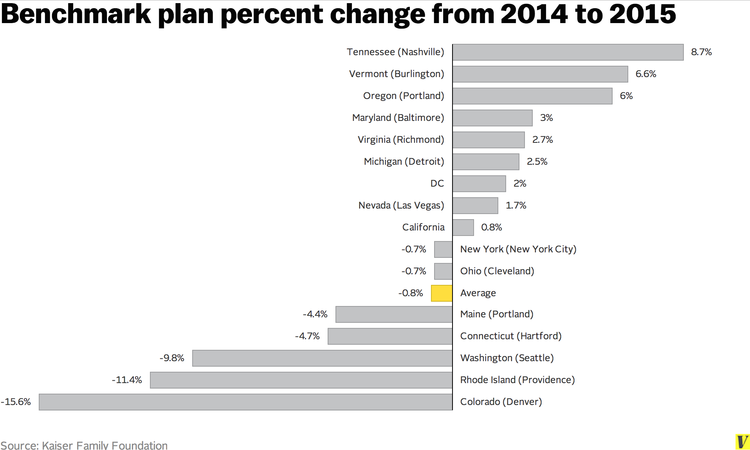
A new report from the Kaiser Family Foundation finds that in seven major cities that have released data on 2015 premiums, the price of the benchmark Obamacare plan — the second-cheapest silver plan, which the federal government uses to calculate subsidies —  is falling.

Yes, falling.

“Falling” is not a word that people associate with health-insurance premiums. They tend to rise as regularly as the morning sun. And, to be fair, the Kaiser Family Foundation is only looking at 16 cities in 15 states and the District of Columbia, and the drop they record is, on average, a modest 0.8 percent (though this is the same methodology they used in 2014, and to good results). But this data, though preliminary, is the best data we have  —  and it shows that Obamacare is doing a better job holding down costs than anyone seriously predicted, including Kaiser’s researchers.

Cohn weighs in:

To appreciate what that means, consider what the market for buying insurance on your own (rather than through an employer) was like before Obamacare came along. Between 2008 and 2010, premiums went up every year and they did so by at least 10 percent, according to an analysis that MIT economist Jonathan Gruber did for the Commonwealth Fund. And that was for insurance that might be sold only to healthy people or that had benefits far skimpier than the ones required by the Affordable Care Act. “There is variation, but so far, premium increases in year two of the Affordable Care Act are generally modest,” Drew Altman, Kaiser’s President and CEO, said in a press release. “Double digit premium increases in this market were not uncommon in the past.”

But it isn’t all good news. Jason Millman explains:

[I]n 12 of the 16 cities that Kaiser studied, at least one of the insurers that offered a benchmark plan in 2014 no longer has benchmark status for 2015. That means that insurer might have raised rates, or another insurer is offering lower prices in 2015. Either way, if a person remains enrolled in what used to be a benchmark plan, that person (assuming life circumstances haven’t changed) will have to pay more toward their premium.

That’s all to say that shopping around for insurance this year could be really important for the new Obamacare enrollees.

A Second Look At The Giant Garbage Pile That Is Online Media, 2014

by Alex Pareene

burger-kings-online-garbage

WARNING: This is a post, by a media professional, about the media. If you are a normal human being, you will not and definitely should not care, except inasmuch as it’s part of a debate about whether or not we, the media, are failing you, the normal human being. If you are looking for something a little more general-interest, may I recommend, I dunno, a 10,000-word Grantland post about a prestige cable show. Or make some fantasy football trades. Or read a book, I don’t know!

On Wednesday, I wrote about Takes. My piece was a blog post, written on the fly, based on ideas that have been rattling around in my head for a while. If I’d taken the time – say a week, or a month – to organize those thoughts better, and clarify my argument, I would’ve written a very different – and almost certainly better – piece. But I didn’t do that (I am only guesting here at The Dish for one short week, after all), so I now cheerfully admit that, as my (friendly) critics contend, I conflated a few different Internet tropes. Specifically, in the words of Jack Dickey, I conflated “aggregated picayune garbage with the Take.”

So let’s get into this a bit more. Here are the primary types of garbage content that lots of money – money that could be spent on making good things – is currently being spent on producing:

No-value-added news blogging

This is “aggregated picayune garbage,” and it is the primary pollutant in the Great Pacific garbage patch of the Internet. It is just mass-produced debris, utterly valueless, thoughtlessly sent into the world without regard for quality, but solely because it fills the short-term need to have some sort of piece of content on which to sell ads.

This makes up 75 percent* of the content on TIME’s “Newsfeed” (“Chris Pratt Messes Up First Pitch at Cubs Game, Is Completely Charming About It,” “43.5 Socks Removed from Dog’s Stomach During Surgery“), with similar numbers at the Huffington Post, and the newsblogs of AOL and Yahoo and MSN. That’s just the general-interest news media. In other fields, it’s frequently worse, largely because shrinking budgets have decimated everything that isn’t cheap aggregation. Music and pop culture sites in particular are full of semi-identical news nuggets (“Kate Bush’s House in Danger of Falling Into the Sea,” “Kate Bush Is Literally Living Life on the Edge,”, “Kate Bush’s House Might Fall Into the Ocean”), as are sites dedicated to film, comics, and entertainment in general.

*(NB: All percentages and figures in this piece are just made-up, but feel right to me.)

This sort of newsblogging is also, to varying degrees, what makes up much of the Gawker Media* sites’ daily output, even as they’ve strived (successfully) to produce a lot of original material that isn’t aggregation. And to be fair to Gawker Media, they were among the first to do this at all. When they were the only game in town, this sort of newsblogging was an entertaining substitute for reading multiple newspapers, blogs and magazines. Now no one actually reads multiple newspapers, blogs, and magazines, besides the people who aggregate for a living. Everyone else just reads what comes in through their feeds, and all publishers are fighting to post the version of the story that ends up in the most feeds.

*(Disclosure: I worked at Gawker Media for many years. It taught me how to write and post little bits of news, with jokes, very quickly. I’ve spent the last few years learning how to do this more slowly, and at greater length.)

Reddit-chasing

This happens when someone at a website is like, “this is on the second page of Reddit so someone put it up.”

For example: Man Buys Every Pie At Burger King to Spite Shitty Little Brat” (Gawker, also Eater, Consumerist, Break, MSN Living, Gothamist, OC Weekly, Refinery 29, etc.)

These are often, though not always, Takes. In this example, some websites thought that the man was funny and good for doing this, and other websites thought that the man was bad. Others declined to pass judgment and instead asked their readers to simply ponder the implications of the story. “This Reddit Post Sums Up All of Humankind,” one site lied. (NB: There is zero evidence – as in absolutely none – that this story actually happened, beyond the claim made by an anonymous person on a message board who subsequently disappeared from that message board. No one who picked up the story really cared.)

Other examples: “Reddit gives two-year-old cancer patient a nonstop pizza transfusion” and 75 percent of BuzzFeed.

“Jon Stewart eviscerates”

This category also includes: “this celebrity Tweeted,” “this cable news guest or host said,” and “a thing happened at an award show.”

Viral bilge

This is the Upworthy/Viral Nova/Elite Daily nexus of “viral” content packaged with manipulative headlines. The worst part of it is that at some places (though not all), it involves nearly as many man-hours of labor (the creation and comparative testing of dozens of headlines, for example) to produce stupid garbage like “9 Charming Traits Class Clowns All Share That Landed Them In Detention Every Day” and “What These People Found In Their Attic Changed Their Lives Forever” as it would to create something actually edifying and interesting.

When these forms of aggregation are ubiquitous – and they’re everywhere, from USA Today to Cosmopolitan to all the Village Voice alt-weeklies to Glenn Beck’s The Blaze to The Bustle to the AV Club to SPIN to Complex – the only means sites have to differentiate themselves are “voice,” speed, and social/SEO juicing. “Voice” leads to the Take; it’s an adaptation to aggregation, designed to help sites differentiate otherwise identical content. The endpoint of Take Culture is “Thought Catalog,” where literally every take, from any person, no matter how stupid or offensive, is presented as just as valid, as every other Take, with the Takes that generate a lot of outraged inbound traffic the most equally valid of all.

This is not to demonize all aggregation and opinion-blogging. The Dish, for example, does both of those things quite well, because at The Dish, the aggregation is wide-ranging, instead of directed purely and cynically at latching onto a currently trending topic or getting some tiny bit of micro-news posted a split second faster than the dozen other sites that will also be posting that tiny bit of micro-news as quickly as possible. As for the opinion-blogging, well, say what you will about the man who has generously allowed me to crash at his place while he’s out of town, but no one can accuse Andrew Sullivan of producing Takes that he doesn’t strongly and sincerely believe in. (At the time he writes them, at least.) Opinion-blogging works when interesting writers have interesting, sincerely-held opinions. “Takes” are attempts to artificially replicate that process with whomever is handy and whatever opinions it seems plausible that someone might hold.

The majority of the shit described in this blog post is useless. The world doesn’t need 5,000 separate-but-barely-distinct versions of every damn story from every damn field of human endeavor. The people getting paid (barely) to produce those slightly differentiated versions of every story ever are wasting their time, unless “able to crop a picture of a celebrity in WordPress without help” becomes, suddenly, a much scarcer and more in-demand skill. The reader, in nearly every case, is getting a less-good version (or several less-good versions) of the story than whatever the original was. The vast majority of this sort of aggregation could be replaced with one curated Twitter feed that every website in existence could run on a siderail, and the media consumer would benefit. And even in that scenario, the bottom-rung producers of content are still effectively screwed. So I don’t know. Maybe it’s time to consider an organized aggregator work slowdown?