The Healthcare Spending Trend

by Dish Staff

Health Care Costs

Yesterday, the Centers for Medicare and Medicaid Services (CMS) released a report on projected healthcare spending. What Jonathan Cohn sees as the “main takeaway”:

We’re making progress on controlling the cost of health care. We might even be making a lot of progress, although it’s too soon to tell.

Why the report may be too pessimistic:

Keep in mind that CMS actuaries are famously conservative. In the past, they’ve tended to overestimate how much spending will risenot because they’re imprecise or biased, but because they tend to err on the side of caution. In a conference call Wednesday, several actuaries made clear they weren’t discounting the possibility that the health care industry is becoming more efficient. One actuary said “Right now it is still too early determine” how much the health industry has changed. Others expressed similar sentiments.

“If the payment reforms have the kind of effect advocates of them expect, these projections could turn out to be conservative,” Larry Levitt, senior vice president at the Kaiser Family Foundation, told me later via e-mail. “The actuaries tend to take a wait and see approach to new developments where there is little evidence as to what effect they’ll have. We are in somewhat unchartered territory here.”

Jason Millman adds important caveats:

A few points worth noting about the actuary’s projections: Taking a cue from the trustees overseeing Medicare, the actuary’s office assumes that Congress will once again approve a “doc fix” to avoid the scheduled 21 percent cut to Medicare physician payments. The actuary also assumes that the Affordable Care Act’s temporary bump in federal reimbursement to Medicaid doctors will go away at the end of the year as planned, though some Democrats and physician groups are pushing for an extension of the policy to encourage more doctors to take Medicaid patients as the program expands.

Philip Klein, as he does with most ACA-related news, puts a negative spin on the report:

As the economy improves, Obamacare continues to expand, and the Medicare age population explodes, health spending is expected to rise by an average of 6 percent a year over the 2015 to 2023 time period. Though this would be lower than the 7.2 percent average over the 1990 to 2008 span, it would still outpace the growth of the economy.

Because of this, health spending as a share of gross domestic product is expected to increase from 17.2 percent in 2012 to 19.3 percent in 2023 – representing nearly one in five dollars of the economy.

Kliff frames the numbers differently:

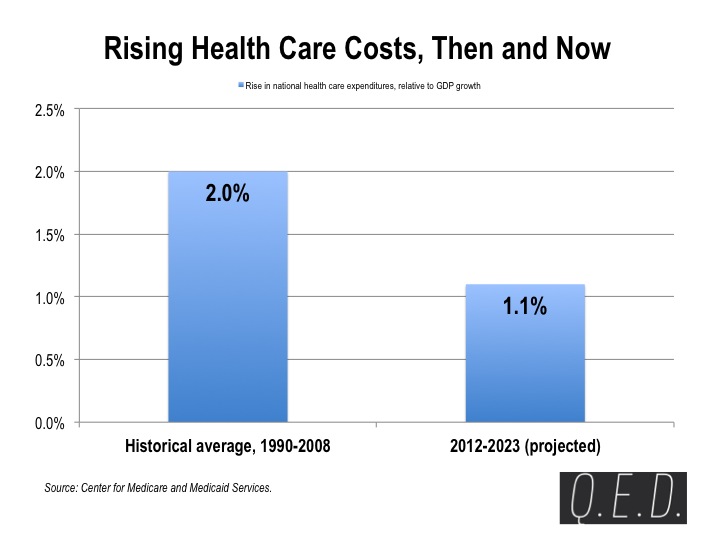
Medicare actuaries expect that health care costs will outpace economic growth by 1.1 percent. That’s not ideal; most health economists would like to see the two numbers grow at the exact same pace. But it’s still a smaller gap than what has existed historically. Between 1990 and 2008, health cost growth outpaced the economy by 2 percent.

This is big. The Medicare actuaries are saying that, while they do expect a slight rebound in medical spending post-recession, they don’t think we’re headed back to the super-fast growth that, for decades, has been a hallmark of the health care industry. And when health care eats up a smaller chunk of the economy (and the federal budget) that leaves more money to spend on other important things like education and infrastructure.
The War Over The Core, Ctd

by Dish Staff

One-time Common Core supporter Bobby Jindal found himself squaring off against his former allies once more last week, when he filed a lawsuit against the Department of Ed alleging that the standards “effectively nationalize [the] education curriculum” and are “patently incompatible with the Tenth Amendment.” Although many view the move as political theater ahead of the ’16 elections and few expect the suit to succeed on its merits, Max Ehrenfreund characterizes it as “an escalation” of the campaign against the standards. In a lengthy article about the conservative backlash against the Core, Tim Murphy notes that its drafters “always anticipated a learning curve – just not a political insurgency intent on destroying the program before it had a chance to produce results”:

The trajectory of Common Core just might wind up resembling that of the Affordable Care Act.

Once the hysteria passes, it’s likely to be viewed as a genuine improvement to the education system– even if the vision of a national standard isn’t fully realized. “The [original] promise was, ‘Wow, this is nearly every state in the country!'” the New America Foundation’s [Anne] Hyslop says. “We may not have that moving forward, but we’re at least going to have a good 25 or 30 states.” From the perspective of the policymakers who pushed for Common Core seven years ago, that would still be a success story.

But it came at a heavy cost: The grand bipartisan consensus has been cut clean to the bone, offering a preview of the obstacles facing future reform efforts. If you thought math and reading standards were a hard sell, try biology. And activists are already taking aim at [Common Core co-drafter David] Coleman’s new Advanced Placement tests, administered by the College Board—tests they fear have been infected with the ills of Common Core.

The political consequences are still unfolding. In June, the Pew Research Center released new evidence that the gap within the GOP had closed: self-identified “business” conservatives opposed Common Core at the same rate as “steadfast conservatives” (61 percent). If that holds true, the 2014 midterms, where many candidates have staked out anti-Core positions, just might determine the standards’ fate in many states. Common Core now faces the highest-stakes test of all—the ballot box.

All Dish coverage of Common Core here.

The PC Police?

by Dish Staff

Margaret Talbot examines the role of political correctness in the sexual exploitation scandal taking place in Rotherham, England:

One explanation for why these crimes went on for so long, more or less unchecked, is that police officers didn’t believe what they were hearing: they thought that the social workers who reported a pattern of sexual abuse involving Pakistani gangs and young girls were exaggerating or misinterpreting. The scale of it could have seemed implausible—an understandable human response, perhaps, though not the most useful one for law enforcement.

The other leading explanation is that, because most of the perpetrators were Pakistani and most of the victims were white, local officials were reluctant to proceed, worried about inflaming ethnic tensions. Last week, the British Home Secretary, Theresa May, denounced what she called “an institutionalized political correctness” at work in this case.

Though this might sound like a rhetorical flourish, there seems to be some truth to this claim.

Rotherham is an economically stressed city of two hundred and fifty-eight thousand people, with an ethnic minority population of about eight per cent. The Labour Party has long controlled the town council, but, in recent years, the Party has been joined by a few members of the populist right-wing faction U.K.I.P. When investigating individual cases, the Rotherham report found no evidence that ethnic consideration had determined outcomes for children. But, when it came to setting policy, a certain skittishness seems to have played a role. According to the report, “Several councillors interviewed believed that by opening up these issues they could be ‘giving oxygen’ to racist perspectives that might in turn attract extremist political groups and threaten community cohesion.” Perhaps that, too, is a concern that deserves some sympathy—though because its immediate result was a failure to rescue children from brutal circumstances, the sympathy only goes so far.

A few days ago, Hugh Muir challenged that interpretation:

[C]an it really be true – as the tabloids and the right robustly claim – that a significant contributor truly was political correctness; the fear of officials that by intervening appropriately in cases where the suspects were Pakistani Muslims, they themselves would be castigated as racist? If it is, it is outrageous. It is also ludicrous.

Political correctness – if we are to persist with that hackneyed term – required members of a diverse society to accord to others the level of dignity they would want for themselves. The right conflated its meaning so as to describe any prescription on its behaviour that it didn’t like. Everything, from the description of coffee to adoption policy, became “political correctness gone mad”. Perhaps the idea was to discredit the concept by hoisting it into the realm of absurdity. But even then, the concept never, ever required anyone to turn a blind eye to the mass abuse of the vulnerable by criminals. And anyway, to do so on grounds of political correctness would never have made sense.

If a backlash was feared, where would it have come from? There is no minority lobby for criminals and paedophiles. So long as communities knew the issue was one of law enforcement rather than an assault on those communities themselves, they would have supported tough action by the authorities.

Moore Award Nominee

by Dish Staff

“Scott Walker has given women the back of his hand. I know that is stark. I know that is direct, But that is reality. … What Republican tea party extremists like Scott Walker are doing is they are grabbing us by the hair and pulling us back,” – Debbie Wasserman Schultz, DNC chair.  (Award glossary here.)

NATO Has Issues

by Dish Staff

As the NATO summit gets underway in Wales, David Francis highlights the alliance’s major challenges, chief among which is getting members to pay their fair share of collective defense spending:

[E]ven with open combat in a country bordering several NATO members, the summit is likely to be dominated by dollars and cents. For years, top officials in the Bush and Obama administrations have angrily called on Europe to spend more on defense so Washington wouldn’t be responsible for the lion’s share of the alliance’s funding. Taken as a whole, the defense budgets of NATO members are down some 20 percent in the last five years. Only three European NATO members — the United Kingdom, Greece, and Estonia — meet the alliance’s threshold of spending 2 percent or more of their GDP on defense. … In 2011, then-Secretary of Defense Robert Gates said that the alliance faced “collective military irrelevance” without an increase in European defense spending. In June, as the Ukraine crisis raged on, Defense Secretary Chuck Hagel warned that Europe had to stop playing lip service to defense spending and upgrade out-of-date equipment.

Yet Gordon Adams argues that NATO’s weaknesses can’t be papered over with more euros:

What is at issue in Europe is capability. If the Europeans ever actually reached the 2 percent defense spending threshold across the Alliance, they would still produce an excess of the kind of defense capability that is not needed (heavy ground combat units or very small air forces) that do not work together well), and militaries that duplicate, rather than complement each other. They spend enough to create up-to-date, deployable forces, but the ones too many of them build are nationally based and static. And they do not build them to a common, trans-European, integrated plan.

And Robin Wright observes that despite having a combined troop strength of over 3.3 million and accounting for well over half the world’s defense spending, “NATO seems to have less nerve and energy than it once did”:

It has focussed more on preventing or containing new fires than on putting out existing blazes raging in Europe, the Middle East, and South Asia. Its recent stats aren’t encouraging, either. Since 2001, NATO has spread its wings beyond the European theatre (its original mandate), into the Middle East, Asia, and Africa. The first of these deployments was in Afghanistan, after the September 11th attacks, when NATO invoked Article 5 of the North Atlantic Treaty. (“An attack on one is an attack on all,” as Obama put it in a speech in Tallinn this morning.) In 2004, NATO formed a training mission for Iraqi security forces. And in 2011 it authorized warplanes to intervene in Libya. That air campaign was pivotal in ousting Muammar Qaddafi. But today Afghanistan teeters. Iraq and its military are in a shambles. Libya is a virtual failed state.

The Midterms Just Got Interesting

by Dish Staff

Kansas Senate

The big political news from last night:

The race for U.S. Senate in Kansas no longer has a Democrat in it. In a stunning development, candidate Chad Taylor asked Wednesday that his name be removed from the ballot, paving the way for independent candidate Greg Orman to face U.S. Sen. Pat Roberts head-on in November.

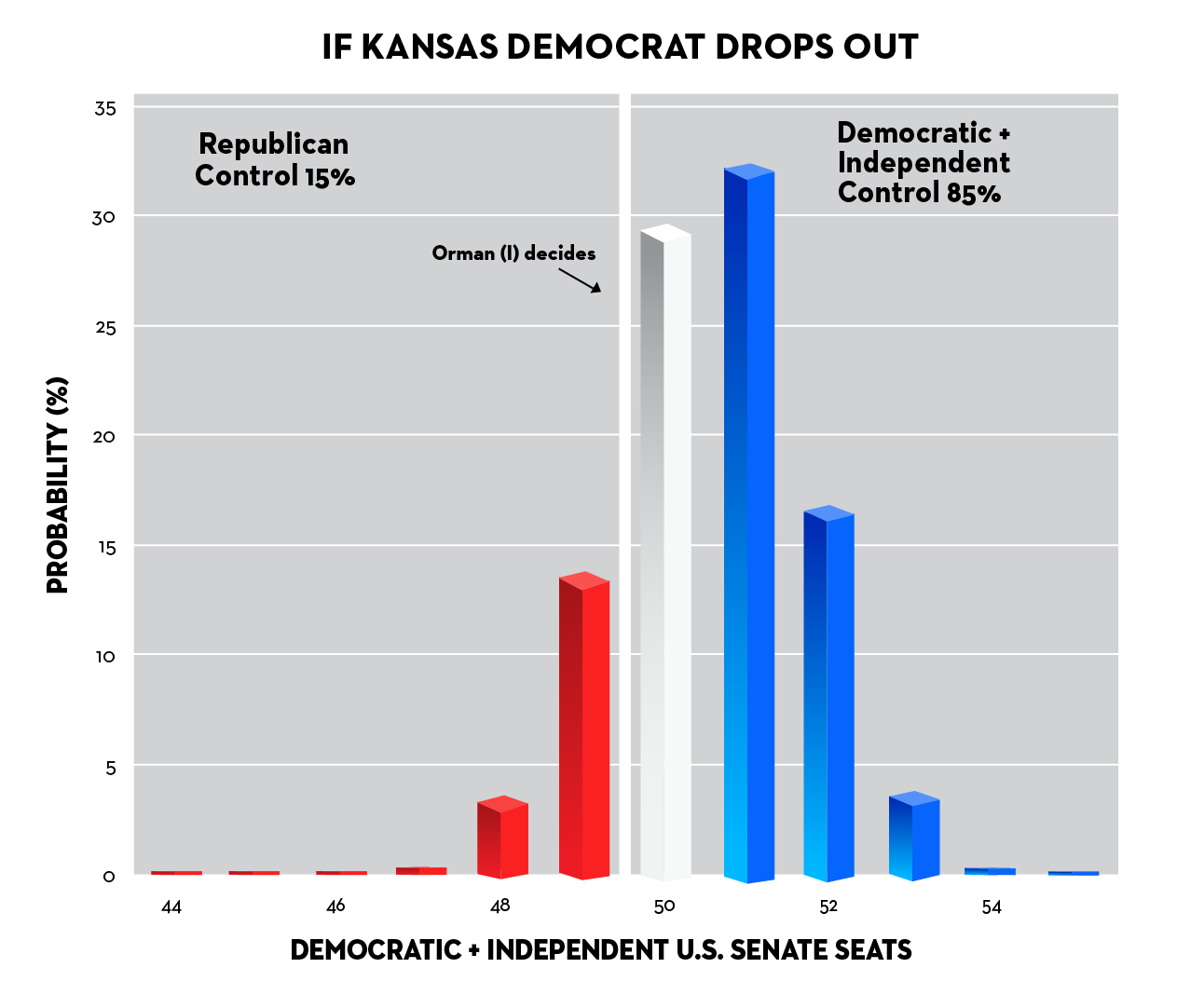
Sam Wang, who posts the above chart, calculates that the Democrats’ odds of keeping the Senate have skyrocketed:

Right before Taylor’s announcement yesterday, according to data from the Princeton Election Consortium, the Democrats had a sixty-five per cent chance of retaining control of the Senate. (Polling wonks will notice that this number is significantly different than what has been put out by outlets like theWashington Posts Monkey Cage, the New York Times’ Upshot, and Nate Silver’sFiveThirtyEight, all of whom give an edge to the Republicans. The Princeton Election Consortium, which I founded, only relies on polling data and does not factor in so-called “fundamentals,” such as campaign finances and incumbency. In the past, our purely poll-based approach has yielded extremely accurate results.) As noted here, with Orman facing off alone against Roberts, the probability of Democratic control shot up to eighty-five per cent.

Silver’s analysis is less favorable to the Democrats. He remarks, that “if Roberts winds up beating Orman by a few percentage points, it wouldn’t be so surprising”:

Another question is which party Orman might caucus with should he win. The default answer would be the Democrats. Orman was formerly a Democrat, he’s mostly taken the political positions of a moderate Democrat, and the Democratic candidate just dropped out of the race. But the more Orman appears to be affiliated with the Democratic Party, the less attractive he might be to Kansas’s red-leaning electorate. … If we do program the model to treat an Orman win as a Democratic pickup, then the Democrats’ chances of retaining the Senate would improve to 38 percent from 35 percent.

Andrew Prokop also wonders who Orman will caucus with:

Orman has said that if he wins, and if one party ends up clearly in the majority, he will “seek to caucus” with that party. But if the Democrats end up with 49 seats to the Republicans’ 50, a victorious Orman would be the vote deciding Senate control, and would be intensely courted by both sides. “Ultimately, I’m going to caucus with the party that’s … most willing to address some of the biggest issues we have,” Orman said Wednesday, according to Politico’s Manu Raju and Kyle Cheney.

Orman describes himself as “someone who is fiscally responsible and socially tolerant,” and has criticized both parties and their leaders. However, he is pro-choice, a critic of the Citizens United decision, and a supporter of comprehensive immigration reform. And, as McCaskill’s actions indicate, Democratic support will likely coalesce behind Orman, while Republicans will try very hard to help Roberts keep his seat, which seems like it could have some impact on Orman’s decision about who to caucus with.

Sabato’s Crystal Ball sizes up the race:

Our Kansas sources stressed two things Wednesday evening. First, Republicans are absolutely furious at Roberts for turning in such a clumsy, second-rate primary performance and allowing this contest to linger in a year when every Senate battle could determine control of the chamber. Second, these same sources — when pressed — believed that ultimately Roberts would be able to fight off the challenge with enough outside assistance.

We’ll see whether the latter view turns out to be realistic or optimistic. For the moment, we’ll put a thumb on the scale for “realistic.” However, Orman has gone to great lengths to emphasize his independence by noting his vacillation between the two parties. He obviously hopes that Kansans will be more amenable to voting for him if they don’t think of him as a Democrat. Republicans, inevitably, are going to try to make Orman as much of a Democrat as possible. Conservative journalists on Twitter are already discussing attack ads aimed at Orman with this theme: “The O in Orman stands for Obama.” In fact, Orman considered running as a Democrat in the 2008 Senate race against Roberts before declining to become a candidate.

Before the Kansas news broke, Nate Cohn looked more broadly at the Senate landscape:

Anything, of course, is still possible. Labor Day is traditionally the start of the campaign, not the end. But what may be more likely than a Republican rout is that 2014 ends up somewhere between 2010 and 2012. Not a Republican landslide or a Democratic victory, but a fairly neutral if Republican-tilting year in which the G.O.P. benefits from a large number of competitive races in red and purple states.

John Sides’ model now gives Democrats nearly a 50-50 chance of keeping the Senate:

[It’s] not that races have narrowed, but that the model has begun weighting information differently — mainly by (a) incorporating polling data (where possible) after the relevant primaries, and by (b) increasing the weight that polls have in the forecast.  What this suggests is that in several states, Democrats are arguably ‘out-performing’ the fundamentals. This doesn’t always translate into a high chance of the Democrat actually winning (see: Kentucky) but it does help the Democrats’ overall chances of retaining a majority.

Peak Obamacare Outrage

by Dish Staff

It appears we’ve passed it:

A new George Washington University “Battleground” poll shows that, on the list of things that people think are wrong with this country, Obamacare actually ranks pretty low. As in behind-“other” low. The poll shows seven in 10 likely voters think the country is off on the wrong track. But unlike other pollsters, it then asked a follow-up question about why people were unhappy. Of the 70 percent who said the country was off on the wrong track, just 5 percent offered a reason having to do with Obamacare. In other words, only about 3.5 percent of all Americans think Obamacare is the bane of American existence right now.

Chait passes along other good news for the ACA – the DC Circuit court will re-hear Halbig:

The short explanation of what this means is that it has closed off the easiest path to crippling Obamacare. … What happens next is that the entire D.C. Circuit will hear the case. Since the logic of the lawsuit is so ludicrous only a wildly partisan Republican jurist would ever accept it, it stands zero chance of success.

Jason Millman unpacks the news:

The entire D.C. circuit is expected to uphold subsidies through the federal-run exchanges, which would eliminate conflicting decisions in the appellate courts. That makes it less likely that the Supreme Court will eventually take the subsidy challenges, though the justices can still decide to do so.

Cohn also eyes SCOTUS:

Most legal experts I know think the justices will, at the very least, wait to see how the full D.C. Circuit rules before taking the lawsuits seriously. The D.C. Circuit rehearing is set for November and that court probably won’t issue a ruling until spring or summer of next year. If those judges end up reversing the decision, the Supreme Court justices might pass on the case altogether, although two other cases are in much earlier stages of the judicial process and could still produce conflicting rulings. As Andrew Koppelman, a constitutional law expert at Northwestern University, notes, “If the Court was going to blow up Obamacare, it would have done so in the big case in 2012. After Roberts paid a big political cost for doing that, why would he now adopt this hyper-technical and unpersuasive legal argument, yanking away benefits that a lot of people are already receiving?”

But remember: It takes only four Supreme Court justices to vote in favor of hearing a case. We know, from that 2012 Obamacare case, that four conservative justices were prepared to throw out not just the individual mandate but also the rest of the law.

The Bush-Obama Continuation

by Jonah Shepp

Dan Froomkin returns to the blogosphere with a provocative post in which he asserts that by institutionalizing many of the bad ideas of the Bush administration, Obama has done even more damage than his predecessor to civil liberties in America:

There will be no snapping back to a pre-Bush-era respect for basic human Obama Bushdignity and civil rights. Thanks to Obama, it’s going to be a hard, long fight. … To his credit, Obama is not driven, like Bush and Dick Cheney were, to involve us in massive land wars. And he inherited a mess full of no-win scenarios. But he chose to extend a dead-end war in Afghanistan for two years — and 1,300 American lives — based on political optics rather than military strategy. And he is blind to reality in the Middle East; cleaving to the belief that airstrikes and fealty to Israel are viable long-term strategies, and ignoring the fact that his counter-terrorism policies actually create more terrorists than they destroy. In retrospect, what the country needed was a radical break from the Bush/Cheney national security policies: A reestablishment of American moral integrity; a rejection of decision-making based on fear (of terrorism, or of political blowback); a reassertion of the international laws of war; and a national reckoning. Instead, the hopes for any change are slim.

My question is this: would another president have done differently? After all, this is what many on the left predicted would happen way back in the early Bush years: once an executive claimed the kinds of powers Bush did, it was laughable to think his successor would relinquish those powers, especially when he had the eternal, existential, international, and all-encompassing War on Terror to justify keeping them. I’m as disappointed in Obama as Froomkin is, but I’m not sure how much of this was really up to the man himself. For years, media and policy elites have beaten the drum of permanent war and attempted to inculcate the public with the belief that this war required a strong executive branch, a massive surveillance state, a concomitant downsizing of civil liberties, and periodic military interventions abroad. In such a paranoid zeitgeist, how harshly can Obama be judged for reflecting it? Just imagine what would happen if he decided to rein in the CIA and NSA, shut down the drone program, and forswear his power to order warrantless assassinations. Impeachment proceedings would begin that same day.

Marriage Equality Update

by Dish Staff

Yesterday, a Louisiana judge upheld the state’s marriage ban:

Throughout his thirty-two-page opinion, the judge noted the near unanimity that has prevailed in other courts on the same-sex marriage issue, and he did not criticize other courts for having done so.   He said those rulings amounted to “a pageant of empathy” for same-sex couples. But he concluded his opinion with an essay on the virtue of leaving such a vigorously debated topic to the choice of the people, acting as legislators at the ballot box or through their state legislative representatives.

An appeal of this decision to the U.S. Court of Appeals for the Fifth Circuit is nearly certain.

Mark Joseph Stern notes that Judge Martin Feldman, “is not the first judge since 2013’s United States v. Windsor to uphold a gay marriage ban. He is, however, the first federal judge, a key distinction that gives his ruling significant clout”:

The thrust of Feldman’s ruling rests on a misinterpretation of the so-called animus doctrine. According to the Supreme Court, laws motivated exclusively by anti-gay animus toward gay people violate the equal protection clause of the 14th Amendment. After the court struck down a federal gay marriage ban in Windsor, the vast majority of judges have concluded that all gay marriage bans are presumptively motivated by animus. That’s a logical conclusion, given the Windsor court’s assertion that the federal ban’s “principal purpose and necessary effect” was to “demean” and “degrade” gay people.

But as I’ve written before, the animus doctrine has a weak spot: It’s pretty easy for an eager judge to put a fig leaf over the hostility that motivates anti-gay laws. Feldman, for instance, is shocked that gays would even suggest such a motive, berating them for insisting that Louisiana’s ban “could only be inspired by hate and intolerance.” Rather, denying gay people the right to marry is a perfectly reasonable way “to achieve marriage’s historically preeminent purpose of linking children to their biological parents.” To insinuate that the law was passed to “vilify” gays, Feldman scoffs, is absurd and insulting.

Rob Tisinai pokes holes in the ruling:

[A]bout that societal interest in ensuring that fundamental social change be cultivated via the ballot or legislature instead of the courts: this is an invitation never to find any law unconstitutional, no matter how great an affront to the Constitution it may be. Feldman hedges his way out of this with the qualifier, “in this case.” But why, in this case? He never explains. The closest he comes is in his comments about linking children to their biological parents. But this is inadequate. Such a policy goal explains why the state permits biological parents to marry. It explains not at all why other marriages should be banned. This is a huge hole in Feldman’s reasoning, and I suspect there really is nothing that could fill it.

Savage extends Feldman’s logic:

Preventing same-sex couples from marrying does not prompt opposite-sex couples to marry. If the state has an interest in “intact” families headed up by “two biological parents,” it would make more sense—and come far closer to achieving the state’s supposedly legitimate interest—if the state made pre-marital sex illegal, compelled straight men to marry the women they’ve impregnated, and banned divorce for straight couples with children.

Garrett Epps suggests that “not coincidentally, [the ruling’s] heart is drawn from an opinion written earlier this year by Justice Anthony Kennedy—whose vote will very likely determine the result when the marriage issue reaches the Court”:

Kennedy is a man with a large but complex heart. On the one hand, it tugs him toward his beloved “dignity” for gay couples and their children; on the other, it draws him toward the privileges of the states and the newly discovered “fundamental right” of majorities. The outcome of that contest is still in doubt, and Feldman’s opinion shows why.

Allahpundit bets Kennedy will side with equality:

One of the core points in Kennedy’s prior landmark opinions in gay-rights cases, especially the case striking down sodomy laws, is that gays are entitled to the same constitutional protections for intimate behavior that straights are. It would be odd if he followed that up by reading the right to marriage the way Feldman does, as a right inherently limited to people of different genders. And it’s not just RINOs who think so: Scalia, dissenting in the Windsor case, laughed at Kennedy’s opinion for being a transparent precursor to eventually finding that the Due Process Clause grants citizens the right to marry another person, not a right to marry only a person of the other gender. I think Feldman’s destined to be overturned, but this is a hopeful note at least for opponents of SSM.

Talking Tough-ish On Eastern Europe

by Dish Staff

NATO

David Frum applauds Obama’s remarks on the Ukraine crisis from Estonia yesterday, calling them “the sharpest language any U.S. president has used toward Russia since Ronald Reagan upbraided the Evil Empire” and “the most important speech about European security … of the post-Cold War era”:

One by one, President Obama repudiated the lies Vladimir Putin has told about Ukraine: that the Ukrainians somehow provoked the invasion, that they are Nazis, that their freely elected government is somehow illegal. He rejected Russia’s claim that it has some sphere of influence in Ukraine, some right of veto over Ukrainian constitutional arrangements. And he forcefully assured Estonians—and all NATO’s new allies—that waging war on them meant waging war on the United States. “[T]he defense of Tallinn and Riga and Vilnius is just as important as the defense of Berlin and Paris and London,” Obama said. “Article 5 is crystal clear. An attack on one is an attack on all. So if, in such a moment, you ever ask again, who’ll come to help, you’ll know the answer: the NATO alliance, including the armed forces of the United States of America, right here, present, now.” This is the ultimate commitment, given by the ultimate authority, in the very place where the commitment would be tested—and would have to be honored. There’s no turning back from that. Today, for the first time perhaps, Eastern Europeans have reason to believe it.

Max Fisher, who passes along the above map, interprets the speech as signaling that the US will not go to war to save Ukraine:

This does not mean that the US and Europe are indifferent to Ukraine’s plight. They have sanctioned Russia’s economy repeatedly and heavily, sending it to the precipice of recession. They have isolated Russia politically, for example by booting it from the G8. But these sanctions are about punishing Russia to deter it from future invasions, or at best an attempt to convince Putin that invading Ukraine is not worthwhile.

But Putin’s actions have demonstrated very clearly that he is willing to bear Western economic sanctions for his Ukraine invasion, and the US is not escalating further, so the invasion continues. The US is taking some tougher steps in Ukraine, but they are not very much. Obama, in his speech, called for “concrete commitments” to help Ukraine modernize its military, but it’s not clear what he meant, and even if Ukraine were armed to the teeth it would still lose any open war with Russia, which has the second-largest military in the world. So building up the Ukrainian military, while a nice symbolic gesture, will not stop Putin.

Apparently the president wasn’t clear enough for Michael Scherer:

“NATO must send an unmistakable message in support of Ukraine,” Obama said. “Ukraine needs more than words.” The rhetoric hit its marks. The message, however, was muddled. As he finished his speaking engagements, several questions remained about how he intends to deal with the multiple foreign policy crises facing his administration. He again condemned Russian incursions into Ukraine, and promised new U.S. and European help to train, modernize and strengthen the Ukrainian military. But his “unmistakable message” of support stopped short of defining or ruling out any additional U.S. military role should Russian aggression continue. While he pointedly promised to defend those countries in the region who are signatories to the North Atlantic Treaty Organization (NATO), Obama offered no similar assurances to Ukraine, even as he highlighted that country’s voluntary contributions to NATO military efforts. … This was not the only issue on which he left gray areas.

Drum shoots that down:

For excellent reasons, foreign policy statements nearly always include gray areas, so it would hardly be news if that were the case here. But it’s not. Obama’s statement was unusually straightforward. He said the same thing he’s been saying for months about Ukraine, and it’s really pretty clear:

  • We are committed to the defense of NATO signatories.
  • Ukraine is not part of NATO, which means we will not defend them militarily.
  • However, we will continue to seek a peaceful settlement; we will continue to provide military aid to Ukraine; and we will continue to ratchet up sanctions on Russia if they continue their aggression in eastern Ukraine.

You might not like this policy. And maybe it will change in the future. But for now it’s pretty straightforward and easy to understand. The closest Obama came to a gray area is the precise composition of the sanctions Russia faces, but obviously that depends on negotiations with European leaders. You’re not going to get a unilateral laundry list from Obama at a press conference.

But Michael Brendan Dougherty worries that even these limited commitments involve us too deeply in another crisis we can’t really fix:

If Ukrainians want to maintain control of Donetsk, they must make compromises with its population, or get on with the ugly business of subjugating or murdering them while retaining control of their own border. But the United States should not be a party to it, no matter how satisfying it is for American hawks to defeat a rebel group that symbolically represents Russian power. Indeed, it is precisely the sense that the Ukraine is a cathartic proxy war that fuels the sentiments of Russian nationalism there. The hawks will say that it will never come to hard questions about whether our sons and daughters will die for Estonia or Donetsk. We can just create deterrents with arms shipments and paper promises forever. But these are the credit-default swaps of national security, a moral hazard that jeopardizes more than our retirement plans.