The Drag Queens Of Lucha Libre

by Dish Staff

In a fascinating profile of gay luchador Saúl Armendáriz, William Finnegan offers a brief history of the gender-bending exótico:

Exóticos have been around since the 1940s. At first, they were dandies, a subset of rudos with capes and valets. They struck glamour-boy poses and threw flowers to the audience. As exóticos got swishier and more flirtatious, and started dressing in drag, the shtick became old-school limp-wristed gay caricature. Crowds loved to hate them, screaming “Maricón!” and “Joto!” (“Faggot!”). The exóticos made a delightful contrast with the super-masculine brutes they met in the ring. Popular exóticos insisted that it was all an act—in real life, they were straight. Baby Sharon was among the first, according to Armendáriz, to publicly say that, no, he was actually gay.

At his début as an exótico, Armendáriz wore no mask. “For my entrance, I wore a butterfly blouse of my mother’s. I wore the tail of my sister’s quinceañera dress. And then, to wrestle, a woman’s bathing suit.” He was billed as Rosa Salvaje, but the match was in Juárez, where everybody knew him. It was a terrifying night. “I thought it was a secret that I was gay, so I thought I was coming out. But everybody already knew. I was the only one who didn’t know.” Still, people yelled, “Kill the fag!” Rosa Salvaje, like Mister Romano, was quick and tough. No limp wrists or squealing. Maybe a brief bump and grind after hurling an opponent from the ring into the first row of seats. Maybe a shock kiss on the mouth for some stud he had in a submission hold. The crowds adored the act.

Previous Dish on exóticos here.

Interventionist Insanity

by Jonah Shepp

Shadi Hamid characterizes Obama’s foreign policy as reflecting a lack of faith in American power:

Obama, far from the prudent technocrat some assume him to be, is a believer in the limits not just of American power (which would be understandable) but American agency, colored by a lack of faith in America’s ability to play a constructive role where religious and ethnic divides are paramount. The president has been surprisingly dismissive of the growing number of former U.S. officials and Middle East and Syria experts who have criticized him for not intervening in Syria more than two and half years ago when less than ten thousand Syrians had died. That Obama appears unwilling to question his original assumptions, despite rapidly changing events on the ground, suggests an insularity and ideological rigidity that surpasses even the Bush administration.

The fact that Syria has gone to shit without American help doesn’t disprove the argument that US intervention wouldn’t solve Syria’s problems. Hamid’s logic here is telling: Obama thought it was a bad idea to intervene in Syria in 2012, and today he thinks it’s still a bad idea (and no evidence has emerged to demonstrate otherwise), therefore Obama is insular and ideologically rigid. After a series of disastrous exercises (Afghanistan, Iraq, Libya) brought about by an overabundance of faith in American power, where do interventionists like Hamid get off criticizing Obama’s lack of faith in this power as though it were some kind of nebbishy tic? Is that lack of faith not a rational response to repeated demonstrations that there are problems in the world that American power can’t solve? Having “faith” in a course of action that has been repeatedly been demonstrated not to work demonstrates not strength, resolve, or leadership, but rather a failure to see what is in front of one’s face. And lacking faith in it seems pretty smart to me.

Hamid, of course, is on the long list of Libyan war cheerleaders whom Freddie deBoer calls out, wondering when their mea culpas will emerge. I’m not on the public record regarding that intervention, but for what it’s worth, I had serious misgivings about it and wasn’t terribly surprised when it went awry, though I admit I was not sorry to see Qaddafi go and did argue with friends on the far left who believed (still do) that he was a great humanitarian rather than an eccentric narcissist who killed a lot of people and bought off a lot of other people with oil money.

But now, the American Power Caucus has turned its attention to Ukraine, where Walter Russell Mead claims (literally) that the only thing separating us from a “Mad Max world” is a good, old-fashioned US intervention:

America’s choices here (as in the Middle East) are few and they are ugly. We can back Ukraine with enough weapons, money, political will and if necessary air power and boots on the ground to tip the balance on the ground, or we can watch Russia conquer as much of the country as it wants. A Russian victory here won’t be the end; Putin is an empire builder and his goal is to restore the Kremlin power in all the former lands of the USSR, for starters. A Russian win in Ukraine will change the world. Putin’s flagrant violation of every standard of decency and restraint leaves the United States with the choice of confronting him or living in a Mad Max world ruled—if at all—by the law of the jungle.

But as Daniel Larison points out, arming Ukraine wouldn’t actually accomplish very much other than raising the death toll:

It’s telling that no one in favor of arming Ukraine believes that it would do anything more than drag out the conflict. That’s the best-case scenario. It is just as likely that Russia would respond to the arming of Ukraine by Western governments with a much larger attack that inflicts even greater damage on the country. Russia has consistently been willing to go much farther than the U.S. and its allies in terms of what it will risk over Ukraine, and we should assume that will also apply to its response to attempts by Western powers to arm Ukraine. At each stage of the Ukraine crisis, Western governments have pursued their policies there without considering how Russia would respond to them. This has repeatedly put Western governments in the absurd position of provoking reactions from Moscow that they should have expected but failed to anticipate.

Another Land Grab, Or Much Ado About Nothing?

by Dish Staff

https://twitter.com/arabiaenquirer/statuses/507058535021445121

On Sunday, Israel declared nearly 1,000 acres of land near Bethlehem in the West Bank to be “state land”, allowing it to be developed into a new settlement, in what Haaretz describes as a partly punitive measure:

The announcement follows the cabinet’s decision last week to take over the land in response to the June kidnapping and killing of three teenage Jewish boys by Hamas militants in the area. Peace Now, which monitors settlement construction, said it was the largest Israeli appropriation of West Bank land in 30 years. … The appropriated land belongs to five Palestinian villages in the Bethlehem area: Jaba, Surif, Wadi Fukin, Husan and Nahalin. The move is the latest of a series of plans designed to attach the Etzion settlement bloc to Jerusalem and its environs. Construction of a major settlement, known as Gvaot, at the location has been mooted by Israel since the year 2000. Last year, the government invited bids for the building of 1,000 housing units at the site, and 523 are currently under construction. Ten families now live on the site, which is adjacent to a yeshiva.

Jonathan Tobin defends the decision by pointing out that this particular area would end up going to Israel in any conceivable two-state deal anyway:

Let’s be clear about this. Neither the ownership nor the future of Gush Etzion is up for debate in any peace talks. In every peace plan, whether put forward by Israel’s government or its left-wing opponents, the bloc remains part of Israel, a reality that most sensible Palestinians accept. The legal dispute about whether empty land can be converted to state use for development or settlement or if it is actually the property of neighboring Arab villages is one that will play itself out in Israel’s courts. Given the scrupulous manner with which Israel’s independent judiciary has handled such cases in the past, if the local Arabs can prove their dubious assertions of ownership, the land will be theirs.

But Damon Linker gets why the continual expansion of the settlements rankles:

Israel’s defenders say the country will repatriate hundreds of thousands of settlers and dismantle and remove or turn over to the Palestinians many thousands of homes, apartments, and buildings used by businesses, as well as roads, electricity, plumbing, and other infrastructure. That sounds like a stunningly foolish and wasteful policy. And yet, against all apparent good sense, Israel apparently intends to continue and expand it. No wonder so many Palestinians have despaired of ever reaching a two-state solution with Israel. Regardless of what Israel’s leaders and apologists say — and these days they often sound ambivalent at best — its actions are those of a country that has no intention of ever leaving the West Bank.

To Will Saletan, the move looks creepily Putinesque:

What’s more disturbing, from the standpoint of international norms, is the close resemblance between Israel’s and Russia’s rationalizations. Israelis point out that hundreds of thousands of Jews live in the West Bank and East Jerusalem. Russians make the same case for protecting ethnic Russians in Ukraine. Israelis say they need the new patch of land to connect their West Bank outposts to Israel proper. Russians use the same logic to justify carving a land bridge to Crimea. Israelis say they captured the West Bank fairly in a long-ago war started by the other side. Russia could say the same about its World War II reclamation of Ukraine. Israel says it’s still willing to negotiate peace; the ongoing settlements just add to its leverage. That’s exactly how Russian officials view their bullying in Ukraine.

Meanwhile, Hamas has grown more popular since the Gaza war:

A new poll appears to show that support for Hamas has surged among Palestinians – in spite of (or perhaps due to) a huge Israeli military operation that battered Gaza and left many of the militant group’s fighters dead. It’s a stark shift. If presidential elections were held today with just the two top candidates, the Palestinian Center for Policy and Survey Research (PCPSR) found that 61 percent of Palestinians would vote for the militant’s leader Ismail Haniyeh over current Palestinian President Mahmoud Abbas. That’s a big increase over a poll conducted in June, which found that 53 percent supported Abbas and 41 percent supported Haniyeh. PCPSR note that it’s the first time that Haniyeh has received a majority in the eight years they have asked the question.

Manipulated By Metaphors

by Dish Staff

Figurative language may warp your perception of reality. Britt Peterson explains:

Lera Boroditsky, an associate professor of cognitive science at the University of California at San Diego, has written a series of papers on the effect of figurative language, particularly metaphors of space and time, on reasoning. One paper, written with Paul Thibodeau, an assistant professor of psychology at Oberlin College, showed that substituting just one word in a text about a crime wave ravaging an imaginary town – comparing crime to a “beast” instead of a “virus” – completely changed how readers responded to the problem. People who read that crime was a beast were far more likely to advocate putting more police on the streets or locking up criminals; people who read “virus” were far more likely to push for education and social reforms. And yet, when people cited the factors behind their decisions, no one mentioned the metaphor. “People love to think that they’re being rational, and all of us love to think that we’re basing our opinion entirely on facts,” Boroditsky told me. “But in fact it was the metaphor that people overlooked.”

Meanwhile, Michael Chorost looks at what happens in our brains when we interpret metaphors:

Neuroscientists agree on what happens with literal sentences like “The player kicked the ball.” The brain reacts as if it were carrying out the described actions. This is called “simulation.” Take the sentence “Harry picked up the glass.” “If you can’t imagine picking up a glass or seeing someone picking up a glass,” [linguist George] Lakoff wrote in a paper with Vittorio Gallese, a professor of human physiology at the University of Parma, in Italy, “then you can’t understand that sentence.” Lakoff argues that the brain understands sentences not just by analyzing syntax and looking up neural dictionaries, but also by igniting its memories of kicking and picking up.

But what about metaphorical sentences like “The patient kicked the habit”? An addiction can’t literally be struck with a foot. Does the brain simulate the action of kicking anyway? Or does it somehow automatically substitute a more literal verb, such as “stopped”? This is where functional MRI can help, because it can watch to see if the brain’s motor cortex lights up in areas related to the leg and foot.

The evidence says it does. “When you read action-related metaphors,” says Valentina Cuccio, a philosophy postdoc at the University of Palermo, in Italy, “you have activation of the motor area of the brain.” In a 2011 paper in the Journal of Cognitive Neuroscience, Rutvik Desai, an associate professor of psychology at the University of South Carolina, and his colleagues presented fMRI evidence that brains do in fact simulate metaphorical sentences that use action verbs. When reading both literal and metaphorical sentences, their subjects’ brains activated areas associated with control of action. “The understanding of sensory-motor metaphors is not abstracted away from their sensory-motor origins,” the researchers concluded.

Faces Of The Day

by Dish Staff

GUATEMALA-RELIGION-RIGHTS

Children members of an ultra-Orthodox Jewish group remain at the building where the group will stay in Guatemala City on September 2, 2014. Two hundred and thirty ultra-Orthodox Jews were expelled from the town of San Juan La Laguna by Mayan indigenous leaders. By Johan Ordonez/AFP/Getty Images. More details on the controversial Orthodox group here.

Remembering Sotloff, Foley, And The Rest

by Jonah Shepp

For the past two weeks, the gruesome death of James Foley has returned to my mind over and over again. Now that Steven Sotloff has met the same fate, I, like many other Americans of conscience, am now haunted by two ghosts. It is well established that journalists, even those of us who do not work in the field, can get PTSD from the horrors we read about and the images we see day in and day out. I didn’t go looking for the videos of these brutal murders, because I don’t need to see someone get his head sawn off from front to back to be chilled by the thought of such an agonizing death. I’ve seen enough as it is. And as long as this war and others drag on, I know there are more horrors to come.

The impulse to make martyrs of our dead leads us to ascribe more importance to some murders than others. Yet Foley and Sotloff are but two among nearly 70 journalists killed while covering the conflict in Syria, hundreds who have been brutally murdered by ISIS jihadists in similarly gruesome fashion, and nearly 200,000 casualties of a civil war gone hopelessly off the rails. We feel for Foley and Sotloff in a way we do not feel for other victims of this compounded Syrian-Iraqi crisis because they look like us and speak our language, because many of us share their Irish and Jewish surnames, and because their grieving families remind us of our own in ways that ululating Iraqi widows don’t. There’s nothing wrong with that: in-group bias can’t be helped, and it doesn’t follow from this outpouring of grief that we do not care about the many others who have suffered so terribly in this war.

Still, as proponents of American leadership-by-war turn to these atrocities as casus belli for an engagement they already wanted, it bears remembering that the forgotten victims of this maelstrom of death are human, too, as Sotloff’s own reporting so eloquently brought out. The humane character of his approach to his job has come up in many of the eulogies written since yesterday. For example, Ishaan Tharoor highlights a story Sotloff wrote from the bread lines in Aleppo:

The piece was the product of a ten-day trip to Syria’s war-ravaged commercial capital at a time when Syria’s “moderate” rebels still appeared to lead the fight against the regime of President Bashar al-Assad. It was published on Christmas Eve. In an e-mail sent to a Time editor alongside a link to the Foreign Policy article, Sotloff wrote that the “situation is nothing like the media dispatches from the West depict it,” alluding to the darker forces shaping the rebellion as well as the revolutionary fatigue of Aleppo’s beleaguered populace. “We are people not cattle,” an Aleppo resident told Sotloff, as the pair watched fights break out in a long line for rations of pita bread. “But this war is slowly killing our humanity without a shot ever being fired at us.”

Sotloff, and Foley too, went to Libya, Syria, and other dangerous locales not to cheer for more war or to agitate against it, and not to propagandize for any cause, but rather to bear honest and clear-eyed witness to the human tragedy unfolding beyond the abstracting lenses of policy and strategy through which politicians, elites, experts, the media and by extension the public, often view these “foreign” wars.

The best way to remember Steven Sotloff, then, is not only to remember Steven Sotloff.

“White Supremacy Ate My French Homework”

by Phoebe Maltz Bovy

Like Bill McKibben, I read Ta-Nehisi Coates’ essay on learning French with interest. I did so both because French, and because of how powerful and prescient I’d found his reparations article. I read this latest essay as a reflection on the ways that studying a highbrow, so-called universal subject can bring about deeper insights on more particular struggles. While I came to the piece with as good a sense as anyone of how studying French can impact Jewish identity (that being, in a roundabout way, the subject of my doctoral dissertation), I had very little idea of what effect it might have on black identity. But it seemed natural enough to me that it might have one. It didn’t, then, seem out-there to me that Coates would take the opportunity of describing his adult-ed French classes to segue into musings on the state of education for African-American children.

Rod Dreher has a somewhat different take. A part of Dreher’s critique of Coates makes sense. Another part of it, however, does not, and then there’s Dreher’s witticism in the comments to his own post: “The more I think about it, the more it seems to me that TNC’s essay amounts to ‘white supremacy ate my French homework.'”

The more I think about that sentence, the more I think that it expresses exactly the sort of breezily-expressed viewpoint – not quite racist (although I’ll leave that for readers of the race in question to decide), but definitively insensitive – that gives conservatism a not entirely fair reputation as… less than ideal, let’s say, when it comes to issues regarding race.

But first, the bit that made perfect sense:

Dreher takes Coates to task for conflating “white” childhoods with ones steeped in cultural capital. This is a common problem with “privilege” critiques – people often round up how easy those who have it relatively easy actually have it. I’ve heard variants of this that are about class, not race – where those who didn’t grow up with college-educated parents assume that those who did spent their dinners discussing Ideas, not squabbling over nonsense, or watching bad television. This gets at a problem I’ve long had with the word “privilege” – while the concept it refers to is sound, the word itself has a tendency to give the impression that anyone with one form of privilege is privileged in the colloquial sense, i.e. all-around advantaged.

On the one hand, it’s part and parcel of lack-of-privilege that you don’t know how it goes for the more privileged in whichever area. On the other, if the end goal is highlighting actual injustices, then it should be pointed out where advantages actually lie. It’s completely fair to point out that some aspects of Coates’ struggle with French are related less to racism than to his class background, or to the fact that he was older than his classmates. Next, the not-so-fair:

Then TNC goes on to draw some sort of black nationalist lesson from his summer at French camp, culminating in this line: “Sometimes you do need the master’s tools to dismantle his house.” OK. Whatever. Reparations scholarships to Middlebury for all!

I snark, but honestly, the idea that the enormous privilege of spending a summer studying a foreign language at a verdant Vermont college should conclude with a resolution to become even more of a militant race man is depressing. Exactly whose house will TNC be burning down as a result of the tools he acquired this summer at Middlebury? François Hollande’s? I don’t get it. I seriously don’t. Seems to me that learning French as a middle-aged American can only do one worthwhile thing: make you more of a humanist.

Agreed that Coates doesn’t end on a particularly upbeat note, but why exactly shouldn’t studying French lead Coates to reflect on racial injustice? Because anyone who gets to go to a language summer school somewhere “verdant” should be so busy expressing gratitude that they wouldn’t even find the time?

Dreher proceeds to dig himself into a deeper hole in a follow-up post. “Ignore the author’s tendentious race politics,” writes Dreher, “and there’s a deeply human lesson in that essay.” Dreher, in other words, instructs readers to ignore the point of the essay. More frustratingly, he constructs a dichotomy between the black and “human” aspects of it: “What he discovered at Middlebury was not the effects of white supremacy, but the limits inherent within himself — limits all of us will eventually discover about ourselves, one way or another.”

Dreher seems oddly attached to the idea that Coates could only possibly have been talking about a universal experience – as if anything particular to Coates’ experience as an African-American was something that a better editor would have thought to take out. There’s a certain irony in this, given that Coates’ essay inspired Dreher, in turn, to discuss the particularities of his own upbringing.

Dreher remains committed to calling out Coates’ “privilege”… when what he’s actually calling out are achievements Coates has earned.

From his initial response:

He is part of the Establishment now. He writes for a well-respected national magazine, about things he enjoys. He takes summers to go to language camp to learn French. That’s great! Why is he such a sore winner? Feeling guilty about one’s privilege doesn’t mitigate it.

And the second:

He’s a senior editor at one of the most respected magazines in the richest and most powerful nation on the planet, he writes for top publications … and he has the luxury of spending his summer studying French at Middlebury. And is embittered because of circumstances in his youth, circumstances he attributes to white supremacy, he’s probably not going to ever master French, at least not to his satisfaction.

We should all be fortunate enough to have such problems.

I suppose Coates is privileged in the it’s-been-a-privilege sense. Unearned advantage, though, is a tough case to make.

Official Mascot Of Financial Crisis Still Unsure Why Everyone Is So Mad At Him

by Alex Pareene

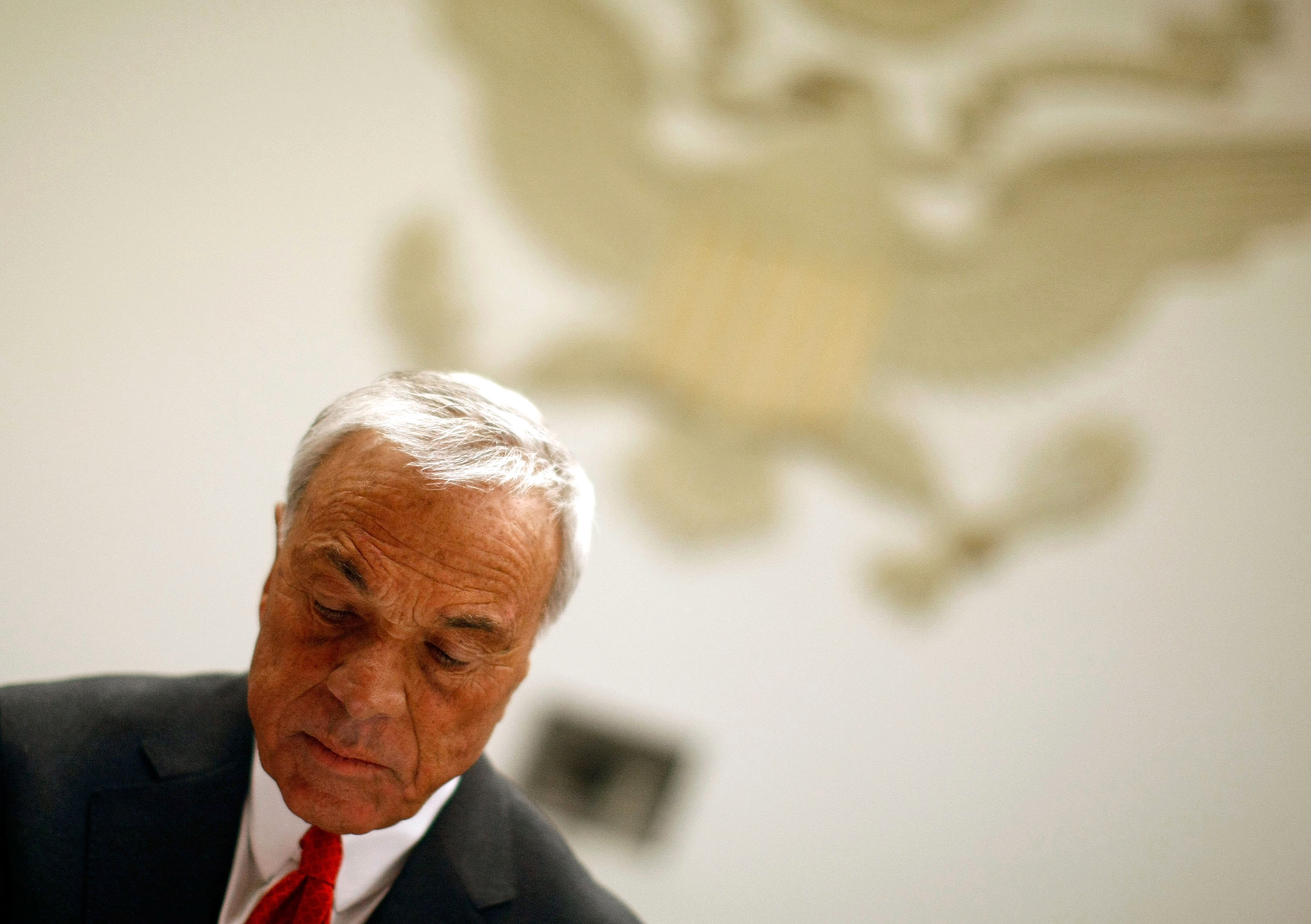
House Hearing With CEO's Involved In Subprime Mortgage Crisis

Angelo Mozilo, the co-founder and former CEO of notorious subprime lending machine Countrywide, was was one of the first top industry figures to be publicly blamed for the financial crisis, and he remains among the very few individuals to be actually punished for his role. He didn’t go to jail or anything, but the SEC made him pay a few million dollars in fines for fraud and insider trading. In exchange, the government dropped its criminal investigation. That seemed, to many people who aren’t Angelo Mozilo, like a decent deal, but now the U.S. Attorney’s in Los Angeles bringing a civil case against him, and Mozilo has emerged from wherever we keep disgraced former financial executives (it’s somewhere really, really nice, btw) to complain to Bloomberg’s Max Ableson that everyone is picking on him for no reason.

Mozilo is being mocked (and rightly) for his insistence that Countywide didn’t do anything wrong, when, in fact, it did a lot wrong, but at times in the interview, Mozilo approaches accidental insight:

“You’ll have to ask those people, ‘What do you have against Mozilo, what did he do?’” he said in a 30-minute call with Bloomberg News before Labor Day, one of his few interviews since the firm’s downfall. “Countrywide didn’t change. I didn’t change. The world changed.”

That’s sort of true! Mozilo’s confusion stems from the bubble in which he spent much of his adult life. He likely never read one remotely negative thing about himself, or his company, before 2007. He was much-admired and frequently adulated in business press, which could not stop giving him honors and awards:

In 2005, Fortune placed Countrywide on its list of “Most Admired Companies,” and Barron’s named Mozilo one of the thirty best C.E.O.s in the world. The following year, American Banker presented him with a lifetime-achievement award.

Mozilo was beloved because his company performed quite well for its shareholders, and made a lot of money. Much of that money came to be made through predatory lending and the production and sale of known toxic garbage; still, the money was still being made, and that’s all that mattered, to everyone who mattered, until the housing bubble revealed that the entire enterprise was based on equal parts malicious fraud and deluded wishful thinking. Basically, though, Mozilo was praised and feted for doing what he did, until he wasn’t, and he is confused. Wouldn’t you be?

On the plus side, he is giving back, by teaching tomorrow’s titans of industry how to repeat the mistakes of the very recent past:

Mozilo decided to teach undergraduates what he knows about finance last year. The former trustee of Gonzaga University in Spokane, Washington, said he spent about two weeks in Italy at Gonzaga-in-Florence, housed in the Mozilo Center overlooking a 16th-century Medici garden.

“I taught them the basics of finance based on my own experiences,” he said. “I really enjoyed being among them. It was very refreshing for me.”

(About the Program: “To the Gonzaga-in-Florence student, Italy is much more than a boot-shaped peninsula in the Mediterranean; it is an opportunity of a lifetime.”) We can take solace in the fact that he is only “teaching” at an American college’s Western European study abroad program. The kids will be too busy recovering from hangovers and trying to figure out where to score ecstasy to actually pay attention to what the disgraced embodiment of a fraud-based financial house of cards is telling them.

(Photo: Angelo Mozilo, founder and former CEO, Countrywide Financial Corporation, stands at the witness table before the start of a House Oversight and Government Reform hearing on Capitol Hill March 7, 2008 in Washington, DC. By Mark Wilson/Getty Images)

Dissents Of The Day

by Jonah Shepp

My assertion yesterday that Russia’s invasion of Ukraine might have had something to do with the eastward expansion of NATO is drawing some fire from the inbox. One reader writes:

I think that you and John Mearsheimer may think yourselves very clever for understanding that the US and NATO’s hubristic expansion is at fault in the Ukrainian crisis. You claim, that without this expansion there would be no Ukraine crisis, a totally ludicrous statement, for which you give no justification. What you fail to appreciate is that the countries in Eastern Europe who clamored to join NATO are also rational independent actors totally capable of acting independently the US or other Western Powers. Poland, the Baltics, Czech Republic, etc.. all know what it is like to be dominated by an imperial power from the east and they certainly wanted protection again such a thing happening again. They chose NATO, not the other way around. In the 90s, most people in the west didn’t think that NATO was even necessary anymore. I think it is completely preposterous to claim that NATO expansion was borne out of some desire for conquest.

Another reader argues that the eternal Cold War mentality belongs to Putin, not the West:

I kept expecting [you] to acknowledge that this only ‘bears out’ anything if one already views NATO’s expansion from a Cold War perspective. I’ll certainly admit that there’s significant tension between the West’s interests and the Russian government’s and that this is not all Russia’s doing, but until this year I’d never though Ukraine joining NATO was even plausible, and even then until this week I’d never thought it was *likely* that Ukraine would join NATO. Now Putin has made it clear to everyone that regardless of anyone else *he* is waging a cold war, so he will keep creating more Cold War responses in those he’s made his foes. I think it’s a real stretch to say  that the failure of the world to dance around this world-view counts as confirmation of it.

And a third points out that the link between Russian aggression and NATO expansion can also go the other way:

I think you have causality the wrong way around when you say that Russia has attacked Ukraine (and, earlier, Georgia) in response to the threat of NATO expanding to include those countries. But there had been no NATO expansion in Russia’s immediate neighborhood in a decade.  And neither Ukraine nor Georgia were going to join NATO . . . until Russia attacked them.  Then they acquired an enormous motivation to try to join an alliance which could defend them against further Russian attacks.  Georgia wasn’t getting anywhere with its request to join either — until the attack on Ukraine, which has caused NATO to reconsider whether “trying not to provoke Putin” was an impossible quest. I can see why Russia would be upset at the prospect of Georgia or Ukraine in NATO.  But if it happens, the overwhelming reason will be Russia’s actions towards those two countries.  In short, Russia will have nobody to blame but themselves.  (Not that this will prevent them from blaming everybody else in sight, of course.)

Well, the causality is a little more complicated. The effort to bring Georgia into NATO started in 2005 and was a major item on Mikheil Saakashvili’s to-do list long before the Russo-Georgian War of 2008. One can easily argue, as Saakashvili himself did, that this effort was in response to fears of Russian bellicosity, but one can also see it the other way around, as Putin and his cohort clearly do, and argue that Russian assertiveness (they probably wouldn’t say “aggression”) was necessary to check NATO’s nefarious plan to weaken Russian influence in its former imperial holdings. It’s not hard to see how they arrived at that conclusion; that is different, however, from saying that the conclusion is correct.

I don’t actually share Mearsheimer’s conclusion that this mess is all the West’s fault. I think it’s useful to remember, though, how the West has condescended to Russia since the end of the Cold War, and to consider how that treatment might have influenced the mentality that drives Putin to adopt such an aggressive posture. Remember how Germany was demonized, humiliated, and driven hopelessly into debt by the victors of World War I? Well, how did that turn out? When Alexander Motyl compares Putin to Hitler, he focuses primarily on their dictatorial ways, but their countries also have some salient similarities:

Both Germany and Russia lost empires and desired to rebuild them. Both Germany and Russia suffered economic collapse. Both Germany and Russia experienced national humiliation and retained imperial political cultures. Both Germany and Russia blamed their ills on the democrats. Both Germany and Russia elected strong men who promised to make them grand and glorious again.

In other words, Hitler had others to thank for the conditions that enabled his rise to power, and one can say the same of Putin. I don’t mean to engage in some wishy-washy, “it’s all society’s fault” leftish apologetics. Putin clearly believes in restoring the Russian Empire by any means necessary, including force, and has committed many misdeeds in pursuit of that belief. But if the question at had is what the West ought to do about it, it’s worth thinking about our past policy choices and how they might have contributed to the problem. If instead we attribute the crisis solely to Putin’s grandiosity, that implies that there’s not much we can do to change his behavior, and that’s scarier to me than admitting we made some missteps.