Bollywood gets the David Attenborough treatment:
The Secret To ISIS’s Success
Josh Marshall passes along an email from a “TPM Reader who’s former US military intelligence/counter-terrorism ops and has worked as a military contractor in Iraq”:
Why is ISIL so successful? Simply put they attack using simple combined arms but they hold two force multipliers – suicide bombers and a psychological force multiplier called TSV – Terror Shock Value. TSV is the projected belief (or reality) that the terror force that you are opposing will do anything to defeat you and once defeated will do the same to your family, friends and countrymen. TSV for ISIL is the belief that they will blow themselves up, they will capture and decapitate you and desecrate your body because they are invincible with what the Pakistanis call Jusbah E Jihad “Blood Lust for Jihad”.
I have worked the Iraq mission since 1987 and lived in and out of Iraq since 2003. TSV was Saddam’s most effective tool and there is some innate characteristic of the Iraqis that immobilizes them when faced with a vicious, assuredly deadly foe who will do exactly as they have done to others – and they will unsuccessfully try to bargain their way out of death by capitulating. The Kurds are not immune to ISIL’s TSV -90% of which is propaganda seen on Facebook, Twitter and al-Arabiya. The Kurds have not fought a combat action of any size since 2003 and like the Iraqi Army it will take the Americans to give them the spine to get them to the first hurdle – they need a massive win to break the spell of ISIL’s TSV.
But Jonathan Freedland contends that the Islamic State’s stunning success is mostly thanks to the weakness of the Syrian and Iraqi states:
The state structures of both Iraq and Syria have all but collapsed. The result is a power vacuum of a kind that would have been recognised in the lawless Europe of seven or eight centuries ago – and which IS has exploited with the ruthless discipline of those long ago baronial warlords who turned themselves into European princes.
“Islamic State are jihadis with MBAs,” says [Iraq scholar Toby] Dodge, speaking of a movement so modern it has its own gift shop. He notes its combination of fierce religious ideology, financial acumen and tactical nous. “It’s Darwinian,” he adds, describing IS leader Abu Bakr al-Baghdadi and his inner circle as those strong enough to have survived the US hammering of al-Qaida in Iraq between 2007 and 2009. But what has been crucial, Dodge says, is “not ancient hatreds but this collapse of state power”.
But Robert Beckhusen thinks ISIS has major vulnerabilities:
Here’s the problem for ISIS. Since ISIS fighters operate semi-conventionally, they are easy pickings for these warplanes. It’s easier to hit vehicles and fixed artillery sites from the air than it is to strike individual insurgent fighters.
It’s possible ISIS has limited anti-aircraft weapons, including shoulder-fired Stingers it took from the Iraqis. Indeed, the loss or capture of a U.S. pilot is a terrifying prospect for the White House. But the bulk of ISIS’s anti-aircraft weapons are DShK and ZU-23–2 heavy machine guns that the terror group has used with brutal effectiveness against Iraq’s dwindling helicopter gunship force—but which don’t stand much of a chance against fast, high-flying fighter planes.
Others disagree that the group is vulnerable to airstrikes:
The problem, some analysts point out, is that airstrikes tend to be most helpful against troops when they are massing. As it stands now, IS is “too big and too dispersed,” argues Christopher Harmer, senior Navy analyst at the Institute for the Study of War. “They aren’t vulnerable to air strikes the way the Republican Guard was with their armored tanks and artillery tubes,” Mr. Harmer says. “Yes, ISIS has some of that – and we can hit it and should – but, fundamentally it’s a light infantry terrorist organization. You can’t beat those guys by dropping a couple of bombs here and there.”
Another way to damage ISIS is to lower its cash flow. Britain is taking steps to do just that:
Britain hopes a diplomatic initiative it introduced in the U.N. Security Council on Friday will contain Islamic extremists in Iraq and Syria by curtailing their fundraising. The plan is to quash their illicit oil and gold exports, prevent ransom kidnappings, and hobble recruitment to stymie the establishment of an Islamic caliphate straddling the two Middle Eastern countries.
How Long Will We Be In Iraq?
It could be awhile:
President Barack Obama said Saturday he doesn’t have an end date in mind for the end of American strikes targeting Islamic militants in Iraq or airdrops supporting stranded Iraqis fleeing those militants. “I don’t think we’re going to solve this problem in weeks,” said Obama told reporters before departing Washington for a family vacation. “This is going to take some time.”
If that’s true, Jack Goldsmith urges Obama to get approval from Congress:
If the President plans to engage in military operations in Iraq for “months” (and almost certainly longer) in an effort to address the militant threat posed over the long term there, then the case for doing so in reliance solely on his inherent Article II self-defense power just grew weaker, legally and especially politically, and the case for seeking authorization from Congress for the military strikes just grew stronger. As I noted yesterday, the case for seeking congressional authorization in this context was made forcefully and persuasively less than a year ago by President Obama himself, when he explained why he was seeking congressional authorization prior to military strikes in Syria. (The Syrian strikes were supposedly going to be “limited in duration and scope,” unlike the longer term strikes now planned for Iraq.)
Larison sighs:
As we know from previous interventions, the initial estimates of how long they will last and what they will cost are frequently wrong. If the administration expects that this “project” will last several months, it will most likely continue for a lot longer than that, and it will end up being a larger commitment that originally advertised.
Beauchamp unpacks Obama’s speech:
“Ultimately, there’s not going to be an American military solution to this problem,” President Obama said in his press conference on the Iraq crisis on Saturday. “There’s going to have to be an Iraqi solution.” This is the key line to understand if you want to grasp the administration’s approach to Iraq — and why the goals of the US military campaign are more narrow than you might think. …
If the United States can beat ISIS back in Kurdistan, why not elsewhere? That line about an Iraqi solution is the administration’s answer. In fact, the Obama administration has been consistent on this question since June, when ISIS first took control of big chunks of Iraq. They see ISIS as, at its heart, a political problem — one that can’t be solved solely with force. But the march on Kurdistan and the siege on Sinjar are narrow military problems, and thus merit military solutions. This distinction between military and political problems is at the heart of the Obama administration’s thinking on Iraq.
Obama further explained his thinking in an interview with Tom Friedman:
“I do think the Kurds used that time that was given by our troop sacrifices in Iraq,” Obama added. “They used that time well, and the Kurdish region is functional the way we would like to see. It is tolerant of other sects and other religions in a way that we would like to see elsewhere. So we do think it’s important to make sure that that space is protected, but, more broadly, what I’ve indicated is that I don’t want to be in the business of being the Iraqi air force. I don’t want to get in the business for that matter of being the Kurdish air force, in the absence of a commitment of the people on the ground to get their act together and do what’s necessary politically to start protecting themselves and to push back against ISIL.”
Face Of The Day

Ellyn Ruddick-Sunstein captions:
For Lady Things, Toronto-based photographer Robyn Cumming creates surreal portraits of femininity, replacing the heads and faces of her female subjects with soft, delicate objects. Against quaint patterned wallpapers, frilly curtains, or ominous blackness, the stiffly posed figures are veiled like strange brides in flower petals, luxurious fabrics, and a flock of doves. Though observably of varying ages, the women become uncannily interchangeable with one another.
See more of her work here.
The Poetics Of Atrocity
Tarfia Faizullah’s first book of poems, Seam, centers on the experiences of Bangladesh’s Birangona – the roughly 200,000 women who were raped and tortured during that country’s war of independence. Jonathan Farmer lauds the book:
The beauty of these poems does not redeem tragedy; at times, in fact, it seems to sully it. But that sullying—the humid tangle of lives, Faizullah’s own losses pressing in alongside the stories of the Birangona, her sexual desires flaring up back at her hotel room, her feelings of shame, her disquiet in the streets of Dhaka, the company of Western authors (Tomas Tranströmer, Paul Celan, Willa Cather) amid everyone else’s words—offers an unusually persuasive image of the ways old tragedies persist. They remain pressed in among the living and preserved by a hunger that is not always and not only for them, including a poet who might, in the midst of all these interviews, “reach for anyone // willing to wrap his good arm tight / around me for as long as the ribboned / darkness allows.” In a society still unable to make sense of the lives engendered by such an atrocity, that dark vitality seems to register more than purity ever could.
An Edible Oedipus
Dan Colman recommends the above short film, which tells the story of Oedipus using stop-motion veggies:
Sophocles and Aeschylus may be spinning in their graves. Or, who knows, they may be taking some delight in this bizarre twist on the Oedipus myth. Running 8 minutes, Jason Wishnow’s 2004 film puts vegetables in the starring roles. One of the first stop-motion films shot with a digital still camera, Oedipus took two years to make with a volunteer staff of 100. But the hard work paid off.
The film’s director, Jason Wishnow, has recently been working on a 10-minute sci-fi flick starring Ai Weiwei:
The team shot in cold and smoggy conditions in Beijing (the pollution index hit a record 800 during production). Because of Ai Weiwei’s status with the Chinese government (one early meeting saw him whisked away for interrogation by police), the film was shot largely in secret, with code-names and various forms of communication. (Though, as Wishnow points out on the project’s Kickstarter page, Ai Weiwei did Instagram a photo from [the] set.) Because of the secretive nature of the project, the Kickstarter campaign was launched after the film was in the can, to recoup costs and help out with VFX, music, subtitles, and other finishing touches.
Show, Don’t Tell, Hemingway
Ian Crouch, reviewing the notes and early drafts included in a new edition of The Sun Also Rises, dishes on the back-and-forth about the novel between Hemingway and his friend, F. Scott Fitzgerald:
F. Scott Fitzgerald … after reading the version that Hemingway had sent to [editor Maxwell] Perkins, wrote a long, dismayed-sounding letter to Hemingway, in which he said, “I think that there are about 24 sneers, superiorities, and nose-thumbings-at-nothing that mar the whole narrative up to P. 29 where (after a false start on the introduction of [character Robert] Cohn) it really gets going.” Though Hemingway would later downplay Fitzgerald’s editorial influence, the published novel begins with the sentence: “Robert Cohn was once middleweight boxing champion of Princeton.”
In the letter, Fitzgerald also criticized Hemingway for injecting his own writerly persona into the text: “That biography from you, who [always] believed in the superiority (the preferability) of the imagined to the seen not to say to the merely recounted.” With this fragment of a sentence, Fitzgerald gives Hemingway the familiar writing-class advice—show, don’t tell; less is more; and what is left out can sometimes be more meaningful than what is included. Earlier versions of the novel contained even more of this “biography”; Fitzgerald had caught the remnants of nervous self-consciousness that Hemingway himself had curtailed as he wrote.
The View From Your Window Contest

You have until noon on Tuesday to guess it. City and/or state first, then country. Please put the location in the subject heading, along with any description within the email. If no one guesses the exact location, proximity counts. Be sure to email entries tocontest@andrewsullivan.com. Winner gets a free The View From Your Window book or two free gift subscriptions to the Dish. Have at it.
Are Liberals Killing Art?
Jed Perl makes that case in TNR, arguing that the “erosion of art’s imaginative ground, often blamed on demagogues of the left and the right, is taking place in the very heart of the liberal, educated, cultivated audience — the audience that arts professionals always imagined they could count on”:
It is relatively easy to point to the deformations of art at the hands of politically correct left-wingers and cheap-shot moralists on the right, as the late Robert Hughes did in the fast-paced, witty series of lectures that he published as Culture of Complaint in 1993. It is far more difficult to explain why people who pride themselves on their carefully reasoned view of the world want to argue that art is not a value in and of itself, but rather a vehicle or a medium or a vessel through which some other human value or values are expressed. That these thoughts are often voiced indirectly makes them no less significant. Indeed, such thoughts may be all the more significant because they are being expressed by critics and scholars who would deny that they are in any way discomfited by the unique powers of the arts. An illiberal view of art is gaining ground, even among the liberal audience.
Alyssa finds common ground with Perl:
I sometimes find myself heaving sighs at pieces I once might have written myself, like Vox’s recent offering “The Bachelor franchise is sexist and needs to go,” from reporter Kelsey McKinney. Of course “The Bachelor” franchise is grotesquely, bizarrely sexist. The entire conceit involves generating drama by making its cast go through intensified versions of antiquated courtship rituals and making them feel bad for themselves if those rituals do not produce a happy result. But in keeping with Perl’s objection, I think we ought to be a bit more careful about declaring that culture “ought to go” on the grounds of its politics. …
[T]here is something suspiciously anti-competitive about the idea that something should go away just because it has bad values. It is an impulse akin to the hope that a politician you dislike will be indicted or caught with a person not their legal spouse, eliminating the need to actually beat them at the polls. This is an end run around figuring out why people like what they like. It suggests a lack of confidence that liberal values will be compelling and a wish to ignore the reasons that something retrograde can also be extremely popular.
Dreher nods along:
Perl is addressing liberals in a liberal magazine, but his point is universal. True art cannot be reduced to the sum of its creator’s parts. It comes from somewhere particular, but it will have achieved the quality of universality that allows it to stand alone from its creator. Your understanding of Dante’s verse is far richer if you understand the historical, theological, and philosophical sources of his vision. But his lines are no less beautiful and true absent that understanding.
But Mostafa Heddaya sighs that Perl “seems, as usual, to be at war with straw men”:
Like much of his criticism, Perl here seems to be talking to no one in particular, bellowing at the present from an oblique angle. And for someone drawing from the ambered debates of modernism, it seems deeply strange for him to blindly assert that emotions are not political, or that politics cannot be emotional. And without getting into an intellectual history of art criticism and history (a subject intelligently surveyed in a recent article by Ingrid Rowland in The New Republic), which might explain a turn away from the belle-lettristic art discourse he seems to advocate but not adhere to, Perl’s recycling of antique arguments under the guise of contrarian thought is tiresome.
The Halloumi Menace
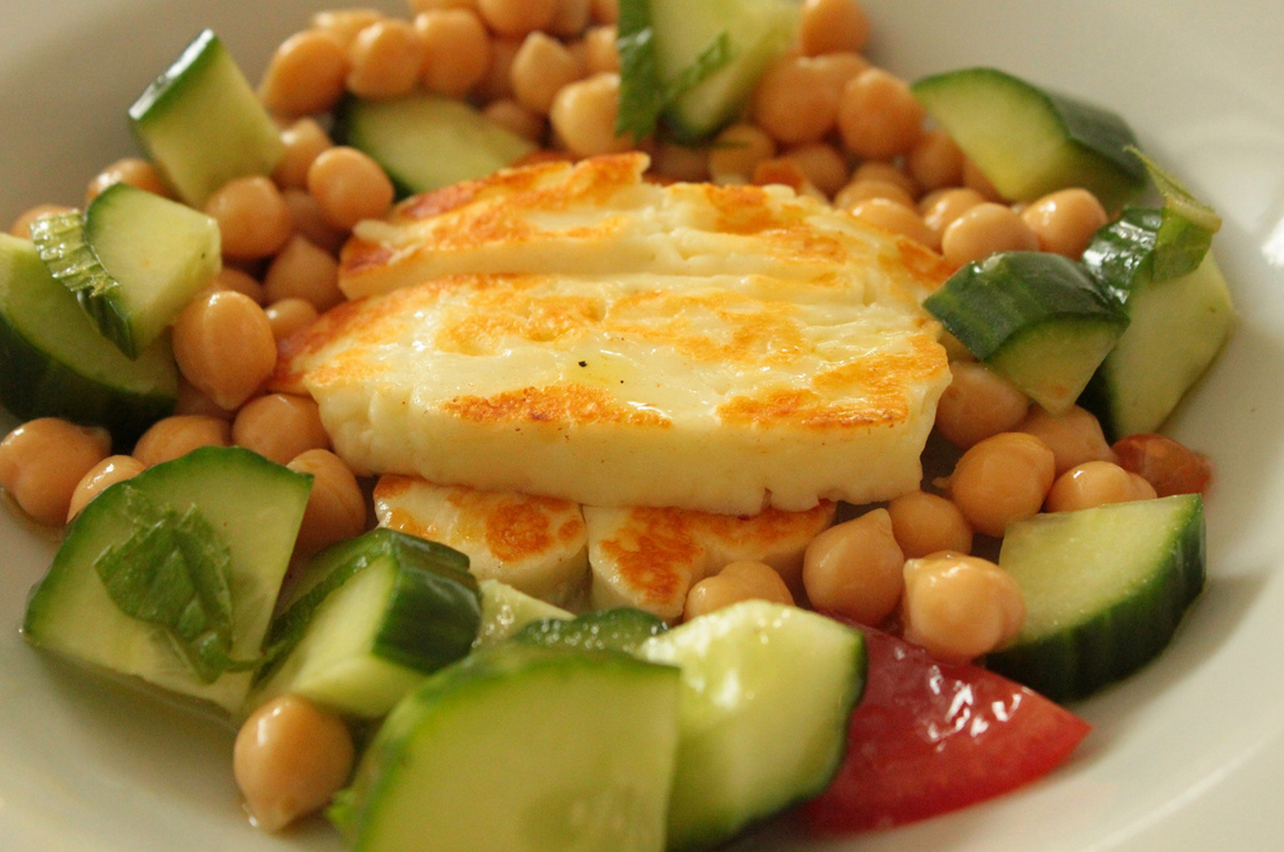
Rebecca Smithers flags new findings about the salt levels in various cheeses:
Halloumi and imported blue cheese such as Roquefort contained the most salt – more than sea water – while cottage cheese contained the least, according to a major new research study carried out by Cash (Consensus Action on Salt & Health) and published in the British Medical Journal…. [The study] is based on an extensive survey of 612 British and imported cheese products sold in UK supermarkets in 2012, using data on the labels to analyse the salt content (g/100g). It looked at the salt reduction targets for ten popular cheeses set by the Food Standards Agency watchdog and implemented by the Department of Health, to be achieved by 2012. While 85% (333 of the 394) of cheeses have already met their targets, 81% (318 of 394) would still get a red (which means ‘high’) colour rating under the so-called ‘traffic light’ labelling scheme.
A Daily Mail headline reminds that the saltiest cheeses are “foreign” in origin. Meanwhile, James Ramsden stands up for the high-sodium dairy products:
This latest study, which brings little new information to the table, reckons salt content to be considerably lower in supermarket own-brand cheddar and “cheddar-style” cheeses than in their branded equivalents. This, they inform us with the sort of dreary lack of appetite you’d expect from a group such as Cash, “demonstrates that it is technically possible to produce cheese with less salt in it”.
Sure. Just as it’s technically possible to make decaffeinated coffee, alcohol-free beer and vegan sausages. But that’s kind of missing the point. And cheese needs salt. Sarah Hampton, who makes goat’s cheese at Brock Hall farm in Shropshire, says: “The effect of salt in cheesemaking performs an essential function in the casein matrix, creates texture and flavour, and affects protein hydration in the cheese body.”
Should more cheeses be made with less salt? “I personally like to be quite sparing with salt quantities,” Hampton says. “For the kinds of semi-soft and semi-hard cheeses I make, too much salt can foreshorten the flavour. But some cheeses need that saltiness. Feta, for example, is more salty than a fresh goat’s cheese, but that level of salinity constitutes the character of the cheese. An unsalted feta would be horrendous.”
(Photo of Halloumi salad by Judith Doyle)
 The Dish