
Mental Health Break

We might end up making an executive decision and declare this one the best cover song ever:

Update from a reader:

How dare you put Cartman’s “Poker Face” ahead of the epic “Come Sail Away” from the Chef Aid episode.  The video doesn’t exist, but the rendition alone is pure gold:

Don’t Call It A “Muslim Democracy”

Bobby Ghosh objects to pundits and politicians who are praising Indonesia as an example to other Muslim countries in light of its successful presidential election:

Over the next few days, you will see and hear commentary on how Indonesia’s election is—or should be — an inspiration for all of Islam. It is proof, the commentators will say, that Islam is not antithetical to democracy. This is an old trope, too frequently embraced by Western political leaders, such as David Cameron and Hillary Clinton. Its subtext is not subtle: If only the Arabs could be more like the Indonesians, they too could enjoy the fruits of democracy and nonviolent transfers of power. And the world would be a much more peaceful place. That view is highly patronizing, of Indonesians, of Arabs and of Muslims in general. …

After years of living and traveling in Arab countries, I am not persuaded that people there need the inspiration of a “Muslim democracy,” if such a thing even existed. I was a correspondent in Baghdad in 2004, when the current Indonesian president, Susilo Bambang Yudhoyono, was first elected. Iraq was four months away from its first post-Saddam election. People there looked forward to a chance to cast their votes freely, and there was a great deal of discussion about democracy. I cannot recall a single instance where anybody invoked Indonesia as an inspiration. Nor was there much reference to nearby democracies, like Turkey. Iraqis were already familiar with the mechanics of voting, even though the “elections” under Saddam were pure sham. All they wanted was genuine choice.

Well, how about a “consolidated democracy”? That’s the term Jay Ulfelder uses in praising Indonesia’s progress:

By my reckoning, this outcome should increase our confidence that Indonesia now deserves to be called a consolidated democracy, where “consolidated” just means that the risk of a reversion to authoritarian rule is low. Democracies are most susceptible to those reversions in their first 15–20 years (here and here), especially when they are poor and haven’t yet seen power passed from one party to another (here).

Indonesia now looks reasonably solid on all of those counts. The current democratic episode began nearly 15 years ago, in 1999, and the country has elected three presidents from as many parties since then—four if we count the president-elect. Indonesia certainly isn’t a rich country, but it’s not exactly poor any more, either. With a GDP per capita of approximately $3,500, it now lands near the high end of the World Bank’s “lower middle income” tier. Together, those features don’t describe a regime that we would expect to be immune from authoritarian reversal, but the elections that just occurred put that system through a major stress test, and it appears to have passed.

Unexcited About The Midterms?

Enthusiasm Gap

You aren’t alone:

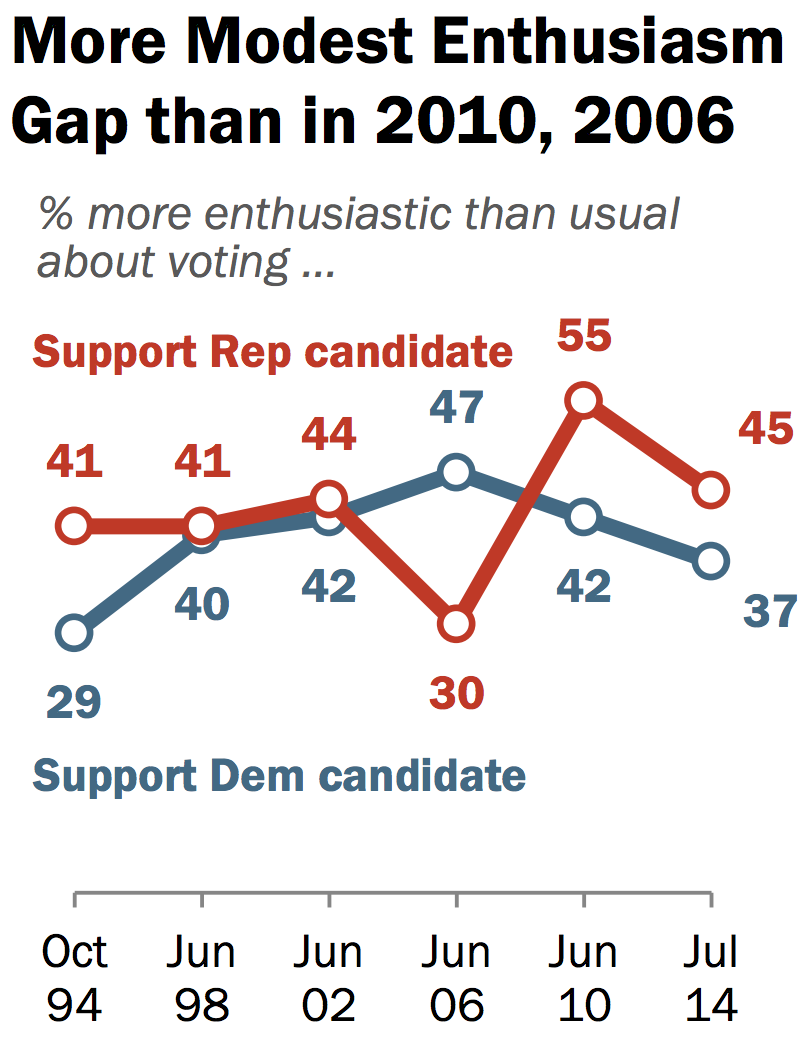
The Republican Party holds a clear advantage in voter engagement in this fall’s midterm elections, according to a new national survey by the Pew Research Center. Yet GOP voters are not as enthused and engaged as they were at this point in the midterm campaign four years ago, prior to the Republican Party winning control of the House of Representatives, or as Democratic voters were in 2006, before Democrats gained control of Congress.

Allahpundit puts the numbers in perspective:

Democrats are down five points from four years ago; the GOP is down 10 points. That’s still good enough for an eight-point lead in enthusiasm, and the number of Republicans who say they’re absolutely certain to vote is statistically the same as it was in 2010, but if you’re looking for reasons to go full eeyore and doubt that the GOP can produce another wave, there you go. As pitiful as Democratic enthusiasm is right now (driven in part by an eight-point drop among Dems when asked if Obama is a factor in their vote this November), the gap between them and Republicans has actually shrunk since the last midterm.

Sabato isn’t betting on a wave election:

If there is political energy out there in the 2014 electorate to match either 2006 or 2010, it has escaped our attention. Obama and the congressional Democrats are undeniably unpopular, yet congressional Republicans have even lower ratings. Partisan redistricting has reduced the number of truly competitive House districts in a general election to an absolute minimum, also reducing interest and excitement. Also, this is the Senate class of seats that involves only about half of the nation’s voters, in contrast to the roughly three-quarters engaged in the seats to fill the other two Senate classes.

Don’t Forget Poland

As Marc Champion puts it, “The Council of Europe [yesterday] found the U.S. guilty of torture, illegal detention and administering unfair trials — and made Poland pay the penalty”:

That, in effect, is what happened at the council’s judicial arm, the European Court of Human Rights. The U.S. wasn’t on trial, of course, because it isn’t subject to the court’s jurisdiction. Poland, however, is. Call it the cost of being a loyal U.S. ally.

The case concerned two suspected terrorists the U.S. picked up — Abd al-Rahim al-Nashiri in Dubai and Zayn al-Abidin Muhammad Husaynin Pakistan — and took on a tour of so-called black rendition sites that ended with Guantanamo Bay, Cuba. Poland was among several European countries suspected of facilitating the air flights and providing detention locations at which the Central Intelligence Agency, alone, conducted the questioning.

The seven judges, who included a Pole, found that the Polish authorities did indeed help the CIA, should have known the men would be tortured and denied the right to a fair trial, and did nothing to prevent these things from happening. … The court ordered Poland to pay 100,000 euros ($135,000) in damages to each of the two, who remain imprisoned in Guantanamo.

Poland is like “Black sites? What black sites?”:

Despite overwhelming proof that the site was on Polish territory and that the CIA had operated there with the consent of Polish authorities, Warsaw has repeatedly and vehemently denied any knowledge of or involvement in the operation. The reactions Thursday were no different. “The ruling of the European Court for Human Rights in Strasbourg seems to be premature,” said Marcin Wojciechowski, a spokesman for the Polish Foreign Ministry. The domestic investigation is still underway, he said. Leszek Miller, who served as prime minister while the black site was up and running, said that the ruling is “unfair and immoral.” “I hope that the Polish authorities never pay out the amount because this money would fuel the accounts of terrorists and would be used to prepare other attacks,” he said.

Relatedly, Bai claims that the Senate may move to release the torture report on its own if Obama doesn’t. I hear it could finally arrive next month – while I’m on vacation.

A Gift To Obamacare Foes

This 2012 video of Jonathan Gruber, a key Obamacare architect, is making the rounds:

The line of Gruber’s that stands out:

What’s important to remember politically about this is if you’re a state and you don’t set up an exchange, that means your citizens don’t get their tax credits—but your citizens still pay the taxes that support this bill.

Ed Morrissey pounces:

So is this a smoking gun in the Halbig case? Politically — yes. Legally? It certainly undermines one argument used by the administration to defend payment of subsidies through the federal exchanges, but it may not be entirely dispositive. What matters here is Congressional intent, not Gruber’s, to the extent that the statute itself appears ambiguous.

Aaron Carroll dismisses the video:

Is there a single CBO analysis which documents what would happen if states refused to set up exchanges and would therefore “lose” their subsidies? Were any of Gruber’s models set up in this manner? If not, then I don’t understand how anyone in Congress or who set up the law thought it was going to work. I accept that the law was written poorly. I accept that there may be individuals who thought it would work in the way the DC Circuit majority said. But there are tons of analyses, reports, interviews, and more that show that no one involved thought that way.

But Michael Cannon sees Gruber’s comments as a big deal:

Now why should we care about what this one health economist says about this hotly disputed feature of the PPACA? Gruber is not a member of Congress, so this isn’t direct evidence that Congress intended to offer tax credits only in state-established Exchanges. (The procedural path the bill took through Congress is dispositive evidence of that.) But he may be the next best thing.

Gruber was an architect of both the PPACA and its Massachusetts precursor, “RomneyCare.” In 2009 and 2010, he was a highly paid advisor to the Obama administration during the congressional debate that produced the PPACA. According to the New York Times, “the White House lent him to Capitol Hill to help Congressional staff members draft the specifics of the legislation.”Later the above video, Gruber boasts of having written part of the PPACA. He boasts to the Times, “I know more about this law than any other economist.” He’s probably right about that.

Suderman chimes in:

There can be no doubt, based on his record, that Gruber is a supporter of the law. He says so in the presentation. “I’m biased, I’m in favor of this type of law, I won’t hide that,” he says. He also explains early on that his entire presentation is made of “verifiable objective facts.”

And what he says is exactly what challengers to the administration’s implementation of the law have been arguing—that if a state chooses not to establish its own exchange, then residents of those states will not be able to access Obamacare’s health insurance tax credits. He says this in response to a question asking whether the federal government will step in if a state chooses not to build its own exchange. Gruber describes the possibility that states won’t enact their own exchanges as one of the potential “threats” to the law. He says this with confidence and certainty, and at no other point in the presentation does he contradict the statement in question.

McArdle adds:

To be sure, this was still two years after the law passed, and my understanding is that the court is not supposed to pay attention to post-facto statements about the law’s effect or intent. But unless this is some sort of elaborate hoax, I think this definitively puts to rest the notion that none of the bill’s architects could possibly have thought or intended that the law would have this effect. Gruber thought the law would have this effect — and if anyone would know, he would.

Cohn gets a response from Gruber:

Among those who say they are surprised by the statement is Gruber himself, whom I was able to reach by phone. “I honestly don’t remember why I said that,” he said, attempting to reconstruct what he might have been thinking at the time. “I was speaking off-the-cuff. It was just a mistake.” As evidence that it was not indicative of his beliefs, he noted that his projections of the law’s impact have always assumed that all eligible people would get subsides, even though, he said, he did not assume all states would choose to run their own marketplaces.

Previous Dish on Halbig here.

Really? No Benefit Cuts?

Suzy Khimm questions how Paul Ryan’s anti-poverty plan will pay for itself without them:

While Ryan says his plan is budget neutral, it does not appear to account for the additional cost of hiring case managers, imposing new work requirements, and creating a new bureaucracy to administer them. That could mean less money for benefits and more for services to administer them, said Donna Pavetti of the Center on Budget and Policy Priorities (CBPP). “There are things about it that sound good, but when you get to the reality of it, it just falls apart,” she said, adding that federal agencies have often struggled to allocate limited resources to staffing and find enough skilled case workers.

“This individualized case management, the work requirements – all of that is really resource intensive. How you’d do that without pulling from resources that help people meet their basic needs?” said Pavetti, CBPP’s vice-president for family income support policy. She points to a state-level program called Building Nebraska Families, which proved effective at moving more welfare recipients to work through intensive home visits, but which was also costly, averaging $7,400 to $8,300 per participant.

In a more comprehensive critique of the plan, Pavetti faults Ryan for ignoring the tradeoffs and limitations it implies:

The case of “Steven,” whom Ryan also highlights, makes the point as well.  A single 19-year-old non-custodial father, Steven is jobless and needs help to get off drugs.

Ryan’s proposal indicates that the Opportunity Grant would help him get drug treatment, move him into transitional housing (a form of subsidized housing), and get him help with attending parenting classes, finding work, and pursuing further education. These are all needed services, and limited funding keeps many people, particularly adults not living with children and who have the same needs as Steven, from obtaining that help.  But the Opportunity Grant structure would not provide additional resources (and as my colleague Robert Greenstein points out, could well provide fewer resources), so the only way to provide this richer set of supports for Steven is to cut the help that other families receive.

Running down how Paul Ryan proposes to keep the plan revenue neutral, Chuck Marr criticizes the cuts he would make to existing programs:

First, he would pay for it in part by eliminating the refundable part of the Child Tax Credit for several million children in low-income immigrant working families, including citizen children and “Dreamers,” thereby pushing many of them into — or deeper into — poverty. He would also eliminate the Social Services Block Grant, a flexible funding source that helps states meet the specialized needs of their most vulnerable populations, primarily low- and moderate-income children and people who are elderly or disabled.  (This program provides the kind of services and state flexibility that Ryan says we need more of when he promotes other parts of his plan that would enable states to cut food stamps and rental assistance and shift the resources to services.)

Also among the programs that Ryan would end is one that provides fresh fruits and vegetables primarily to children in schools in low-income areas.  By contrast, the President would pay for his EITC expansion by closing tax loopholes for wealthy taxpayers.

In Jared Bernstein’s take, the plan is a potentially costly solution in search of a problem:

The broader reason his plan is misguided is because Ryan starts from the mistaken assumption that the current U.S. anti-poverty system is broken, when in fact it’s actually quite effective, and not just in lowering market-based poverty rates, which it does by almost half, but also by investing in the longer term well-being of its beneficiaries. (Bob Greenstein provides the details here.)  That’s not good enough by a long shot, but neither is it motivation to radically change the system in ways that introduce a dangerous set of new risks, as this new plan does, I fear. …

The implication here is that while a faceless bureaucrat in D.C. can’t possibly evaluate your nutritional needs, for example, a bureaucrat in Albany or Sacramento can easily and efficiently do so. And while the plan requires state officials to use the resources for poverty reduction, and not, say, tax reduction, consolidation also raises serious risks of diverting funds to areas of anti-poverty interventions that state officials favor vs. areas of need.

It’s Time To Take A Break From Bombing Schools

PALESTINIAN-ISRAEL-CONFLICT-GAZA

It’s not just in American schools that they slaughter kids. To John Cassidy, the alleged shelling of an UNRWA school in Beit Hanoun yesterday underscores the need for an immediate ceasefire:

Alarmingly, hopes for a ceasefire faltered on Thursday. Secretary of State John Kerry left a meeting with Benjamin Netanyahu without securing an agreement. According to a report in the Washington Post, Netanyahu was furious about a ban on commercial airliners landing in Tel Aviv that the Federal Aviation Administration imposed earlier this week, suspecting that “it was an attempt by the Obama administration to squeeze Israel to end its Gaza campaign.” The flight ban was lifted on Thursday night, but Israel and Hamas gave no indication that they were ready to reach a deal. A senior official for Hamas reiterated that it wouldn’t halt its rocket attacks until Israel agreed to end its blockade of Gaza.

Meanwhile, Moshe Ya’alon, Israel’s defense minister, told troops preparing to enter the Strip that the I.D.F. was on the verge of broadening its offensive. “We are preparing the next stages of the fighting after dealing with the tunnels, and you need to be ready for any mission,” Yaalon told the soldiers, according to the Post. “You need to be ready for more important steps in Gaza, and the units that are now on standby need to prepare to go in.” After Thursday’s tragic strike, where can Gaza residents take shelter?

Colum Lynch puts the strike on the school in context:

The tragedy at Beit Hanoun came during a particularly grim week for the United Nations.

Three Palestinian teachers employed by the U.N. Relief and Works Agency (UNRWA) were killed this week, marking the first casualties for the international organization since fighting began 16 days ago. Chris Gunness, UNRWA’s spokesman, announced on Twitter: “1st UNRWA deaths in #Gaza war, all teachers, 2 killed while at home, another walking home after working in an UNRWA shelter.”

During his Tuesday videoconference with the Security Council, Ban praised UNRWA for carrying on in the midst of war. “I want to stress how deeply proud I am of our many U.N. colleagues, with UNRWA in the lead, courageously assisting the people of Gaza under such difficult circumstances.” He also said that the escalation in fighting was “acutely affecting” UNRWA’s operations and that 23 of its installations have been closed and 77 damaged during the latest round of fighting. Palestinian militants have taken advantage of those closures, turning vacant U.N.-administered schools into temporary arsenals for rockets, causing even more friction between the United Nations and Israel.

(Photo: A trail of blood is seen in the courtyard of a UN School in the northern Beit Hanun district of the Gaza Strip on July 24, 2014, after it was hit by an Israeli tank shell. By Marco Longari/AFP/Getty Images)

Why Am I Moving Left?

crashing-elephant-thumb

Tom Ricks penned a mini-manifesto of sorts yesterday on why he finds himself moving to the left. He’s always thought of himself as a centrist, but now finds himself drifting further away from American conservatism and Republicanism. Money quote:

I am puzzled by this late-middle-age politicization. During the time I was a newspaper reporter, I didn’t participate in elections, because I didn’t want to vote for, or against, the people I covered. Mentally, I was a detached centrist. Today I remain oriented to the free market and in favor of a strong national defense, so I have hardly become a radical socialist.

But since leaving newspapers, I have again and again found myself shifting to the left in major areas such as foreign policy and domestic economic policy. I wonder whether others of my generation are similarly pausing, poking up their heads from their workplaces and wondering just what happened to this country over the last 15 years, and what do to about it.

Good question, Tom. Like Ricks, I don’t believe my general inclinations politically have changed that much over the years. I prefer smaller government in general; I too believe in a robust defense; I have few issues with the free market; I think marriage and family are critical social institutions; I’m still a believing Christian; I have deep qualms about abortion and abhor affirmative action; I’m a fiscal conservative; want radical tax reform, cuts in unfunded entitlements, and culturally, I’m a libertarian, with a traditionalist streak alongside radical tendencies (so, for example, I both love the Latin Mass and intend to go to Burning Man next month). I haven’t renounced my precocious devotion to Thatcher and Reagan, even as I have out-grown them, as the world has as well.

But I am now regarded as a leftist by much of the right and to some extent, they’re right. In today’s polarized political climate, I have few qualms in backing president Obama over almost anyone in the opposition, and am genuinely insulted these days when some people call me a Republican. Tom laid out several critical issues which have now placed him on the left rather than the right in today’s environment. They’re well worth reading through. Here are my critical reasons, as of now, for wanting the Republicans defeated in any forthcoming elections.

The defense of torture.  As disturbing as the deployment of torture by the Bush-Cheney administration was, the continuing refusal of anyone on the right to cop to it and make amends for it is a clear and present danger to our core decency. Calling it something else doesn’t cut it. Violating the sacred honor of the United States and a founding principle of Western civilization because of one man’s panic and extremism cannot be put aside. Today’s conservatism – in stark contrast to Reagan and Eisenhower and every civilized nation on earth – is now intertwined with barbarism. Until they revoke this and become fully accountable for it, I cannot in good conscience be a member of the “right.”

Political brinksmanship. The conduct of the GOP during the Obama administration has been a nihilist disgrace. In 2009, Obama inherited crises on every front: an economy in terrifying free-fall, a bankrupted Treasury, an even more morally bankrupt foreign policy, and two failed wars. He deserved some measure of cooperation in that hour of extreme national peril and need. He got none. From the get-go, they were clearly prepared to destroy the country if it also meant they could destroy him.

In fact, from that first stimulus vote on, Obama faced a unanimous and relentless nullification Congress. If he favored something, they opposed it. Despite Obama’s exemplary family life, public grace and composure, and willingness to compromise, they decided to cast him as a tyrant, a radical, a traitor and an incompetent. Their demonization of a decent, pragmatic man simply disgusts me to the core. And, sorry, if you do not smell any whiff of racism in all of this, you’re a better person than I am.

Ideological blindness. Any party that can respond to the fact of yawning economic inequality in the 21st Century by blaming the 99 percent for not working hard enough has put ideology before reality. Any party that even now thinks slashing taxes below their current historically low levels will cure our economic ills is utterly delusional. Any party that is unconcerned with the social dangers of an economic system that increasingly rewards only the very very rich cannot be trusted with government. There has to be a pragmatic element to any conservatism and an ability too adjust to new circumstances and new problems. There are some hopeful signs among reformocons, but the tenor of the discourse remains absurdly doctrinaire, treating Reagan as some kind of god and compromise as the ultimate evil. Over the last decade, the GOP has seemed like a church rather than a political party, with dogma rather than policies, and beset by heresy-hunts rather than genuine debate.

Race, gender, sexual orientation. Yes, it’s hard to support a political party that harbors deep discomfort with racial and sexual minorities and many women. I’m a debater but I’m also a human being. I’ve enjoyed the back-and-forth over the last two decades on marriage equality – but to say I haven’t been affected by some of the rank bigotry displayed in that whole enterprise would be untrue. Listening to Republicans on race has also made me feel sick. The anger, the loathing, the condescension and the frustration are not things I want to associate with in any way, even though, for example, I’m sympathetic to many right-of-center positions – such as opposition to hate crimes or affirmative action. And the way in which women’s lives and sexuality are treated by the current right – the tone as much as the substance – repels me.

Anti-Intellectualism. I came of age when the right was bristling with new ideas and the left was pretty much exhausted. More important, the quality and civility of the conservative intellectual discourse encouraged eggheads like me to believe in a conservative future that was intelligent, reasoned and nimble. But it’s a long, long way from the heady days of Policy Review to the fulminations of the Daily Caller, a steep slope from Allan Bloom to Mark Levin, and a free-fall from the John McCain of the 1990s to the nomination of Sarah Palin as vice-presidential timber. Skepticism of a kind of liberal intellectual rationalism is one thing; scorn for the entire intellectual and academic exercise is quite another.

This is a rough and ready and short list. Longtime readers may be familiar with much more. The party of Lincoln, of Eisenhower and of Reagan still appeals. Which is why the party of Cheney, of Hannity and of Adelson so appalls.

The New (And Improved?) Paul Ryan

In his first take on Paul Ryan’s anti-poverty plan, Douthat welcomes the  Wisconsin congressman into the fold of the reform conservatives:

Taken as a whole, this document basically eliminates the daylight that existed between “Ryanism” and reform conservatism on safety net reform. As I discussed two weeks ago, the reformocon quasi-movement has tended to view some of the projected discretionary cuts in the Ryan budgets as implausible and/or unnecessary, and generally prefers a revenue-neutral overhaul of the safety net that spends more on some programs (an E.I.T.C. expansion or wage subsidy, most notably) while cutting others and devolving others to the states. That’s basically what Ryan is proposing here, in a more detailed form than we’ve seen from any other figure of his stature to date, which means that there is now pretty clear unity (on this set of issues) between the House Budget chairman and the wonks who have praised him on entitlement reform, health care reform and other issues in the past.

Yuval Levin also situates the plan within the reformocon agenda and argues that it speaks to the health of the GOP. “Indeed,” he remarks, “it is becoming harder all the time to sustain the proposition that congressional Republicans aren’t engaged in the country’s major policy debates”:

In just the past year, we have seen proposed two major tax reforms, several pro-market Obamacare alternatives, several major safety-net-reform proposals, a higher-ed-reform proposal, several fundamental federal transportation-funding reforms, and several sentencing-reform proposals, among others. Some Republicans have also begun at last to take on corporate welfare, to rethink financial regulation, and to propose piecemeal immigration reforms that would address key problems discretely rather than in an all-or-nothing package that looks worse than nothing. Some of these proposals have been offered as bills, some have been more like policy papers, and of course none has gotten anywhere near the president’s desk. But has there been another twelve-month period when the minority party in Washington has put forward so many elements of a comprehensive domestic agenda?

The Bloomberg View editors give Ryan a pat on the back for rethinking his views on poverty and the safety net:

With this proposal, Ryan has returned to the fold of the late Representative Jack Kemp of New York, his mentor, who wanted to cut spending but also reduce poverty. Like Kemp, Ryan wants the government to help the poor yet still hold them accountable. There is and always will be a tension inherent in government programs for the poor — between providing assistance and discouraging dependence. For too long, the Republican Party has paid too much attention to the latter at the expense of the former. One promise of Ryan’s plan is that it may shift his party’s focus.

Vinik is a bit suspicious of this sudden transformation, asking: “Who is the real Paul Ryan?”:

Is he a deficit hawk who panders to the far right? Or is he a pragmatic policymaker that wants to increase antipoverty spending? Ryan’s supporters say that he’s the latter and that his budget wasn’t his exact position, but represented the opinion of the entire House Republican caucus. … In effect, then, Ryan is saying, “Ignore my past four budgets and the radical spending cuts in them. That was a show for the far right. I actually want to increase spending on anti-poverty programs.” Of course, Ryan won’t actually admit that, because it would infuriate the far right. But make no mistake, that’s what Ryan was implicitly saying Thursday.

But Ezra Klein urges Democrats to play ball with the rebooted Ryan:

Ryan has a quality most reformers don’t: he is exceptionally good at building consensus within the Republican Party. And that’s what makes his poverty plan so important: Ryan is ratifying a shift in the GOP’s focus away from the kind of policies contained in his budgets and towards the kind of policies contained in his poverty plan (and that have also been offered by Sen. Marco Rubio, Sen. Mike Lee, and others). This is a conversation that should, in theory, offer much more opportunity for common ground with Democrats.

This plan, for instance, marks an important point of agreement between Ryan and the Obama administration: their proposals for expanding the EITC are almost identical — where, previously, the Obama administration wanted to expand the EITC and Ryan wanted to cut it. Their disagreement now is about how to pay for expanding the EITC. That’s a gap that should, under normal political circumstances, be bridgeable.

“It’s important to know,” Neil Irwin stresses, “that none of this is remotely a repudiation of conservative ideals”:

The E.I.T.C. is a version of a “negative income tax,” first imagined by the libertarian economist Milton Friedman as a way of helping the working poor with fewer downsides than conventional welfare programs, like large administrative expense and the creation of incentives for people not to work. Mr. Ryan even proposes paying for the increase in the tax credit by eliminating programs he calls ineffective, including the Fresh Fruits and Vegetables Program and the Farmers’ Market Nutrition Program. But a funny thing has happened over the past generation. What was once a conservative idea, created in the Gerald Ford administration and expanded by President Reagan and both Presidents Bush, is now more controversial on the right.

(Correction: this post originally referred to Ryan as a Senator. Not yet.)

Best Cover Song Ever?

The latest round of cover contest:

“All Along The Watchtower” is an answer that’s too perfect, too obvious, to be fun.  So I’ll go with Alien Ant Farm’s version of “Smooth Criminal”, which is nothing if not fun:

Another reader:

Thanks for the much-needed and timely mental health break! I usually just lurk and read, but I couldn’t help but send this one, since it came to mind immediately upon reading the contest description – Alanis Morissette covering Black Eyed Peas “My Humps in a slow ballad style:

Another genre-bender:

Obadiah Parker’s “Hey Ya!”:

What nobody hears in the original, very upbeat original is the devastating sadness of this song. It’s full of passages like:

If what they say is ‘Nothing lasts forever,’
Then what makes love the exception?
Oh why oh why are we so in denial
When we know we’re not happy here?

But everyone’s too busy dancing to notice. Then along comes this overweight hippy who gets what the song’s really about and captures the shit out of it.

And rocks one helluva beard.