Truvada And Women

It’s been a telling facet of the debate so far that the potential for the drug among women has been absent. This is often the case with AIDS drugs – the gay white rich men pioneer the treatments and only then do others get in on the action. But in some ways, it seems to me, the liberating potential of the anti-HIV drug is even greater for many women, especially in the developing world. A huge factor in their risk profile is the fact that their sexual partners often refuse to use condoms, and, in patriarchal societies, women are put at risk. Truvada might help shift that power differential. Two steps that could speed that process:

WHO needs to quickly issue guidance on PrEP for all of the populations that can benefit. truvadaThe data are strong enough to warrant this move, as the U.S. Centers for Disease Control and Prevention recently showed with its guidance that recommended that doctors consider oral PrEP for anyone at high risk of HIV infection … Gilead Sciences Inc., the maker of Truvada, needs [also] to move swiftly to secure regulatory approval in countries where PrEP is most needed. This starts with the countries that hosted clinical trials, where, tragically, PrEP is now out of reach. In two of those countries, South Africa and Thailand, Gilead recently filed for approval. This is an important and welcome step but the process needs to happen much faster and in more places. That requires both more aggressive efforts by Gilead and the willingness of national regulatory authorities to quickly review and approve the company’s applications.

The sooner the better. Update from a reader:

As a biomedical journalist, I have written about HIV for 20+ years. The US is the only place where regulators have approved a Truvada indication for PrEP; that label indication is not approved in Africa, Europe, even Canada. So it is appropriate to deal with PrEP in the context of the US. The CDC estimates that women constitute 20% of new infections and 24% of persons living with HIV in the US. The only data we have on who was prescribed PrEP was presented at ICAAC last September. In the first year after approval, 1774 persons started PrEP; 48% were women.

So it is decidedly NOT true that rich white gay men have been getting PrEP at the expense of other less favored socio-demographics.

Sneaker Sustainability

Bonnie Tsui spotlights the footwear industry’s embrace of knitting:

[K]nit technology just might transform the entire traditional shoemaking process. Athletic shoes make up 30 percent of all footwear sales, and Nike and Adidas dominate, with$14.5 billion and $9.5 billion in sales, respectively, in 2013. Widespread use of the knitting technique could boost the industry’s efficiency—cutting down on materials, labor, shipping, and time, as the products can be made start-to-finish in one place. In its latest sustainability report, Nike states that a Flyknit running shoe is made with 80 percent less waste than a typical Nike design. Consider that Americans buy an average of seven pairs of shoes a year—that’s more than two billion new pairs annually—and you begin to see the difference that a change in manufacturing could make. …

With knitting, you start with a single thread, and you only use as much yarn as you need. “Picture a flat pattern in a butterfly shape,” says [James] Carnes [the global creative director of sport performance for Adidas]. “With the knitting process, you only make that. That’s the breakthrough. You can build into the single knitted layer all the functionality you need, by adjusting the density of the knit in different areas”—a tighter weave to give the foot more arch support, say, or a thinner, breathable weave to create more airflow.

Putin Isn’t Backing Down

Janine Davidson is distressed:

[T]he lack of de-escalation and the media war being conducted by Putin are both alarming signals to the international community that this tragedy has not fractured the resolve of the pro-Russian separatists, nor those in the shadows supporting them.  Since the downing of MH-17, pro-Russian separatists have used surface-to-air missiles to bring down two more Ukrainian military jets; for now, there seems no interest in dialing down hostilities.

Eugene Rumer advocates talking to Putin:

It is impossible to rewind this tape, but even at this late point in the crisis there is no substitute for talks and compromise. A military solution is out of the question. Putin has made it clear that he does not want to send his army into Ukraine. He has also made it clear that he can and fully intends to keep Kyiv from winning the war in Eastern Ukraine by sending more fighters and more weapons there. At this point freezing the conflict in place and then looking for a way out of it appears as the only possible option. But that requires talking by all parties to all parties without preconditions. Piling on sanctions and arming Ukraine will only prolong this crisis.

Heidi Hardt downplays the value of direct negotiations between Russia and NATO:

The least costly but least effective route would be for NATO to reopen formal communications with Russia. As of May 1, NATO officially suspended all cooperation with Russia, including cooperation on terrorism, proliferation and other areas related to peace and security. As James Goldgeier writes, Russian President Vladimir Putin ultimately ‘wants instability, not stability, in Ukraine,’ suggesting that pressure for a negotiated solution may have some value. Putin, however, has shown resilience to both diplomacy and targeted sanctions in past crises, such as the 2008 Georgia conflict. This suggests that a return to dialogue or even offering Russia the benefit of reengaging in civilian cooperation would have limited value for convincing the government to stop arming and supporting the separatists.

Masha Gessen posits that Putin “has not lost his resolve to take eastern Ukraine, nor has it been affirmed—Ukraine has very little to do with this story at all”:

It’s not Ukraine that Putin has been waging war against: It’s the West. And if you analyze the Russian president’s statements and actions in the past week through the prism of Putin’s great anti-Western campaign, you will find very few contradictions in them—and even less reason to hope for peace.

Over the course of two and a half years, since starting his third term as Russian president against the backdrop of mass protests, Putin has come to both embody and rely on a new, aggressively anti-Western ideology. It began with simple queer-baiting of protesters, which included accusing them of being agents of the U.S. State Department, and quickly transformed into an all-encompassing view of Russia and the world that proved shockingly powerful in uniting and mobilizing Russia. The enemy against which the country has united is the West and its contemporary values, which are seen as threatening Russia and its traditional values. It is a war of civilizations, in which Ukraine simply happened to be the site of the first all-out battle. In this picture, Russia is fighting Western expansionism in Ukraine, protecting not just itself and local Russian speakers but the world from the spread of what they call “homosfascism,” by which they mean an insistence on the universality of human rights.

Sick Of Not Knowing

Seth Mnookin tells the harrowing story of a couple whose son was the first person ever to be diagnosed with his severe genetic condition:

When Bertrand was a newborn, Matt joked to friends that he would be so relaxed as a parent that he wouldn’t care which technical field his son chose to pursue for his Ph.D. In May of 2009, the Mights closed Bertrand’s college savings accounts so that they could use the money for medical care. That fall, Bertrand was rushed to the emergency room after suffering a series of life-threatening seizures. When the technicians tried to start an I.V., they found Bertrand’s veins so scarred from months of blood draws that they were unable to insert a needle. Later that evening, when Cristina was alone with Matt, she broke down in tears. “What have we done to our child?” she said. “How many things can we put him through?” As one obscure genetic condition after another was ruled out, the Mights began to wonder whether they would ever learn the cause of their son’s agony. What if Bertrand was suffering from a disorder that was not just extremely rare but entirely unknown to science?

But they weren’t alone:

Thirteen months after Bertrand Might became the first NGLY1 patient in the world, the Mights had helped identify nine more cases. “There were more kids—it wasn’t just our son,” Cristina told me one afternoon in her kitchen. “There are parents like us, who have been lost and confused and jerked around.” Matt nodded. “Even if Bertrand dies, there are kids out there that are just like him,” he said.

Dissents Of The Day, Ctd

A reader scratches her head:

Wait, what? Am I missing something? You wrote:

What I’m saying is that it is not self-evident that an abortion has the same moral weight as a root canal. They may be equally legal, but they are not self-evidently equally moral. It is reasonable to treat it differently as a medical procedure for those reasons alone.

As others have repeatedly pointed out to you, no one advancing “admitting privilege” laws claims they’re doing so because of the “moral weight” of abortion. They say it’s about health and safety. Why is it wrong to take action to expose the falseness of this position? If it’s valid to “treat [abortion] differently as a medical procedure” because of its moral weight, then the advocates of these laws should stand on that terra firma.

It’s clearly a way to provide some sort of speed bump before human life is taken. Yes, you can argue that it’s disingenuous in its aims. And I take that point. But the proposed remedy is also a little disingenuous – dentists are not going to be forced to recite the same precautions that an abortionist does. The proposal is primarily a rhetorical point to argue that these delaying procedures for abortions should be removed entirely. What I objected to – and all this sturm and drang comes from two sentences – was the assumption that abortion should never be treated as different from other medical procedures.  And although I can full sympathize with my readers’ frustration and anger, I find the easy and glib equation of abortion with a visit to the dentist – which is the rhetorical force of Marcotte’s argument – the kind of absolutist position I’d rather avoid. And look: we didn’t have to air the idea at all. But we did so fully, with a caveat from me so that readers would not infer that I have no moral qualms about abortion, when I very much do. Another reader nods:

How does one read this: “Want to force abortion clinics to meet ambulatory surgical center standards and abortion providers to have hospital admitting privileges? Well, dentists will have to meet the same standards before they can drill a tooth,” and come up with a comment like yours without deliberate obtuseness? What does making abortion providers having to meet higher medical requirements have to do with a moral issue regarding abortion?

Then you go on to defend your comment with this:

“I was objecting to the breezy dismissal of any moral conundrum at all.” Which would be a reasonable thing to object to except that there was no such breezy dismissal. Rather, it was a discussion about specific laws that force people to present factually incorrect information and requiring doctors to meet higher medical standards if they are performing abortions than other doctors providing equally complex medical procedures.

But the point is not the complexity of the procedures, but their very nature. Abortions end human life. If a dentist ended a human life, he’d be disbarred. Another argues:

It is one thing to argue morally that abortion is murder and fight the case that therefore Roe (and Casey) should be overturned. It is another to publicly claim a different rationale and use that rationale to make abortion impossible because you cannot make it illegal.

Who is making abortion impossible? And it is not necessary to believe that abortion is “murder” to believe it is the taking of human life. Meanwhile, another considers the response to the reader who shared her story of ending a pregnancy:

Sometimes I wonder if you read the reader’s comment before you respond when you talk about abortion. You have comfortably settled into your “I think abortions before 20 weeks should be safe, legal, and rare.” But then, you defend yourself against readers who point out what that means in real lives and say, “But taking my HIV meds does not end human life, something that abortion as a medical procedure almost uniquely does.” Your reader’s entire story was about a specific situation, with a pregnancy which could not come to term (or would not last long if it did), and the entire informed consent script did not apply to her situation. As I read that, you value a dying fetus more than a grown woman, her health and her family.

Sigh. The Dish has long addressed the agonizing and highly sympathetic situations of women facing late-term abortions, namely the long-running “It’s So Personal” series. But, look, in a spirited debate, I understand I can sometimes come off as dismissive of the genuine concerns of my readers, and I was too curt in my response to my reader’s anguished email. I apologize for that. I do not apologize for my belief that that there is a genuine moral issue with abortion – the fate of human life – that a fair argument would acknowledge rather than dismiss as self-evidently untrue.

The Next Places To Legalize

OR Tax Revenue

The Beaver State is likely to be among them:

New Approach Oregon’s petition to make marijuana legal for adults has qualified for the ballot this coming November, Huffington Post reports. More than 87,000 valid signatures were collected for the petition, which allows adults age 21 and older in Oregon to possess up to eight ounces of marijuana privately and one ounce in public and would have the marijuana market regulated by the Oregon Liquor Control Commission. Any sales taxes collected would be distributed to schools, law enforcement, and drug prevention programs.

It is very likely that this initiative will pass in November, with a recent poll stating that 57% of Oregon’s likely voters support recreational marijuana use.

Jon Walker passes along the above graphic, which estimates the amount of tax revenue Oregon could collect:

new report by ECONorthwest for the New Approach Oregon campaign estimates that the marijuana excise tax contained in their initiative would generate $38.5 million during the first fiscal year of tax receipts. That money would come only from the newly legalized adult-use market. They assume most people using the current medical marijuana system will stay with it, which seems likely based on what has happened in Colorado so far. The initiative doesn’t tax medical marijuana.

German Lopez lists off other upcoming marijuana ballot initiatives. One close to home:

DC’s Initiative 71 would allow adults 21 and older to possess up to two ounces of marijuana, grow up to six plants, and gift marijuana to other adults 21 and older. It would not legalize sales, because voter initiatives in DC can’t deal with that issue.

The initiative is not yet confirmed to be on the ballot, although the campaign turned in more than double the number of petition signatures required to get approval. If it makes it on the ballot, it has a good chance of victory: a Washington Post poll found marijuana legalization is favored by DC residents almost two-to-one.

 Know dope. And heads up, hippies:

Egypt’s Stake In A Gaza Truce

Lina Khatib scrutinizes Egyptian leader Abdel Fatah al-Sisi’s eagerness to broker a ceasefire in Gaza, which she suspects has as much to do with political strategy as humanitarian concerns:

The Egyptian president needs to demonstrate to his own people that he is indeed a leader with clout. He also wishes to assert himself in the international arena. … For Sisi, in addition to strengthening his position within Egypt and confirming the narrative of a “strong Egypt” externally, the initiative would give him the upper hand vis-à-vis Hamas. Further down the line, this would give Egypt greater control over its border with Gaza as well as increase the legitimacy of its measures against Islamist groups within Egypt, particularly Hamas’ ally the Muslim Brotherhood.

The success of the Gaza initiative would also grant Sisi a platform to engage in brokering other deals in the future, such as in context of the Syria and Iraq crises, that would continue to affirm Egypt’s reclamation of its regional leadership. As such, Sisi is heavily invested in the Hamas-Israel deal and cannot afford to see it fail.

The Economist asserts that “Egypt nowadays is simply not well placed to broker peace”:

Since Egypt’s army, then headed by Mr Sisi, ousted the Muslim Brotherhood in a coup in July 2013, official policy towards Hamas has hardened.

Egyptian officials accused Hamas, without presenting evidence, of opening prisons during the revolution of 2011 that toppled Hosni Mubarak. In August Egypt shut its Rafah border crossing with Gaza indefinitely after clashes. An Egyptian court also banned Hamas from carrying out activities in the country. Egypt has lost influence thanks to its terrible relations with Doha, the Qatari capital, where Hamas’s external leadership is based, over the Gulf state’s close ties to the Brotherhood.

Egypt has long enjoyed links with both Israel—with which it has a peace treaty—and Hamas, but that has become more lopsided under Mr Sisi. He appears to reckon that cosying up to Israel and putting the cosh on Hamas will help stabilise Egypt’s Sinai peninsula, where disgruntled Islamists have sought to make mayhem—among other things, by assassinating soldiers—since last year’s coup. The Egyptian media, which obsequiously says what it thinks the regime wants to hear, has been unusually hostile to Hamas, too. Azza Samy, deputy editor of al-Ahram, a state-owned daily, tweeted: “Thanks to you Netanyahu, May God send many of your likes to crush Hamas, agents of the Muslim Brotherhood.” That does not go down too well at home, where many Egyptians sympathise with the Palestinians and grandly consider themselves the Arab world’s “beating heart”.

Will Europe Pass Serious Sanctions? Ctd

Russian Exports

The Bloomberg editors condemn European states for dithering over Russian sanctions:

It’s true that sanctions alone may not persuade Putin to end his support of separatists in Ukraine. But there’s a chance they might — and even if they don’t, they’re still worthwhile. One thing sanctions can do — and there is some evidence they are hurting Russia’s economy already — is deter future behavior. If Putin has unleashed a nationalist hunger to restore Russian dominance that he has lost either the will or the ability to control, all the more reason to cut off the arms and money that fuel further adventures, in Ukraine or elsewhere.

Steve LeVine suggests targeting Gazprom could be effective:

Some analysts think that Putin is awaiting a sign of greater Western toughness in reaction to the crash of Malaysia Airlines 17 before deciding what he does next in Ukraine. “If Europe is only going to wag its finger—if he can get away with this kind of crisis—he will be encouraged to destabilize Ukraine even more,” Itzhak Brudny, a professor at the Hebrew University of Jerusalem, told Quartz. Targeting Gazprom—or even hinting that such a move is on the table—could be the best way to display that toughness.

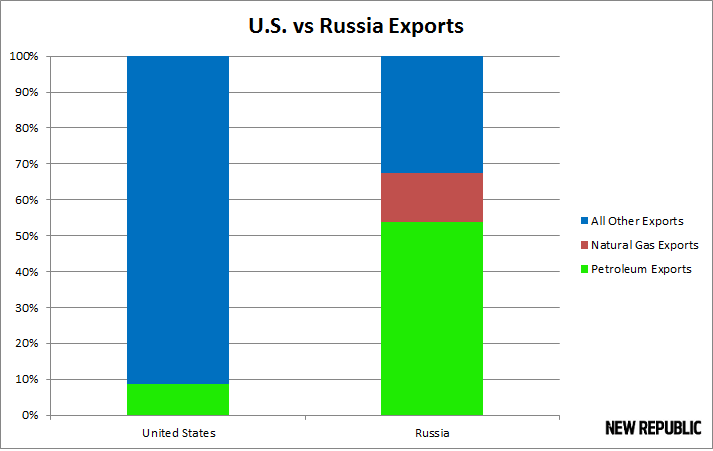
Danny Vinik demonstrates Russia’s reliance on energy exports with the above chart:

This is a double-edged sword: The dependence gives the world significant leverage to inflict economic damage on the Kremlin, but Europe’s reliance on Russian energy exports puts their economies at risk if they follow through on that threat.

Consider: In 2013, the United States exported more than $1.5 trillion of goods. Of those, just $137 billion were either crude oil or petroleum products. (Due to the Energy Department’s slow approval process, the U.S. has a de facto ban on natural gas exports.) In Russia, on the other hand, the export of crude oil, petroleum products, and natural gas made up more than two-thirds of their total exports … Oil and gas revenues make up more than 50 percent of the Russian government’s total revenue, most of it coming from Europe. If the Eurozone nations decided to reduce or end their purchases of Russian oil and natural gas, it would leave a massive hole in the nation’s budget.

Mark Whitehouse observes that “Europe’s economic ties to Russia are much stronger than they were when Putin came to power”:

Back in February 1999, soon after he took over from former President Boris Yeltsin, Russia’s share of German exports and imports was less than half what it is today. Apparently, building new pipelines to Europe has served Russia’s geopolitical interests well.

Jason Karaian finds that European public opinion is turning against Russia:

After the downing of a Malaysia Airlines plane in eastern Ukraine, more than half of Germans polled now support trade sanctions against Russia. This is a big jump from a similar survey in March, just after Russia’s annexation of Crimea … Support for sanctions rose even more in the UK over the same period, which will encourage prime minister David Cameron to keep up the tough talk against Russia, including picking fights with allies he deems less committed to the cause. But the British public is less keen on freezing financial assets than imposing trade embargoes, perhaps reflecting how much Russian cash currently flows through London’s financial center.

Earlier Dish on possible EU sanctions here.

The Worrying Vacuity Of Hillary Clinton

Hillary Rodham Clinton Book Presentation

I’ve tried to avoid the Clinton book tour bullshit this past month or so. Not good for my blood pressure. When I checked in occasionally, it was to discover that nothing much has changed. The Clintons are still self-pitying money-grubbers – $12 million in speaking fees since she left the State Department? – and now their offspring, exploiting her nepotistic advantage with all the scrupulous ethics of her parents, is continuing the grift. If you ask of Clinton what she’s fighting for, what she believes in, if you want to get her to disagree with you on something, good luck. Any actual politics right now would tarnish the inevitability of a resume-led coronation. That the resume has little of any substance in her four years as secretary of state does not concern her. She was making “hard choices”, and if we cannot appreciate that, tant pis.

I’d like to find a reason to believe she’s a political force who stands for something in an era when there is a real appetite for serious change. She could, after all, decide to campaign vociferously in favor of the ACA this summer and fall (universal healthcare is, after all, one of her positions), but that might siphon money away from her foundation and candidacy. She could get out there and start framing a foreign policy vision. But, again, too risky. I see nothing that suggests a real passion for getting on with the fight – just the usual presumptions of a super-elite, super-rich and super-cocooned politician of the gilded age.

So I did watch the Daily Show interview last week,  and was not surprised. As in most of her softball media appearances, she was both unctuous and vapid. But even I was aghast at the sheer emptiness and datedness of her one attempt to articulate a future for American foreign policy. She actually said that our main problem is that we haven’t been celebrating America enough, that we “have not been telling our story very well” and that if we just “get back to telling” that story about how America stands for freedom and opportunity, we can rebuild our diminished international stature. One obvious retort: wasn’t she, as secretary of state, you know, responsible for telling that tale – so isn’t she actually criticizing herself?

Next up: could she say something more vacuous and anodyne? Or something more out of tune with a post-Iraq, post-torture, post- Afghanistan world? Peter Beinart had the same reaction: “As a vision for America’s relations with the world,” he wrote, “this isn’t just unconvincing. It’s downright disturbing”:

It’s true that young people overseas don’t remember the Cold War. But even if they did, they still wouldn’t be inspired by America’s “great story about [promoting] human freedom, human rights, human opportunity.” That’s because in the developing world—where most of humanity lives—barely anyone believes that American foreign policy during the Cold War actually promoted those things. What they mostly remember is that in anticommunism’s name, from Pakistan to Guatemala to Iran to Congo, America funded dictators and fueled civil wars.

Larison piles on:

Changing the substance of policies is never seriously considered, because there is little or no recognition that these policies need correction or reversal. This takes for granted that opposition to U.S. policies is mostly the product of misunderstanding or miscommunication rather than an expression of genuinely divergent interests and grievances. I don’t know that Clinton is naive or oblivious enough to believe this (I doubt it), but it’s instructive that she thinks this is a good argument to make publicly. She is more or less saying that there is nothing wrong with U.S. foreign policy that can’t be fixed by better marketing and salesmanship, and that’s just profoundly wrong. It’s also what we should expect from someone as conventionally hawkish and “centrist” on foreign policy as Clinton is.

My fear is that she doesn’t actually mean any of this. She just needed to say something, and so came out with a stream of consciousness that is completely platitudinous and immune to Fox News attacks. It’s a defensive crouch that is always her first instinct. Think of the Terry Gross interview – and her discomfort in grappling with actual disagreement, from her own base that time. Her goal is always safety. And safety won’t cut it in a populist age.

So if she runs, my guess is she’ll wrap herself tightly in the maximalist concept of American exceptionalism and make this her appeal as a post-Obama presidency. See? she’ll say to the same voting groups she went for last time. I’m a real American, and I believe in America. And yay America!

Maybe this is merely a function that she isn’t running yet (and still may not). Why stir the pot if your goal at this point is merely selling books and raking in more corporate, Goldman Sacks dough? But when, I wonder, has she been otherwise? She remains scarred by the 1990s, understandably so. But the country has moved on in a way she seems to find hard to comprehend.

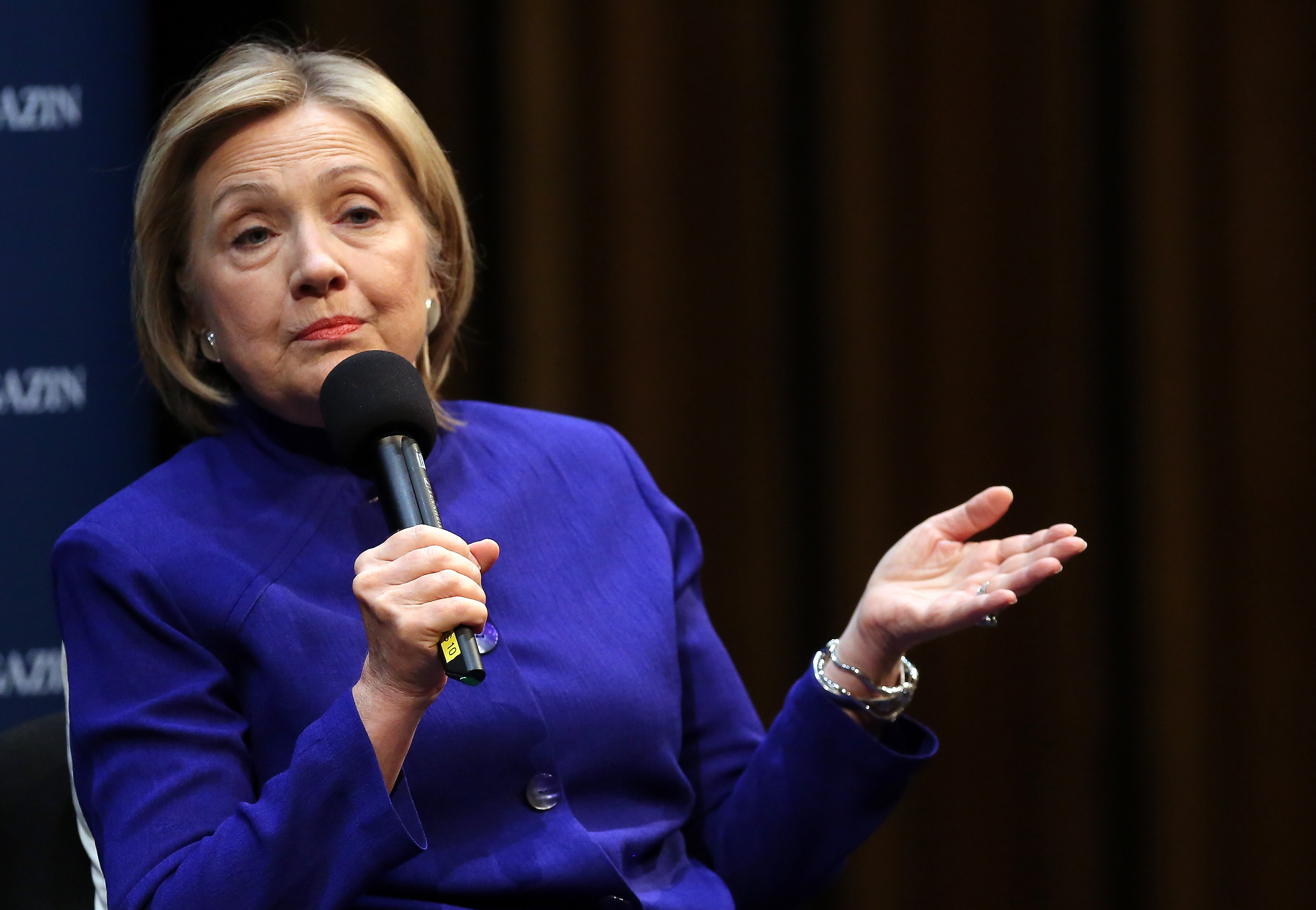
(Photo: Hillary Rodham Clinton, former United States Secretary of State, U.S. Senator, and First Lady of the United States, speaks during the presentation of the German translation of her book ‘Hard Choices’ (‘Entscheidungen’ in German) at the Staatsoper in the Schiller Theater on July 6, 2014 in Berlin, Germany. By Adam Berry/Getty Images.)