Father Time’s Racial Bias

Tom Jacobs highlights new (but not the first) research showing that African-Americans “age” faster than those of other races:

“On average, the biological age for blacks was 53.16 years,” compared to 49.84 years for whites, the researchers report. After controlling for socioeconomic status and health behaviors (they note that obesity rates are higher for blacks than whites, and excess weight can “contribute to progressive breakdowns in biological tissues and systems”), this gap shrank somewhat, but was still pronounced: 52.72 years for blacks, compared to 49.89 years for whites.

Previous researchers have pointed to the corrosive influence of racism as a possible explanation for the poorer health of blacks in America. A small study released in January found blacks who had experienced racism and come to accept (even unconsciously) the concept of racial inferiority had shorter leukocyte telomeres—a different biomarker of aging.

Levine and Crimmins did not attempt to measure negative health effects of racism, but their results are consistent with the theory.

The World’s Third-Largest Democracy Votes, Ctd

The final results of Indonesia’s presidential election came in yesterday, and Jakarta Governor Joko “Jokowi” Widodo won with 53 percent of the vote. All is not yet settled, however, as his opponent Prabowo Subianto intends to challenge the election in court:

A case would test the institutions of Indonesia’s young democracy, especially the Constitutional Court. Set up after the fall of Suharto, its reputation suffered a severe blow earlier this year when Akil Mochtar, its former chief justice, was imprisoned for life after being convicted of graft—for rigging rulings in disputed local elections. His successor, Hamdan Zoelva, used to belong to one of the six parties that backed Mr Prabowo. Their association makes many Jokowi supporters uneasy.

Still, it is hard to see how a challenge could succeed. The court would have to find evidence that more than 4m votes had been tampered with to overturn Jokowi’s victory. Some irregularities in the counting process have come to light, but Mr Prabowo has produced no evidence of fraud on the scale he alleges. And while the court may have the final say on the election, the political mood already seems to be turning Jokowi’s way.

Assuming Prabowo’s challenge fails, Jokowi will become the first Indonesian president not plucked from the country’s political or military elite. Yenni Kwok calls his election the start of a new chapter in Indonesian history:

Unlike many established figures who dominate the political arena, the 53-year-old Jokowi came from a humble provincial background: he grew up in a riverside slum in Solo, Central Java, and does not have ties to an influential family. After a career as a furniture entrepreneur, he started in politics as mayor of his hometown less than a decade ago — and this rapid rise, along with the level of electoral enthusiasm and volunteerism his candidacy generated, has invited comparisons to U.S. President Barack Obama (the two were even born in the same year). Many see Jokowi’s win as an augury for a more mature era in Indonesian politics.

“His candidacy would have been improbable just a few years ago,” says Aaron Connelly, East Asia research fellow at the Lowy Institute in Sydney, who focuses on Indonesian politics. “This has not historically been a country in which parents told their children that they could grow up to become President.”

Ariel Heryanto attributes Jokowi’s success to the unpaid, unorganized grassroots movement that supported him:

Jokowi’s success is hugely a result of the spontaneous popular support from largely non-organised groups of ordinary Indonesians. They converged in various forms, with a high degree of fluidity. Famous artists and public intellectuals form parts of it, but the majority are everyday commoners. … As a candidate, Jokowi had limited resources and interest to mobilise the masses to support him. From early on his supporters impatiently pressed him to run for president. In contrast to the flow of the familiar “money politics”, individual citizens proudly published bank slips on social media, showing off their tiny share of donations to Jokowi’s election campaign. Jakarta’s pro-Jokowi July 5 concert attracted over 100,000 people. Unpaid volunteers with no political party affiliation designed and ran the event.

But the new president won’t have much time to bask in the glory of his victory, however historic it may be. James Lindsay rolls out the long list of problems he has to contend with:

Economic growth is slowing, inflation and interest rates are rising, the currency is weakening, and investment is falling. Economists expect things to get worse before they get better, largely because Indonesia’s commodity exports are fetching lower prices in world markets. The Indonesian government is running a substantial budget deficit, in good part because of overly generous fuel subsidies that amount to nearly $12 per day per driver in the country. The resulting surge in domestic demand for gasoline is one of the reasons why the former member of OPEC has become a net importer of oil. The cost of fuel subsidies is also keeping Indonesia from making desperately needed investments in infrastructure. Jokowi probably won’t be able to make much progress on any of these problems if he doesn’t do something about the country’s long history of government corruption. And you thought you had a lot of things on your to-do list?

Best Cover Song Ever?

A reader throws down the gauntlet in our new contest (guidelines here): “For me, Johnny Cash’s version of Nine Inch Nails’ “Hurt” takes the cake.” He has a point:

Songwriter Trent Reznor’s quote is worth reading:

I pop the video in, and wow… Tears welling, silence, goose-bumps… Wow. [I felt like] I just lost my girlfriend, because that song isn’t mine anymore… It really made me think about how powerful music is as a medium and art form. I wrote some words and music in my bedroom as a way of staying sane, about a bleak and desperate place I was in, totally isolated and alone. [Somehow] that winds up reinterpreted by a music legend from a radically different era/genre and still retains sincerity and meaning — different, but every bit as pure

It really builds and builds …

America Puts Away Too Many People

And Emily Badger finds little reason to believe it makes us safer:

[T]he Sentencing Project points out that declining violent crime rates in New York and New Jersey have actually outpaced the national trend, even as these states have reduced their prison populations through changing law enforcement and sentencing policies.

We certainly can’t take these three charts and conclude that reducing prison populations reduces crime. But these trends do make it harder to argue the opposite — particularly in the most heavily incarcerated country in the world. As the Sentencing Project puts it, “in the era of mass incarceration, there is a growing consensus that current levels of incarceration place the nation well past the point of diminishing returns in crime control.”

Reihan agrees the US uses incarceration too much. But he also wonders if other countries rely too little on it:

For example, while the prison per population rate (per 100,000) of the U.S. as of the end of 2012 was 707, it was 72 in Norway, 60 in Sweden, 58 in Finland, 73 in Denmark, and 78 in Germany: all roughly in the neighborhood of one-tenth the U.S. prison per population rate. Unfortunately, while violent crime is generally less prevalent in these countries (particularly intentional homicide — the U.S. has a homicide rate five times that of Sweden), it’s by no means nonexistent. Police recorded rapes in Sweden, for example, are twice as high as they are in the United States, though we might attribute this to better reporting. But Sweden’s robbery rate (103 cases of robbery per 100,000 people) is fairly close to that of the U.S. (133). And its police recorded assault rate (927 cases per 100,000 people) far exceeds that of the U.S. (262). Broadly similar patterns obtain in a number of other affluent European countries.

None of this is to definitively establish that, say, Sweden’s criminal justice system is too lenient, but it certainly points in that direction. So while it seems fair to say that the pendulum has swung too far towards reliance on incarceration as a crime control strategy in the U.S., the pendulum appears to have swung too far in the other direction in much of northern Europe.

Growing Up On The Big Screen, Ctd

After enjoying almost uniformly positive reviews, Linklater’s new movie Boyhood is starting to attract some negative attention. Christopher Orr is restrained in his criticism:

[I]f there’s a critique to be made of Linklater’s film, it is that it has a great deal more to say—or at least more interesting things to say—about grownups than about growing up. Remarkable as Mason Jr.’s physical transformation may be, socially and psychologically he’s not all that different at 18 from at six: a taller, more articulate version of the dreamy, aimless boy whose teacher complained that he spent his time “staring out the window all day,” but one whose life has developed in a relatively straight line—insofar, of course, as it’s had the opportunity to develop at all. Moreover, it is obviously a tricky thing to cast an actor so young and commit to his development over the next dozen years, and [actor Ellar] Coltrane never quite develops the gravitational pull to tether the movie. Yes, his character is meant to be an unfocused youth, but occasionally his comes across as merely an unfocused performance.

A much harsher Mark Judge finds that the “endless, enervating, boring” movie lacks spiritual depth, scoffing that it could be titled I Became a Teenaged Hipster. He psychoanalyzes the rave reviewers:

I think what we have here is an example of the Sideways syndrome.

Sideways is a mediocre 2004 independent movie that became a hit when critics began gushing about it. A.O. Scott in the New York Times had the courage to write that critics loved Sideways because the main character is a schlubby wine snob and critic. In others words, critics saw, and praised, not Sideways, but seeing themselves in Sideways.

Something similar may be going on with Boyhood. Movie critics identify with Mason’s social awkwardness, the liberalism of his biological parents, even the gender-bending when Mason lets a girl paint his nails. Ann Hornaday: “By the time Mason, now a deep-voiced teenager, affects an earring, blue nail polish and an artistic interest in photography, viewers get the feeling that he’s dodged at least most of the misogynist conditioning of a boy’s life.” Yes, and he’s also missed the passion, and conflict, and girl-crazy adrenaline-rushed joy of being a boy.

Eve Tushnet identifies three major flaws in the film:

First and most basically, Mason the teen is just kind of boring. The movie slams to a halt when he hits about tenth grade and never recovers. We get acres of teen philosophy (“I just want to be able to do anything I want, just because it makes me feel alive, not because it gives me the appearance of normality”) and the stakes suddenly feel very low.

That’s because of the second problem, which is that Mason never does anything really wrong. He’s a prototypical good-but-aimless kid. We see his foibles–he’s a bit surly and a tad whiny, he smokes some pot if you consider that a foible, he comes home late at least once which possibly makes his mom cry, he sometimes fails to do his homework–but no real sins. … Where’s the casual cruelty of childhood, the hurtful rather than just boring narcissism of adolescence, the misdeeds which will only be acknowledged and regretted years later? I mean, I get that “Boyhood” isn’t “Carrie,” but must it be “Annie”? …

And the final problem is that as Mason nears college age, the Meaning of Life begins to rear its horrid head. And the meaning of life, it turns out, is that we feel stuff.

How The Peace Process Collapsed … Again

In a lengthy narrative piece, Ben Birnbaum and Amir Tibon chronicle John Kerry’s efforts to broker an Israeli-Palestinian peace deal, and how the talks finally broke down. (Believe it or not, TNR decided to publish an account of the entire thing that blames everything on the Palestinians.) In their account, everything fell apart when Abbas made good on his threat to seek membership in 15 UN conventions, and went ahead with a reconciliation agreement with Hamas, after Netanyahu was unable or unwilling to meet Palestinian conditions for resuming negotiations. Toward the end of the piece, the authors wonder what comes next:

The Palestinians may resume their quest for full-fledged U.N. membership this fall. In Israel, there are almost as many plans as people: Lieberman, the foreign minister, wants his country to make peace directly with the Arab League; Bennett, whose party is JORDAN-US-PALESTINIAN-ISRAEL-DIPLOMACYnow polling just behind Likud, is advocating partial Israeli annexation of the West Bank. Livni has spoken about unilateral steps that would forfeit Israeli claims to West Bank territory outside the settlement blocs and freeze building in those areas. In the United States, top Middle East voices are urging Kerry to bypass Abbas and Netanyahu and put forward his own detailed peace plan. …
There’s no shortage of ideas, in other words. And some of themparticularly that lastmay bring Israelis and Palestinians closer to a deal than Kerry got this time. But few of the people we spoke to expected progress any time soon. With Netanyahu entrenched, Abbas on his way out, settlements and rocket ranges expanding, and the populations increasingly hardline, we seem to have reached the end of an era in the peace process. And no one harbors much hope for what comes next. “I see it from a mathematical point of view,” said Avi Dichter, the former chief of Israel’s Shin Bet intelligence agency. “The American effort will always be multiplied by the amount of trust between the two leaders. So if Kerry’s pressure represents the number five, and then Obama’s help brings the American effort to ten, it really doesn’t matter. You’re still multiplying it by zero. The final result will always be zero.”

Martin Longman quibbles with how the piece blames the failure of the talks solely on the Palestinians:

The way this reporting is constructed, it makes it look like there is all this flurry of activity on the American and Israeli sides which is just cut off at the knees by an impatient Abbas. I don’t doubt the basic reporting here, but I think it doesn’t take into enough account the degree to which Netanyahu was either delaying with a purpose or simply incapable of delivering.

Do the reporters actually believe that Netanyahu was on the verge of rounding up the votes he needed to release the fourth tranche of prisoners? If they do believe this, they didn’t bother to say that they believed it. Yet, the way they reported it implies that they actually believe it. It appears that Livni and the Americans thought it was possible. So, maybe it was. A successful vote wouldn’t have been any magic elixir anyway, but it would have kept the process alive. And that would have been a much better place to be than where we are now, wouldn’t it?

Frum, of course, finds the narrative of Palestinian intransigence more plausible, but his other takeaway is a great deal of respect for the work Kerry put in. “It’s amazing how much more gets done,” he writes, “when the secretary of state isn’t running for president”:

John Kerry’s initiative failed. But the risk of failure attends every political initiative. It’s fine to calculate how much political risk to accept. But when a secretary of state in pursuit of his or her own political future decides that no risk is acceptable, then nothing much is ever tried. Which is why Hillary Clinton’s record as secretary of state is so blank. By 2012, Obama had apparently given up on hopes of negotiating an Abbas-Netanyahu deal. Kerry’s hopes had dwindled, but not yet died. “I think we have some period of time—in one to one-and-a-half to two years—or it’s over,” Kerry said in 2013. So he tried. He failed. But in other places where is he trying, he seems to be succeeding: smoothing the post-Karzai political transition in Afghanistan, reaching U.S.-Europe consensus on how to respond to Russia in Ukraine. It seems you get a lot more done by doing your job than by positioning and planning for your next one.

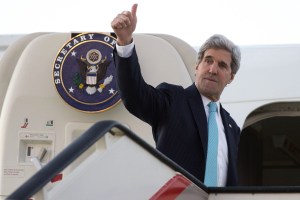
(Photo: US Secretary of State John Kerry gestures as leaves the Jordanian city of Amman on March 27, 2014, en route to Rome. Kerry and Palestinian president Mahmud Abbas held “constructive” talks on the Middle East peace process, a US official said Thursday, as crunch decisions loom in the coming days. By Jacquelyn Martin/AFP/Getty Images.)


Mental Health Break

A reader serves up the first candidate for our “Best Cover Song Ever” contest:

With all the anxiety and tumult in the news, I figure we need a good metal song for some catharsis. Better yet, a metal song play with a bit fey musical instrument! I therefore nominate Rob Scallon’s ukelele cover of “War Ensemble” by thrash metal legends Slayer.

Our selection committee is giving more weight to covers that blend genres like that. Email your submissions to contest@andrewsullivan.com.

For Israel, There’s No Such Thing As An Innocent Gazan, Ctd

Noam Sheizaf engages Israeli incredulity at why Gazans support Hamas, and explains why it’s not beyond the pale for them to do so:

The people of Gaza support Hamas in its war against Israel because they perceive it to be part of their war of independence. … Israelis, both left and right, are wrong to assume that Hamas is a dictatorship fighting Israel against its people’s will. Hamas is Shujaya neighborhood of Gaza full of dead bodiesindeed a dictatorship, and there are many Palestinians who would gladly see it fall, but not at this moment in time. Right now I have no doubt that most Palestinians support the attacks on IDF soldiers entering Gaza; they support kidnapping as means to release their prisoners (whom they see as prisoners of war) and the unpleasant fact is that most of them, I believe, support firing rockets at Israel.

“If we had planes and tanks to fight the IDF, we wouldn’t need to fire rockets,” is a sentence I have heard more than once. As an Israeli, it is unpleasant for me to hear, but one needs to at least try and understand what lies behind such a position. What is certain is that bombing Gaza will not change their minds. On the contrary.

Meanwhile, Francesca Albanese wonders why the Hamas 10-year peace proposal has been greeted with deafening international silence. And Jamelle Bouie demolishes Thane Rosenbaum’s WSJ op-ed, which rehashes the argument that Gazan civilians are legitimate targets because they voted for Hamas and harbor militants in their homes and neighborhoods:

For comparison’s sake, here’s Osama Bin Laden attempt to justify the Sept. 11 attacks:

[T]he American people are the ones who choose their government by way of their own free will; a choice which stems from their agreement to its policies. Thus the American people have chosen, consented to, and affirmed their support for the Israeli oppression of the Palestinians, the occupation and usurpation of their land, and its continuous killing, torture, punishment and expulsion of the Palestinians. The American people have the ability and choice to refuse the policies of their Government and even to change it if they want.

For both Rosenbaum and Bin Laden, the situation is straightforward: Because a majority of Gazans/Americans voted for leaders who used violence or waged war against Israelis/Muslims, both have forfeited their claim to noncombatant status. After all, if they wanted to avoid conflict, they wouldn’t have elected those people in the first place. If you recoil from this logic, your head is in the right place.

(Photo: People frantically attempted to to pick up the dead and the wounded in the blood strewn area while plumes of smoke from the recent Israeli shelling lingered in the air on July 20. By Mahmood Bassam/Anadolu Agency/Getty Images.)

Chart Of The Day

Ukraine Opinion

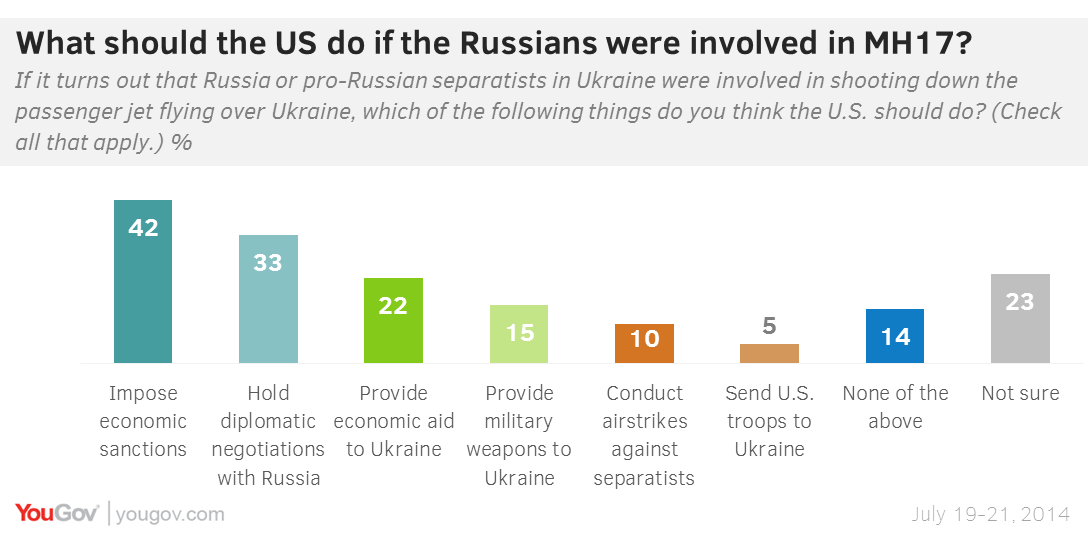
Americans remain opposed to getting involved militarily in Ukraine:

Public support for the various measures the US could take are actually relatively unchanged from when they were first asked in March 2014, when respondents were provided with a similar question that did not reference the shooting down of MH17 or the possibility of airstrikes on separatists. 40% of Americans supported economic sanctions then, compared to 42% now, though support for diplomatic negotiations with Russia has dropped from 44% to 33%.

Convert, Submit, Or Die, Ctd

In light of the persecution of Iraqi Christians by ISIS, Dougherty argues that the US has a serious moral obligation to help:

[T]he U.S. should look for ways to provide direct monetary and diplomatic assistance to neighboring states in the region where persecuted Iraqis are seeking refuge, perhaps even going so far as to directly assist in the emerging centers of authority in Kurdistan, where some refugees have sought protection from ISIS, and which continues to prove itself capable of maintaining some order and security. Although I’m generally inclined toward a more restrictive position on immigration, the U.S. should, as a matter of practice, be especially generous in granting refugee status to the collateral victims of the war we started in Iraq. It should even offer some refugees of ISIS persecution the material resources to emigrate to America if they so desire.

The dream of transforming Iraq into an incubator of Arab liberalism has turned into a nightmare for religious minorities. America’s intervention in Iraq, and its support of Syrian and Libyan rebels, have created a disastrous disorder in which Islamist threats thrive. Mosul was a home for Christians for as long as Christianity existed. Not anymore. Now, the U.S. cannot restore these people to their homes, nor reverse the desecration of Christian shrines. But our diplomatic, financial, and moral energies should be used to protect them from any further harm.

Meanwhile, a few readers consider why Americans are relatively quiet over the plight of Iraqi Christians:

Why the silence? It could be, as Tim Stanley said, that the West is embarrassed about the idea of Christians being a persecuted minority. Or fear of another invasion. Personally, I think it’s because large numbers of Christians in the West, primarily of the Evangelical variety, harbor bigoted attitudes towards Arabs in general and Catholics (Roman, Orthodox, Anglican, Coptic, etc.) in particular. Having spent time in Israel and the West Bank, I continually find people at home surprised to hear of the plight of Palestinian Christians there. They are surprised to hear that one could be an Arab, a Palestinian, and a Christian. Most people are simply ignorant of the fact that there is a Christian Arab presence in the Middle East at all. It should seem obvious, but it’s not. The assumption is that all Palestinians are Muslims, and all Muslims are jihadists. (I live in the South; what can I say).

Another takes a different approach:

I do not think, as Stanley does, that it has anything to do with feeling embarrassed about Christians as a persecuted minority.  Rather it has to do with stories like this one:

In a joint statement, the chairmen of the United States Conference of Catholic Bishops’ Ad Hoc Committee for Religious Liberty and Committee on Laity, Marriage, Family Life and Youth decried the decision [by Obama banning discrimination against transgender employees]. “Today’s executive order is unprecedented and extreme and should be opposed,” said Archbishop William Lori of Baltimore and Bishop Richard Malone of Buffalo. “In the name of forbidding discrimination, this order implements discrimination.” “With the stroke of a pen, it lends the economic power of the federal government to a deeply flawed understanding of human sexuality, to which faithful Catholics and many other people of faith will not assent,” they continued. “As a result, the order will exclude federal contractors precisely on the basis of their religious beliefs.”

American Christians have cried wolf too many times over superfluous issues like this one and the HHS mandate positioning both not as misguided government overreach, but as persecution.  After repeated self-indulgence, will anyone listen to them when there is real and life-threatening persecution of Christians in other parts of the world?  This case illustrates the real harm that many American Christians have committed focusing on their first world problems rather than on the worldwide body of Christ.