Israel’s Self-Defense Plea

Amos Guiora defends the bombing of Gaza on traditional lines, stressing that “Israel has an obligation to protect its citizens harmed by Hamas’s decision to endanger its own population”:

While the number of Palestinian casualties suggests both a disproportionate operational response and an exaggerated application of self-defense, the reality is simultaneously nuanced and obvious. Nuanced because limits must be imposed; otherwise, the nation state violates the essence of international law. Obvious, because the nation-state’s primary obligation is to protect its civilian population. Israel has the right to self-defense in accordance with commonly accepted principles of international law. Application of that right, in the context of Hamas’s actions, requires recognizing two realities: the price paid by innocent Palestinians as a result of human shielding and the clearly foreseeable deaths of numerous Israelis if tunnels are not destroyed. While the loss of innocent life is always tragic, aggressive self-defense is the essence of operational counterterrorism.

Spot the euphemism: “aggressive self-defense.” Just war theory allows for no such thing. Defense is defensive, not aggressive. Pre-emptive slaughter as a means to deter future attacks doesn’t hack it. And defense should be proportionate to the actual threat to Israel not the potential one. Or as George Bisharat puts it: “All nations have a right of self-defense, including Israel. But that right may be exercised lawfully only in limited circumstances. Israel cannot validly claim self-defense in its recent onslaught against Gaza for two main reasons”:

First, despite its 2005 withdrawal of ground forces and settlers from Gaza, Israel still exercises effective control over the region by controlling its airspace, coast and territorial waters, land borders (with Egypt), electromagnetic fields, electricity and fuel supply. Accordingly, Israel remains an occupying power under international law, bound to protect the occupied civilian population. Israel can use force to defend itself, but no more than is necessary to quell disturbances. Hence this is not a war – rather, it is a top military power unleashing massive firepower against a penned and occupied Palestinian population.

Second, self-defense cannot be claimed by a state that initiates violence, as Israel did in its crackdown on Hamas in the West Bank, arresting more than 400, searching 2,200 homes and other sites, and killing at least nine Palestinians. There is no evidence that the terrible murders of three Israeli youths that Israel claimed as justification for the crackdown were anything other than private criminal acts that do not trigger a nation’s right of self-defense (were an American citizen, or even a Drug Enforcement Administration agent killed by drug traffickers on our border with Mexico, that would not entitle us to bomb Mexico City).

And that, in a nutshell, is Waldman’s answer for why Israel is losing the PR war:

If Israel is losing the propaganda war, it’s because propaganda can only take you so far when the facts are telling a story you’d rather people didn’t hear. Social media has something to do with it, but it’s still traditional media that show the largest numbers of people what’s going on. And when you have a Palestinian death toll that now exceeds 500 and is going nowhere but up while the numbers of Israeli civilians who have died is still in the single digits, you just aren’t going to be able to spin a story of equal suffering and blame.

It’s as though Hamas said, “I dare you to kill those people,” and Israel replied, “You got it,” then turned to the rest of the world and said, “Hey, what do you want — he dared me!”

It’s impossible to be a moral human being and not be horrified by what is happening to the civilians in Gaza. If that is the price for quiet, it is too high. And what this toll is doing to Israel’s broader global legitimacy far outweighs its short term security goals.

It’s Time For A Contest!

It’s been a while since we had a full-fledged Dish reader bonanza, and, if you’re like me, one mental health break a day is not quite hacking it this July, given the depressing news out of Gaza and Ukraine. So here’s an idea: nominate your favorite ever cover version of a previous hit song. The cover should supplant the original in its arrangement or performance or ingenuity. And it shouldn’t be too obscure. Bodenner offered up the following as a starter:

I’m pondering mine .. and trying mightily not to be a self-parody. You can all do much better – email your Youtubes with “Cover Contest” in the header to this address: contest@andrewsullivan.com

Baghdad’s Bullies Back In Business

Jacob Siegel is in the Iraqi capital, monitoring the revival of hardline Shiite militias whose ideologies aren’t much friendlier than that of ISIS. In his latest dispatch, he reports on the threats faced by a local NGO that protects abused women and gay Iraqis:

It was the police who phoned the organization Sunday morning, [Dalal] Jumaa [who heads the office of the Organization of Women’s Freedom in Iraq] said. They told her they had heard she harbored gay men and runaway girls. But the threat, which the police were relaying, came from Asaib Ahl al Haq, a powerful and notoriously brutal Shia militia in Baghdad. “I cannot stop Asaib Ahl al Haq,” the policeman told her, “they received this information and will kill you if you don’t leave.”

The Organization, as everyone calls it, stood accused of pimping out the young women in its shelters, which Jumaa said is a lie commonly used to slander Iraqi groups advocating for women’s rights. She convinced the policeman of her innocence but the militia wouldn’t be waiting to hear her out. Asaib Ahl al Haq is the group believed to have slaughtered 29 women alleged to be prostitutes last week in the upscale neighborhood of Zayouna.

When The Right Wasn’t Always Reflexively Behind Israel

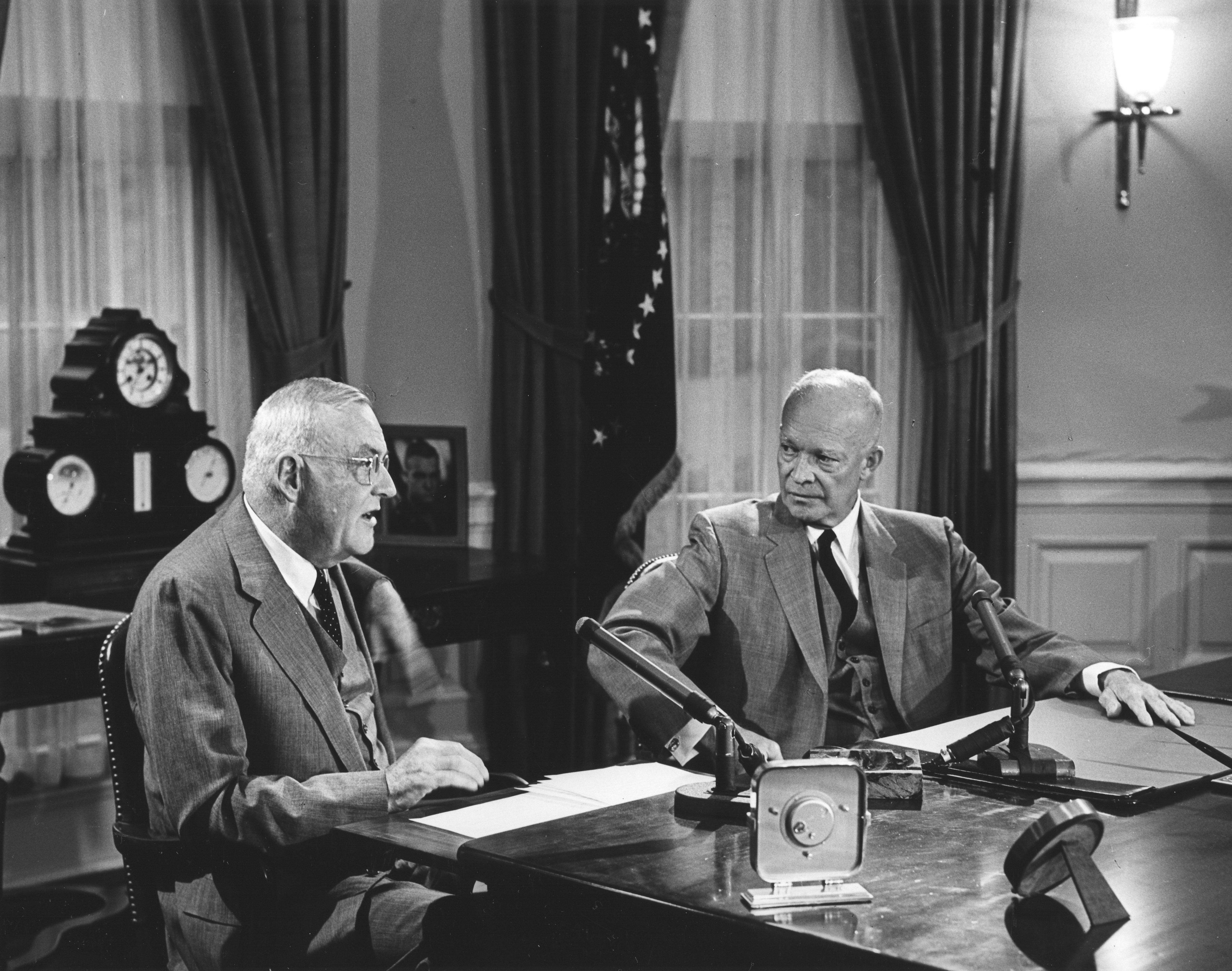
Ike & Dulles From The White House

Scott McConnell has an interesting trip down memory lane at The American Conservative. He remembers a time when the first thing Republicans would consider with respect to Israel was the national interest of the United States. Remember Suez? Money quote:

During the Cold War 1950s, Israel was not especially favored by the right. It was perceived as vulnerable and somewhat socialist, and even conservative publishing houses like Regnery produced books sympathetic to the Palestinians. But the 1967 war transformed Israel’s image for conservatives—as it did for other groups, American Jews especially. By 1970, the Nixon administration and many on the right had begun think of Israel as a useful Cold War asset. The Jewish state had demonstrated it could fight well against Soviet allies. The idea of Israel as a strategic asset was always somewhat problematic—it would be called into question when America suffered the Arab oil embargo of the 1970s, and there were sharp disagreements over Israel’s invasion of Lebanon in the 1980s. But one could safely generalize that most conservatives considered Israel an asset—a proposition that the neoconservatives, valued newcomers to the conservative movement, pushed enthusiastically.

When the Cold War ended, this became more complicated.

Israel proved useless when Iraq invaded Kuwait: American diplomacy had to devote much time and energy to ensuring that Israel did not enter the conflict, as Israeli involvement would have blown up the anti-Saddam coalition President George H.W. Bush had painstakingly constructed. What good was a regional ally that must be kept under wraps when a regional crisis erupts? More generally, once Americans began to see their Mideast problems as originating from within the region, rather than from Soviet meddling, issues such as Israel’s treatment of the Palestinians became salient. For a brief time, the place of Israel in the conservative mind was in flux.

McConnell makes the argument that it was at this point that the neoconservatives made their move – by ending the careers of Joe Sobran and Pat Buchanan at National Review, both of whose criticism of US-Israel relations sailed very close to the wind of anti-Semitism. It’s been a while since those controversies, and it’s impossible to defend Sobran, especially given the hate-filled rants he would go on to pen. Buchanan is a trickier case because, whatever else you can say about him, he has a first class mind and a real, if often noxious, worldview. But the threat of having your career ended by saying the wrong thing about Israel lingered in the atmosphere, as it was always intended to do:

Buckley’s depiction of the power of the Israel lobby to break people’s reputations is perceptive and unequivocal. Describing his first private dinner with Joe Sobran where they discussed the Decter/Podhoretz charges, Buckley relates that he told the story of William Scranton, a governor of Pennsylvania who was considered presidential timber in the 1960s. Nixon sent him on a fact-finding mission to the Mideast and he came back with a recommendation that the United States be a little more evenhanded, and… no one ever heard from him again. Buckley writes: “We both laughed. One does laugh when acknowledging inordinate power, even as one deplores it.”

Would Buckley now be considered an anti-Semite because if his description of AIPAC as having “inordinate power”? Maybe five years ago. But one senses a little more nuance and a little more circumspection about the consequences of always backing Greater Israel for ever. Even, perhaps, on the right, however much money Adelson and his buddies pour into the process.

(Photo: During a radio and television broadcast, US Secretary of State White House John Foster Dulles (1888 – 1959) (left) speaks with US President Dwight Eisenhower (1890 – 1965) in the Oval Office at the White House, Washington DC, August 3, 1956. The men were discussing the recent nationalization of the Suez Canal by the Egyptian government. By Abbie Rowe/PhotoQuest/Getty Images)

Our Sketchy Intel On Ukraine

UKRAINE-RUSSIA-CRISIS-MALAYSIA-ACCIDENT-CRASH

The government shared some of it yesterday. Shane Harris summarizes:

The officials offered little new information about the MH17 investigation, except to say that U.S. intelligence analysts are now persuaded that the jet was downed by accident, likely by forces who believed they were taking aim at a Ukrainian military aircraft. The officials circulated widely available information, including photographs of the suspected missile launcher posted to social media in recent days, and pointed to voice recordings posted to YouTube of separatists acknowledging that they shot down a jet, which they later discovered was a civilian plane. One official stressed that analysts weren’t relying solely on social media information, such as tweets and online videos. But nothing in the agencies’ classified files has brought them any closer to definitively blaming Russia.

Max Fisher’s two cents:

What’s perhaps more interesting is what the US intelligence officials would not say: that the attack was deliberate or that Russia pulled the trigger. The officials said they suspected the rebels fired on a commercial airliner mistakenly; this too had become conventional wisdom, as the rebels had only previously fired on Ukrainian military aircraft, but the hint of possible confirmation is something.

But the rebels compromised the wreckage, which makes our investigation much more difficult:

While Malaysia was finally able to recover the black boxes from the rebels at the crash site, investigators at the site have determined other evidence has been “significantly altered.” Michael Bociurkiw, a spokesperson for the Organization for Security and Cooperation in Europe, has said large pieces of the front of the plane have been cut away. Investigators have seen power tools on the site, used to cut into the fuselage. Rebels said their reasoning was to move the large plane pieces in order to retrieve bodies. However, OSCE said the cuts made were “very invasive.”

Clive Irving doesn’t think this obstacle is insurmountable:

There has been a lot of concern about contamination of the evidence at the site. In reality, it’s hard to deliberately mess up a debris field as large as this one. First of all, you would need to know which bits are likely to be the most damning, a knowledge unlikely to be present in this case. Secondly, large pieces of wreckage can’t be moved without someone seeing that happening. And, thirdly, even if you are moving pieces of wreckage, there are eyes in the sky watching it all from satellites.

Patrick Tucker explains what investigators will be looking for:

If the Obama administration is correct, what will the ground evidence show? The distribution of debris, once fully catalogued, would confirm a violent sudden explosion, as opposed to a long trail of parts indicating a slow breaking apart and would include missile shrapnel. It would also show that the radar-guided missile likely exploded within about 65 feet from the target. Infrared imaging might show explosive residue somewhat evenly distributed on the bottom of the plane.  Conversely, an excessive amount of explosive residue on the engines could indicate that the missile was heat seeking and not shot from an SA-11 and that the U.S. was wrong.

Mark Galeotti worries about Putin taking advantage of a lengthy investigation:

You don’t need to be a fan of the vintage British political sitcom Yes Minister to know that inquiries can as easily be used as tools of obfuscation and delay. As the suavely cynical Sir Humphrey Appleby puts it in one episode, “The job of a professionally conducted internal inquiry is to unearth a great mass of no evidence.”

(Photo: A photo taken on July 23, 2014 shows the crash site of the downed Malaysia Airlines flight MH17, in a field near the village of Grabove, in the Donetsk region. The first bodies from flight MH17 arrived in the Netherlands on July 23 almost a week after it was shot down over Ukraine, with grieving relatives and the king and queen solemnly receiving the as yet unidentified victims. By Bulent Kilic/AFP/Getty Images)

Dissents Of The Day

Readers seize on a recent comment:

In your dismissive response to Marcotte’s analysis of the recently proposed Women’s Health Protection Act, you said, facetiously, “Because a tooth has the same moral standing as a fetus.”

I have rarely seen as deliberate a misreading from you. Abortion is legal. Because of that annoying fact, opponents of abortion have had to sneak in restrictions, such as mandatory admitting privileges in local hospitals for abortion providers, under the cynical guise of protecting the health of pregnant women. This is the clear and obvious context of Marcotte’s reference to dentists and admitting privileges: The procedures she lists carry similar, and in some cases greater, risks for the health of patients compared to a standard out patient abortion.

I’m not deliberately misreading anything. What I’m saying is that it is not self-evident that an abortion has the same moral weight as a root canal. They may be equally legal, but they are not self-evidently equally moral. It is reasonable to treat it differently as a medical procedure for those reasons alone. I’m open to the idea that it shouldn’t be – but that’s not the tone of Marcotte. I was objecting to the breezy dismissal of any moral conundrum at all. Another elaborates:

You do realize that the hospital admitting privileges requirement for abortion providers isn’t there for the protection of the fetus, right? It’s there, allegedly, for the protection of the female patient, undergoing one of the least complicated and safest medical procedures performed. Of course the requirement is really about preventing the dentist from doing his job at all – I’m sorry, I meant abortion provider.

Another shares her personal perspective:

In 2000, when I was 42 years old, I elected to have an abortion rather than continue a pregnancy I was told would probably end in the second or third trimester, and if not, would result in the baby dying a month after being born. I had nearly died as a result of a miscarriage four years before that, so I was distinctly unkeen to risk my life (and the well-being of my then two children, who were 10 and 7 and who seemed to need a mother) to walk around like a time bomb waiting for a fetus to die and possibly take me with it.

In order to get that abortion, I was subjected to Michigan’s “Informed consent for abortion” law.

Our conservative Catholic governor’s idea of “informed consent” was that I had to take a day off work to go to my doctor’s so that my doctor could read to me from a script. Practically nothing in the script was factually correct for my case, so the situation was prolonged by the doctor reading a paragraph (as required by Michigan law) and then putting down the script, facing me, and telling me what was actually true about my own condition (as required by his medical ethics).

And so it went: paragraph read, actual discussion of actual facts, repeat, for four or five pages of lies. Just what about the actions the law mandated in that situation seems moral to you? Since when is requiring people to recite outright lies in order to make a medical procedure more expensive a moral act? How would you feel if the state mandated that every time you got your life-sustaining HIV medication, you had to pay extra money and take time off work to listen to a lecture on how sexually sinful you were insofar as you had contracted the disease by doing something a politically powerful religious minority disapproves of? Would you feel it was a moral moment that caused you to reflect on the sinfulness of your ways?

All the “informed consent” blather did was piss me off. If the right really thought that this approach would change my mind, they are not just nuts, they’re deceiving themselves. Is there any evidence – do such laws even seek to gather such evidence – that women reconsider after these charades are played out?

The informed consent laws are old news. The newer laws (which I’m guessing wouldn’t have to exist if the older moral lecture laws had worked) don’t make any moral claims one way or another – requiring doctors in standalone clinics to also have hospital admitting privileges isn’t being done for ostensibly moral reasons; it’s being done as a backdoor approach to banning abortion with some window dressing of “concern for public health.” And those laws are working. They are not ending abortion, but they are ending legal, safe abortion. The purpose of the law before Congress is to strip the window dressing: that is, to make the anti-abortion laws more honest about their intent. There’s no argument implicit in this that fetuses have the same moral standing as teeth.

Yes there is. The analogy my reader makes is to my HIV meds. But taking my HIV meds does not end human life, something that abortion as a medical procedure almost uniquely does. You can take any view on that question, but to ignore it entirely seems to me unpersuasive.

The Hard Limits Of The Lawnmower Strategy

Dish alum Zack Beauchamp scrutinizes Israel’s strategy in Gaza, one that emerged from its past conflicts with Arab states. In that approach, “Israel would have to live with a certain level of threat … but would use its military to occasionally weaken those threats and ensure they didn’t ever reach truly existential proportions”:

Obviously, Israel recognizes that the threats from groups like the Gaza-based militant group Hamas aren’t the same as the Cold War-era threats it faced from Arab invasions. So it’s developed a new version of its long-held threat management strategy, which is often called “mowing the grass.” It’s a pretty creepy term, as it implies that periodically killing people is the same as keeping your lawn groomed. But that’s the basic analogy: Hamas, like grass, can’t disappear, but it can be regularly cut down to size. And, like mowing the grass, it’s implied that this is a routine that will be continued forever.

According to Efraim Inbar and Eitan Shamir, Israeli academics based at the Begin-Sadat Center for Strategic Studies, the basic difference between “mowing the grass” and Israel’s old strategy is that the end-goal has changed. In the era of wars with Arab conventional armies, Israel hoped that eventually “a long and violent struggle, punctuated by decisive battlefield victories, could eventually lead Arab states to accept the notion of Israel’s permanence.” In other words, Israel believed that its threat-management strategy would eventually lead to peace, which in cases such as Egypt it did.

Israel does not believe the same thing today about applying this strategy to non-state militant groups. Israel sees Hamas and other militants as “implacable enemies, who want to destroy the Jewish state and there is very little Israel can do on the political front to mitigate this risk.”

So will “mowing the grass” make Israel safe in the end? Of course it won’t. Au contraire:

Israel’s approach to Arab states worked, after a fashion, because it accomplished critical political ends. Some of Israel’s greatest enemies, such as Egypt and Jordan, gave up on the quest to destroy Israel. They’ve even signed peace treaties with Israel, making the Jewish state far more secure than it was during the Cold War.

But there’s no equivalent political endgame in mind here. Israel has no vision for how to “solve” the Hamas problem, which means rocket fire and periodic crises are inevitable for the foreseeable future. In both 2009 and 2012, Israel fought similar wars against Hamas, both designed to stop rocket fire out of Gaza. Yet here we are today.

“The bottom line,” Gershon Baskin stresses, “is that there is no military solution that Israel can attain”:

The underground bunkers are protecting the Hamas leadership and its military commanders. Those taking the hits are the Palestinian civilians in Gaza. Not a single important Hamas commander has been killed, but hundreds of civilians have paid with their lives. …  The Hamas regime can be brought down by Israel; Israel has the capabilities to do this. But it will require a full reoccupation of Gaza for an extended period of time and in the end, I fear the Israeli victory in Gaza will look very much like the victory of George W. Bush over Saddam Hussein – and look at Iraq today.

Daniel Levy suggests an alternative:

Perhaps start by not denying another people’s rights in perpetuity, including the right to self-determination. Reverse the current incentive structure that reciprocates both Fatah demilitarization and Hamas cease-fires with variations on an Israeli brand of deepening occupation. There is no military solution, but Israel’s government refuses any political solution – neither it nor the governing Likud Party have ever voted to accept a Palestinian state. Hamas’s nonrecognition of Israel is troubling, and so should this be.

Humans do not respond well to humiliation, repression and attempts to deny their most basic dignity. Palestinians are human. Palestinians will find ways to resist — that is human — and sometimes that resistance will be armed. … What would you do under such circumstances? Start by treating the Palestinians as humans, as you yourself would wish to be treated.

Yes, treating human beings like human beings is always a good start. But Massie takes a more sympathetic view of Israel, which he perceives as being trapped in a situation that compels it to act against its own interests:

Israel’s tragedy – or rather, one strand of the several tragedies threatening Israel – is that it feels obliged to follow a course of action in which it cannot quite believe. It must do something, make some response to Palestinian provocation even though any such response offers at best a period of temporary relief and, quite probably, will make matters worse in the longer-term. But what else can she do? Doing nothing is not an option either.

The rockets fired from Gaza are a kind of trap. Hamas knows that and so does Israel and so do all the rest of us. But Israel will fight anyway because it cannot avoid doing so even though if fights on ground that is not of its choosing and on terrain upon which, in terms of international opinion, it cannot possibly win. Is is futile and counter-productive and unavoidable.

Alex’s piece is a must-read. But it seems to me he misses a couple of things. Hamas did not initiate this round of conflict. Netanyahu used the murder of three Israeli teens by a splinter Hamas group often at odds with Hamas proper to sweep across the West Bank, and imprisoning countless Hamas operatives and supporters who had nothing to do with the horrible crime. And he did so while suppressing the full facts at his disposal and whipping up the Israeli populace to a Putinesque degree. Equally, Israel is not a victim when it comes to the settlements. It can choose to end them but has instead chosen to accelerate them as its most important priority. This empowers Hamas as much as it undermines Abbas.

Those in power in Israel have always had these choices. They still do. They had a super-power willing and able to hold their hands through the entire process and an international community committed to Israel’s security in return for some basic equity for the Palestinians. Netanyahu didn’t only say no; he did all he could to humiliate president Obama and even back his opponent in 2012.

This cul de sac has always been a choice. And I’m tried of finding excuses for the inexcusable crime of the settlements – a permanent and constant provocation every day.

Americans Back The ACA – Or More – By 57 – 42 Percent

That, I’d argue, is the real news from the CNN poll today on the ACA. The headline numbers are actually the opposite, showing opposition beating out support by 59 – 40 percent. But this omits a rather large point:

“Not all of the opposition to the health care law comes from the right,” said CNN Polling Director Keating Holland. “Thirty-eight percent say they oppose the law because it’s too liberal, but 17% say they oppose it because it’s not liberal enough. That means more than half the public either favors Obamacare, or opposes it because it doesn’t go far enough.”

To buttress this interpretation of the polling, a 53 percent majority also believes that they, their family or others have benefited from the ACA, compared with 44 percent who insist the law hasn’t helped anyone at all (a ludicrous and obviously ideological view when you come to think of it). That’s one more reason why the sudden threat by literalist judges, preferring to interpret a few words rather than an entire law, is not such a great thing for the GOP. Stripping millions of health insurance means confronting that 57 percent.

And that’s why I remain befuddled by the lack-luster Democratic message machine in this summer before the mid-terms. On so many issues, the Democrats are ahead: on healthcare, on climate change (63 percent backing Obama’s stance on carbon dioxide emissions and fuel emission standards), on marriage equality (55 percent support) and on a non-interventionist foreign policy (65 percent want the current or less involvement with Ukraine-Russia, for example). I find it hard to understand why a political party with all these advantages has to play defense in the upcoming elections. Maybe a Republican over-reach on the ACA may stir their base. But what about their feckless leaders?

What Happens Next For Halbig?

Margot Sanger-Katz reviews the possibilities. The one that is getting the most attention:

All the judges on the D.C. Circuit could decide the Halbig v. Burwell case. There is a process called “en banc” review in which the case would be reargued before all of the 11 judges on the D.C. Circuit Court, and the Obama administration has said it will ask the court for such a review. A majority of the judges would have to agree to rehear the case for it to be reconsidered in this way. Appellate courts rarely accept cases for en banc review, but this is a big one. Many legal experts think that the full court would view the government’s position more favorably than the two judges who ruled against them in the original decision on Tuesday; legal questions don’t necessarily break down along political lines, but Democratic appointees outnumber Republican appointees on the court and include four new judges recently appointed by President Obama.

Danny Vinik thanks Reid for having deployed the nuclear option:

Here’s where the Democrats’ use of the nuclear option is important. The D.C. Circuit has 11 judges on it, seven Democratic appointees and four Republican ones. The only reason Democrats have a majority is due to the nuclear option.

As University of Michigan law professor Nicholas Bagley explains at The Incidental Economist, the D.C. Circuit will likely review the decision and vacate Tuesday’s rulingall because of those extra three judges.

“There’s no doubt that having a court with more members appointed from the left will end up having real consequences for the en banc decision, in terms of whether they take the case and the eventual outcome,” Bagley told me. If the full D.C. Circuit does overturn the ruling today, the appellants could appeal to the Supreme Court. Given the prominence of the case, that might just happenin which case, the nuclear option doesn’t matter. But it is not guaranteed.

Tom Goldstein looks at when SCOTUS might hear the case:

For the case to be heard in the Court’s upcoming term, a petition for review would have to be filed by early November.  The challengers could easily meet that schedule by appealing the case they lost in the Fourth Circuit.  But the Justices may wait to step in until the D.C. Circuit is completely done with its case, which could take an extra six months.  If so, then a decision would have to wait another year.  Time is probably on the administration’s side, because as a practical matter the courts will be less and less likely to strike down the subsidies as more and more Americans get the benefit of them to buy health insurance.

Cassidy seriously doubts SCOTUS will kill the ACA:

In June, 2012, you will recall, the high court, in a five-to-four decision, ruled constitutional the A.C.A. provision mandating that individuals purchase insurance, on the grounds that the mandate was a tax, which Congress has the right to impose. As many commentators, myself included, remarked at the time, this innovative and largely unexpected maneuver looked like a political one. In the power to tax, Roberts, who wrote the majority opinion, found a way to avoid unleashing the enormous political storm that would doubtless have followed the Court’s decision to overturn President Obama’s signature reform, one he had campaigned on in 2008, and which took more than two years of haggling and debate to become law. Two years on—considerably more by the time this case would reach the Supremes—I very much doubt that the Chief Justice will have discovered the urge to strike down the Affordable Care Act.

But Trende warns against underestimating Halbig:

I think commentators are hanging far too much on the fact that the Supreme Court wouldn’t strike down the subsidies because of its ruling in the 2012 case.  Let’s remember first that the court, before Chief Justice Roberts changed his vote, was apparently poised to strike down the ACA in its entirety — something that even observers on the right doubted it would do.  Justice Kennedy, whom many expected to be the swing vote, was on board for full repeal to the end.