Speak Loudly But Carry A Small Stick

Politico_Poll

That’s the message Yglesias gleans from a new Politico poll (pdf), which finds that Americans are wary of getting involved in foreign wars but still trust Republicans more than Democrats on foreign policy:

By a margin of 39 to 32 the GOP is the party that’s more trusted with the country’s foreign policy. That points to an optimal political strategy for Republicans of complaining loudly and repeatedly about Obama’s lack of leadership in various foreign crises without saying too much in detail about what they would do specifically. In other words, what the GOP is already doing. Most people, it turns out, don’t have detailed and fully coherent ideas about the whole range of public policy issues so they can turn toward the more hawkish party without embracing any particular hawkish ideas.

Drum is on the same page:

Bottom line (for about the thousandth time): Americans prefer the actual foreign policy of Democrats, but they prefer the rhetorical foreign policy of Republicans. They want lots of bluster and chest thumping, but without much in the way of serious action. In other words, pretty much what Reagan did.

By “serious action” I assume Kevin means actual military conflict by the US (and not by proxies). And isn’t this merely a predictable response for a country still reeling from the over-reach of the Bush years? Of course we still want the illusion of controlling and running the world; we just know deeper down that we can’t, and when we’ve tried, have been humiliated. So there remains some hope that somehow some figure can restore it all, which is why I fear the GOP candidate will run on a classic peace-through-strength platform in 2016.

But the far more important fact is that the GOP can have all the debates it wants between non-interventionists and neocons and global hegemonists. In the country at large, the non-interventionists have already won.

How Big Of An Impact Could Halbig Have?

Waldman focuses on the people affected by the court decision:

Now pause for a moment and consider what it is Republicans are asking the courts to do here. They want millions of Americans to lose the subsidies they got this year, in many if not most cases making health insurance completely unaffordable for them, and their justification is this: We found a mistake in the law, so you people are screwed. As far as the Republicans are concerned, it’s like spotting that a batter’s toe missed second base as he was trotting around for his home run, and therefore claiming that they won the game after all.

But it’s not a game, it’s people’s lives. If they succeed at the Supreme Court, people will die. That’s not hyperbole. Millions of Americans will lose their health coverage — 6.5 million by one estimate — and many of them won’t be able to afford to go to the doctor, and many of them will have ailments that go untreated. People will die.

Pierce is also furious:

Simply put, there is almost an entire half of our political system that believes that a great number of Americans simply do not matter enough to make it economically feasible to help them stay healthy. They do not count. It does not matter how many of them die preventable deaths. It is better for the country, this half of the political system believes, that they grow sick and bankrupt themselves.

Michael Cannon, who Weigel calls Halbig’s “chief advocate,” shifts blame:

The D.C. Circuit applied the law that Congress enacted. Any downstream effects of Halbig are the result of the PPACA itself, not today’s ruling. If those effects are intolerable, then it is up to Congress to change the law, not the IRS. If Halbig results in people losing health-insurance subsidies, the blame lies with a president who recklessly offered millions of Americans tens of billions of dollars in subsidies he had no authority to offer, that could vanish with a single court ruling.

Waldman thinks this isn’t going to cut it:

If [prominent conservatives] really cared about those millions of Americans and their fate, they’d want to do something about it, now that the lawsuit they filed threatens to take away that health coverage. So what are they going to do? The answer is, nothing. There will be precisely zero conservatives who propose to actually help those people. And if you ask the lawsuit’s supporters what should happen to them, none will have anything resembling a practical suggestion.

Philip Klein sees how a Halbig victory could put Republican governors in a tough spot:

When it comes to Obamacare’s exchanges, Republican governors have been able to have it both ways. By refusing to set up state-based exchanges, they’ve been able to boast to conservatives that they rejected Obamacare. But because the Obama administration has been giving out subsidies in their states anyway, benefits are flowing to their residents. If Halbig were ultimately upheld, however, governors would be in a tight spot. Conservative activists would be pressuring them to hold the line and refuse to set up their own exchanges. But there would be an uproar from liberal groups, newspaper editorial boards, hospitals and insurance lobbyists, and protests from individuals who had been receiving subsidies and would be facing the loss of their insurance.

Is Obamacare In Jeopardy?

Obamacare Ruling

Noah Feldman asserts that “the ACA is not yet quite dead. But there’s blood in the water, and the great whites in robes are circling.” McArdle assesses the damage to Obamacare:

Much will depend on the courts: Does the case get en banc review, does that review rule for the government, and if so, will the plaintiffs be able to push an appeal all the way to the U.S. Supreme Court? Will the Supreme Court expose itself to more outrage from whichever side they rule against? All that is unknown. We do know this much: this was a big blow for the government, and a potentially fatal one for the administration’s signature legislative achievement.

But Emily Bazelon expects the government to prevail:

[I]t is the D.C. Circuit’s ruling that is probably going nowhere beyond a victory lap by the strategic conservative lawyers who brought this case, and a round of postmortem hand-wringing among law professors, who are already deriding the decision. That is because the legal reasoning of the majority in D.C. is seriously unconvincing, and as Slate contributor and UC–Irvine law professor Richard Hasen quickly pointed out, the next stop on the legal train is the D.C. Circuit as a whole, where today’s result will likely be reversed.

Bloomberg View’s editors weigh in:

Obamacare isn’t dead. And given the flimsy logic of the latest legal argument against it, there’s a good chance it never will be. … The legal battle now moves to the full D.C. Court of Appeals and perhaps from there to the Supreme Court. The worst-case scenario is that the strict-constructionist view of the dispute will prevail. Even then, however, Obamacare can survive — if state policy makers take the opportunity to set up their own exchanges.

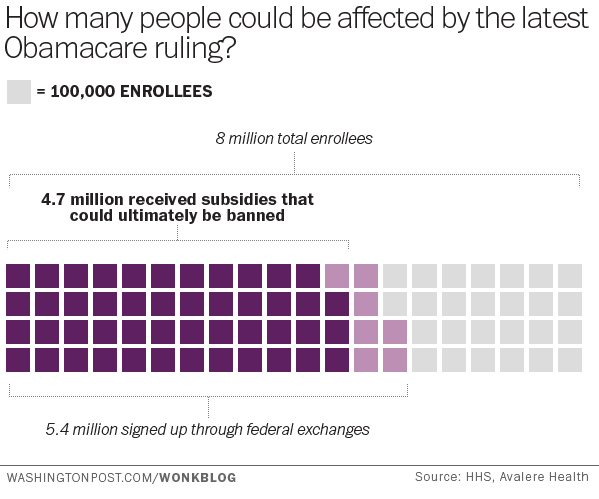
Ingraham provides the above chart, which shows how many current enrollees would be impacted if federal exchange subsidies are banned. Kevin Drum also imagines what would happen if SCOTUS sides with Halbig’s plaintiffs and “in a stroke, everyone enrolled in Obamacare through a federal exchange is no longer eligible for subsidies”:

What happens is that people in blue states like California and New York, which operate their own exchanges, continue getting their federal subsidies. People in red states, which punted the job to the feds, will suddenly have their subsidies yanked away. Half the country will have access to a generous entitlement and the other half won’t. … You’d have roughly 6 million people who would suddenly lose a benefit that they’ve come to value highly. This would cause a huge backlash. It’s hard to say if this would be enough to move Congress to action, but I think this is nonetheless the basic lay of the land. Obamacare wouldn’t be destroyed, it would merely be taken away from a lot of people who are currently benefiting from it. They’d fight to get it back, and that changes the political calculus.

Ponnuru’s similar thoughts:

Neither party should be confident about how those consequences would play out. Democrats in states without their own exchanges could put pressure on Republicans to establish exchanges or see many people pay higher premiums. Republicans nationally have never made clear how they would replace Obamacare without stripping coverage from millions of people. That failure could become a bigger political problem for them if the courts ultimately conclude that a lot of exchange participants aren’t eligible for subsidies.

Nicholas Bagley also considers the consequences of Obamacare’s opponents prevailing:

If that happens, the states with federally established exchanges will come under enormous pressure to establish their own exchanges. In turn, the federal government would want to make it as easy as possible for those states to convert to state-established exchanges.

Ideally, HHS would also want to relieve states of the need to develop new exchange infrastructure. Rollout challenges in Oregon and Massachusetts, not to mention Healthcare.gov, suggest that getting a website up and running isn’t such a simple task. What if the refusal states could just enact laws (or sign executive orders) saying they’ve “established” their exchanges, but let Healthcare.gov continue to run them?

He admits that “not every state would accept the invitation to establish its own exchange, even if doing so were more or less a formality,” but he suspects “lots of states would, especially as voters started to howl about losing their tax credits.”


Time To Quit Babysitting The Middle East?

In a long and wide-ranging interview with David Rothkopf, Zbigniew Brzezinski opines on how the US should engage the Middle East today:

I think the whole region now, in terms of the sectarian impulses and sectarian intolerance, is not a place in which America ought to try to be preeminent. I think we ought to pursue a policy in which we recognize the fact that the problems there are likely to persist and escalate and spread more widely. The two countries that will be most affected by these developments over time are China and Russia — because of their regional interests, vulnerabilities to terrorism, and strategic interests in global energy markets. And therefore it should be in their interest to work with us also, and we should be willing to play with them, but not assume sole responsibility for managing a region that we can neither control nor comprehend.

He also thinks it’s wiser to pursue accommodation with Iran than to continue treating it as a greater threat than it really is:

I see Iran as an authentic nation-state. And that authentic identity gives it cohesion, which most of the Middle East lacks. In that sense, it’s a more solidly defined state than, let’s say, Egypt, which is similar and — but doesn’t have yet authentic, real cohesion. The problem with the Iranian regime of course is, one, its unsettling effects on the Sunnis, particularly Saudi Arabia, and, secondly, its potential threat to Israel.

The question is, how do you best solve that? I certainly don’t accept the notion that the best solution is all options are on the table, which is the politest way of saying we’re going to go to war if we don’t solve the nuclear problem quickly. The fact of the matter is Israel has an effective nuclear monopoly in the region, and it will have that for a long time. And one thing that the Iranians are certain not to do is to undertake some suicidal mission the moment they have one bomb. So the notion that’s been publicized in America that there could be a crazy Iranian rush to have the bomb in nine months is, to me, meaningless.

A Split Decision On Obamacare

Jason Millman summarizes yesterday’s news:

The federal appeals court in the District of Columbia ruled 2-1 this morning that the Affordable Care Act doesn’t authorize the federal government to provide subsidies to low- and middle-income Americans to buy insurance in the 36 states where the federal government set up exchanges to sell health-care coverage. Just two hours later, a three-judge panel of the Fourth Circuit Court of Appeals in a similar case unanimously found just the opposite — that the IRS correctly interpreted the text of the ACA when it issued a rule allowing all public exchanges, regardless of who set them up, to provide insurance subsides.

Emily Badger explains what the lawsuits hinge on:

This latest legal challenge focuses on four words in the mammoth law authorizing tax credits for individuals who buy insurance through exchanges “established by the States.” Thiry-six states declined to set up their own exchanges — far more than the law’s backers anticipated — and in those states, consumers have been shopping for health care on exchanges run instead by the federal government. Now the D.C. Circuit Court of Appeals has ruled that these consumers are not eligible for subsidies because, well, they bought their insurance on exchanges not “established by the States.”

This is a tremendously literal interpretation of a small but crucial part of the law, and it’s one that was arguably never intended by its creators.

Greg Sargent joins the debate over the meaning of “established by the States”:

[T]he phrase does not literally say that subsidies should not go to people who get subsidies from the federal exchange, which under the law must be established in states that decline to set up their own exchanges. In fairness, opponents are right — the phrase also does not literally say that subsidies should go to those on the federal exchange. But all of that is precisely what makes the statutory language in question ambiguous. Once you accept this point — that the meaning of the phrase is not clear — then there is ample precedent for the courts evaluating the intent of Congress as expressed in the whole statute.

Philip Klein quotes from the DC federal appeals court ruling, the one which went against the administration:

“We reach this conclusion, frankly, with reluctance,” they wrote. “At least until states that wish to can set up Exchanges, our ruling will likely have significant consequences both for the millions of individuals receiving tax credits through federal Exchanges and for health insurance markets more broadly. But, high as those stakes are, the principle of legislative supremacy that guides us is higher still. Within constitutional limits, Congress is supreme in matters of policy, and the consequence of that supremacy is that our duty when interpreting a statute is to ascertain the meaning of the words of the statute duly enacted through the formal legislative process. This limited role serves democratic interests by ensuring that policy is made by elected, politically accountable representatives, not by appointed, life-tenured judges.”

Adrianna McIntyre disagrees with this logic:

You can’t examine the part of the statute that sets up federally-facilitated exchanges in isolation; you have to look at it in the broader context of the reform law. Since affordable coverage is a core tenet of the law, to say that people in state and federal exchanges aren’t equally entitled to tax credits would set the law at war with itself. That could be enough to call it ambiguous on its face.

When a law is ambiguous, the courts defer to the interpretation of the agency responsible for implementation. Obviously implementation has moved forward under the assumption that residents of every state are entitled to subsidies, regardless of what kind of exchange the state uses.

But Harsanyi calls the text in question “a fictional drafting error”:

As the plaintiff’s lawyers point out, entitlements and subsidies are regularly tied to state participation — this includes Medicaid, SCHIP, and other health care tax credits … Read Jonathan Adler and Michael Cannon here.

Sean Davis seconds that logic:

[I]f the law’s authors originally intended to constrain subsidies to state plans, what was the rationale for the IRS about-face in 2011? That’s actually an easy one to answer: the administration never imagined that so many states would refuse to establish Obamacare exchanges. The subsidies for state exchange plans were meant to be pot sweeteners—incentives for states to set up their own exchanges. If fines for mandate non-compliance were Obamacare’s stick, the subsidies for state exchange health plans were the carrot. To the law’s backers, that plan made sense: the White House didn’t really want to have to manage 51 separate exchanges. They wanted the states to do all the heavy lifting. Unfortunately, several dozen legislatures and governors had different plans.

Beutler counters such arguments:

What the challengers have asked judges to do is to ignore the “fundamental canon” and buy into the idea that the Democrats who passed the law unambiguously structured it to withhold premium subsidies from states that refused to set up their own exchanges, as some sort of high-stakes inducement. This is plainly false. It’s the giant whopper underlying the entire theory of Halbig. A completely fabricated history of the Affordable Care Act, which treats the scores of reporters who covered the drafting of the law as idiots, and the aides and members who actually drafted it as bigger idiots and liars as well.

Tomasky sighs:

What Randolph and Thomas Griffith, the other conservative judge who ruled with him, essentially did was to take one sentence of a law that runs to thousands of pages and play gotcha. What judges are supposed to do is look at statutory language in context and think about the drafters’ actual intent. But hey, don’t take it from me. Take it from a certain Supreme Court justice, who wrote in a decision just last month of the “fundamental canon of statutory construction that the words of a statute must be read in their context and with a view to their place in the overall statutory scheme.” That was Antonin Scalia.

But these were strange words, coming from Scalia. The context was his majority opinion in last month’s case about the EPA’s regulation of greenhouse gas emissions, which was a complicated and split verdict, albeit one that ultimately gave the EPA most of what it was asking for under the Clean Air Act. More typically, Scalia is a textualist. You can tell what that means, I’d wager, without me even explaining it, and in this case, it ain’t good: “I can’t read legislators’ minds. I can go only by the words in the bill. If they left out a word, they left out a word. Tough.”

Abbe Gluck calls the opinion “terribly disappointing from a statutory interpretation perspective”:

[A]pplying the exclusio unius presumption  (that when Congress specifies X we can assume that it meant not to specify X elsewhere) to a statute as long and complicated as the ACA — and one that did not go through the usual linguistic “clean up” process in Conference (as I wrote here) does a disservice to textualism and all those who have defended it over the years–turning it into a wooden unreasonable formalism  rather than the sophisticated statutory analysis that textualists have been claiming they are all about.

Suderman has a very different view:

The challenge is legitimate. As with the challenge to Obamacare’s individual mandate, which ultimately lost at the Supreme Court, the health law’s backers and the liberal legal community had long argued that the argument made by the challengers was more or less meritless. The win in the D.C. Circuit makes clear that it is not, and even the Fourth Circuit ruling concedes that it is a tough call, saying that “the applicable statutory language is ambiguous and subject to multiple interpretations” and only coming to its conclusion by “applying deference to the IRS’s determination.” Basically, the government won not because it was obviously in the right, but because it got the benefit of the doubt.

Finally, Cohn compares the current Obamacare lawsuits to previous ones:

The previous lawsuits were about some big, weighty issuesnamely, the boundaries of federal power and the extent of personal freedom. The plaintiffs, whatever their true motives, at least claimed to be fighting on behalf of liberty.

These new lawsuits, about which two courts issued conflicting rulings on Tuesday, make no similarly lofty claims of principle. They focus, instead, on some ambiguous text in the language of the law and allegation that Congress intended the law to work differently than the Obama Administration says.

Oh, the legal briefs make some real arguments about constitutional principles and it’s entirely possible that the plaintiffs who wrote those briefs believe them. But it’s hard to escape the conclusion that these arguments are altogether secondary to the real goal herethat these lawsuits are simply one more attempt to cripple Obamacare and yank insurance away from millions of people, no matter what it takes.

Quote For The Day

Tensions Remain High At Israeli Gaza Border

“It’s maddening to think that the tremendous military power Israel has amassed is not giving it the courage to overcome its fears and existential despair and take a decisive step that will bring peace. The great idea of the founding of the State of Israel is that the Jewish people has returned home, and that here, we will never be victims again. Never shall we be paralyzed and submissive in the face of forces mightier than us.

Look at us: The strongest nation in the region, a regional superpower that enjoys the support of the United States on an almost inconceivable scale, along with the sympathy and commitment of Germany, England and France – and still, deep inside, it sees itself as a helpless victim. And still it behaves like a victim – of its anxieties, its real and imagined fears, its tragic history, of the mistakes of its neighbors and enemies.

This worldview is pushing the Jewish public of Israel to our most vulnerable and wounded places as a people. The very essence of “Israeliness,” which always had a forward-looking gaze and held constant ferment and constant promise, has been steadily dwindling in recent years, and is being absorbed back into the channels of trauma and pain of Jewish history and memory. You can feel it now, in 2014, within very many of us “new” Israelis, an anxiety over the fate of the Jewish people, that sense of persecution, of victimhood, of feeling the existential foreignness of the Jews among all the other nations.

What hope can there be when such is the terrible state of things? The hope of nevertheless. A hope that does not disregard the many dangers and obstacles, but refuses to see only them and nothing else,” – David Grossman.

(Hat tip: Jeff Weintraub)

(Photo: Israeli soldiers weep at the grave of Israeli Sergeant Adar Barsano during his funeral on July 20, 2014 in Nahariya, Israel. Sergeant Barsano was killed along with another IDF soldier on the twelfth day of operation Protective Edge, when Hamas militants infiltrated Israel from a tunnel dug from Gaza and engaged Israeli soldiers. By Andrew Burton/Getty Images.)

Putting Food On The Table

L.V. Anderson comments on Tracie McMillan’s multimedia piece on American hunger:

McMillan takes aim at various misconceptions about poverty and hunger by profiling four families across the country. Think all you need to eat healthy on a budget is cooking skill? Talk to Jacqueline Christian, a mother of two who works full-time as a health aide and wouldn’t have the time or energy to cook even if she weren’t living in a homeless shelter. Think it’s impossible to struggle with hunger if you’re overweight? Spend some time with Christina Dreier, an obese stay-at-home mom in Iowa who skips meals in order to feed her kids tater tots and hot dogs from a local food bank. …

What goes unsaid in McMillan’s article is that the task of feeding children on an inadequate budget falls primarily to women. That women still do the majority of household labor is well known, but usually it’s discussed in the context of middle-class obsessions like leaning in and the mommy wars, not in the context of growing poverty.

Publicists’ Bad Publicity

Pivoting off Jennifer Pan’s recent piece on the PR industry, Ann Friedman further examines sexism-tinged stereotypes about women who work there:

The Princeton Review, in its guide to careers for college students, explains that “the successful PR person must be a good communicator — in print, in person and on the phone. They cultivate and maintain contacts with journalists, set up speaking engagements, write executive speeches and annual reports, respond to inquiries and speak directly to the press on behalf of their client.” So why do we associate PR professionals with mindless fakery rather than hard-won relationships and quick thinking?

On a New York Observer list of fictional publicists in pop culture, every notable character since the mid-’80s is a woman — typically sharp-tongued but not supersmart. Think Jennifer Saunders on Absolutely Fabulous, or Debi Mazar on Entourage. One of the most popular sketches on Comedy Central’s Kroll Show is “PubLIZity,” a reality-TV parody starring Nick Kroll and Jenny Slate as vapid pseudo-professionals in neon heels. Even when they’re portrayed as savvy, like Sex and the City’s Samantha Jones, PR people are never intellectual heavy-hitters. They are the working world’s sorority girls: salad-eating, prosecco-ordering up-talkers, manicured to the hilt.

Born With A Silver Lining

Zachary A. Goldfarb highlights a recent study showing higher birth weights in poor communities:

Something extraordinary is happening to poor pregnant women…: They’re giving birth to healthier babies. While other economic and health disparities have widened, giving way to huge national debates about inequality, pregnant women at the lowest rung of the nation’s economic ladder are bucking that trend. They have narrowed the gap with wealthier women in the health of their babies.

While experts agree that government policy has been critical to boosting the health of poor newborns, the improvements aren’t because of a single policy or administration. Rather, they reflect improved access to care, as well as a complex array of other factors, some not easily within the government’s grasp to change, from pollution to nutrition to violence at home.

Jessica Grose argues that Medicaid expansion played a major role in this improvement:

It seems like common sense that babies whose mothers had access to adequate health care would do better than babies whose mothers did not have such access. But if you want to see more proof, you can look at the OECD’s paper on comparative child wellbeing across 30 different countries. When it comes to birth weight, the countries with big social safety nets and low levels of income inequality—it’s always the Scandinavians!—have the lowest incidence of low birth weights. The countries with a high percentage of low birth weight babies and high infant mortality rates—like Turkey and Mexico—also have high levels of income inequality.

Another factor that could improve outcomes for children of poor families? Nurturing classes:

[R]esearchers recruited 272 African American mothers and children residing in rural Georgia, half of which were living below the poverty line. Then, the researchers provided 173 of the mother-child pairs with 14 hours — or 7 weeks — of parental training when their children turned 11. The training taught parents how to speak to their kids about risky behaviors, household rules, racism, and alcohol use. The remaining mother-child pairs received pamphlets on child development and stress management through the mail instead.

Eight years later, the scientists took samples of the teenagers’ blood to determine their levels of inflammation. They also recorded other health variables, such as smoking and weight status, as well as the level of parental involvement that they experienced. They found that children whose parents had participated in the training had much lower levels of inflammation than the children of parents who didn’t.

Will Europe Pass Serious Sanctions? Ctd

foriegn markets

Yglesias argues that the EU is in the driver’s seat:

Here’s the one fact you need to know to understand where the real balance of power lies: Russia’s top trading partner is the European Union, but the EU’s top trading partner is the United States followed by China. In other words, the 306 billion euro trading relationship is a big deal either way you slice it, but it’s fundamentally a bigger deal for Russia than it is for Europe

And, as Tim Fernholz illustrates with the above chart, the Dutch have significant Russian capital under their control:

It’s no accident that Netherlands is one Russia’s largest offshore-financial centers—it has actively welcomed capital flows from multinational companies seeking to avoid taxes and scrutiny, and it just so happens many of those companies are Russian, often with ties to the Kremlin. That capital is useful for a small country like the Netherlands, but if investigators are able to prove allegations of Russian involvement in the air disaster, it will put the Netherlands’ financial sector in an uncomfortable bind: Can it be a banker to Russia’s biggest companies while Putin’s regime supports groups that murder Dutch citizens?

Yglesias, in another post, assumes that Europe will crack down on Russia eventually:

[N]o anti-Russian move comes without some costs. And those costs fall differently on different European countries. So everyone’s preference is for someone else to bear the cost. But that doesn’t mean nothing will be done. It merely means that some arrangement needs to be worked out to share the burden. That takes time. But pressure on Putin is steadily ratcheting up, and the Russian leader is fitfully trying to distance himself from his own overreach in Ukraine. Europe is slow, not weak.

Earlier Dish on possible EU sanctions here.