Tracing Our Steps

The makers of an iPhone app that tracks exercise have transformed big data into beautiful GIF maps:

Using data collected from the Human smartphone app, major urban centres such as dish_humanappLondon, New York and Amsterdam have been drawn with pixels created by the movement of inhabitants that use the app. “We visualised 7.5 million miles of activity in major cities all across the globe to get an insight into Human activity,” said the team. “Walking, running, cycling, and motorised transportation data tell us different stories.”


The iPhone app was originally designed to encourage users to undertake at least 30 minutes of exercise each day. Using the phone’s location services and movement sensors while sat in a pocket or bag, it records the wearer’s type of movement and tots up the amount of activity completed. … As well as the city maps, the information was also used to rank the cities in percentage order of their residents’ most common means of transport. Amsterdam topped the list for cycling, Washington for walking, Berlin for running and Los Angeles for motorised transport.

Mark Byrnes recommends the video visualization seen below the jump:

The city-by-city results are perhaps most fascinating when viewed as a video. Displaying minute-by-minute data from each location, Human shows how the volume of movement around different parts of each place changes throughout the day:

Write Wingers, Ctd

Recently the Dish featured Adam Bellow’s manifesto urging conservatives to engage with popular culture, especially novels, as a way of spreading their message. Adam Kirsch, however, argues that “a conservative literary revival, along the lines Bellow desires, is not going to happen.” The reason? He sees too much anger and resentment driving the proposal:

[A]nger is a not a conservative emotion. Genuine conservatism is something much broader and deeper than a political orientation; it is a temperament, one that looks to the past with reverence and the future with trepidation, and which believes that human nature is not easily changed or improved. Defined in this way, conservatism is in fact a major strain in contemporary American literature. David Foster Wallace, the leading novelist of his generation, was a champion of earnestness, reverence, self-discipline, and work—never more so than in his last, unfinished novel, The Pale King, whose heroes are hard-working accountants. Dave Eggers made his name with a memoir about raising his younger brother after his parents died, a hip but deeply earnest hymn to family values. Zadie Smith excels at the conservatism of comedy, which resolves differences in laughter and exposes human follies with an indulgent understanding.

Kirsch goes on to pan Bellow’s new site for conservative fiction, Liberty Island, which describes itself as a place where “good still triumphs over evil, hope still overcomes despair, and America is still a noble experiment and a beacon to the rest of the world“:

The problem is not that these are conservative ideas, but that they are simpleminded ideological dogmas, and so by their very nature hostile to literature, which lives or dies by its sense of reality. If you are not allowed to say that life in America can be bad, that Americans can be guilty as well as innocent, that good sometimes (most of the time?) loses out to evil—in short, that life in America is like human life in any other time or place—then you cannot be a literary writer, because you have censored your impressions of reality in advance.

Micah Mattix adds:

Kirsch is right that conservatism is much more than patriotism or a defense of individual freedom, even if he also overestimates how many “conservative” works of fiction are published today (only two of the novelists he cites are actively writing; Wallace, Malamud, and Bellow are dead, of course), and even if has a rather rose-colored view of the commitment of liberal writers to art above politics. …

I’d like to see more conservatives write good fiction and poetry, not in order to win the culture war, but in order to have better fiction and poetry. There are number of conservative positions that are true and that are often ignored in fiction and poetry today. In Rod’s article last year on conservatives and storytelling, I noted one of these: The belief that evil is rooted in individuals and not in the structures of society (the church, schools, property ownership).

The Best Of The Dish This Weekend

Tensions Remain High At Israeli Gaza Border

There are times, I suppose, when our weekend reflections might seem out of place in a busy, bruising, secular world. And that might have seemed all the more true these past two summer days, thick as they have been with the hubris of Putin, the nihilism of Hamas, and the collateral massacre of the innocent that is happening in Gaza, as I write these words.

But I would offer a mild disagreement. When there is nothing you or I can actually do about the disgusting criminality of the Russian separatists and goons in Eastern Ukraine, or the cynical, smug Hamas theocrats lobbing useless rockets, or the persistence of the Israeli military past the corpses of dozens of children, we can nonetheless find ways to live among it. It says so much more about the civilizing skepticism of Montaigne, for example, that he was making the case for doubt as the religious wars of absolute certainty were getting underway in his own country and beyond. It speaks to me, at least, that a Muslim cleric could also make the case, during Ramadan, that

oppression attempts to strip the oppressed of their rights and dignity; whereas oppressing strips the oppressor of their very own humanity.

He wasn’t referring to Israel’s endless mowing of the human lawn, but he surely might have. It helps too, I’d argue, to counter the more high-minded counterpoints to the horror to remember that war-makers are seeking peace as well, in their own way:

People who choose to participate in military action are more likely to be altruists than egotists: they are prepared to sacrifice their own lives for the sake of something that transcends them, such as their country or their religion, or socialism, secularism or democracy, or a world where peace and tolerance will reign in perpetuity.

What is Zionism if not a utopian desire for a peaceful, promised land – a desire now etched for ever in the blood and bitterness of so many – and that you see today in the bloodied tears of the Israeli soldier above?

This weekend, we further explored what makes life worth living – in the acerbically honest poems of Deborah “working girl” Garrison; in sex after sixty (I think); of sex between races – perhaps the best rebuke one can make to war between Jews and Muslims; in an escape from reality like Burning Man, seen here from a drone above – or in a post-acocalyptic Eden in Vanuatu. It was fitting too as children were blown apart by bombs, that I spent hours today reading a terrific book about Montaigne (the book club discussion is imminent – buy the book here), whose sanity and spirit reaches us across the centuries, and helps keep me sane, and even happy, although I am simultaneously distracted and distraught.

The most popular post of the weekend was A Game-Changer For Ukraine; followed by The Oldest Depiction Of Sex On Record.

This last week was the most trafficked since February; and brought in the most new subscribers in the same period. Join the 29,616 subscribers here. Or if a friend has a birthday coming up, buy a gift subscription here.

And see you in the morning.

(Photo: An Israeli soldier weeps at the grave of Israeli Sergeant Adar Barsano during his funeral on July 20, 2014 in Nahariya, Israel. Sergeant Barsano was killed along with another IDF soldier on the twelfth day of operation “Protective Edge,” when Hamas militants infiltrated Israel from a tunnel dug from Gaza and engaged Israeli soldiers. By Andrew Burton/Getty Images)

The Open-Source Sky

dish_astronomynet

Professional astronomers have been looking at Flickr to better understand the universe:

To get detailed images of deep space, astronomers have a couple of options…. They can either use a long exposure to capture one really detailed image, or stack multiple less-detailed images together. [Astronomer Dustin] Lang and colleagues opted for the second approach. But rather than using multiple photos taken with the same telescope, they looked to the web.  The team used a new alogorithm to stack nearly 300 images of the Galaxy NGC 5907 that they found on Flickr, Bing, and Google. They did this by “[l]iterally searching for ‘NGC 5907’ and ‘NGC5907’,” explains Astrobites.

For a photo of the night sky to be useful, though, the scientists first needed to know exactly what they were looking at. For that they turned to Astrometry.net*, a site that pinpoints exactly which patch of the sky is shown in an image. … Once they were stacked together, the images revealed faint features that offered information on the mass, age and orbitial configurations of the celestial bodies in galaxy NGC 5907–information that was not present in a single photo.

(Image via Openiduser2916 via Astronomy.net)

Quote For The Day II

Tensions Remain High At Israeli Gaza Border

“Gaza is part of our Land and we will remain there forever. Liberation of parts of our land forever is the only thing that justifies endangering our soldiers in battle to capture land. Subsequent to the elimination of terror from Gaza, it will become part of sovereign Israel and will be populated by Jews. This will also serve to ease the housing crisis in Israel. The coastal train line will be extended, as soon as possible, to reach the entire length of Gaza.

According to polls, most of the Arabs in Gaza wish to leave. Those who were not involved in anti-Israel activity will be offered a generous international emigration package. Those who choose to remain will receive permanent resident status. After a number of years of living in Israel and becoming accustomed to it, contingent on appropriate legislation in the Knesset and the authorization of the Minister of Interior, those who personally accept upon themselves Israel’s rule, substance and way of life of the Jewish State in its Land, will be offered Israeli citizenship,” – MK Moshe Feiglin, outlining a future for Gaza that will also surely, eventually, after another provocation, be applied to the West Bank.

(Photo: A man stands with an Israeli flag on a hill overlooking the Gaza Strip on July 20, 2014 near Sderot, Israel. By Lior Mizrahi/Getty Images.)

The Shocking Truth, Ctd

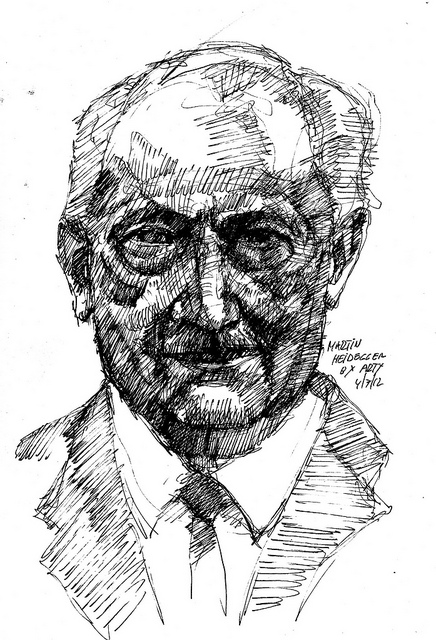
Recently the Dish noted new research suggesting that people prefer getting electric shocks to being alone with their thoughts. Remarking on the study, Damon Linker gives our restlessness an existentialist gloss. He turns to the German philosopher Martin Heidegger for an explanation of why we crave distraction:

Heidegger proposed that we human beings are uniquely terrified of our own mortality because we’re more keenly aware than any other animal of all we have to lose 7499910498_5bc8525143_z by dying. Each of us inhabits a world overflowing with meaning. We care deeply, almost infinitely, about ourselves, our lives, our loved ones. And the prospect of losing it all — of the world and everything in it winking out of existence when we cease to be — is unspeakably horrifying. Heidegger also suggested that we spend much of our lives fleeing from the fact of our finitude, throwing ourselves into the world and its concerns, including technological distractions and diversions.

But there are also moments when the truth reveals itself to us. This happens in certain moods, among them anxiety and boredom, when a dawning awareness of the groundlessness of our ordinary, everyday pursuits transfigures the world. When that happens we grasp as we otherwise rarely do that our lives are lived hovering over an abyss that at some level we know with complete certainty will eventually — perhaps a mere moment from now — swallow us whole, along with everything we’ve ever cared about.

Nothingness: that is what we’re trying to wave away when we reach for our phones in line at the grocery store, and when the obtrusive music played during a meal rescues us from what would otherwise be an excruciatingly awkward silence.

(Image of sketch of Heidegger via Arturo Espinosa)

Theology For Technologists

Scott Adams, who was raised Methodist and later became an atheist, describes how he’s now come around to seeing religion as the “user interface to reality.” He writes that “when I hear people debate the existence of God, it feels exactly like debating whether the software they are using is hosted on Amazon’s servers or Rackspace”:

Religion is similar to software, and it doesn’t matter which religion you pick. What matters is that the user interface of religious practice “works” in some sense. The same is true if you are a non-believer and your filter on life is science alone. What matters to you is that your worldview works in some consistent fashion. If you’re deciding how to fight a disease, science is probably the interface that works best. But if you’re trying to feel fulfilled, connected, and important as you navigate life, religion seems to be a perfectly practical interface. But neither science nor religion require an understanding of reality at the detail level. As long as the user interface gives us what we need, all is good.

Some of you non-believers will rush in to say that religion has caused wars and other acts of horror so therefore it is not a good user interface to reality. I would counter that no one has ever objectively measured the good and the bad of religion, and it would be impossible to do so because there is no baseline with which to compare. We only have one history. Would things have gone better with less religion? That is unknowable. … What I know for sure is that plenty of people around me are reporting that they find comfort and social advantages with religion. And science seems to support a correlation between believing, happiness, and health. Anecdotally, religion seems to be a good interface.

Face Of The Day

Ellyn Ruddick-Sunstein spotlights an empowering photo series:

In a world where the words “bikini season” are met with judgement, panic, and dread, it canenhanced-29149-1400922911-3 be hard to embrace our bodies as they are. For breast cancer survivors and patients who have undergone single or double mastectomies, the season’s swimsuits can be alienating, as they are most often designed to accommodate twin bosoms.

Hoping to challenge the damaging pressures and judgements placed on the female chest, Ph.D. Elina Halttunen came up with the idea to manufacture bathing suits specifically for women who, like she, have one breast. With the help of design duo Tärähtäneet ämmät (Nutty Tarts), a group of trailblazing Finnish designers, and a dedicated group of models, all of whom had undergone mastectomies, her dream became a reality. Their fashions and images are all part of the project Monokini 2.0.

Taking inspiration from legendary fashion photographer Helmut Newton, the team at Nutty Tarts have conceived of glamorous, edgy designs with a distinctive yet cohesive aesthetic. The Monokini 2.0 designs comprise looks that convey both strength and softness. Designer Outi Pyy creates pieces designed with warriors and mermaids in mind. Tyra Therman, who works in luxury underwear, sees the project as a way to redefine femininity and celebrate the courage of women.

Support their Kickstarter here.

Loving Your Oppressor

Imam Sohaib N. Sultan offers a Ramadan reflection on the theme:

The Qur’an often describes sins and wrongdoings as “oppressing one’s own soul” (7:23). It begs the question, therefore, what the difference is between the oppressor who commits wrongdoing and the oppressed that is wronged if both are, ultimately, being oppressed. I think, the answer may lie in that oppression attempts to strip the oppressed of their rights and dignity; whereas oppressing strips the oppressor of their very own humanity. …

It is worth noting that the Prophet referred even to the oppressor as “your brother.” When we encounter the tyrant, our first instinct is to wash our hands of him or her and to deny that we have anything to do with them. While this instinct is understandable, the reality is that even the worst of human beings are related to us in humanity, if not faith. And, therefore, opposing the tyrant is an act of sincere love, the same sincerity that one would naturally show to their brother. Opposing oppression must never be rooted in hatred, for that would, inevitably, cause the cycles of oppression to continue.

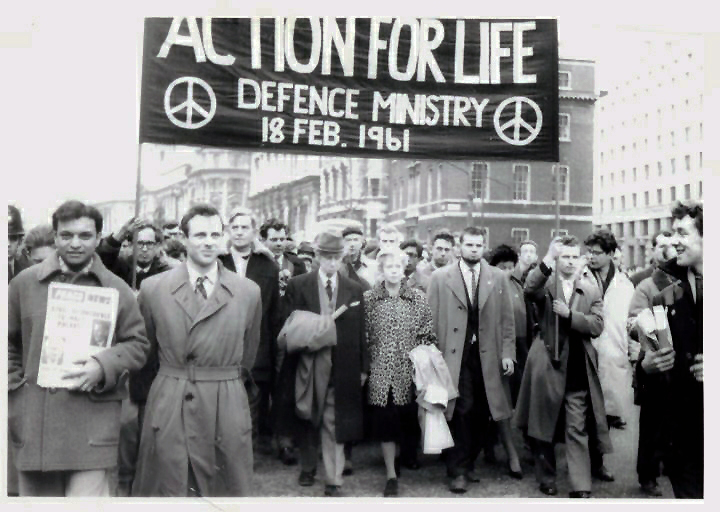
Bertrand Russell, Peacenik?

Bertrand_Russell_leads_anti-nuclear_march_in_London,_Feb_1961

Surveying the British philosopher’s pacifist writings and activism, Jonathan Rée isn’t quite persuaded by how he formulated the nature of war:

The peace agenda of Russell and his followers was always based on the assumption that war is simply a euphemism for the madness of state-sponsored mass murder, and that we could prevent it by standing up for moral and political sanity – by committing ourselves to global justice and the relief of poverty, for instance, or social and sexual equality, or common ownership, or world government…. But the paths to war are paved not with malice but with righteous self-certainty. People who choose to participate in military action are more likely to be altruists than egotists: they are prepared to sacrifice their own lives for the sake of something that transcends them, such as their country or their religion, or socialism, secularism or democracy, or a world where peace and tolerance will reign in perpetuity. Of course they are liable, like the rest of us, to be seriously mistaken in countless ways:

they probably have an inconsistent scale of values, a shaky grasp of facts and a faulty sense of proportion. They may, just possibly, be open to persuasion through tactful argumentation, subtle negotiation and ingenious rhetoric, but nothing will be gained by accusing them of selfishness, nihilism or moral idiocy, or delivering lectures about self-sacrifice, high principle and the future of humanity.

Different threats to peace, like different threats to health, require different precautions and different interventions, depending on the individual case, and success in averting war is going to depend on luck as much as judgement. If the prospect of nuclear extermination has receded since the time when Russell was prophesying it, the explanation lies less in campaigns for peace and freedom than in the unexpected consequences of developments that no one could have foreseen – the calculations and miscalculations of Mikhail Gorbachev, for instance, or the accidental canniness of Ronald Reagan. Irony is a force of history as well as a figure of speech, and in politics you need to be prepared for surprises, even if you are as clever as Bertrand Russell.

(Image: Bertrand Russell and his wife, Edith Russell, lead an anti-nuclear march by the Committee of 100 in London on February 18th, 1961, via Wikimedia Commons)