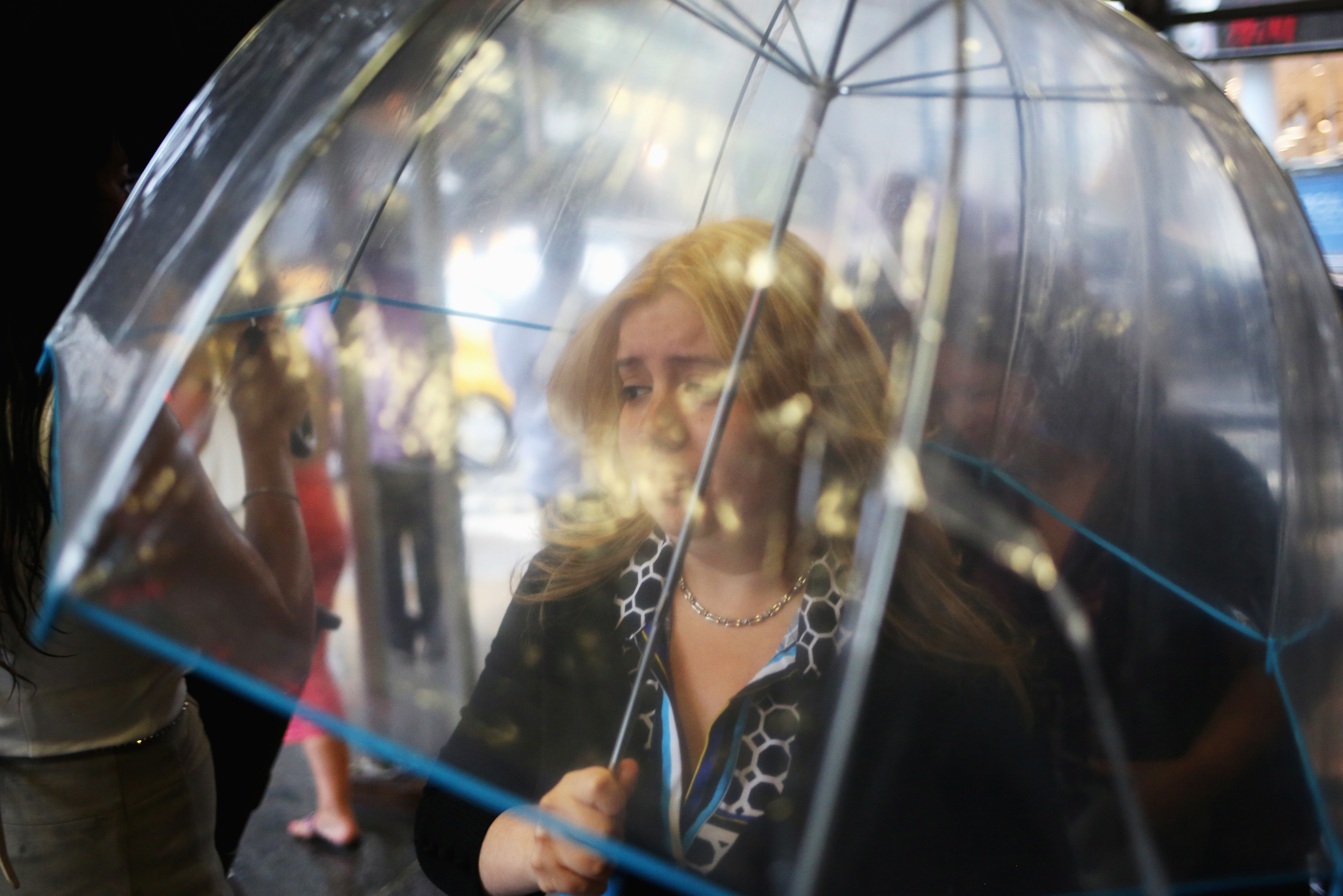
Would you believe New York is one of them? Eric Jaffe examines a new working paper on the subject:
Some of the happiest cities measured by [economist Edward] Glaeser and company were Charlottesville, Virginia; Rochester, Minnesota; Lafayette, Louisiana; Naples, Florida; and Flagstaff, Arizona – in keeping with a classic theory that people like to go where it’s warm. Some of the least happy places were Scranton and Erie, Pennsylvania; South Bend and Gary, Indiana; New York, Pittsburgh, and Detroit.
These relationships held true even after controlling for income and employment, and after considering factors like education, race, and age. … What’s more, these unhappy places tended to have unhappy histories. Glaeser and collaborators found that the connection between place and happiness held true whether they took into account long-term residents or those who just moved there. In other words, it’s not that these places were once happy and then became unhappy after just a few years of decline. Rather, in the eyes of the researchers, these are and have long been “unhappy cities.”
The authors find that in past decades, places with lower levels of happiness tended to have higher average wages; more recently, less happy places have had lower average rents.
(Photo: A woman walks through the rain under an umbrella on 5th Avenue in Midtown Manhattan on July 15, 2014 in New York City. By John Moore/Getty Images.)
So argues James Wolcott in an essay exploring the recent 90s nostalgia craze:
Nostalgia isn’t the worst narcotic, but it used to feed a different vein. It was both generational and individual, a distillation of personal experience as unrecoverable as blushing youth. When F. Scott Fitzgerald, the dewiest prose lyricist of the Jazz Age, peered back at the reckless abandon and champagne fizz of the 20s through the clouded curtains of the Depression-era 30s, he elegized himself, Zelda, and the rest of his strewn generation for who they were and what they did. Sixties nostalgia operated that way too, the pang of regret over who so many of them were (rebels, hippies, wanderers, crusaders) and what they became (reactionaries, office drones, commuters, cynics).
In our media-saturated age, when every couch potato is king, this mode of nostalgia no longer applies.
It isn’t about who we aspired to be as fledglings leaving the nest—full of hopes and dreams and boogying hormones—but about what we watched, played, listened to, downloaded, and identified with as junior consumers. Before the Web became our neural extension, when print and celluloid held reign, the passage of time and the discrimination of critics and enthusiasts winnowed away the flotsam and jetsam of the past, allowing its true achievements and revelatory visions (even those unheralded or derided at the time) to surface and radiate.
The Internet, however, is an inexhaustible suction pump that indiscriminately dredges up the dreck along with the sunken pearls. Search engines are scouring devices, algorithms have no taste buds, and monster Web-site aggregators such as BuzzFeed—which one writer called the Hellmouth of 90s nostalgifying, with its inane quizzes (“Which ‘Dawson’s Creek’ Character Are You?”) and dipstick listicles (“32 Reasons Christmas Was Better in the ’90s”)—are to curating what hoarders are to connoisseurship.
Why do sunflowers track the Sun from east to west every day? New research indicates the plants “are not responding simply to light, but also to an internal clock”:
Plant biologists Hagop Atamian and Stacey Harmer of the University of California in Davis grew sunflowers in a field and then transferred them to growth chambers with a fixed overhead light that was always on. The plants continued their daily journey from east to west and back for several days after the transfer, suggesting that they were not responding only to the direction of the light, but their own timekeeper….
The researchers went on to study gene expression on each side of the plant. Atamian hopes to use this data to learn more about how a sunflower’s internal clock can alter growth on one side of the stem but not the other. “Somehow the same clock in the same organ is having opposite effects on opposite sides of the stem,” he says. “It’s a big open question.”
Other plants perform a similar diurnal dance, including agriculturally important crops such as soybeans, cotton and alfalfa. Such solar tracking has been shown to boost plant yield. But sunflowers eventually weary of the waltz. Mature sunflowers stop tracking the Sun and stand straight — often facing the east, ready to soak up each new sunrise.
Over the past week, Russia has taken a number of steps to revive its partnership with the Castro regime in Cuba. Ahead of a visit to Havana last Friday, Putin announced that he was writing off $32 billion of the island’s debt to Moscow, and just Wednesday, Russian media broke the news that Putin would reopen a Soviet-era intelligence facility there:
Opened in 1967, the Lourdes facility was the Soviet Union’s largest foreign base, a mere 155 miles from the US coast. It employed up to 3,000 military and intelligence personnel to intercept a wide array of American telephone and radio communications, but Putin announced its closure in 2001 because it was too expensive – Russia had been paying $200m (£117m) a year in rent – and in response to US demands. … “Lourdes gave the Soviet Union eyes in the whole of the western hemisphere.
Jay Ulfelder expects this revival to delay, but not forestall, Cuba’s economic reckoning:
Putin’s government seems to be responding in kind to what it perceives as a deepening U.S. threat on its own borders, and this is important in its own right. As a specialist on the survival and transformation of authoritarian regimes, though, I am also interested in how this reinvigorated relationship affects prospects for political change in Cuba. …
None of these developments magically resolves the fundamental flaws in Cuba’s political economy, and so far the government shows no signs of rolling back the process of limited liberalization it has already begun. What’s more, Russia also has economic problems of its own, so it’s not clear how much help it can offer and how long it will be able to sustain that support. Even so, these developments probably do shrink the probability that the Cuban economy will tip soon into a deeper crisis, and with it the near-term prospects for a broader political transformation.
“A writer cannot simply sit around, hoping that an idea for a book will just magically appear,” argues Rachel Jelinek. “Instead, they have to leave their home and experience the world around them”:
I think there is a major difference between reading about an experience and actually living the experience. With the numerous books I’ve read over the course of my life, I have read about love, loss, traveling around the world, and being successful. I have felt twigs snapping beneath my feet in the Alaskan woods with Chris McCandless from Into the Wild and I have travelled across the country on a train with Jacob Jankowski from Water for Elephants.
But the main difference is that I have read about them, not actually experienced them for myself. The key to producing great writing is to be able to portray the five senses (sight, smell, touch, taste, and sound) and to make that reader feel as though he or she is in the character’s place. But if a writer has not done these things for himself or herself, than the writing is not as authentic. The character’s experiences will stay on the page instead of leaping out and being felt by the reader.
Can you please put the graphic images of dead people and children after the link? I am begging you. I have been avoiding these images all day. Maybe you do not understand, but I am sick about Gaza and MH17 enough already. I don’t need graphic images to shake me out of some indifferent stupor – I am already there, right with you. Please help out your readership.
But another gets it right:
Thank you for posting the photo of the debris and the bodies under the post “A Game-Changer For Ukraine”. It is a horrible, terrible image, yes. And it’s the kind of photo that many will jump on as “disrespectful to the dead” and so forth. But let me counter with this:
I do NOT want anyone who takes in this news to see only “sanitized” images of this barbaric action and hear only clean and neat reports out of a conference room at a hotel in Amsterdam, Washington, or Kuala Lumpur. It’s much too big and awful and important to stuff down into a bureaucratic exercise at a podium and treat like some report out of a county board.
Your treatment – one photo, not large, not the only coverage – is totally honest and appropriate. Thank you for using good judgment and appropriate wisdom on this.
But another thinks we misfired on another image:
One of the reasons why I like the Dish is your willingness to share uncomfortable images which other media outlets censor – but I was seriously disappointed to see you pick a zoom-lense shot of a grieving relative as your “Face of the Day“. In my view, this seriously oversteps the line between news reporting and invasion of privacy.
Someone I know was killed on the flight – someone who had devoted their life to battling AIDS. Those who are grieving have the right to do so in private, without paparazzi chasing them around the airport looking for grief-porn shots. The fact that Getty saw fit to take and distribute the photo is a discredit to them, and that fact that you would publish it is a discredit to you, and a disappointment to those of us who thought the Dish stood for something better.
We have debated this issue extensively in the past. See the results of a reader survey here. The Dish stands by its policy of airing every image that illuminates the truth of war.
(Photo: Israeli soldiers take cover during clashes with Palestinian demonstrators at the entrance of Israeli-run Ofer prison in the West Bank village of Betunia, on July 18, 2014, following a protest against Israel’s military operation in the Gaza Strip. Israeli Prime Minister Benjamin Netanyahu spoke of bolstering his ground assault on Gaza in what commentators said was part of a strategy to pressure Hamas into a truce. By Abbas Momani/AFP/Getty Images)
That’s the direction the World Health Organization is headed:
The Economist has flagged a report on prevention and treatment for HIV in groups most likely to contract the disease. In the report,the WHO quietly recommends decriminalizing drugs — specifically, injectable drugs that spread HIV. According to a recommendation made in the report, “Countries should work toward developing policies and laws that decriminalize injection and other use of drugs and, thereby, reduce incarceration.” Buried several pages into the 113-page report, it’s not the most explicit announcement, but it is a rebuttal to the UN’s official stance: prohibition, with criminal penalties for offenders.
Paul Best mentions how this strategy worked in Portugal:
Portugal decriminalized drugs in 2001 in response to the declining health of drug users in the country. George Murkin, the policy and communications officer for Transform Drugs, published a report last month detailing some of the benefits that have come from Portugal’s decriminalization. He reported that drug use among the group most likely to use drugs, 15- to 24-year-olds, declined; average rates of use in the general population have decreased; drug use is below the European average; and most importantly, the number of people injecting drugs decreased from 2000-2005, which is the time period with the most recent available data. The WHO’s solution to the spread of HIV appears to have worked in Portugal, because over the past decade the number of newly diagnosed HIV cases has dropped at an astounding rate for people who inject drugs, falling from 1,016 in 2001 to 56 in 2012.
Earlier this week, German Lopez made the case for decriminalizing all drugs:
The failure to significantly raise drug prices or reduce drug use are why drug policy experts in general agree the war on drugs — and criminal enforcement against drugs in particular — isn’t working.
Even [Mark] Kleiman, the most cautious of the three experts interviewed for this story, supports decriminalization. Kleiman once opposed the idea, but he says he warmed up to it after looking at the evidence.
“What I’ve learned since then,” he says, “is nobody’s got any empirical evidence that shows criminalization reduces consumption noticeably.”
That’s how Sean O’Neal eulogizes Elaine Stritch, the legendary Broadway star most recently known as Jack Donaghy’s mom:
Stritch’s persona – bawdy, blunt, and with a 3 a.m. voice that sounded like it was carelessly swinging around a vodka stinger – was established early on stage, where Stritch came up as an understudy for Ethel Merman who soon had Noel Coward reworking all of 1961’s Sail Away around her scene-stealing presence. Her Broadway roles included star-making turns in shows like Bus Stop, Goldilocks, and Sondheim’s Company, which yielded what would become one of her signature tunes, “The Ladies Who Lunch.” A scathing look at high society women punctuated by mock “I’ll drink to that” toasts, Stritch’s recording for the original cast album – as documented by D.A. Pennebaker in his behind-the-scenes film – was an exhausting, 14-hour struggle, a testament to just how hard Stritch worked to get it right. In the documentary’s climactic final scene, Stritch returns the next day to nail it in one triumphant take.
Charles Isherwood adds, “It’s common to describe a talent as singular, one of a kind or larger than life. And yet those words seem strictly accurate, albeit a bit flimsy, when applied to Elaine Stritch”:
Perhaps more than any other performer, she embodied the contradictions that churn in the hearts of so many actors and singers:
Her constitution seemed to be equal parts self-assurance and self-doubt, arrogance and vulnerability. A need to be admired did constant combat with a nagging fear of being rejected. But unlike most performers, Ms. Stritch never felt the necessity (or had the filter) to mask either the egotism or the fragility, in public or in private. She made the complications of her own personality part of her art, indeed the wellsprings of it. And in acknowledging the depth of her needs, she touched a universal chord.
More than her epitaph, her alcoholism, her TV roles, and even her outlandish, cantankerous personality, Stritch will most likely be remembered for the song that’s now as inextricably hers as “Somewhere Over the Rainbow” is Judy Garland’s: “Ladies Who Lunch,” from Stephen Sondheim’s Company. Stritch originated the role of Joanne, a bitter, booze-addled woman of a certain age who rants exquisitely about the vacuity of wealthy socialites and their daily proclivities while gesturing extravagantly with a martini. The irony of the number isn’t lost on Joanne, nor was it on the actress who played her, with Stritch telling a Times reporter in 1968, “I drink, and I love to drink, and it’s part of my life.” (She quit eventually, although started having a daily cocktail or two again in her 80s.)
Stritch’s voice – raspy, rough, and almost acidic in its ability to cut through a note – was utterly unlike the identikit vibratos that tend to proliferate around Broadway. In a recording of “Ladies Who Lunch” from the ’70s, filmed for PBS, she sits on a stool in a white shirt and stares aggressively at the camera, eking out syllables with all the confidence of one who knows the conductor follows her. “The ones who follow the rules/ And meet themselves at the schools/ Too busy to know that they’re fools/ Aren’t they a gem?” she half-screams, eventually letting out a roar of feral frustration at how infuriating it all is. “I’ll drink to them.”
You can see the full gamut of emotions Stritch accesses in that video, from self-awareness to theatricality to vulnerability to a wink and a smile. It’s that melding of fear and bravado that made musical theatergoers adore her so, as she drank to overcome crippling stage fright and wrestled with insecurity every time she opened her mouth to sing.
For more, go check out the documentary recently made about her:


 The Dish