Russia Isn’t Winning Any Popularity Contests

Russia

It’s losing support around the globe:

In the United States, unfavorable views of Russia had jumped by 29 points in just one year. Similarly, in Europe, they climbed 20 points. Latin America, Asia and Africa had also seen their opinions of Russia grow more guarded, albeit by a far smaller margin.

In sum: more than two-thirds of people in the United States, Europe and the Middle East — all the regions most interested in what comes next — are pretty much anti-Russia. Any way you slice the data, Russia has few allies beyond China and a smattering of others that include Greece, Bangladesh and Vietnam.

The Other Jihadist Menace

On top of the fact that most of the schoolgirls kidnapped by Boko Haram in April are still missing, Erica Schwiegershausen reminds everyone that the Islamist militants are also still terrorizing northern Nigeria:

[V]iolence by the Boko Haram has continued to escalate: Human Rights Watch reported yesterday that the terrorist group has been responsible for at least 2,053 civilian deaths in the past six months — a dramatic increase from last year. Recently, Boko Haram fighters allegedly killed over 300 people in the northern Nigeria town of Gamboru Ngala, setting houses on fire and shooting residents who attempted to escape (possibly in response to security forces from the town, which were reportedly going after the kidnapping victims), and are believed to have abducted another 91 people (60 women and 31 boys) from the Nigerian village of Kummabza last month. In the video released over the weekend, the Boko Haram also claimed responsibility for two explosions at a fuel depot in Lagos last month, and The Wall Street Journal reported this morning that the group has killed 44 civilians in the past two days.

After relaying the grim prognosis from Western diplomats who believe the girls may never be rescued, at least not all at once, Colin Freeman addresses “the wider challenge for Nigeria of defeating Boko Haram itself”:

Neither the Nigerian government nor the vast majority of northern Nigerians want the kind of medieval caliphate that the group seeks to impose in return for laying down its arms. Meanwhile, the economic improvements that will drain Boko Harm of its millions-strong recruiting swamp of jobless young men will take decades, not years. So far, the only effective strategy has been to set up citizens self defence groups – known as civilian joint task forces– which have had some success in identifying and chasing known Boko Haram sympathisers from major cities. But even they have done little more than push the threat into the countryside, while critics say their rough brand of vigilante justice will sow the seeds of future problems.

Instead, many observers believe that the most likely solution appears to be an amnesty, which will tempt less committed commanders away with offers of jobs and freedom from prosecution. That might sound like soft terms for people who have killed so many of their own countrymen. But in Nigeria, it is not without precedent. Many believe the group is holding out for a repeat of the amnesty offered to Nigeria’s Delta insurgents, who caused mayhem in the oil-rich south until a deal in 2009.

Whence This Shrinking Labor Force?

residual

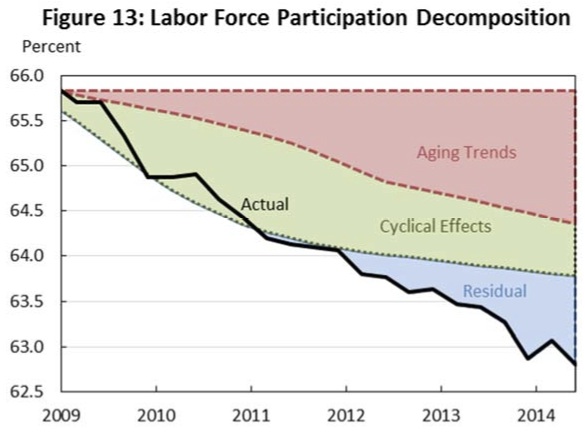
One of the mysteries of the recovery that feels like a recession is that since 2012, more Americans have been dropping out of the workforce than demographic and cyclical trends can account for. Zachary Goldfarb peruses a new report from the White House Council of Economic Advisers that seeks to explain why:

The first theory is that higher levels of long-term unemployment as a result of the Great Recession are causing more workers to exit and remain outside the labor force. A well-chronicled feature of the economic recovery has been the very large numbers of Americans unemployed for more than six months — 3.1 million in June. The report highlights other economic research that has shown that jobless Americans have lower odds of finding a job the longer they’re unemployed. And a big part of the reason is that employers discriminate against those with long spells of joblessness. …

The report’s second theory essentially boils down to the idea that the participation rate is lower because when the recession started, the labor market was already much weaker than was widely recognized.

Nearly every demographic group saw labor force participation declines ahead of the recession. It was especially problematic for men, who have been beaten down by declines in manufacturing, advances in workplace automation and expanding trade. The report does not specify how exactly the Great Recession would have led to an intensification in those trends. But it’s not hard to imagine that the severe economic contraction would have kicked out many workers, particularly men, who were just hanging on to the labor force before the economic decline even began. It’s startling to think about, but as a percentage of the population there are far fewer men working today than at any point in the past 50 years.

As the above chart illustrates, the CEA estimates that the “residual” accounts for about one-third of the decline. But as Ben Casselman remarks, this estimate itself carries a political charge:

Economists more or less agree on what the factors are behind the decline in the labor force. What they don’t agree on is how much of the decline to assign to each factor. The debate has huge policy implications. If the drop in participation is mostly about the weak economy, that means the labor market is much worse than the 6.1 percent unemployment rate would normally indicate; there are millions of Americans who don’t count as unemployed but would be working if there were more jobs available. That means the government should be doing more to help boost the economy, whether through monetary policy, tax cuts, government stimulus or other programs.

On the other hand, if the drop is mostly about aging and other long-term factors, then the recent decline in the unemployment rate accurately reflects a rapidly improving economy. Rather than trying to stimulate the economy, policymakers should be focused on making sure it doesn’t overheat and lead to faster inflation.

Borderline Politics On The Right

Contra Conn Carroll, Ross argues that Republicans in Congress need to do something about the border crisis:

It would be one thing if the G.O.P. genuinely didn’t think anything should be done about the current crisis: Then they could stand by their inaction on principle and blast the president for making extralegal moves. But the party’s official (and correct!) position is that we need more funding for immigration enforcement, both in the context of the current inflow and more generally, and that the Wilberforce Act’s guarantee of hearings should not be applied to most of today’s child migrants. Regardless of what the president does or doesn’t do, I just don’t see what Republicans lose from passing legislation that reflects both positions: If the president fails to execute it faithfully or if it ends up amended in some counterproductive way, they can attack the White House and the Democrats for that, without carrying the burden of looking like do-nothings who are weirdly demanded more of the kind of executive “creativity” they officially oppose.

But Ted Cruz is now pushing for any legislative response to the border crisis to include language ending the president’s Deferred Action for Childhood Arrivals program. Sargent comments on what this means for the prospects of Congressional action, as well as for the GOP’s public image:

Ted Cruz is essentially calling on Republicans to formalize in their legislative response to the crisis what is already their actual position on immigration in general. (House Republicans already voted in 2013 to end DACA.) And not only that, National Review reports that more and more conservatives are now giving voice to the Cruz stance, arguing that Republicans must not offer any legislative response to the crisis because Obama’s “amnesty” for the DREAMers proves he cannot be trusted to work with them even on the current border debacle.

In the short term, this Cruz gambit could make it tougher for John Boehner to get any border bill through the House, and increasingly reliant on Dems to do so. But beyond this, it’s a reminder that even if the crisis is very tough politics for Obama and Dems, it is also putting Republicans in a terrible position, dramatizing that they have only moved further to the right on immigration since their 2012 loss led to a big round of soul searching about how to broaden the party’s appeal beyond core constituencies.

Weigel theorizes as to why Cruz would throw such a bomb, knowing that a bill ending DACA has no real chance of passing Congress:

Well, Cruz believes in it, and as far as he’s concerned it focuses the blame for the current crisis on DACA. A worried House Republican aide (remember, lots of these people still sort of want the House to pass an immigration bill before the election) tells Joel Gerkhe that Cruz’s bill “could look like an overreach, particularly given how the mainstream media will distort it.” But Cruz has previously found that the media’s coverage of his effort bounces right off of Republican voters. He has been able to spin the 2013 Obamacare funding fight not as a tragic own goal on the GOP, but as the very reason Obamacare riled the 2014 electorate. It’ll be dead easy to tell Texas (and Iowa) crowds that he wanted to kill the border crisis at the root, but mushy Republicans failed to stand with him.

Allahpundit, in character, is disappointed that Cruz only wants to end DACA going forward, rather than repeal it entirely and re-outlaw the immigrants who have already benefited from the program. He sees that as a political choice, too:

If you already qualify for amnesty under DACA, you get to keep your amnesty. This is all about ending eligibility for future illegals, not taking it away from people who already have it. That makes sense in light of what I said above. Cruz wants to show that he’s tougher on illegal immigration than his GOP rivals but not so tough that he’s a punching bag for “YOU HATE CHILDREN!” attacks from the left. He’s willing to let children currently involved in the program keep their eligibility. Which makes this a miniature version of comprehensive immigration reform: So long as future waves of illegals are turned away, the ones who are already here enjoy legalization.

Previous Dish on the politics of the border crisis here and here.

Who Is Putting Gazan Lives At Risk?

PALESTINIAN-ISRAEL-CONFLICT

Philip Klein flags an UNRWA statement about rockets its relief workers found stored in a vacant Gaza school, offering it as proof of Hamas’s disregard for the lives of Gazans:

UNRWA said it had taken steps to have the weapons removed. As I noted on Wednesday, the fact that Palestinian terrorists store and fire rockets from schools, hospitals and residential areas increases the likelihood of civilian casualties.

But does that justify bombing the school? Max Fisher thinks not:

Israel has overwhelming military superiority in the conflict, and while that does not make Hamas rockets disappear or obviate their very real effects on Israeli civilians, Israel is strong enough to choose not to bomb a mosque and a center for the disabled in Gaza, as it did on July 12. It can choose not to bomb Gaza beaches frequented by civilians, as it did on Wednesday, killing four boys between the ages of 9 and 11. …

This is the one thing that both Hamas and Israel seem to share: a willingness to adopt military tactics that will put Palestinian civilians at direct risk and that contribute, however unintentionally, to the deaths of Palestinian civilians. Partisans in the Israel-Palestine conflict want to make that an argument over which “side” has greater moral culpability in the continued killings of Palestinian civilians. And there is validity to asking whether Hamas should so ensconce itself among civilians in a way that will invite attacks, just as there is validity to asking why Israel seems to show so little restraint in dropping bombs over Gaza neighborhoods. But even that argument over moral superiority ultimately treats those dying Palestinian families as pawns in the conflict, tokens to be counted for or against, their humanity and suffering so easily disregarded

Both sides are putting innocent Gazan lives at risk. And Israel cannot grotesquely pin the deaths of, say, those four boys, or countless others, on Hamas. Omar Baddar adds that the question of who is using “human shields” is also not as clear as Israel would like it to be:

While human rights organizations haven’t yet addressed “human shields” allegations in the ongoing round of Israel-Gaza violence, they did after the 2009 round when Israel killed at least 773 Palestinian civilians, compared to three Israeli civilian casualties (a ratio of 257:1), and used the same “human shields” argument to deflect responsibility for those deaths. When the dust settled, Amnesty International investigated the matter and concluded that there was “no evidence that [Palestinian] rockets were launched from residential houses or buildings while civilians were in these buildings.” …

By contrast, the same report found that “in several cases Israeli soldiers also used [Palestinian] civilians, including children, as ‘human shields’.” Going back in time just a little further to put this into context is important: when the Israeli Supreme Court ruled in 2005 that the Israeli military had to stop using Palestinian civilians as human shields, the Israeli “defense” establishment objected to the ruling. The appeal against the ruling failed, and the practice remains technically illegal, but Israel implicitly encourages it to continue by offering an “inadequate … slap on the wrist,” as Human Rights Watch put it, to Israeli soldiers caught using this reprehensible tactic.

Christa Case Bryant and Ahmed Aldabba examine why Gaza doesn’t have bomb shelters like Israel does:

If Gaza’s leadership were able to replicate [Israel’s] civilian infrastructure, would it be able to achieve similar protection in the face of Israel’s military superiority? “If there is a direct [Israeli] hit … the shelter will not stand,” says Lt. Col. Avi Bitzur (res.), former head of the Israeli military’s fortifications branch. “If [the munitions] will fall next to the shelter, it can stand against it.”

From an urban planning perspective, it would be feasible to build an extensive network of civilian shelters in Gaza despite the outdated infrastructure, says Bitzur, who now serves as deputy head of Homefront Defense Studies at Beit Berl College.  But financially it is unworkable, he says. “It’s too much expense, too much to do it now. You cannot give now a shelter for 1.5 million people,” he says, estimating that it would require billions of shekels and at least five to six years.

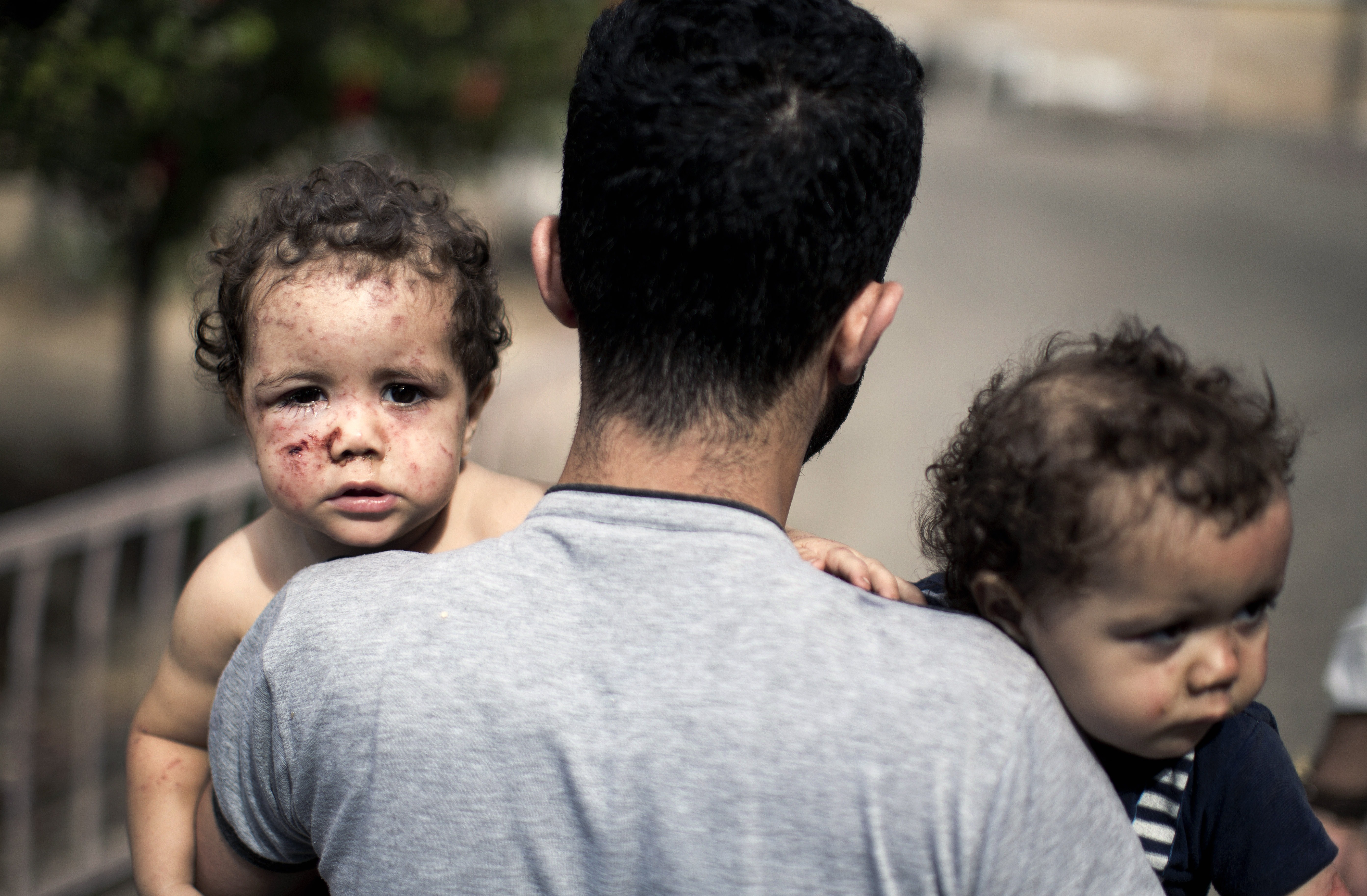
(Photo: A Palestinian man holds his daughters, Shada and Lama al-Ejla, who were injured in an Israeli tank attack, as he leaves al-Shifa hospital on July 18, 2014 in Gaza City. Israel warned it could broaden a Gaza ground assault aimed at smashing Hamas’s network of cross-border tunnels, as it stepped up attacks that have killed more than 260 Palestinians. By Mahmud Hams/AFP/Getty Images.)

How Reagan Handled A Situation Like This

Andrew Rudalevige draws parallels between the MH17 tragedy and the USSR shooting down a Korean Airlines plane in 1983. Reagan’s reaction to it:

Reagan demanded an apology to the world and continued a number of sanctions — but he decided not to end grain sales to the USSR or to suspend arms control talks. George Will argued that “the administration is pathetic…. We didn’t elect a dictionary. We elected a President and it’s time for him to act.”  The Manchester Union-Leader editorialized that “if someone had told us three years ago that the Russians could blow a civilian airliner out of the skies – and not face one whit of retaliation from a Ronald Reagan administration, we would have called that crazy. It is crazy. It is insane. It is exactly what happened.”

Even at the height of the Cold War, however — and keeping in mind that the flight had departed from the U.S., with dozens of American passengers, including a sitting member of Congress – Reagan told a National Security Meeting that “we’ve got to protect against overreaction. Vengeance isn’t the name of the game.”

What Putin And Netanyahu Have In Common

Meeting of Vladimir Putin with Benjamin Netanyahu in Kremlin

Both have been riding nationalist waves of xenophobia – and have done their best to inflame it some more; both believe that military force is the first resort when challenged; both have contempt for the United States under its current president; both regard Europeans as pathetic weaklings and moral squishes; both use a pliant mass media to instill the tropes of paranoia, wounded pride and revenge; both target “infiltrators” in their midst, whether it be African immigrants and Palestinians or gays and Westerners; and both have invaded and threatened their neighbors. Perhaps most important of all: both have lost control to the even more enraged extremists to their right.

Check out the thoughts of  Gleb Pavlovsky as told to David Remnick:

The nightly television broadcasts from Ukraine, so full of wild exaggeration about Ukrainian “fascists” and mass carnage, are a Kremlin-produced “spectacle,” [Pavlovsky] said, expertly crafted by the heads of the main state networks. “Now this has become a problem for Putin, because this system cannot be wholly managed,” Pavlovsky said. The news programs have “overheated” public opinion and the collective political imagination.

“How can Putin really manage this?” Pavlovsky went on. “You’d need to be an amazing conductor. Stalin was an amazing conductor in this way. Putin can’t quite pull off this trick. The audience is warmed up and ready to go; it is wound up and waiting for more and more conflict. You can’t just say, ‘Calm down.’ It’s a dangerous moment. Today, forty per cent of Russia wants real war with Ukraine. Putin himself doesn’t want war with Ukraine. But people are responding to this media machine. Putin needs to lower the temperature.”

Now consider the vigilantes who poured gasoline down the throat of a young Palestinian and burned him alive. Do you think they come out of a vacuum? Or the horrifying tweets of young Israelis proudly urging genocide of Arabs. Or the cheers from the hilltops outside Sderot as Israelis celebrate the slaughter of civilians in Gaza. Or the fact that Netanyahu’s endless provocations have led to a cabinet even more hawkish than he and a country ever further away from any reconciliation with the people whose land it took decades ago.

Both men have the supreme self-confidence of fools; and the political instincts of geopolitical arsonists. Our only hope in restraining them is to watch them slowly hoist by their own canards. The problem is that hundreds of civilians in an airplane and in the crowded streets of Gaza keep becoming the collateral victims of their posturing.

(Photo: Israeli Prime Minister Benjamin Netanyahu and Russian president Vladimir Putin appear during the Security Council meeting in the Kremlin on November 20, 2013 in Moscow, Russia. Netanyahu was on a one-day visit to Russia. By Dmitri Azarov/Kommersant via Getty Images.)

Culpability And Morality In Gaza

PALESTINIAN-ISRAEL-CONFLICT-FUNERAL

Emily Hauser reflects on these thorny questions:

Targeting enemy civilians is a war crime. Let’s not entertain any doubt about that. Hamas and other Palestinian militants have targeted Israeli civilians with rockets for years; the fact that these rockets are crude and their aim poor doesn’t mitigate the simple fact: Targeting civilians is a war crime. Trying to determine who “started” our current state of conflict is not quite so simple, though, unless we accept ideology as fact. For some Jews, the Palestinians started it by refusing to accept our nationalism as ascendant to theirs; for some Palestinians, the Jews started it, in precisely the same way.

If, however, we’re trying to uncover a chain of discrete events leading to the seemingly permanent state of war between Israel and Gaza, the waters are muddy. Did the latest round of rockets come in response to an IDF incursion, or the other way around? Did it start when Israel neutralized a terrorist infiltrator, or was that terrorist a farmer trying to gather crops? Both sides play into the provocation-response cycle, each conveniently forgetting that actions have consequences, often beyond those we first imagined.

Her bottom line:

I have lived under missile attack, and I have family under attack in the south right now. I do not for one moment doubt Israel’s right to self-defense. But even if we set aside the damage and forget the dead, if we remain incurious about the impact both might have on our enemy’s will to compromise – even if all we consider is sheer efficacy – how can we look at this history and believe that repeating past failures will keep the Jewish State safe? Are you safe now?

For Gobry, it is crystal clear that Israel has the moral high ground:

What I have not forgotten is the following: the State of Israel is a democracy with the rule of law and respect for human rights (yes, imperfect, unlike the United States and Europe, which, as we all know, are perfect); demonic hatred of Jews is a real and persistent fact of history and when left unchecked it always leads to atrocities; this demonic hatred is absolutely clearly distilled into the enemies of Israel; and most, most importantly this: if tomorrow Hamas, Hizbullah and other enemies of Israel dropped their weapons, peace would break out; if tomorrow Israel dropped its weapons, a genocide would break out.

There is, there can be, no moral equivalency. Sometimes there really are Good Guys and Bad Guys.

But not to Seumas Milne, who stresses the centrality of the occupation in driving the conflict:

The idea that Israel is defending itself against unprovoked attacks from outside its borders is an absurdity. Despite Israel’s withdrawal of settlements and bases in 2005, Gaza remains occupied both in reality and international law, its border, coastal waters, resources, airspace and power supply controlled by Israel.

So the Palestinians of Gaza are an occupied people, like those in the West Bank, who have the right to resist, by force if they choose – though not deliberately to target civilians. But Israel does not have a right of self-defence over territories it illegally occupies – it has an obligation to withdraw. That occupation, underpinned by the US and its allies, is now entering its 48th year. Most of the 1.8 million Palestinians enduring continuous bombardment in Gaza are themselves refugees or their descendants, who were driven out or fled from cities such as Jaffa 66 years ago when Israel was established.

Waldman argues that justifying Israel’s assault by referring to Hamas’s criminality is “no justification at all”:

It’s been said many times that no government would tolerate rockets being fired into its territory without a response, which is true. But those rockets do not grant Israel a pass from moral responsibility for what it does and the deaths it causes, any more than prior acts of terrorism have. In this as in so many conflicts, both sides—and those who defend each—try to justify their own abdication of human morality with a plea that what the other side has done or is doing is worse. We’ve heard that argument made before, and we’ll continue to hear it. But when we do, we should acknowledge it for what it is: no justification at all.

Actions are either defensible on their own terms or they aren’t. The brutality of your enemy makes no difference in that judgment. It wasn’t acceptable for the Bush administration’s defenders to say (as many did) that torturing prisoners was justified because Al Qaeda beheads prisoners, which is worse. And our judgment of Hamas’s lobbing of hundreds of rockets toward civilian areas tells us nothing about whether Israel’s actions in Gaza are right or wrong.

(Photo: A relative mourns during the funeral of Rani Abu Tawila, a Palestinian who was killed in an Israeli attack, on July 18, 2014 in Gaza city. Israel warned it could broaden a Gaza ground assault aimed at smashing Hamas’s network of cross-border tunnels, as it stepped up attacks that have killed more than 260 Palestinians. By Mahmud Hams/AFP/Getty.)

No Drama Obama vs High Drama Putin: Meep Meep

It’s been a study in contrasts for quite some time. One global leader whips up nationalist sentiment to get sky-high ratings at home; the other glides through another summer of Tea Party dyspepsia with imperturbable equanimity. One leader acts on the world stage by annexing a neighboring country and then threatening it some more; the other slowly and painstakingly ratchets up sanctions, whether it be on Iran or Russia, and keeps his options open. And it all came to a fitting climax yesterday. In the morning, no-drama Obama announces new, tougher sanctions because of intelligence showing deeper Russian assistance for the slowly fading separatists in east Ukraine; and only hours later, Putin’s hot-headed goons, using weapons they clearly are not fully in control of, shoot down a civilian airliner. So who, Mr Krauthammer, looks weak now?

Putin has lost Ukraine, its trade pact with the EU is now signed, and its Russophile separatists exposed as fanatical, fantasizing idiots, while Ukraine elected a new president to chart its future. The Russian economy, already hobbled, could face increasingly strong headwinds, if Merkel decides to press the West’s advantage or finally leverages a real climb-down from Moscow over Ukraine. Obama, on the other hand, has a wide noose around the Russian economy and just increased the odds of deeper EU tightening.

And if the missile that shot down the plane can be traced to Russia itself, then the consequences dramatically widen. And that seems possible this morning. Austin Long points out that a Buk missile launcher would not have been easy for Ukrainian rebels to capture from the Ukrainian government and that the operation of such weaponry is complicated. This leads him to suspect that “the Buk was provided by Russia along with any necessary training”:

This is supported by U.S. and Ukrainian reports last month that Russia had provided tanks and other heavy equipment to the separatists. Notably both the tanks alleged to have been provided (T-64s) and the Buk are older Soviet-era equipment that Russia would not miss but would also be plausibly present in Ukrainian arsenals. This allows the Russians to retain a figleaf of plausible deniability about the equipment.

If Russia is directly involved in this way, it seems to me that Putin has now over-reached in such a way that all but destroys what’s left of his foreign policy.

And Josh Marshall’s right that the spectacle of Russian cluelessness, amateurism and recklessness could be the worst news of all for Putin. If there’s one thing a neofascist Tsar cannot afford it’s the appearance of incompetence and chaos.

Leonid Bershidsky, meanwhile, declares that “the separatists’ campaign is doomed.” He argues that there “is no chance of the rebels marching on Kiev or even making secession work: They are too weak for that, and after MH17, they have lost their last shreds of moral authority”:

If Putin keeps backing the insurgents until their inevitable defeat, his international isolation will deepen, as did that of the Soviet Union’s leaders after their jets shot down a Korean passenger jet in 1983, and former Libyan dictator Muammar Qaddafi after the 1988 bombing of a PanAm airliner over Lockerbie, Scotland. Malaysia, a Muslim nation that has long fought American influence, can hardly be expected to listen to Russian fairy-tales about the crash. The developing world will now join the West in condemning the rebels — and Putin as their only ally.