And The Beat Goes On

https://twitter.com/jetpack/status/490124421567635456

As Netanyahu vows a “significant expansion” of the ground offensive in Gaza, the WaPo’s live blog updates the body count so far:

Israeli forces launched a ground operation in Gaza Thursday night. Since then: 28 Palestinians and one Israeli soldier have died. This brings the Palestinian death toll to more than 260, with more than 2,000 injured. The Israeli death toll is at 2.

Emma Green digs deeper into how the toll of the conflict is measured and how that contributes to the media narrative:

Even the tallies of rockets fired and shelling exchanged aren’t simple: The numbers themselves are imbued with meaning. The New York Times has a running count of “the toll in Gaza and Israel, day by day“; aggression from Hamas is measured in “X rockets launched from Gaza,” while aggression from Israel is measured in “X targets struck by Israel.” The unit of measurement is the important part: Palestinian firepower is measured as discrete weapons, rockets that Hamas is intentionally hurling at Israeli civilians. Israeli firepower is measured in hits, which are called “targets” (not people, or houses, or “militants”). And yet the two numbers are placed side by side for comparison, implying clarity of fault, or even clarity of what’s happening on the ground in Gaza and southern Israel.

Gregg Carlstrom expects no breakthroughs anytime soon, partly because Hamas’s conditions for a ceasefire are unacceptable to Israel and Egypt:

Hamas has been clear about its demands since the conflict began: It wants Israel to lift the siege of Gaza, and to release the dozens of prisoners freed in the 2011 deal for captured Israeli soldier Gilad Shalit, who were rearrested this summer in the wake of the killing of three kidnapped Israeli teens. Neither of these demands, however, are politically viable. Members of Netanyahu’s government, including the hawkish Economy Minister Naftali Bennett, have demanded an end to prisoner swaps. And the military-backed government in Egypt, which labeled Hamas a terrorist organization and spent a year demonizing the Muslim Brotherhood, is unlikely to agree to open the Rafah crossing with Gaza.

Comparing the situation in Gaza to the US military’s experience in Fallujah, Iraq, in 2004, Juan Cole expands on his longstanding argument that Israel can’t achieve permanent “quiet” with force:

The Israelis cannot actually destroy Hamas or its capabilities as long as significant numbers of Palestinians in Gaza support it. That support is political, having to do with the organization’s role in at least trying to stand up to Israeli oppression, occupation and blockade. Just as the enemies of the US ultimately prevailed in Falluja, so the enemies of Israel will prevail in Gaza.

Oppression and occupation produce resistance. Until the oppression and the occupation are addressed, the mere inflicting of attrition on the military capabilities of the resistance will not snuff it out. Other leaders will take the place of those killed. If Israel really wanted peace or relief from Hamas rockets, its leaders would pursue peace negotiations in good faith with Hamas (which has on more than one occasion reliably honored truces). Otherwise, invading Gaza will have all the same effects, good and bad (but mostly bad) that the US invasion of Falluja had on Iraq.

The Lusitania Of The 21st Century?

1024px-RMS_Lusitania_coming_into_port,_possibly_in_New_York,_1907-13-crop

It was, eerily enough, 99 years ago, and the parallels are a little too close for comfort. A reader writes:

When I heard of the plane having been shot down yesterday, I immediately thought of the Lusitania. Now, that was probably mostly because I’m currently working on finishing my dissertation which includes a chapter on World War I. And while as a historian, I am quite aware that history doesn’t simply repeat itself and that the current situation is indeed very different from the one a hundred years ago, there are a few takeaways from the sinking of the Lusitania.

The passenger vessel was torpedoed by German submarines in 1915 after Germany had declared the waters around the UK a war zone. 1,198 people on board lost their lives. Among them were 128 U.S. citizens. This act of aggression against a civilian target caused the American public’s attitude toward Germany to change and made America’s entry into the war in 1917 easier.

We are in a very different situation now. The skies above Ukraine were not declared a war zone by Russia. Russian military (as far as we know) did not shoot down this plane. But the Russian supported separatists in Eastern Ukraine apparently did. With Russian support of these separatists (including apparently military equipment), this puts Russia in a similar predicament that Germany was in after the sinking of the Lusitania.

Similar in the following aspects:

Russia and the separatists so far had several important countries that showed sympathies towards their position. It has also received support from parts of the population of several Western countries, even though their governments were sympathetic towards the Ukraine. This may now well change – just as sympathies towards Germany changed after the Lusitania sinking, especially with so many citizens of Western countries among the dead. Will this lead to additional sanctions? Yes. Will there be military retaliations? Highly unlikely. Will this be a repeat of World War I? No. History doesn’t simply repeat itself. But we can learn lessons from it. Let’s hope Mr. Putin does.

I do too. I’ll note, however, Putin’s willingness to tell bald-faced lies about the situation in Ukraine, his Cheney-esque inability to admit error, and the highly pitched nationalist atmosphere his entire political standing now rests on. I’ll also note the pathetic unwillingness of the Germans and the Italians and the British to enact any serious sanctions so far (including Merkel’s refusal to commit to anything yesterday); and the somewhat Putin-supportive words from the Chinese government, decrying a rush to judgment on who shot down the plane.

This is a 21st Century tragedy born of a 19th Century farce.

What If You Had A Waiting Period For Your Prostate Biopsy?

Marcotte applauds a bill in Congress that would prohibit targeted restrictions on abortion providers:

It’s called the Women’s Health Protection Act, and it would end the attacks on abortion clinics through one simple measure: requiring states to regulate abortion providers in exactly the same way they do other clinics and doctors who provide comparable services. No more singling out abortion providers. …

Want to force women seeking abortion to listen to a script full of lies and then make them wait 24 or 48 hours to think it over? Better be prepared to do the same for people who need colonoscopies. Want to require a bunch of unnecessary visits before a woman is allowed to have a procedure? Now you need to do that for a biopsy, too. Want to force abortion clinics to meet ambulatory surgical center standards and abortion providers to have hospital admitting privileges? Well, dentists will have to meet the same standards before they can drill a tooth.

Because a tooth has the same moral standing as a fetus. And this is apparently self-evident. Callie Beusman concedes that “there’s basically no chance that the bill will pass the GOP-controlled House” but adds, “that doesn’t mean it’s not significant”:

It serves the valuable purpose of asking Republicans to explain the disingenuous, unsupported reasoning behind the scores of excessive regulations they’ve imposed in the past few years. As [sponsor Richard] Blumenthal notes, this may effectively remove the “patina of respectability” from the whole ridiculous charade. Which would be a very welcome change indeed.

Meanwhile, Elizabeth Nolan Brown mulls over the proper libertarian response:

Putting an end to this sort of infringement on women’s abortion access is a noble goal. But it’s one thing to fight states passing these types of laws and another to say the federal government should pass a law blocking states from passing these types of laws. If the state laws are unconstitutional, shouldn’t that be left to the courts to determine? Why a federal act? …

I put this question to some libertarians I know, inside and out of Reason, and received a range of responses. Some pointed out that the text of the Women’s Health Protection Act was very vague—under what standard do we determine if an abortion restriction is “medically unwarranted” or oppressive? And under what constitutional provision is Congress claiming the power to enact this law?

But others said that when it comes to protecting individuals from government intrusion, federal action can be appropriate; and where government is passing laws to restrict itself to uphold the Constitution, that can be a good thing. “I’m a peoples’-rights advocate, not a states-rights advocate,” as one Facebook friend commented. “What matters is if individual liberty is, on net, increased.”

Meanwhile, Ted Cruz describes the bill as  “a very real manifestation of a war on women … given the health consequences that unlimited abortion access has had on many women.” It will be interesting to see if “many women” agree.

Why Undertipping Makes You A Real Jackass, Ctd

More readers chip in:

The tipping debate seems to rear its head somewhere online every year or so now, and I’ve never understood what the big fucking deal is. I’m a former server, bartender, and front-of-house manager; I’ve worked at family restaurants and bars in the Midwest and a tourist trap in New York City (which was probably the most fun job I’ve ever had). My experience is far from exhaustive – there are plenty of people who’ve been in the industry longer and worked at more places in more parts of the country – but I have some idea what I’m talking about, and I am staunchly pro-tipping. Here’s why:

1. I’ve never heard a server complain they weren’t making enough. Whenever I hear some concerned soul expressing anxiety over how servers need to stop getting tipped and be paid a real minimum wage, I’m reminded of the activists who want to stamp out all sex work without asking any sex workers how they feel about it. There were a lot of things that bugged me about waiting tables, but the money I made was never one of them. Yes, you can have a bad shift. Generally speaking, though, my coworkers and I came out making substantially more per hour in tips than we would have getting paid minimum wage. (I will absolutely grant that this may not be the case at every establishment, especially right now – but I would guess that’s more a function of the economy than of tipping itself.)

2. Tipping gives everyone more freedom and flexibility. As you rightly noted, if restaurants have to pay higher hourly wages, they are going to build that additional expense into the cost of the meal. So the customer will still end up spending the money. As a customer, wouldn’t you rather be able to exercise control over where your money goes? With tipping, if you get crappy service, you pay for your food and can leave your server what little or none they deserve. Without tipping, you’re paying for your food and you’re paying a premium for the service, regardless of quality. (Also: If the anti-tipping crowd really thinks all the additional money from raising prices would make its way into servers’ pockets, I think they’re deluding themselves about how businesses work.)

3. Tips are fun!

I never see anyone talk about this, but tips are largely what makes waiting tables fun. It’s a little game – I think I’m doing a good job. How much are they gonna leave me? Tipping encourages upselling, which is good for the business, good for the economy, and, frankly, a plus for diners. (I’ve never seen anyone uncomfortably coerced into ordering dessert or another drink; I have known hundreds of customers who just needed a little nudge and were very glad for it.) And it’s so much fun to pick up the cash or the credit card slip after they leave. Plus, for all the cheap jerks out there, there are also many people who overtip, especially on special occasions. Sure, hypothetically they still could do so if we abolished tipping as a general practice – but in reality, it wouldn’t happen nearly as often.

Waiting tables is a sales business, and salespeople tend to be motivated by commission. Tips are our commission. Why do people want to take that away, just so (1) we can make less money, (2) they can be forced to pay more for bad service, and (3) we can enjoy our jobs less?

Another is less enthusiastic about the practice:

I wish tipping would go away. It would level the playing field in other ways.

Currently, I overtip because I drink water with restaurant meals – no soda, no alcohol, no coffee or tea, no milkshake. So my check is smaller even though I’m in the seat for the same amount of time as a person having a glass of wine with the meal. I feel I shouldn’t shortchange the waitstaff for my abstinence.

The thing is, I’ve noticed some places the tips appear to be dumped into a common container and pooled. This may help reduce fraud and split the money equally, but it doesn’t reward the server who recognizes me and gives good service. Furthermore, it means my more generous tips just subsidize someone else’s cheapness.

Set the price based on what running the restaurant costs. Stop tipping in all but the really high-end restaurants, and consider stopping it there. Tipping in restaurants is kind of like John Oliver’s “America Ball” lottery, where the servers in high-end venues get richer, but servers at all other restaurants don’t receive increases consonant with the cost of living because people refuse to tip generously, can’t afford to tip, or are living so long their ingrained tipping habits result in undertipping. There are also teens who go on group trips – say, a sports clinic at a nearby college – eat someplace where they are waited on, and totally stiff the servers because either they’re poor, short of money or ignorant because they’re used to paying for fast food, where the labor cost is part of the posted prices.

2408593449_f40a675123_zI hope this would mean that places like sandwich shops and bagel stores, which never had tipping but have to pay minimum wage, would stop with the tip jar by the register, too. Delis and doughnut shops never used to do that kind of begging until the minimum wage stagnated and someone decided taking your order was the same as providing table service. I guess that proves I’ve become an old fogey, too, if not a jackass in one respect.

(Photo by Flickr user Lightsight)

The Case For Cameras In The Jailhouse

Pell v. Procunier, which upheld the constitutionality of the California Department of Corrections’ decision to forbid press interviews with specific inmates, was decided 40 years ago this summer. Looking back on that ruling and on Angela Davis’ famous 1972 prison interview (above), Adrian Shirk traces the ruling’s ramifications through the decades and explains why the rarity of such interviews today is a bad thing:

Since Pell v. Procunier, access to inmates has diminished steadily from coast to coast.

In 2013, media-access scholar Jessica Pupovac noted in The Crime Report that today, “at least five states (Arizona, Alabama, Georgia, Louisiana and Michigan) make any access the exception to the rule” and that Kansas and Michigan flat out refuse to arrange interviews with specific inmates. In Florida, Kansas, Michigan, New York, and New Hampshire, inmates must “put reporters on their visitation or phone call list if they wish to speak to them, thus forfeiting a visit or call with family or friends.” In Wyoming, officials can screen all questions ahead of time, and if an interview veers from the approved list, a minder can end it. Even state correctional departments that don’t explicitly deny media access to specific inmates still have sanction under Pell to make ad-hoc restrictions and deny access on a case-by-case basis. Meanwhile, the California State Correctional Manual remains unchanged.

The fact that journalists are still allowed direct contact through mail protects a decent portion of testimonial integrity. But what if the inmate is illiterate? Or dyslexic? Or simply can’t communicate well on the page? The ruling also assumes that visual and sonic information is not integral to reporting and does not carry its own unique body of information. In Freedom of the Press: A Reference Guide to the United States Constitution, Lyrissa Barnett Lidsky and R. George Wright propose that while a document like Martin Luther King Jr.’s “Letter from the Birmingham Jail” may have had deeper and broader effects than any number of broadcast interviews, a “televised interview may convey a sense of visual immediacy and dynamism far beyond the capacity of typical letter writing or letter reading.”

Teaching To The Text

Meredith Broussard argues that standardized tests measure “specific knowledge contained in specific sets of books: the textbooks created by the test makers”:

All of this has to do with the economics of testing. Across the nation, standardized tests come from one of three companies: CTB McGraw Hill, Houghton Mifflin Harcourt, or Pearson. These corporations write the tests, grade the tests, and publish the books that students use to prepare for the tests. Houghton Mifflin has a 38 percent market share, according to its press materials. In 2013, the company brought in $1.38 billion in revenue.

Put simply, any teacher who wants his or her students to pass the tests has to give out books from the Big Three publishers. If you look at a textbook from one of these companies and look at the standardized tests written by the same company, even a third grader can see that many of the questions on the test are similar to the questions in the book. In fact, Pearson came under fire last year for using a passage on a standardized test that was taken verbatim from a Pearson textbook.

Jarvis DeBerry adds:

If standardized tests are going to be based on textbooks that school systems can’t afford, [Broussard] writes, then you can guarantee that poor school districts are going to fail. She points out that in the 2012-13 school year, a school in Southwest Philadelphia used a reading curriculum by Houghton Mifflin called the Elements of Literature. The textbook paired with that curriculum costs $114.75. The school’s entire textbook budget per child? $30.30.

Update from a reader:

So we’ve gone from “teaching to the test” to “teaching to the text?” What’s the difference? None, actually! And what’s wrong with either of them? Why would you NOT want to test for the success of what you’ve taught or trained students to do? It’s absurd that this would even be a question.

Would you give a test in physics for a class in English? Well, maybe if you wanted to test the student on the reading of physics, but in order to do that you have to be able to understand physics. Reading is for one of two things – pleasure or gaining knowledge – and in order to comprehend one of the key elements is background knowledge.

Background knowledge, or rather the lack of it, is the root of the reading problem. If a child from an impoverished area has never heard of let alone seen about painting a fence, how can they even understand the concept?

Standardized testing is a problem. Personally, I believe it should never be used in measurement for evaluating. It should be a tool to decide what is missing and what needs to be the next step. Politicians and corporations are responsible for the evaluating turn. The tests are written for recall and regurgitation. They do not show what a student is capable of accomplishing.

The Common Core has been assailed for many different reasons. The #1 we’ve seen is parents not understanding the questions. Louis C.K. made a big deal because of a math problem his daughter had that he couldn’t understand. He said there was no answer. There was an answer, but he was looking for 2+2=4 and the question asked why the student had solved the question incorrectly. No one tried to even identify the multiple problem solving steps that had to be in play. Well, at least the adults didn’t; all they did was bitch because they actually felt stupid – well, ignorant actually. A 4th grader would be trained to answer the problem; the first step they have to take is to solve the stated question correctly; they then work back to see what the other student did incorrectly. This, in itself, is invaluable.

Education has this problem of reinventing the wheel. It usually comes from the insistence of outside influences. Influences that have no idea of what they speak. Something interesting has been quietly happening in schools around the country. Teachers & principals are re-finding John Dewey’s Progressive Education. They are also being incredibly successful, not only with the kids but also doing better & better on the standardized tests.

Oh, if you look closely at Common Core, you can discover that most of it is based on John Dewey. Here is a link to Wiki. If you just look at the bullet points at the beginning, you can get an idea of what it’s about – Progressive Education.

Haute But Reheated

fast foie gras

Sandra Haurant reports on a new French law that asks restaurants to label their dishes as from-scratch or otherwise:

It might be surprising that a country whose cuisine has World Heritage status needs such a law. And yes, there are plenty of restaurants across France serving delicious freshly cooked food. But midrange restaurants in particular have faced criticism for using factory-made shortcuts in the kitchen.

A survey carried out by French catering union Synhorcat suggested 31% of restaurants (not including cafeterias, bars and fast food outlets) used industrially prepared foods Others claim the proportion is much higher – Xavier Denamur, restaurateur and fresh-food campaigner and filmmaker, carried out his own personal survey, which took him to dozens of restaurants throughout France. He believes closer to three quarters of restaurants relied on industrially produced food.

Lizzie Porter, meanwhile, argues that French cuisine’s greater flaw is monotony, which bureaucratic intervention doesn’t address:

[T]he last thing France needs is yet more rules and symbols to nurture and promote its best cuisine. Already, diners are confronted by an army of stamps and logos that purportly mark quality. Label Rouge denotes free-range eggs and poultry “reared using traditional, free-range production methods”, for example, while AOC – “appellation d’origine contrôlée” (controlled designation of origin) – specifies products, including cheese, meat, lavender and lentils, which have been grown and processed by specific producers in designated geographical areas.

The ins and outs of all the various quality stamps are enough to leave even the most passionate foodie scratching his or her head. Indeed, the proof is in le burger when it comes to younger French generations, who seemingly cannot get enough of fast food chains like McDonald’s and Quick (a French version of Maccy D’s). And when the first Parisian Burger King opened last year, locals queued around the block for a taste of the Whopper.

While France has commendably preserved an independent restaurant industry and pockets of excellent regional cuisine, the latter of which has all but fallen by the wayside in Britain, its haughty belief that its classics are better than everyone else’s is the bigger concern. Instead of stifling restaurant owners with another layer of bureaucracy with which they may comply (inspections on restaurants claiming to offer food “fait maison” are to come into force next year), the French government would be better to foster an environment in which diversity and ingenuity in cooking are encouraged.

(Photo by Amy Ross)

Harassment In The Field

Not even scientists are safe from it:

The paper, published in PLOS ONE, surveyed more than 600 anthropologists, archaeologists, biologists, zoologists, and other scientists about their experiences while doing fieldwork away from the university. And the picture was disturbing – here were many experiences of sexual harassment and assault, as well as little awareness of how to report abuses.

Now, the survey was not a random sampling of researchers – so this can’t be used to extrapolate the frequency of sexual harassment. But it’s the best existing data set yet on harassment and assault within science. And the data suggests that this indeed an issue in need of closer attention.

Brandy Zadrozny delves into the findings:

Incidences were much more common with women: 71 percent of women reported harassment and 26 percent reported assault on site, compared to men’s 41 percent and 6 percent respectively. …

[T]he majority of women victims were subordinates who oftentimes worked directly under their perpetrators, while harassment aimed at men usually came from peers. Similar to existing harassment research that shows the most vulnerable are often predominantly targeted, 96 percent of women reported they were trainees or employees at the time of unwanted sexual attention. Five were still in high school.

Caelainn Hogan revisits one woman who came out about her experiences:

Two years ago, a young woman identified as “Hazed” spoke out about her experience of sexual harassment in the field and her professor who joked that only “pretty women” were allowed work for him, confiding in [study coauthor Kate] Clancy who made the story public in a blog post on Scientific American in 2012. “There were jokes about selling me as a prostitute on the local market,” the young woman wrote. The size of her breasts and her sexual history were openly discussed by her professor and her male peers, and daily pornographic photos appeared in her private workspace. “What started out as seemingly harmless joking spiraled out of control, I felt marginalized and under attack, and my work performance suffered as a result,” she wrote.

Henry Gass notes that this is the first study to examine harassment during scientific field studies:

The trips can last for weeks or months, taking scientists to wild and remote areas, far from home and support systems. …. While there isn’t much data to support it, [Study coauthor Katie] Hinde said many survey respondents had described a “what happens in the field, stays in the field” attitude. “I speculate that yes, some academics consider ‘the field’ as different from other workspaces such as the office, lab, or classroom in such a way that relaxes or suspends workplace norms of behavior,” Hinde wrote in a follow-up email.

The Best Of The Dish Today

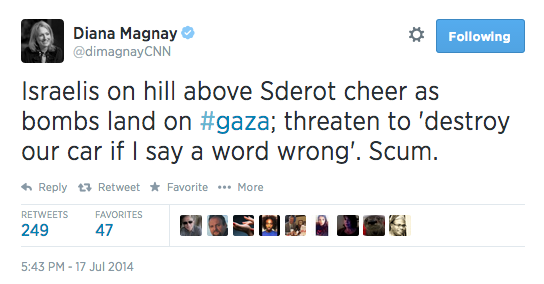
Dorsey Shaw flags the above video and notes that “a few minutes later, the reporter, CNN’s Diana Magnay, tweeted this and then deleted it about 20 minutes later:”

enhanced-31646-1405634778-17

She was right the first time. As if on cue, the US Senate passed a resolution backing Israel’s new invasion of Gaza:

Sens. Bob Menendez (D-N.J.) and Lindsey Graham (R-S.C.) authored S.Res. 498, which reaffirms Senate support for Israel, condemns unprovoked rocket fire and calls on Hamas to stop all rocket attacks on Israel. “The United States Senate is in Israel’s camp,” Graham said on the Senate floor Thursday.

We knew that already, Butters. Only too well.

I have only two thoughts about the horrifying events in Ukraine. First, a prayer for the souls lost and their loved ones. Second, a provisional inference: If the plane was downed by the Russian separatists – as seems pretty obvious from the smoking gun audio – then Putin has just found out how reckless grandstanding can come back and bite you back in the posterior. It will change a huge amount in the fraught politics between Putin’s neo-fascist Russia and Europe. The new Tsar will soon have a choice: to keep lying and become an international pariah, or to back down and get a grip. I suspect he’ll keep lying … and quietly back down. But these are Thursday night conjectures. They may evaporate with more information by the morning.

You can read all our Ukraine coverage of today in one place here. And you can read all our coverage of the Gaza war in one place here.

We’re now at 29,550 subscribers. You can join them and help get us to 30,000 here – and get access to all the readons and Deep Dish – for a little as $1.99 month. Gift subscriptions are available here. A new Dishhead writes:

Just wanted to say I subscribed this evening for the first time. I discovered your blog a few months ago when that horrendous gay discrimination bill in Kansas blew over and was really impressed with the quality of the discussion, so I’ve stuck around since then, religiously reading the posts as they come in. After today’s one-two punch of the Israeli invasion of Gaza and the shooting down of the plane over Ukraine, coming here for the news is like night and day compared with the sensationalism of traditional media. Looking forward to scouring the Deep Dish in the weeks to come. Keep it up.

See you in the morning.