Will Israel Crush Hamas?

That appears to be the objective as IDF ground troops continue to infiltrate Gaza:

This morning’s reports that a cease-fire could occur by Friday morning are now looking much less likely. “The IDF’s objective as defined by the Israeli government is to establish a reality in which Israeli residents can live in safety and security without continues indiscriminate terror, while striking a significant blow to Hamas’ terror infrastructure,” the Israel Defense Forces said in a statement late Thursday, confirming it had begun a ground operation in Gaza.

“The prime minister and defense minister have instructed the IDF to begin a ground operation tonight in order to hit the terror tunnels from Gaza into Israel,” Benjamin Netanyahu’s office confirmed. “In light of Hamas’ continuous criminal aggression, and the dangerous infiltration into Israeli territory, Israel is obligated to act in defense of its citizens.” Casualties have already been reported.

Josh Marshall interprets this as a sign that Netanyahu has capitulated to his coalition’s right flank:

The backstory on the Israeli side has been a tug of war between the military chain of command and the government over whether to intensify the campaign in Gaza and whether to launch a ground invasion. The military, cognizant of 2009, has generally been trying to avoid an intensification of the campaign. And Netanyahu himself seems to have been generally siding with the generals, but with intensifying demands from members of his own government for a full out ground assault. As the rocket fire out of the strip has continued, the pressure to launch a ground invasion has escalated. That question now seems to have been answered.

While that may be the case, Yishai Schwartz argues, “the more likely explanation is that Israel just didn’t have any other options”:

Israel could have continued its aerial and artillery exchanges with Hamas, but this campaign did not appear to be damaging either the will or the capability of Hamas. It could have loosened its rules of engagement and struck Hamas more effectivelybut doing so would have inflicted unconscionably disproportionate civilian damage. It could have capitulated to Hamas’s ultimatums to release hundreds of security prisoners and reopened Gaza to shipments of arms- and tunnel-making materials. Apart from the moral implications of such a concession, doing so would simply have strengthened Hamas and ensured additional fighting. An extended cease-fire would be ideal. But so far, Egyptian attempts to broker such a cease-fire seem to have fallen on deaf ears. So Netanyahu was left with a choice that wasn’t really much of a choice.

Fred Kaplan believes Israel is no longer thinking strategically:

[L]et’s say an invasion crushes Hamas, a feasible outcome if the Israeli army were let loose. Then what? Either the Israelis have to re-occupy Gaza, with all the burdens and dangers that entails—the cost of cleaning up and providing services, the constant danger of gunfire and worse from local rebels (whose ranks will now include the fathers, brothers, and cousins of those killed), and the everyday demoralization afflicting the oppressed and the oppressors. Or the Israelis move in, then get out, leaving a hellhole fertile for plowing by militias, including ISIS-style Islamists, far more dangerous than Hamas.

Either way, what’s the point?

Mataconis speculates:

This could simply be a relatively small operation on Israel’s part designed to maximize the gains it has made against Hamas in the current conflict before a cease fire takes hold. That is not an uncommon tactic in war, of course, so it would make sense if that’s what’s going on here. For the moment at least, though, there doesn’t seem to be any indication that the military is limiting its objectives in this operation, and Hamas seems to be fighting back as vigorously as they can. Given all that, I’d put the odds of a cease fire at any time in the [near] future as being pretty slim if not non-existent.

Indeed, ceasefire talks are going nowhere fast:

Earlier in the day, Palestinian Authority President Mahmoud Abbas and Arab League Secretary-General Nabil Al-Arabi conducted cease-fire talks in Cairo. The session was also attended by an Israeli delegation but it left after several hours of discussions. For the time being, Arab diplomats in New York were waiting to see whether talks in Egypt on a cease-fire progress before deciding whether to turn to the U.N. Security Council for help in stopping the fighting. “There is intense effort being made by President Abbas in Cairo in trying to finalize what would be a cease-fire,” said one Arab diplomat. “That’s where all the efforts are for the moment.”

Even if a ceasefire does takes hold, Ibrahim Sharqieh stresses, nothing will be resolved:

It is delusional to assume that when the current battle ends, both parties will return to their communities to resume normal lives. The Israeli-Palestinian conflict has created two meanings of normality. The 40,000 Israeli reservists who were called up this time will, for the most part, go back to their jobs and homes when the fighting ends. But Gazans, 39% of whom are unemployed, will go back to their “normal” lives under the brutal conditions of the Gaza blockade and be at the mercy of Israel’s rules about what type and quantity of food and other basics are allowed into Gaza. The Palestinians in the West Bank will go back to their daily humiliation of roadblocks and expanding Israeli settlements at the expense of their livelihoods. …

To prevent another tragic war in the future, things must change. Palestinians mainly need two things: dignity and bread. Israel must end the occupation in general and the Gaza blockade in particular. The mistake of the 2008 and 2012 mediation efforts was that they produced cease-fires that allowed the Israelis to go back to business as usual — but left the Gaza blockade intact and perpetuated untenable conditions, which led to further and bloodier fighting.
The Timing Of Our Sanctions

It’s quite a coincidence. Yesterday, before today’s tragedy, the US Treasury announced new sanctions on a number of Russian individuals and businesses. Beauchamp tries to understand the rationale behind them:

What’s the point of imposing them now?

“I’d assume it’s the blatant transfer of Russian weapons to the rebels,” Dan Drezner, a professor at Tufts’ Fletcher School and an expert on sanctions, said. Indeed, Russia has been openly dumping weapons — including tanks and rocket launchers — into East Ukraine. That’s because the Ukrainian military had been slowly getting the upper hand over the Russian-backed separatists, including retaking two major rebel-held cities, Slovyansk and Kramatorsk, in early July.

Keith Johnson and Jamila Trindle explain the sanctions:

Despite the tough talk, the United States didn’t cut off whole sectors of the Russian economy, but it went after four big energy and finance firms. The Treasury Department banned a pair of big Russian banks — Gazprombank and VEB, Russia’s state-owned development bank — from issuing any new debt or equity in U.S. markets. It also banned two energy giants, Novatek and Rosneft, from tapping U.S. debt markets. But the United States did not target Gazprom, Russia’s mammoth oil and gas firm, directly. The United States also blacklisted eight Russian arms firms and a list of senior Russian officials.

The sanctions announced Wednesday will essentially close U.S. capital markets to those big firms. That limits those big firms’ abilities to roll over or refinance their debts, making it more expensive for them to borrow new money. Officials said those firms would likely have to turn to Russia’s Central Bank to try to fill their financing needs.

Leonid Bershidsky is unimpressed:

[The announcement] names large companies such as the state-controlled oil major Rosneft, second-biggest natural gas producer Novatek, third biggest bank, Gazprombank, and government-owned development bank, VEB, which makes for impressive headlines. But the sanctions against them are narrow.

The banks are not banned from dollar clearing, and Gazprombank-issued Mastercard and Visa cards will still work, unlike for a few previously sanctioned small Russian banks. The energy companies can still trade with U.S. entities. Igor Sechin, Rosneft CEO and Putin’s close friend, says he is confident his company’s several big projects with ExxonMobil are going ahead, and nobody in the U.S. has contradicted him.

The only thing denied to the big Russian companies will be new financing with a maturity of more than 90 days from U.S. entities and individuals. The markets have already taken care of that: In recent months, it has become hard for Russian public and semi-public companies to line up foreign credit.

Although the new sanctions include “tons of loops and caveats,” Ioffe is persuaded that they might be effective in the longer term:

In sum, it’s a gradual ratcheting up, as slow-motion as the conflict on the ground. But it’s definitely a powerful crank of the handle. Take, for instance, ExxonMobil: the sanctions don’t kill its multi-billion-dollar deal with Rosneft outright, but they might eventually. The official said that these sanctions “don’t provide an exemption for Exxon.” Under this latest order, certain types of transactions and refinancing could easily be blocked, throwing the whole deal into jeopardy. (Apparently, these plans weren’t shared with Exxon in advance and the sanctions team seems pretty indifferent to the oil giant’s coming travails. “What they do now I cannot say,” the official said.)

“It’s as much a signal to Wall Street as it is to the Kremlin,” says [the head of Russia research for the Eurasia Group, Alexander] Kliment. “While the measures are limited in certain ways, the U.S. is making clear that its not scared to go after major Russian companies. It’s a pretty wide noose at the moment, but it’s one the U.S. is prepared to tighten.”

Robert Kahn is cautiously optimistic that the sanctions will bite, especially if Europe plays along:

It is not quite full “sectoral” sanctions–both because it is limited in what it blocks (new debt and equity of maturity greater than 90 days) and because it excludes Sberbank, which holds the majority of Russian deposits. But I would argue that the reach of this new executive order in terms of institutions covered is sufficiently broad that the effects on the Russian financial system could be systemic.

Europe chose not to match these sanctions, so it is critical that large European banks not fill the gap left by the withdrawal of U.S. banks.  Moral suasion from European leaders on their banks (and the desire of those banks not to run afoul of U.S. law in this space post BNP/Citi fines) should be effective, and U.S. officials appear confident that the easy loopholes are closed.  In addition, if any leg of the transactions require U.S. institutions, the deals will fail based on U.S. action alone.  In this sense, the U.S. can go ahead of Europe and pull them along.

Henry Farrell wonders if the downing of MH17 will push EU leaders to impose harsher sanctions of their own:

If it turns out that Russian sponsored rebels have used Russian advanced weaponry to down an aircraft bound from the Dutch capital to Kuala Lumpur, it may transform Europe’s debate, and make it far harder for countries like Italy to remain holdouts. EU member states – like all states – tend to be pretty hard nosed about pursuing their self-interest, and it could be that several countries would prefer to limit their actions to rhetorical condemnations. …

However, as Frank Schimmelfennig shows in his account of bargaining over E.U. enlargement, states can also find themselves “entrapped” by rhetoric into taking positions that run counter to their true preferences.

But, even if the EU decides against new sanctions, Russian trade with Europe is already on the downslope:

According to new data out today (pdf), trade with Russia shrank particularly sharply in the first four months of 2014, a period that includes the annexation of Crimea in March and a few rounds of EU travel bans and asset freezes against Russian officials. The EU’s imports from Russia—mainly oil and gas—fell by 9% in the year to April, while exports from the EU to Russia dropped by 11%. Given steadily souring relations, further declines seem likely. …

But even without explicit sanctions, the EU has been hitting Russia where it hurts. Various technical and bureaucratic hurdles have been erected to limit the flow of Russian gas into the EU via Germany, Ukraine, and a proposed southern pipeline. Today the EU delayed, again, a decision on allowing more Russian gas to flow through a pipeline to Germany. Structural, long-term dynamics in global energy markets won’t be kind to Russia’s key exports, either. It all adds up to more trouble ahead for Russia’s sputtering economy.

The Dish covered the two previous rounds of US sanctions on Russia here, here, here, and here.

What The Hell Just Happened Over The Skies Of Ukraine? Ctd

UKRAINE-RUSSIA-POLITICS-CRISIS-MALAYSIA-ACCIDENT-CRASH

The latest developments via Twitter:

A reader reacts to that statement:

That’s all I need to know that Russia and/or its Ukrainian rebels shot down the airline. Putin is preemptively seeking to muddy the waters of blame.

All of our crash coverage is here.

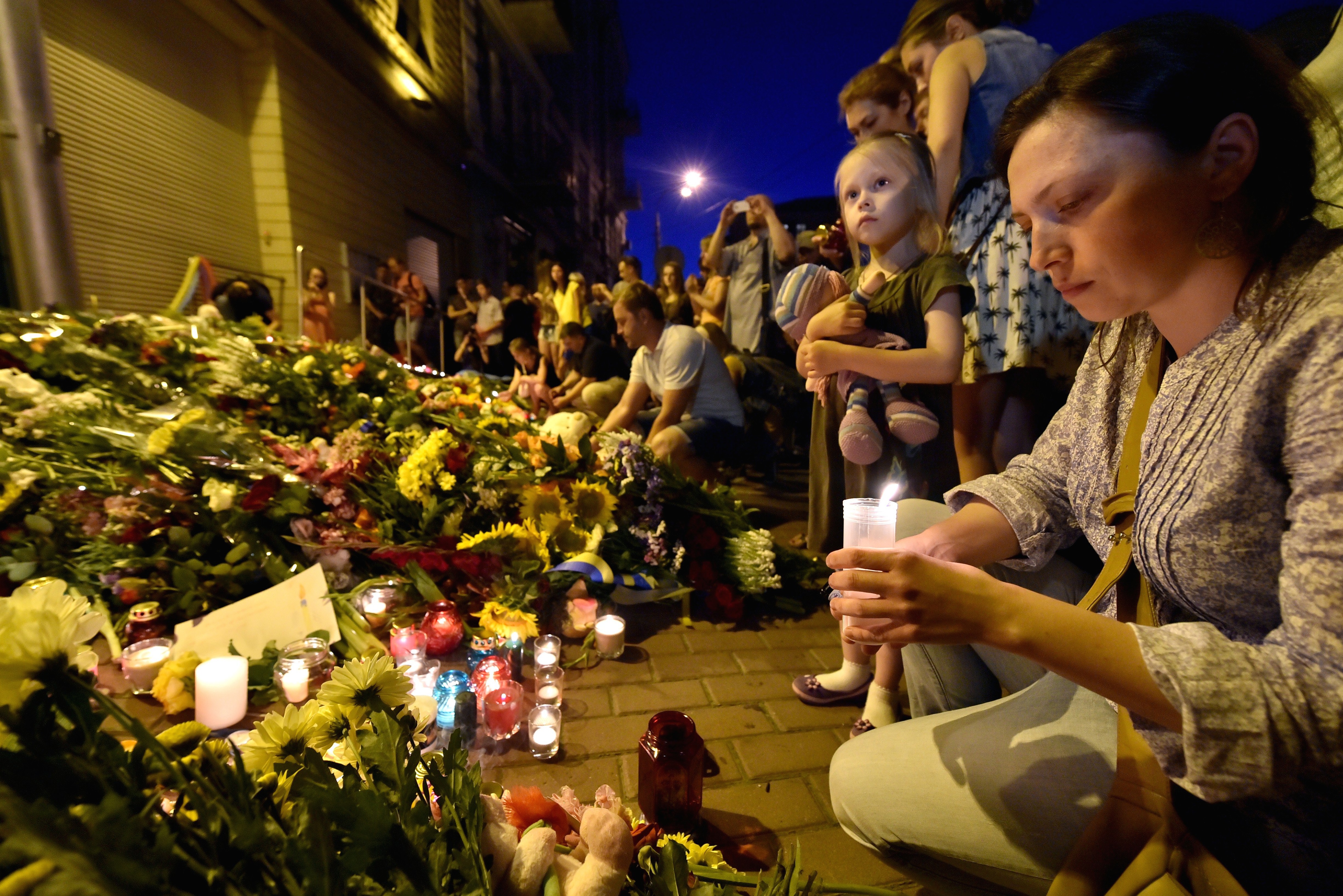
(Photo: A woman lights a candle in front of the Embassy of the Netherlands in Kiev on July 17, 2014, to commemorate passengers of Malaysian Airlines flight MH17 carrying 295 people from Amsterdam to Kuala Lumpur which crashed in eastern Ukraine. By Sergei Supinsky/AFP/Getty Images)

Face Of The Day

Air Malaysia Passenger Jet Crashes In Eastern Ukraine

Family members are leaving Schiphol airport in Amsterdam, Netherlands in a provided bus on July 17, 2014. Air Malaysia flight MH17 travelling from Amsterdam to Kuala Lumpur has crashed on the Ukraine/Russia border near the town of Shaktersk. The Boeing 777 was carrying 280 passengers and 15 crew members. By Robin Utrecht Photography/Getty Images.

Flying Over A Conflict Zone

It’s more common than you’d think:

Since April, the Federal Aviation Administration had banned U.S. carriers from flying over Crimea and the Black Sea (due to potential miscommunication between Ukrainian and Russian air traffic officials and “related potential misidentification of civil aircraft”). But that no-fly zone did not include the mainland part of Ukraine where the Malaysian flight appeared to go down — and where the airline had flown regularly, once a day, in recent weeks.

The jet was on a major route:

Even more worrying is that the planned path that brought MH17 near the disputed region, known as airway L980, is one of the most popular and most congested air routes in the world. L980 is a key link between major international hubs in Europe, such as London Heathrow, Amsterdam Schiphol, and Frankfurt, and Asian megacities, like Singapore, Mumbai, and Hong Kong. The airspace over Ukraine is traveled by virtually every commercial flight from Western Europe to south Asia.

But they are avoiding that airspace now:

“A Game-Changer For Ukraine”

That’s Feaver’s read of the tragedy:

[I]f Ukraine is at fault, then Obama’s options of response are more limited: mainly reinvigorating efforts at negotiation. If Russia or pro-Russian forces are at fault, we will UKRAINE-AVIATION-ACCIDENT-RUSSIA-MALAYSIAlikely see much greater pressure to ratchet up sanctions even more significantly than has happened thus far, albeit in conjunction with reinvigorated efforts along the diplomatic track. Moreover, if Russia or pro-Russian forces are at fault, this puts Putin on the defensive to the point where a meaningful retreat is plausible — not a retreat from Crimea, which appears to be lost, but a retreat on Eastern Ukrainian pressure points — provided that Obama does in fact re-engage at a level commensurate with the stakes.

Ioffe agrees that this is major:

Make no mistake: this is a really, really, really big deal. This is the first downing of a civilian jetliner in this conflict and, if it was the rebels who brought it down, all kinds of ugly things follow. For one thing, what seemed to be gelling into a frozen local conflict has now broken into a new phase, one that directly threatens European security. The plane, let’s recall, was flying from Amsterdam.

For another, U.S. officials have long been saying that there’s only one place that rebels can get this kind of heavy, sophisticated weaponry: Russia. This is why a fresh round of sanctions was announced yesterday. Now, the U.S. and a long-reluctant Europe may be forced to do more and implement less surgical and more painful sanctions.

This also seems to prove that Russia has lost control of the rebels, who have been complaining for some time of being abandoned by President Vladimir Putin.

(Photo: A picture taken on July 17, 2014 shows bodies amongst the wreckages of the Malaysian airliner carrying 295 people from Amsterdam to Kuala Lumpur after it crashed, near the town of Shaktarsk, in rebel-held east Ukraine. By Dominique Faget/AFP/Getty Images)

Did The Rebels Do It?

Ukraine

Max Fisher examines a big piece of evidence:

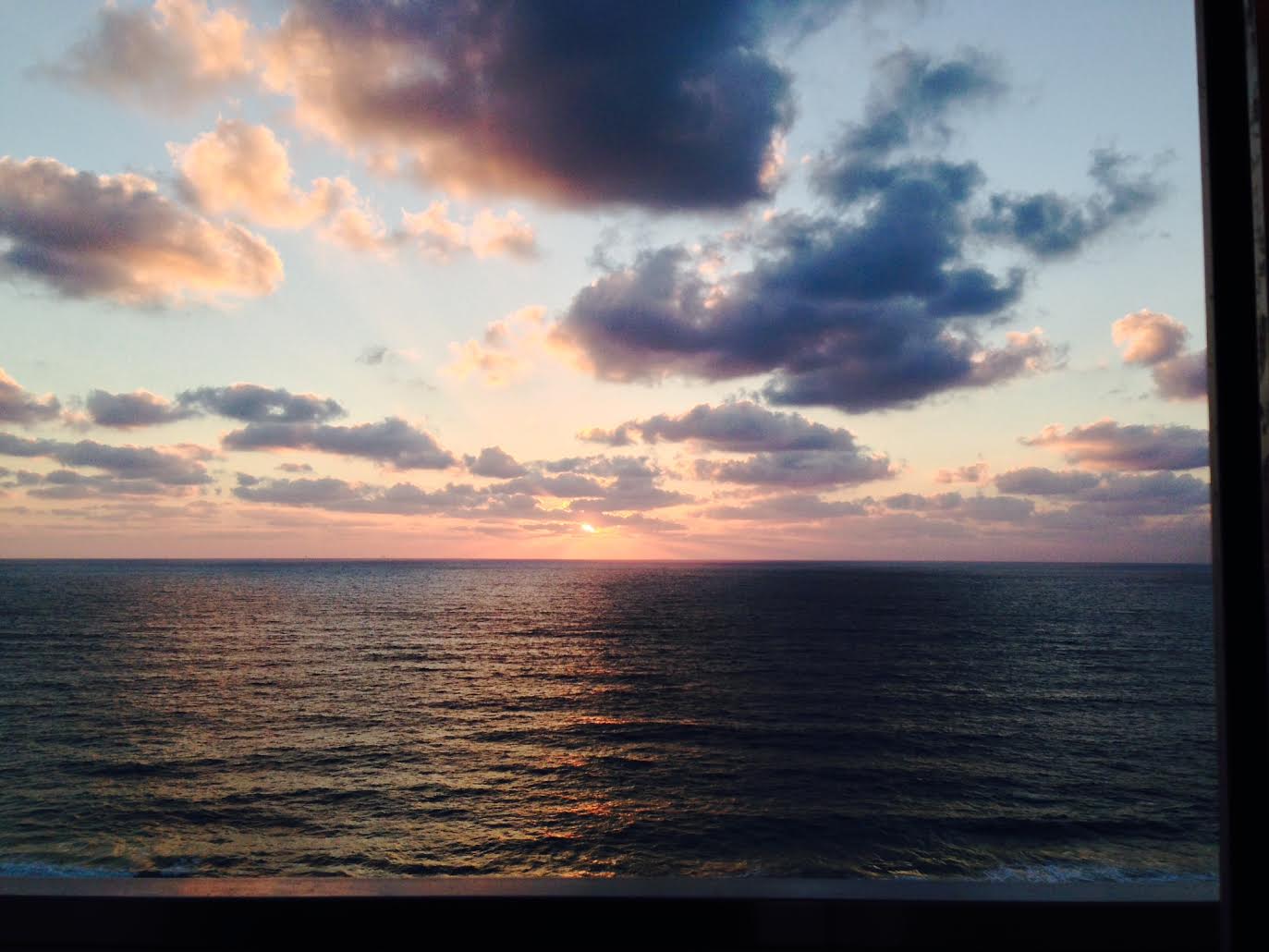
It looked like the smoking gun: exactly 35 minutes after Malaysia Airlines flight 17 went down over eastern Ukraine, a social media account belonging to the eastern Ukrainian rebel commander Igor Strelkov posted a message bragging of having “brought down” an aircraft.

But there this isn’t as clear-cut as it first seemed:

(1) Strelkov’s post, on the Russian social networking site VK, was quickly deleted. A later post appeared to blame Ukrainian government forces for shooting down the plane.

(2) The VK account may not actually be run by Strelkov at all. BuzzFeed’s Max Seddon spoke to eastern Ukrainian rebels who said the page “is a fake made by fans.” If that’s the case, it may be that Strelkov fanboys saw the plane go down, surmised (perhaps wrongly) that rebels had shot them down, and bragged about it on the VK page. It is also possible, to be fair, that the rebels were lying to Seddon about the VK page.

(3) Strelkov’s post appeared to claim credit for shooting down not a civilian airliner but an Antonov AN-26, a two-prop transport plane that is often used by militaries in eastern Europe. The AN-26 is 78 feet long; MH17 was a Boeing 777, which is 242 feet long. It’s possible that rebels mistook the large Boeing 777 for a much smaller AN-26, especially from thousands of feet away. But this casts a bit further doubt on the idea that people fired on the airplane and then posted on VK about it; if someone fired on the plane they likely would have noticed it was a large jet and not a small-ish prop plane.

Ukraine is blaming Russia:

On The Ground In Gaza: Tweet Reax

https://twitter.com/jetpack/status/489863843749707777

https://twitter.com/SullyR_/status/489867655776845825

How Hard Is Shooting Down A Jetliner?

Elena Holodny talked to sources on the ground that confirm seeing a Buk missile system near the site of the crash. Alexis Madrigal explains that “it may sound implausible that a group of rebel fighters could take out a 777, but, given the right anti-aircraft weaponry, it is not”:

The Buk system was developed by the old Soviet Union. Its missile batteries are portable. The missiles themselves are radar guided. If one is in the area, and there are people who can operate it, it has the technical capability to shoot missiles far beyond 33,000 feet.

A passenger jet, in particular, would make an easy target, relative to a fighter jet or a rocket. They are big and they move in very predictable straight lines across the sky. Passenger planes emit a transponder signal, too, which could be used for tracking.

Linda Kinstler suspects that whoever “shot down the Malaysia Airlines flight MH17 over Donetsk on Thursday, killing all 295 people aboard, probably didn’t know what they were shooting at”:

It appears that the plane was taken down by a Soviet-era Buk missile system, which separatists claimed to have gotten their hands on when they gained control of a Ukrainian air defense base on June 29. The Buk is a Soviet-era air defense system used by both Ukrainian and Russian defense forces.

“When you’re sitting behind a radar screen of one of these things, there’s no way to tell what it is. With the Buk, there’s no way to distinguish between friendly and foe. You’re just going to take a shot at it,” says Raymond Finch, a Eurasian military analyst at the Foreign Military Studies Office. “If [the separatists] had reports that the Ukrainians were flying over their airspace, they would shoot. It begs the question of who is sitting behind the trigger. Are they highly trained? My guess is no they are not.”

It’s highly possible that the civilian airliner was mistaken for a Ukrainian Il-76 military transport plane, the same model that separatists in Luhansk shot down on June 14, killing all 49 people on board, mostly Ukrainian servicemen.