The Moral Case Against Zoos

Intercoastal System

Pivoting off Alex Halberstadt’s piece from last week, Benjamin Wallace Wells argues forcefully against keeping animals captive:

A giraffe who freaks out about men with large cameras, a brown bear whose cage door is the subject of his obsessive compulsive disorder, a 5,000-pound killer whale who shows her trainer who is boss by dragging him underwater for just about as long as he can live, before letting him go — these episodes seem like something more complicated than simple errors of confinement. It is hard to avoid the conclusion that in some way the animals understand that the world around them is an artificial one, that these phobias and psychotic episodes represent reactions to that artifice, or subversions of it. Which means that the central illusion of the zoo is no longer holding. The animals know.

All of which makes [veterinarian] Vint Virga’s project — sustaining that illusion, by incremental changes in how the animals are treated — seem more than a little quixotic. Last August, the Costa Rican government announced it was closing all its zoos. The new policy, the government declared, was “no cages.” (A court ruling has so far kept the zoos open.) I think we’re moving slowly toward the same sensibility. In 25 years, there will likely still be some way for Americans to see exotic animals. But I will be pretty surprised if those places have cages, mirrors, smoke machines, and conference-room tanks for 12,000-pound whales. There may be nature preserves. But it seems to me that we’re pretty rapidly reaching the end of the era of the modern urban zoo.

Relatedly, Laurel Braitman reports on the giving of psychiatric drugs to zoo animals. Here’s the story of the Central Park Zoo’s polar bear Gus:

[T]he zoo staff didn’t want Gus to scare children or their parents, so they put up barriers to keep visitors farther away from the window. Gus soon started to swim in endless figure eights.

Hoping to curb the neurotic behavior, the zoo hired Tim Desmond, an animal trainer who had trained the orca who played Willy in the film Free Willy. Desmond was able to reduce Gus’s compulsions by giving him new things to do, such as bear food puzzles or snacks that took him longer to eat: mackerel frozen in blocks of ice or chicken wrapped in rawhide.

The zoo redesigned his exhibit and installed a play area stocked with rubber trash cans and traffic cones that Gus could pretend-maul. They also put him on Prozac. I do not know how long he was on the drug, or even if it was as effective as his new exhibit and entertainment schedule, but eventually Gus’s compulsive swimming tapered off, though it never went away entirely.

(Image from Daniel Kukla’s Captive Landscapes series. Earlier Dish on Kukla’s work here. See more of it here.)
When Bacteria Get Sick

Michael Byrne explains what happens:

It’s tempting to look at bacteria as a kind of binary realm, with “good” and the “bad” sorts that have good and bad impacts on health, when it’s really not that easy. Our own personal bacterial flora might help keep harmful bacteria at bay through competitive pressure, but the goodness of these tiny helpers is less a function of benevolence than geography – set them loose elsewhere in the body, beyond the inner-outside of the digestive tract, and very bad things will happen. A different set of bad things awaits a host with just a bit too much or too little friendly bacteria, ranging from cancer to inflammatory bowel diseases. While it’s possible to live without gut flora, such an existence portends a wide variety of troubles.

One fascinating aspect of this would-be dualism is how the bacteria that we provisionally know as friendly and harmful interact with each other. We know well enough that our gut flora help us out with immunity and keeping virulent bacterial invaders at bay, but it’s hardly because of some secret intraspecies armistice. A study out [last] week in the journal PLOS ONE examines the response of gut flora (in mice) to colitis-causing bacterial infection elsewhere in the body, finding that our own personal colonies of helper bacteria get sick themselves in a very real sense. It’s an observation that paves the way for not just better understandings of bacterial interrelationships, but also “early warning” tools for diseases.

The Crossword’s Puzzle

3167153820_a4eb3c4cc2_z

Tanya Basu considers the future of the newspaper standard:

A print loyalist, [Binghamton University English professor Michael Sharp] notes that demographics of newspaper readership dictate the content of the crossword puzzle and therefore, what segment of the population is interested in it. In fact, he predicts the average puzzle solver is a college-educated white woman in her sixties. “It’s still older college-educated white people who dominate the solver base, and I don’t think apps change that,” Sharp remarked. “It’s worth noting that solver demographics might look very different if you move off of the Times and more elite puzzles.”

But apps are the future of crosswords, and puzzle aficionados realize this. According to a Pew report, tablet usage has spiked among those over 65, with 27 percent of senior citizens owning a device; only 18 percent of seniors own a smartphone. But paper is still the preferred method by which seniors get their news: while 59 percent go online every day, they lag behind their younger counterparts. Something, however, gets muddled in using a tablet versus newsprint, and puzzlers worry about the loss of the ink-on-paper experience.

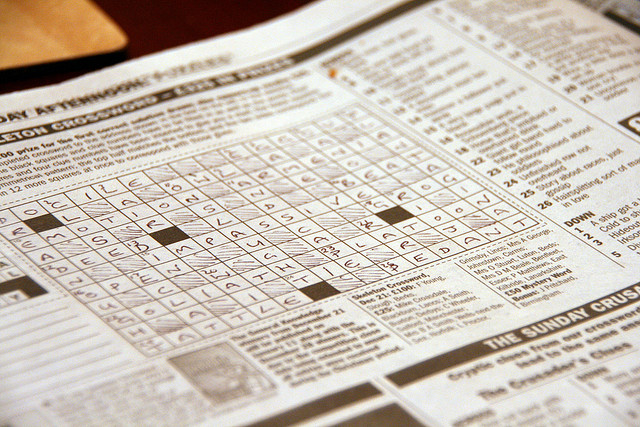
(Photo via Flickr user Pete)

When Your Heart Goes Out, Ctd

A few readers respond to our post on people who pass away after the death of loved ones:

This reminded me of one of my favorite Kurt Vonnegut gems, from Cat’s Cradle. Without getting too into Bokononism, Vonnegut describes a specific kind of karass called a “duprass” which is a pairing of people who stay together for life. Whenever I hear about someone who dies from grief soon after the death of their spouse, I always think of the duprass. Per Vonnegut:

“A duprass … is a a valuable instrument for gaining and developing, in the privacy of an interminable love affair, insights that are queer but true.”

“A true duprass … can’t be invaded, not even by children born of such a union.”

“Members of a duprass always die within a week of each other.”

Another raises a related issue:

Don’t ignore advance care planning, the process that can relieve so much of the stress, pain, and spiritual distress you write about so eloquently. If we have rich, reflective discussions about our past experiences, choose an agent wisely, and share our values and wants with them as we move through life, the whole dying process is different.

I’m gonna keep bugging you about this. Advance care planning is great policy and superb blog fodder. I’m a loyal Dishhead and something of a leader in this movement, and ready to share more as soon as you are. One video introduction to the concept is here.

The Best Of The Dish Today

The Daily Mail's 'Downing Street catwalk'

Yep, the Republican base is not the only one with a problem taking women pols seriously. The above is a Daily Mail two-page spread about some of the new female members of the Tory cabinet in Britain:

The newspaper referred to the employment minister Esther McVey as “thigh-flashing Esther” on its front page, before examining the hair, legs, bag, shoes, dress and makeup of nine ministers on a double-page spread … Following the furore, McVey, who was promoted to attend cabinet, brushed off complaints about the press coverage. The Wirral West MP said she was delighted that powerful women are being depicted on the front pages, after the newspaper described her as “Queen of the Downing Street catwalk”.

As well as featuring a prominent picture, the Mail article described her appearance in detail, saying her dress “cinched in her waist and emphasised her bust”. An article accompanying the pictures described her as “sashaying” into Downing Street and throwing her “blond mane backwards as in a shampoo advert”.

Lovely, innit?

Today, the debate over the latest round of Israel-Hamas warfare continued, even as four boys playing football on the beach became the latest fatalities. The death toll is now well over 200 – 1 in favor of the Israelis, as Americans shifted in their views of the Jewish states. Four other posts worth revisiting: an astonishingly slick classified ad for a used car; the cascading failures of the federal government; the hathos of Renaissance kitsch;  and the sub-par political skills of Hillary Clinton.

The most popular post of the day remained the increasingly viral Understanding The Permanence Of Greater Israel; followed by The Astonishing Actual History Of The Gay Rights Movement. Readers responded to the post today here.

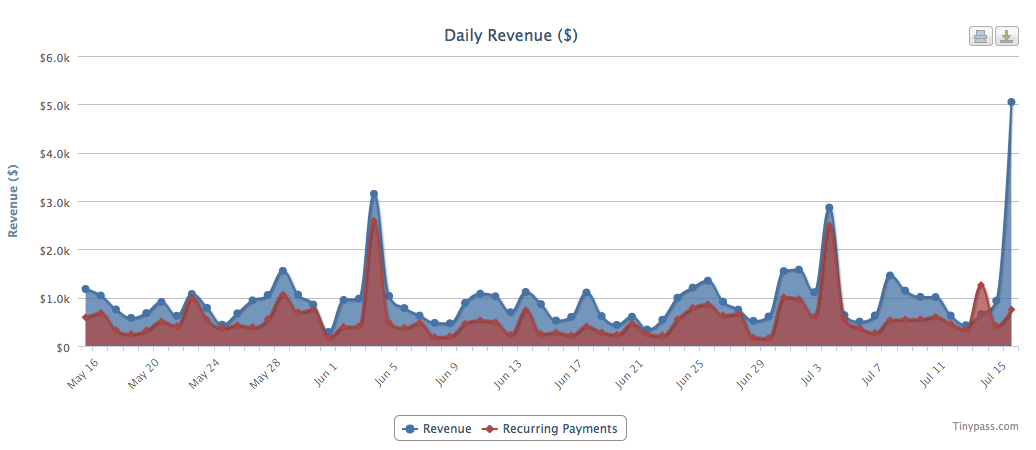
A million thanks to all those founding members who re-upped after a final, nagging email today from yours truly. We got a serious spike in revenue, as you can see below:

Screen Shot 2014-07-16 at 8.34.06 PM

We now have close to 29,500 active, auto-renewing subscriptions, which is something we could only have dreamed of a couple of years ago. It really does make us different in online media: no other purely web-based site has that kind of reader support and thereby staggering independence from commercial and advertizing pressure and clickbait incentives. And that independence allows us to engage in debates where others may fear to tread – the most current being a real tussle over Israel-Palestine. So please join the throng and help us get to that magic 30,000 number. Subscribe here in less than two minutes, and back a model that can actually keep online journalism more honest. It’s less than $20 bucks a year or $2 a month.

A founding subscriber writes:

Dude, I’m back.  You broke me down.  I avoided re-upping because I was justifying not spending the $20 bucks since I moved to New York and this damn place is so expensive that we’re trying to save money for “must-haves”.  Instead, I constantly press the Read On button on your site reflexively and constantly get bounced out while I continue to pay the $40 “leaving your house” tax in this city everyday.

A man after my own heart. See you in the morning.

Getting By In Aleppo

SYRIA-CONFLICT

A resident provides a glimpse into her day-to-day life in the war-ravaged city:

I make my coffee while reading Facebook to see what damage last night’s bombings caused. I am lucky to have the money to pay for a satellite internet connection. This is the only way to get online here in the rebel-held areas of Syria because for almost two years all means of communication have been cut—landlines, the mobile network and the internet—as collective punishment for areas that rebelled against the regime. Fighters and activists use walkie-talkies but as a woman I am not allowed to use one. This area of the city has long been very conservative and women don’t participate in public life; now it is also a frontline in a warzone, even more of a male-only domain.

The electricity is on for around four hours a day, so many people have paid to get an alternative source of power. Local traders invest in huge generators and they distribute electricity to others for a monthly fee. Sometimes the electricity is completely cut off for a week and the generator breaks, like today.

I have breakfast and wash the dishes with a trickle of water to save what is left. The water comes on for an hour per week. That is enough to fill the tank on my roof and with careful use I won’t run out this week. If I do, I will have to buy water from a well. New wells are being dug randomly, without engineers or studies—I recently saw one being dug in the middle of a crowded neighbourhood.

It is 11 am and I put on a hijab (not something I wore before the war) and a loose knee-length sweater and leave to go to a field hospital where a friend I am filming is living. She is the only female citizen journalist working in the northern rebel-held areas and I am doing a profile of her. As well as being dressed conservatively, I have to make sure I have a male “guardian” with me. This area of Aleppo has always been conservative, but before the war visitors could wear what they wanted. That is no longer the case now the social tradition is armed.

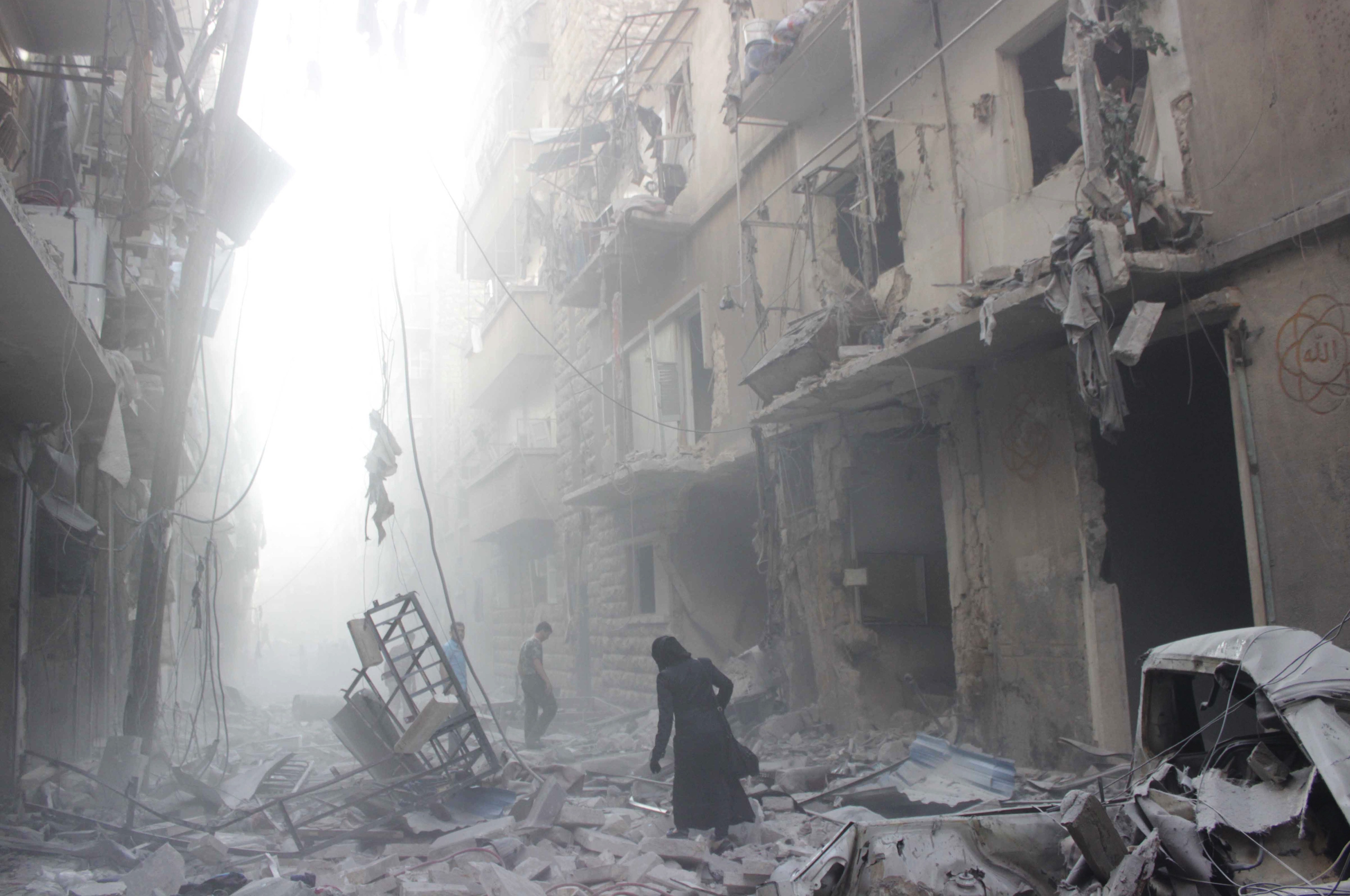
(Photo: A Syrian woman makes her way through debris following an air strike by government forces in the northern city of Aleppo on July 15, 2014. More than 170,000 people have been killed in the three-year war, one third of them civilians, according to the Syrian Observatory for Human Rights. By Karam Al-Masri/AFP/Getty Images)

This Worm Can Handle Its Alcohol

By modifying their genetic makeup to alter a molecular channel that binds alcohol in the brain, scientists have developed worms that can’t get drunk:

Normally, when worms are put in a petri dish that contains alcohol, they become drunk. For a worm, this mean not being able to wiggle from side to side as much. It also means crawling much more slowly. But with the modified channel, the worms acted just as they did without the alcohol. The researchers were able to do this by tweaking the human alcohol target just enough to prevent “a research model worm from getting drunk,” said Jonathan Pierce-Shimomura, a neuroscientist at the University of Texas at Austin and a co-author of the study, in an email to The Verge. …

The researchers now hope to develop drugs that would have the same effect in mice — and eventually humans. “We found a way that future drugs may target a single human brain protein, called the BK channel, to stop alcohol from activating it and causing intoxication,” Pierce-Shimomura said. If the scientists could find a drug that has the same effect as the mutation, they might be able to help people overcome addiction and the effects of withdrawal.

But Becky Ferreira cautions against celebrating too soon:

As promising as the findings sound, it will likely be many years before they will be tested on humans. And as Motherboard’s Michael Byrne warned a few weeks back,“off-switches” for addictions may be tantalizing, but they won’t necessarily be cure-alls. For now, we’ll just have to be satisfied with the fact that the great enterprise of science has gifted the world a bunch of mutant worms that can’t get drunk.

Time To Put Down The Pixie?

https://twitter.com/TheLockPerson/statuses/443795734605729792

Nathan Rabin, who coined the term “manic pixie dream girl” in a 2007 essay, regrets it and wants to retire the term:

In an interview with Vulture, “Ruby Sparks” writer-star Zoe Kazan answered a question about whether her character was a Manic Pixie Dream Girl by asserting: “I think it’s basically misogynist.” … Here’s the thing: I completely agree with Kazan. And at this point in my life, I honestly hate the term too. I feel deeply weird, if not downright ashamed, at having created a cliché that has been trotted out again and again in an infinite Internet feedback loop. I understand how someone could read the A.V. Club list of Manic Pixie Dream Girls and be offended by the assertion that a character they deeply love and have an enduring affection for, whether it’s Diane Keaton’s Annie Hall or Katharine Hepburn in “Bringing Up Baby,” is nothing more than a representation of a sexist trope or some sad dude’s regressive fantasy.

But Lisa Knisley defends the term as an “intensely useful and important” way of describing a real element of our culture, not just movies and TV:

The ability to shorthand what seemed to be a pervasive and powerful cultural ideal of white femininity embodied by the on-screen MPDG has been invaluable as I came to feminist consciousness and began to more deeply analyze the representations of femininity marketed to my generation. But, more than that, the concept of the MPGD doesn’t just describe a gendered film trope—it helps me make sense of non-fictional gender relations as well.

I’d be hard-pressed to say I’ve ever met a real-life MPDG, of course. Flesh and blood women, no matter how they come off at first, are inevitably more complex and substantial than the superficial waifs of our collective pop culture fantasies. Still, for women of my generation, perhaps especially middle-class, heterosexual, white women, the Manic Pixie Dream Girl is one powerful version of our ideal selves and many of us have found ourselves emulating her, wanting to become her.

Elisabeth Donnelly stakes out a middle position, arguing that Rabin’s initial diagnosis of the MPDG was valuable but agreeing with him now that it has become an cliché catch-all for lazy critics:

Where Rabin’s trope started to feel cruel was in the semi-pointless appellation of “manic pixie.” Perhaps it was applicable to the female characters in Garden State and Elizabethtown, but would you really call anyone else a manic pixie, beyond, say, Tinkerbell? In all honesty, when it comes to writing about half-baked, terrible characters in art, we need to use a broader range of terms beyond just slotting all wispy girlfriends into the Natalie Portman-in-Garden State slot. Go deeper. Write with more eloquence about why the character is underwritten, why the lack of an interesting woman in a movie is a problem. Pin it on the follies of the art.

Previous Dish on the MPDG here, here, and here.

Faces Of The Day

Request

Three days ago, a grieving father put out a request on Reddit:

My daughter recently passed away after a long battle in the children’s hospital. Since she was in the hospital her whole life we never were able to get a photo without all her tubes. Can someone remove the tubes from this photo?

The Reddit community answered with the images you see above. Cari Romm is moved:

[S]ocial media-driven responses to death can range from uncomfortable—is hitting “Like” on a Facebook death announcement supportive or crassly insensitive?—to the downright cringe-worthy, like the Tumblr “Selfies at Funerals.” But every so often, the world wide web offers up  to the bereaved some small piece of atonement for its missteps. …

Selfishly, it’s comforting for the rest of us, too. The longer we exist on social media, the more loss we’ll all eventually live out through our computer screens. Let’s hope that this, rather than funeral selfies, becomes the future norm for public grief.

Inside The Mind Of Hamas

In an interview with Zack Beauchamp, Hussein Ibish offers his take on what the Gaza crisis means for the militant group’s strategic position:

Hamas has been desperately trying to get out of this morass that it’s found itself in; it really feels trapped and desperate. And they tried to foment trouble in the West Bank, and it didn’t succeed. They didn’t get anything out of the unity agreement, so it’s falling back on what it knows sometimes gets results — which is rocket attacks. What they are hoping for, this time, is concessions not from Ramallah or from Tel Aviv, but from Cairo, Egypt. I don’t think that most people understand that — it’s all about Egypt.

What Hamas can get can only come from Egypt. From Israel, they’re demanding the release of prisoners that were part of the shahid squad [a Hamas military group] that was arrested when Israel was pretending they didn’t know the teenagers were dead. Israel tracked them down and dealt Hamas a serious blow. Which is why Netanyahu isn’t so interested in getting into an artillery/aerial exchange with Hamas — the Israelis frontloaded their retribution. It was all done in the West Bank, before the bodies were found.

Allison Beth Hodgkins also views Hamas as having been backed “into a corner where it had to chose between the Russian roulette of escalation and irrelevance”:

It chose the former — a high stakes gamble to reclaim the mantle of resistor in chief on behalf of the struggle and shore up its tenuous stake in the Palestinian marketplace.

To a large degree, Shlomi Eldar gets it mostly right here when he says that Hamas’ main objective is to avoid looking like a defeated movement. What it really can’t afford to look like is a religiously conservative version of Fatah: weak, ineffective and seen as trading a continued hold on power for continued occupation. While the business of governing the fractious Gaza Strip has forced Hamas to make compromises in order to pay the bills and keep the sewage from overflowing, these compromises have required enforcing the November 2012 ceasefire on all the resistance factions in the strip. This is no easy task in good times (or not so bad times), but with the popular mood turning from generally irritated to downright irate, groups like Islamic Jihad, the PFLP and other new challengers smell blood in the water.

In light of this weakened position, Mitchell Plitnick advises the militants to cut their losses:

There simply isn’t an endgame that represents progress for Hamas. In 2012, when then-Egyptian President Morsi brokered an agreement, Hamas could claim a few minor concessions from Israel (which never really materialized once there was no pressure on Israel to follow through with them). There will be nothing of that sort here, but Hamas seems to be desperately clinging to the hope that it can extract something to base a claim of victory on.

That’s a terrible gamble. It is much more likely that the refusal to agree to a ceasefire is giving Netanyahu exactly what he wants: the chance to deliver a blow to a weakened Hamas regime in Gaza. Hamas has given Netanyahu the means to do this without having to overcome the global opposition that was apparent at the beginning of the current fighting.