Renaissance Kitsch

dish_rosso

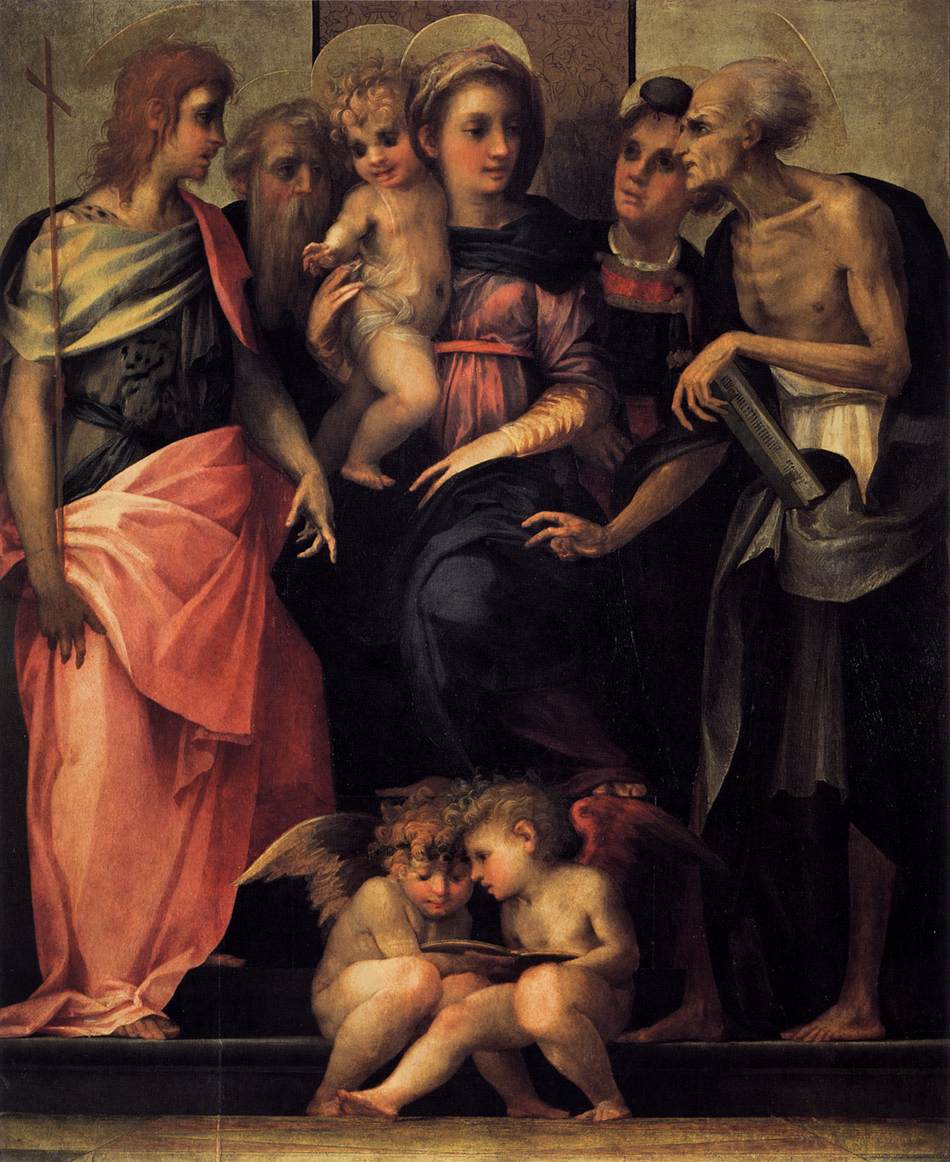
Reviewing the exhibition “Pontormo and Rosso Fiorentino: Diverging Paths of Mannerism” at the Palazzo Strozzi in Florence, Barry Schwabsky applauds the works of Rosso Fiorentino for displaying “truly bad taste.” He argues that “whatever is cringe-inducing in Rosso’s pictures is more or less inextricable from what sometimes makes them so breathtaking”:

Rosso [aka “Florentine Red”] offended established taste almost from the get-go. Vasari tells us that the young artist wouldn’t stay with any master, “having a certain opinion of his own that conflicted with their manners.” Commissioned in 1518 to paint an altarpiece, he invited the patron, Leonardo di Giovanni Buonafede, to view the work in progress; alas, “the Saints appeared to him like devils,” according to Vasari, and so “the patron fled from his house and would not have the picture, saying that the painter had cheated him.”

The work, Madonna and Child With Four Saints, also known as the Spedalingo Altarpiece, was exiled to a small provincial church, where it slumbered until the nineteenth century; in 1900, it was admitted to the collection of the Uffizi and has now moved across town for the Palazzo Strozzi exhibition. As David Franklin writes in the catalog, the learned Carthusian who was so horrified by Rosso’s painting thus far “was a prolifically experienced if conservative patron of altarpieces” whose “reaction, although vehement, was well-informed.”

Schwabsky goes on to describe what makes the painting so unnerving:

Most demoniac in appearance is the harsh and wasted figure of St. Jerome on the right. Franklin suggests that the red-haired St. John on the left—the artist’s namesake, and the only one of the painting’s figures (aside from the infant Christ and the sweetly earnest cherubs at Mary’s feet) who doesn’t appear to be an emanation of the blue shadows swirling around the Madonna’s legs—is Rosso’s way of announcing that the painting was intended as his “impassioned personal contribution to the hothouse atmosphere of Florence in the first two decades of the 16th century.” I shouldn’t wonder. In any case, despite Vasari’s claim that it was all a misunderstanding and that Rosso intended to “sweeten the expressions” of the saints in the process of finishing the painting, they retain to this day the “savage and desperate air” that drove the poor churchman running from Rosso’s door.

(Image of Madonna Enthroned with Four Saints by Rosso, 1518, via Wikimedia Commons)

The Growing Partisan Gap On Israel

partisan-mideast

Although Americans’ sympathies remain broadly on the side of the Jewish state, our views on the conflict are becoming more politically polarized:

73 percent of Republicans favor the Israeli side, compared to 44 percent of Democrats, and 45 percent of Independents. Moreover, this partisan gap has widened considerably since 1978, when the gap between Republicans and Democrats was only 5 percentage points.

Flagging the same poll, Ed Morrissey remarks that the dramatic increase in Republican support “may end up being worrisome to Israel in the long run”:

The US has a long history of bipartisanship when it comes to our alliance with Israel, even though some members of both parties have criticized it for various reasons. If this becomes another issue of partisanship testing, that will not benefit Israel, nor would it benefit our own politics.

On the other hand, every demographic in the survey has a plurality sympathizing with Israel by a wide margin. Even among the lowest levels of sympathy for Israel — liberal Democrats and religiously unaffiliated — the margins are double-digit at 39/21 and 36/20. There are substantial differences about the level of sympathy in the age demos, but not the balance of sympathy. The youngest demo, 18-29YOs, favor Israel 2:1 at 44/22, while among seniors it rises to 60/9.

Philip Klein adds:

Some political reporters like to talk about the “Sheldon Adelson primary” — of Republican candidates seeking the approval of the pro-Israel casino magnate. As the Pew poll shows, however, the whole idea of of an “Adelson primary” is a sloppy description of what’s happening within the GOP. In reality, support for Israel among Republican primary voters is broad and deep. A 77-percent to 4-percent issue among predominantly Christian conservatives is not representative of the party platform being overtaken by a small cabal of Jews. No Republican has a chance at the nomination if he or she is perceived as anything but a staunch supporter of Israel, and this goes far beyond Adelson.

But that means, of course, further enabling of Greater Israel’s maximal goals, and an ever-spiraling antagonism with much of the Muslim world. And you wonder why I’m resigned to an endless war.

Running Without A Campaign

This embed is invalid

Lynn Vavreck sees it as hazardous for Hillary Clinton:

This is the danger for Mrs. Clinton in running a quasi-campaign instead of a real campaign and holding off on discussing the things she would do as president if she were to run and win. She risks campaigning in a low-information environment of her own making. And that means that instead of debating whether her tax policies would help the middle class, we are left to talk about whether her conception of herself as not “truly well-off” or “dead broke” means she cannot relate to the middle class. Instead of asking what qualities she would favor in nominating justices to the Supreme Court, we instead focus on whether she hid or changed her public position on gay equality over the decades because it was politically expedient.

My deeper worry is that this kind of blah blah tour is where Clinton is most comfortable. Because she does actually and rather aggressively suck at politics itself:

Consider that Clinton has run in three elections. Her two wins in New York are not all that impressive, really. Instead of facing the powerful and well-funded Rudy Giuliani in 2000, who withdrew for health reasons, she was up against Representative Rick Lazio. Lazio only entered the race five months before it ended. And in her re-election in 2006, the New York GOP let a Yonkers mayor, John Spencer, be the sacrificial lamb…

And of course she lost the only electoral race where she faced a credible opponent. In the 2008 race for the Democratic nomination she blew a massive early lead. One of the only reasons she did not get completely pasted by Barack Obama was his horrible off-the-record flub about rural voters “clinging to their guns and religion.” Clinton immediately invented a strategy later used by the Tea Party and Glenn Beck of trying to tar Obama as an alien and radical. In their April 16 debate in Pennsylvania, she tried to highlight Obama’s “relationship with Reverend Farrakhan” and portray him as a supporter of Hamas. This strategy failed utterly.

If I were a Democrat, I’d worry about her useless stump speeches, her increasingly regal and dynastic affect, her lack of any appreciable political instincts, and her propensity to regard herself as a beleaguered victim. Apart from all that, I couldn’t be more impressed.

Are We Abetting Central American Gangs?

Taking a hard look at the refugee crisis, Frum blames it primarily on US immigration policy, which has unwittingly strengthened the gangs from which these children are fleeing. “If you want to migrate to the United States from Central America,” he writes, “you will probably have to seek the aid of a criminal gang. That fact implies a few follow-on facts”:

First, for all the talk of the “desperation” of migrants, those who travel here from Central America are not the poorest of the poor.

The poorest of the poor can’t afford it. Illegal migrants either have the funds to pay for the journey—or can at least receive credit against their expected future earnings. The traffickers don’t only move people. They also connect them to the illegal labor market in North America, and then act as debt collectors once the migrants have settled in their new homes. Salvadorans in the United States are less likely to be poor than other Hispanics are: illegal migration networks don’t have any use for people who can’t generate an income. On the other hand, Salvadorans are also less likely to own a home—their smugglers have first claim on their earnings.

Second, if these latest migrants gain residency rights in the United States, the gangs who brought them to the country will be enriched and strengthened. Gangs, like any business, ultimately depend on their customers. If too many people find that their $5,000 to $8,000 investments in border-crossing are not paying off, the illegal-migration business will dwindle. If, on the other hand, the gangs succeed in exploiting the opportunity Obama created, they’ll attract more business in the future.

Third, each wave of illegal settlement induces and produces the opportunities for the next. The unaccompanied minors smuggled into the United States this year all have relatives back home. If resettled in the United States, they’ll acquire the wherewithal to pay for the transit of those relatives. And, of course, many of these minors either currently belong to the gangs carrying out the smuggling or will soon be recruited by them. That’s another way to pay the cost of the trip.

Recent Dish on the sources of the crisis here and here.

An Archbishop Heightens The Contradictions, Ctd

Yesterday, we got a glimpse of the actual affidavit filed by the former chancellor of the archdiocese of St Paul and Minneapolis that charges the Archbishop and others of continuing to ignore child sex abusers in their midst. Jennifer Haselberger appears to be a rare figure who actually cared about the safety and welfare of children in the archdiocese and tried to keep the entire place operating professionally and legally. And failed on both counts. What makes this case different is that the cover-up of child-abuse is occurring long after new rules were put in place to prevent it, and we have in Haselberger an unprecedented whistle-blower from the inside:

Most clergy abuse lawsuits rely on decades-old documents, testimony from a handful of experts on church law, and depositions from recalcitrant church officials and abusive priests. Top chancery officials rarely come forward to disclose the church’s secrets. [Attorney Jeff] Anderson called the affidavit “historically important” in the history of the clergy sexual abuse scandal in the U.S. Catholic Church.

Haselberger resigned in April 2013 in protest over the archdiocese’s handling of abuse cases. She contacted MPR News in July 2013 and disclosed how Nienstedt and other top officials gave special payments to abusive priests, failed to report alleged sex crimes to police and kept some abusers in ministry. Her account was especially stunning because it involved decisions made by church leaders as recently as April 2013.

To add to this toxic stew, Nienstedt is fighting back against “multiple allegations” of inappropriate sexual encounters with seminarians, priests and other men – including one accused of child abuse. He is also – surprise! – an almost fanatical opponent of marriage equality and a constant, obsessive voice against the evils of homosexuality. Dreher flips out at the prospect of another theocon revealed as a fucked-up fraud:

Haselberger says what drove her to quit in anger was realizing how little the archdiocese cared about protecting children, only protecting priests — even priests they knew were guilty — and how vulnerable children were. She says that Archbishop Nienstedt was such a micromanager that he would send stern notes (“nastygrams”) to chancery employees for such petty offenses as leaving the lights on, or not wearing a tie — but when it came to dealing with clerical sexual misconduct, he was seemingly indifferent … If Haselberger is telling the truth, it staggers the mind to think that Pope Francis — who has the right to remove Nienstedt — tolerates this man remaining in charge a single day longer.

It will and should be another acid test for this Pope on child abuse. This is about enforcing rules that have now long been implemented; it’s about retaining even a sliver of moral credibility; and it’s about protecting children from psychologically damaged products of the church’s incoherent and impossible teachings on sex. I wish I were more hopeful. But who can be, at this point?

Nah – The Young Are Still Leaning Left

Ideology By Generation

Using some new Gallup data, Leonhardt pushes back on the notion that today’s teenagers are more conservative than millennials:

For starters, the Gallup data indicates that today’s oldest teenagers do not identify themselves as any more conservative than people in their 20s. About 27 percent of 18- to 21-year-olds identify as liberal, compared with about 25 percent who call themselves conservative. Among 25- to 29-year-olds, the liberal lead is 28 percent to 27 percent. … Eighteen- and 19-year-olds look roughly as Democratic-leaning as people in their 20s. The Democrats have an advantage of about 14 or 15 percentage points.

Chait chimes in:

As Leonhardt notes, there may be a slight tilt away from the Democrats. But that still would count not so much as good news for Republicans as somewhat less terrible news.

As every election cycle, older, Republican-leaning voters die off and are replaced by newer, Democratic-leaning ones. If the youngest and newest cohort is somewhat less Democratic leaning than the previous one, it would slow the process. But it’s like having your house flood at a slightly less rapid pace. The fabled new teenage conservatism remains as yet illusory.

Yglesias feels that the GOP is simply out-of-touch with today’s youth:

There’s something very oldsterish about contemporary conservative politics. The constant bickering about Ronald Reagan is very odd to anyone too young to have any particular recollection of the Reagan years. Calling a group of people “Beyoncé Voters” as an insult is weird. Some of this oldsterism is just ticks, but some of it has policy implications. The sort of budgetary priorities that call for huge cuts in all domestic spending, except no cuts at all for anyone born before 1959 is kind of weird. The huge freakout over New York City starting a bicycle program last summer was bizarre. It’s easy to imagine a political party that’s broadly favorable to low taxes and light regulation without sharing this particular set of ticks. And then there was the time George Will wrote a column-length rant against blue jeans.

Bernstein bets this will change eventually:

Republicans will adapt to the biases and preferences of people who vote Republican in the 2020s, rather than only attracting people who are drawn to the current Republican mix of policies and rhetoric. And why will people be Republicans? Because they started out as Republicans (either by inheritance, or because they started voting in good Republican years). If the economy collapses when a Democratic president is in office, Republican “oldster” rhetoric isn’t going to matter much.

Or, to put it another way: The reason that Democratic positions and rhetoric, especially on second and third-tier issues, sound good to Yglesias and those younger than him is that he and so many of those folks are Democrats. Not the other way around. And when younger voters are mostly Republican (and, yes, that’s going to happen at some point), then Republican rhetoric and policy preferences will adapt to that cohort.

Book Club: Montaigne As Your Mentor, Ctd

On Monday I’m planning to start the discussion over Sarah Bakewell’s How to Live: Or A Life of Montaigne in One Question and Twenty Attempts at an Answer, so buy the book here if you’d like to join in. My intro to the book selection is here. A reader writes:

Great book recommendation, but I’m pretty pissed at the number of Game Of Thrones 513f2INPtgLspoilers that Bakewell crams in her work. Henri II is killed in a jousting tournament when his visor is knocked off and a splinter is lodged in his brain? Then his adolescent son takes over under the domineering regency of Cersei – I mean Catherine de Medici? Just replace “Huguenots” with “White Walkers” and I think I know how George RR Martin will end Song of Ice and Fire.

Seriously, this small passage in page 70 of my copy of How To Live was a great reminder that the Middle Ages were more brutal and hostile than even our modern imaginations. Actual history beats the hell out of fantasy.

Another:

I’m a subscriber to Dish, and enjoy the quality of its thought and breadth of exposure to interesting issues. For the second time now, I’ve downloaded a book you’ve recommended (just bought How to Live and just finished On Looking). But when I click on a link to give you credit for the purchase, it only takes me to the Kindle edition.  I prefer Apple iBooks, to be read on my iPad.  (Yes, I’ve drunk thebookclub-beagle-tr iKoolAid.)  So I get out of Amazon, go to Apple, and buy the book there, but then you don’t get any credit, or even the knowledge that people are buying stuff you recommend.  You might consider additional links to those of us who prefer a different online format.

The iBooks link is here. To help you find the book at a public library, go here. But this link to Amazon is the only way to support the Dish with some affiliate revenue (especially if you purchase other things on your shopping list during that web session). It’s pennies on the dollar, but those pennies add up for a small independent company.

A Shoddy Infrastructure Bill

Arit John sums up yesterday’s news:

The House overwhelmingly passed an unpopular proposal to use revenues from underfunded pensions to pay for one year of funding for the Highway Trust Fund. According to NBC News, the House bill will pay for a 10-month funding extension for road and infrastructure projects “using pension tax changes, customs fees and a transfer from the Leaking Underground Storage Tank Trust Fund.” Despite threats from conservative groups Club for Growth and Heritage Action, only 45 Republicans voted against the bill.

Sargent explains why Republicans voted for the bill:

The battle over infrastructure in the context of the HTF is one area where GOP anti-government rhetoric collides with reality.

It’s easy for Republicans to strut around ranting about crony capitalism, and they know they can attack the Export-Import Bank’s efforts to help U.S. exporters as improper Big Gummint meddling in the economy because no one cares about it. But here was a case where infrastructure projects — and jobs — could have been put on ice in many GOP districts.

Plumer rattles off critics’ objections to the legislation:

For one, the House bill would only avert the crisis until next May — and doesn’t address the underlying structural problems with the Highway Trust Fund. Some Democrats would prefer to deal with the highway problem this December, in the lame-duck session right after the midterm elections. … Other tax experts have criticized the “pension smoothing” provision. As Len Burman points out, the move may not actually raise any money: Yes, companies can reduce their pension contributions now under the rules. But the amount those companies will eventually owe in pensions doesn’t change — which means they’ll have to increase their contributions later (and tax revenues will fall).

Bloomberg View’s editors pine for a long-term fix:

It’s a shame that Obama and members of Congress, including those who wanted to raise the gas tax, didn’t find another solution to the funding problem. The president reluctantly endorsed the House bill, explaining that he does not want to see the fund run dry in August, as the Department of Transportation says it will. That’s understandable, but it’s also shortsighted.

If the bill could be stopped, the economic impact would be limited. Work wouldn’t cease on projects already under way; funding for those is guaranteed. Some states might be forced to delay future projects, but this would help push unions and governors to increase the pressure on Congress to find a better answer. Without strong political pressure, Congress will keep the gimmicks coming — and that needs to stop.

Reform That’s Borderline Impossible

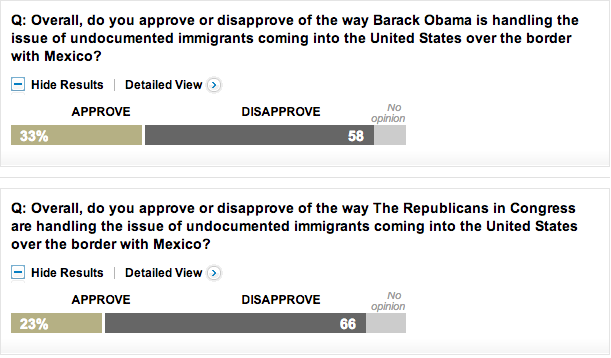
A new WaPo/ABC News poll dings both Obama and Republicans in Congress for their handling of the border crisis:

Screen Shot 2014-07-16 at 11.01.33 AM

The Republicans fare especially badly, but Noah Rothman attributes that to dissension in the ranks:

Republicans in Congress, who receive poor marks from nearly two-thirds of the public, can attribute some of that antipathy to their own voters. “Almost as many Republicans disapprove of their party’s handling of the issue as say they approve, with negative ratings rising to a majority among conservatives,” reads The Post’s write up of the poll. 48 percent approve of the GOP’s approach to the crisis while 45 percent disapprove. Only 22 percent of independents and 9 percent of Democrats approve of the GOP’s approach to the crisis.

The president, meanwhile, maintains the support of 57 percent of Democrats who approve of his approach to the border crisis. 12 percent of Republicans and 28 percent of independents agree. If the GOP maintained the intraparty unity that Obama benefits from, their numbers would look similar to the president’s.

The poll also asked respondents about the government’s $3.7 billion proposal to address the crisis. Sargent believes these results augur poorly for the plan’s fate in the House:

Crucially, only Republicans and conservatives oppose the plan. A majority of independents (51 percent) and moderates (58) support it, but only 35 percent of Republicans back it, versus 59 percent who are opposed, and only 36 percent of conservatives back it, versus 59 percent who are opposed. Among “conservative Republicans,” those numbers are a dismal 29-66.

This again raises the question: Can any plan to address the crisis pass the House? As I noted the other day, conservative groups such as Heritage Action are opposed, and may “score” the eventual vote on it, meaning more pressure on GOP lawmakers to vote No. Any funding plan first has to clear the Senate, which will be hard, but Democratic aides believe it will be doable. The House is another matter.

Drum agrees:

So Democrats are split and Republicans are opposed. This is not fertile ground for any kind of compromise. The only thing Obama has going for him is that what’s happening on the border really is a crisis, and at some point everyone might genuinely feel like they have to do something. But what? Even Obama’s fairly anodyne proposal has already drawn significant opposition from both sides, and any proposal that moves further to the left or the right will draw even more opposition. This could take a while unless, by some miracle, both parties decided they’re better off just getting this off the table before the midterm elections. But what are the odds of that?