The Right To Be?

Are our present joys linked, in some inextricable way, to “some mass atrocity that was committed in the past”? Philosophy professor Peter Atterton considers (NYT) how historical injustices affect our existence today:

Nietzsche once surmised that anyone who had ever wanted to relive a moment of joy was committed to affirming the idea of reliving the entirety of his or her life up to that point. Why? Because Nietzsche, a dyed-in-the-wool determinist, believed that the present instant of joy is made possible by all the events in one’s past that caused it. As he lyrically put it, “All things are enchained with one another, bound together by love.” For Nietzsche this is a splendid thing, for it gives us the power to redeem the past. … I had always solaced myself with Nietzsche’s idea of looking back at one’s life and affirming all of it, even the bad parts, which are indispensable conditions for whatever happiness my life currently contains, until one day it dawned on me that if I am to say “yes” to those events in the past that caused me to suffer but which are causally necessary for my life’s being lived as I live it now, then I must also say “yes” to those events that have caused others to suffer as well.

But who can do this? Who can maintain in good conscience that the Holocaust or slavery was justified because otherwise he or she, or anyone else currently living for that matter, wouldn’t have been born. (Nietzsche notoriously maintained that the only justification of the French Revolution — including the Reign of Terror — was that it produced Napoleon.) Whose natural narcissism is so extreme that he or she can justify the unjustifiable suffering of innumerable innocent lives? The Jewish philosopher Emmanuel Levinas was more discerning: “What is most natural becomes the most problematic. Do I have the right to be? Is being in the world not taking the place of someone?”

A Poem For Sunday

7313560214_b59cc14868_k

“Summer Moods” by John Clare (1793-1864):

I love at eventide to walk alone
Down narrow lanes o’erhung with dewy thorn
Where, from the long grass underneath, the snail
Jet black creeps out and sprouts his timid horn.
I love to muse o’er meadows newly mown
Where withering grass perfumes the sultry air,
Where bees search round with sad and weary drone
In vain for flowers that bloomed but newly there,
While in the juicy corn the hidden quail
Cries “wet my foot” and hid as thoughts unborn
The fairylike and seldom-seen landrail
Utters “craik craik” like voices underground,
Right glad to meet the evening’s dewy veil
And see the light fade into glooms around.

(From “I Am”: The Selected Poetry of John Clare, edited by Jonathan Bate © 2003 by Jonathan Bate. Reprinted by permission of Farrar, Straus & Giroux. Photo by Tom Marsh)

The Depths Of Writing

Looking back at the writing and publication of his book The Life You Save May Be Your Own, Paul Elie recalls the advice he received from the editor and poet Jonathan Galassi – “Go deeper. You need to go deeper”:

I asked him what he meant, and he explained, roundabout but in such a way as to draw clear lines between the literary text and all the other kinds of writing that washed up against the pilings of our office. What I’d written was too journalistic. It made too much of superficial connections. It was boosterish in style—it was trying to put the idea of a “school” of American Catholic writing over on us instead of trusting the material. And (again, all this was conveyed indirectly) it didn’t get to the bottom of what made these people a school, or what made them Catholic writers, or what made them Catholics at all, or why what they believed mattered to them or us.

Roger Straus liked it too—and Jonathan and FSG signed up the book. And day and night for a thousand days and nights I sought to go deeper, starting by moving my point of entry into the story back nearly half a century—to the moments where those four writers themselves turned, in their different ways, to literature and to religious belief in their own efforts to go deeper. And somewhere in the middle of those thousand days and nights, I concluded that the experience of depth—intellectual, emotional, spiritual depth—is the central literary experience. It is what makes literature literature, and what makes us read literature, and write it.

“Go deeper.” It’s not advice a writer can outgrow or set aside as unnecessary. Augustine asked, “Who understands his sins?” Likewise, what writer can truly say, “I’ve gone deep enough”?

Faith At All Costs

Asher Elbein visited Toco Hills, a “Modern Orthodox enclave nestled near the edge of Midtown Atlanta,” and found that for many observent members of the community, it’s a struggle to make ends meet:

The stereotype that Jews are wealthy—or at least comfortably middle class—has long ignored the truth that many are struggling to get by. And Orthodox Jews, who often have higher living expenses than other Jews due to their observance and the limited choices they face when looking for a place to live, are especially vulnerable to shifts in the economic climate. For [Rabbi Ilan] Feldman, dealing with the correlation between religious observance and financial hardship is part of his job. “For someone making $60,000 a year, in America, that’s middle class,” Feldman said. “But in this Orthodox community, $60,000 means you aren’t going to make it.”

Elbein talked to people in the community about what keeps them connected to Toco Hills:

For [Tzivia] Silverstein, it comes down to value instead of cost. In terms of personal and spiritual fulfillment, she says, the neighborhood pays for itself. As heavy as the expenses are, they are necessary sacrifices for belonging to the community. “I see maybe one movie a year,” she said. “I choose to put my kids through religious school instead of buying a nicer car. It’s astounding, the amount of money that other people have, to spend on things like renovating their house or buying a bigger TV. To me, my most important relationship is with God. The material world is a means to an end.”


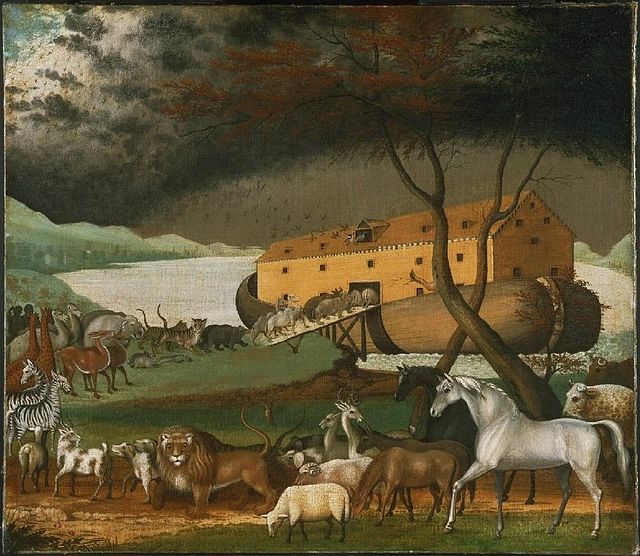
Sinking Noah’s Ark

Noahs_Ark

Noting that it’s “the only biblical story, violent or otherwise, that has spawned Fisher Price toys and nursery decoration” and that “it holds the dubious honour of being the Bible text most often given as a present by religious relatives to the children of atheist parents,” Myra Zepf makes the case against Noah’s ark and its place in our culture:

It struck me recently why this story makes believers feel warm and fuzzy and leaves me cold. Fundamentally, they identify themselves with Noah in his self-righteous smug destiny, being saved by God for their purity and goodness, whereas I recognise myself among the rest of humanity in my watery grave, sitting as I do on the wrong side of divine judgement. Noah’s faith saved him, and I’m toast. This makes it all the less appropriate as a fluffy introduction for our children to the wonders of religion.

To be honest, it’s the disrespect inherent in this soft missionising that bothers me rather than the presence of religious books in my house per se. In fact, Noah’s Ark is a spectacularly rich text from which to springboard discussion about reality versus fiction with curious little people. There is endless fun to be had wondering together how Noah managed to build an ark half the length of the Titanic, a millennium before the Iron Age, without saws, hammers or nails. Then the minor detail of how he collected the estimated 1,877,920 species from around the globe, including penguins from Antarctica and kangaroos from Australia. What about the food supplies for a year of confinement, including fresh meat for the lions and bamboo for the giant panda? Where did the floods, which were higher than Everest, drain to? Kids will love looking up how much excrement a pair of elephants produces in a year.

(Image: Noah’s Ark by the American folk painter Edward Hicks, 1846, via Wikimedia Commons)

“God Is Off The Hook”

In an interview with Gary Gutting, philosophy professor Michael Ruse explains (NYT) why he doesn’t think evolution and theism are incompatible:

G.G.: Do you think that evolution lends support to the atheistic argument from evil: that it makes no sense to think that an all-good, all-powerful God would have used so wasteful and brutal a process as evolution to create living things?

M.R.: Although in some philosophy of religion circles it is now thought that we can counter the argument from evil, I don’t think this is so. More than that, I don’t want it to be so. I don’t want an argument that convinces me that the death under the guillotine of Sophie Scholl (one of the leaders of the White Rose group opposed to the Nazis) or of Anne Frank in Bergen-Belsen ultimately contributes to the greater good. If my eternal salvation depends on the deaths of these two young women, then forget it.

This said, I have never really thought that the pains brought on by the evolutionary process, in particular the struggle for survival and reproduction, much affect the Christian conception of God. … If God is to do everything through unbroken law, and I can think of good theological reasons why this should be so, then pain and suffering are part of it all. Paradoxically and humorously I am with Dawkins here. He argues that the only way naturally you can get the design-like features of organisms — the hand and the eye — is through evolution by natural selection, brought on by the struggle. Other mechanisms just don’t work. So God is off the hook.

Face Of The Day

dish_fotdsun13

For his series Urban Shamans, Andrea Frazzeta photographed the healers, or curanderos, of Lima:

As many of the city’s residents visit shamans, they are able to compete with psychiatrists and physicians alike. At one time, the parliament of Peru considered a bill that regarded curanderos as doctors. Unfortunately, an estimated three quarters of healing practitioners are frauds, exploiting the trust of their patients.

Here, Frazzetta hopes to tell an honest narrative that explores the complexities of the unusual profession. Curanderos treat such maladies as fear and evil eye energies, as well as addressing concerns relating to work and travel. … Nestled in plain sight throughout the streets of Lima, these generations of shamans and their sometimes shocking ritual practices toe the line between cultural fixture and anomalous spectacle, inspiring ethical questions and often contradictory feelings.

See more of his work here.

The Bible For Bibliophiles

Alan Jacobs flags an interesting venture:

Bibliotecha is a remarkably successful new Kickstarter project for designing and printing a Bible made to be read, in multiple volumes and with bespoke type design.

Designer Adam Lewis Green discusses the project with J. Mark Bertrand:

JMB: The factor that “solves” a lot of the traditional challenges with Bible publishing – the tiny text, the thin, translucent paper – is dividing the text into multiple volumes. The Nonesuch Bible, for example, contains three, and Bibliotheca will have four. Whenever I’ve floated the idea in the past, it’s been met with resistance: I’m told people don’t want the Bible in several parts. But the success of Bibliotheca contradicts that. Why do you think there’s a sudden openness to a multi-volume Bible? Is it a question of reaching a different kind of reader?

ALG: I am not sure whether this is a different kind of reader or not. Obviously, the economy and practicality of a single volume is appealing, but there is also an idea out there that the biblical library belongs together in one volume, because “that’s the way it has always been, and was always meant to be.” Understandably – and this included me until I became really nerdy about bible design – a lot of people who read and appreciate the biblical literature don’t know much about the history of its physical form. Why would they? The format of the Bible as it has been given to us for generations took shape in the post-enlightenment world of empiricism, often more concerned about demonstrable facts than the enjoyment of beauty. Now, I believe (or hope), we are coming out of that, to a more balanced place.

Green adds:

I think the response to this project signifies that the biblical anthology is much too large (and I don’t mean in a physical sense) to be contained in any one format or type of reading experience. This is a diverse literature, which transcends time, culture and style in a way that very few have done, and none to the same extent. It has always taken on different forms within various contexts – artistic and technical, story-driven and study-driven. These forms will continue to change and, at times, surprise us.

When Prayer Is More Than Words

Rowan Williams offers a glimpse into his prayer life, which features meditative repetition of the Jesus Prayer – “Lord Jesus Christ, Son of God, have mercy upon me, a sinner” – along with physical disciplines, such as sitting and breathing in certain ways, all with the aim of “bringing the mind into the heart”:

The interest in uniting words with posture and breath is, of course, typical of non-Christian Rublev's_saviourpractices also; and over the years increasing exposure to and engagement with the Buddhist world in particular has made me aware of practices not unlike the “Jesus Prayer” and introduced me to disciplines that further enforce the stillness and physical focus that the prayer entails. Walking meditation, pacing very slowly and co-ordinating each step with an out-breath, is something I have found increasingly important as a preparation for a longer time of silence.

So: the regular ritual to begin the day when I’m in the house is a matter of an early rise and a brief walking meditation or sometimes a few slow prostrations, before squatting for 30 or 40 minutes (a low stool to support the thighs and reduce the weight on the lower legs) with the “Jesus Prayer”: repeating (usually silently) the words as I breathe out, leaving a moment between repetitions to notice the beating of the heart, which will slow down steadily over the period.

The prayer isn’t any kind of magical invo­cation or auto-suggestion – simply a vehicle to detach you slowly from distracted, wandering images and thoughts. These will happen, but you simply go on repeating the words and gently bringing attention back to them. If it is proceeding as it should, there is something like an indistinct picture or sensation of the inside of the body as a sort of hollow, a cave, in which breath comes and goes, with an underlying pulse. If you want to speak theologically about it, it’s a time when you are aware of your body as simply a place where life happens and where, therefore, God “happens”: a life lived in you.

(Image: Christ the Redeemer by Andrei Rublev, 1410, via Wikimedia Commons)