Roman Khudyakov, a member of the Russian Duma, is gravely concerned about a moral threat to the country’s children: he recently discovered that youngsters are being exposed, on a daily basis, to a graphic image of male genitals. The object of Khudyakov’s outrage is the hundred-ruble note (worth a bit less than three dollars), which shows the façade of the Bolshoi Theatre, adorned with a world-famous sculpture of a chariot driven by the Greek god Apollo. It is Apollo’s intimate parts that, in Khudyakov’s opinion, pose a dire problem.
In a televised interview on Euronews, he said he had evidence that the hundred-ruble note provoked unhealthy curiosity:
he had personally seen a little boy and a little girl closely examining the bill and pointing to the region of the body in question. (If true, the two kids must have been highly inquisitive: it is extremely difficult to even discern the actual “parts” without magnifying the image.) Khudyakov’s proposed solution was to mark the bill with an eighteen-plus rating. Better still, as he suggested in a letter to the Russian Central Bank, remove the morally improper bills from circulation and replace them with ones bearing an image of Crimea, annexed by Russia in March.
Khudyakov’s initiative may sound like a joke—and, indeed, the Russian media and social networks promptly made fun of it, suggesting that children should now be barred from human-anatomy classes and museums—especially in St. Petersburg and Italy, where a minor might be exposed to the works of Michelangelo and other Renaissance sculptors—and certainly kept away from the statue of the Manneken Pis, in Brussels. The lawmaker’s attack on the banknote was hardly a joke, though. It was, rather, of a piece with the anti-liberal trend that has dominated the Russian scene since Vladimir Putin’s return to the Kremlin.
— Herdwick Shepherd (@herdyshepherd1) May 26, 2014
Dish poetry editor Alice Quinn writes:
Last Friday on July 4th, in an Ask Me Anything segment, Andrew responded to a reader’s question as to whether after 30 years here he identified more as American or English. I was struck by his saying, “The impact—when I look at it now—of the English countryside on my psyche was bigger than I ever really anticipated. I find myself drawn constantly to that sort of rural calm.”
We’ve recentlypostedpoems by John Clare (1793-1864), and I can’t seem to stop reading and memorizing his work, particularly the sonnets which are so expressive of his tender devotion to the English countryside. So this week we’ll post a few more and dedicate them to Andrew, to England, and to readers of The Dish who may be moved to learn some poems by heart this summer. We’ll start with one with a dog to up the ante with Mr. Sullivan! In the poem, “nine-peg-morris” refers to a game played on squares cut in turf.
“The Shepherd Boy” by John Clare:
Pleased in his loneliness he often lies
Telling glad stories to his dog—and e’en
His very shadow that the loss supplies
Of living company. Full oft he’ll lean
By pebbled brooks and dream with happy eyes
Upon the fairy pictures spread below,
Thinking the shadowed prospects real skies
And happy heavens where his kindred go.
Oft we may track his haunts where he hath been
To spend the leisure which his toils bestow
By “nine-peg-morris” nicked upon the green
Or flower-stuck gardens never meant to grow
Or figures cut on trees his skill to show
Where he a prisoner from a shower hath been.
Richard Linklater spent more than a decade filming his new movie Boyhood:
[I]n 2001, a few years after his eldest daughter started elementary school, he felt compelled to make a movie about growing up. But focusing on any one facet of the passage through youth would require “trumping something up”—exactly the opposite of what worked in his unfussy observational classics Dazed and Confused and Before Sunrise. So, long interested in research like the famous Grant Study, which has tracked 268 Harvard students’ development over 76 years, he devised a longitudinal method: film a single child actor for a few days each year for more than a decade, resulting in a fictional coming-of-age story whose star actually comes of age onscreen.
In a rave review, Dana Stevens looks back at Boyhood‘s cinematic precursors:
I can think of few feature films in the history of the medium that have explored the power, and the melancholy, of film’s intimate enmeshment with time in the way Richard Linklater’s Boyhood does.
There’s François Truffaut’s Antoine Doinel series, in which we watch that character, a truant kid played by Truffaut’s onscreen proxy and eventual quasi-adopted son Jean-Pierre Léaud, age from around 12 to around 32. But since those five films were made over a period of 20 years, the shock of watching Léaud grow up comes at us serially, in chunks. Michael Apted’s extraordinary Up documentaries, which check in every seven years on the progress of the lives of a group of British schoolchildren first filmed in 1964, are even more widely spaced; visiting each new installment is like attending a family reunion, wondering who will show up and what condition he or she will be in.
Like Stevens, Chloe Schama finds the film a “carefully calibrated, subtle exploration of the various textures of different ages and the passage of time”:
It’s hard to write about this theme – and probably much harder to make a film about it. The subject lends itself to hazy, dorm-room theorizing of a particularly cringe-inducing variety. But the film seems self-conscious of its pretensions. Yes, it opens with a dreamy shot of young Mason lying in the grass while Chris Martin croons “Look at the stars, look how they shine for you …” And it ends with a conversation between Mason and an implied new love interest about the true meaning of “carpe diem.” It’s like, the girl says, the reverse: “the moment seizes us.” Yeah, Mason agrees: “It’s always right now.”
But these awkward articulations of the philosophical undertones of the film seem almost tongue-in-cheek, and they’re not so prevalent as to become oppressive. The point here seems to be that college freshman Mason is not much more enlightened about the funny tricks of time than his wistful six-year-old self, but there is beauty in his attempts to approach some insight on the matter.
Praising the film as a “masterpiece,” Marlow Stern marvels at how the scriptwriting process came together:
Linklater began the project with a skeleton of sorts. He had each character’s main plot points mapped out, and knew how the film would end—as well as its final shot—at conception. According to Linklater, he’d watch and edit the footage he’d shot from the previous year several times before starting an outline, which would later evolve into a script, for the following year. Sometimes, the script wouldn’t fully materialize until a few days before shooting.
“I got to watch my film, think for a year, and re-script it,” says Linklater. “I could never re-shoot anything, but could re-script it, which is where I’d incorporate the incremental changes of my four actors growing and changing, and where I could adjust any ideas I had to the reality in front of me.”
The actors filled in the free-form “unconventional script” with their own life experiences. Linklater and Hawke based the latter’s character on their fathers, since both men were Texan insurance agents who found happiness in their second marriage. Arquette based her character heavily on her mother who, like her character in the film, went back to school, got her degree, and became a psychiatrist. Ellar, meanwhile, seemed to gain more and more confidence in his acting ability as the “living project” progressed, and it shows onscreen.
In an interview, Ellar Coltrane talks about what it’s like to watch that process play back now that the movie is finished:
[M]y experience with it changes every time I watch it, really. I watched it a couple of weeks ago and it was so different from the first time I watched it. … [W]here the film ends is more or less—especially the first time I watched it—where I am in my life. It’s exactly where Mason is in that last scene. I was going through that emotional change and that process. So it was very super fresh, and every time I watch it I’m getting a little farther away from the film and from where the character is at the end. So I can’t imagine in 10 years, but I’ll always have it. And it’s comforting to know that I’ll always have this thing to watch at any point in my life and just remind myself.
The movie isn’t as Here Comes the Big Cry as the trailer and the concept would make you think; it’s far too smart and wise for that. Yet I still bet it makes you bawl your head off. Boyhood comes as close as capturing actual human existence as any film I’ve ever seen. It will feel like you have watched a full life, fully lived. And the best part: As the film ends, Mason’s life is only beginning. Everyone’s always is.
In their new book Thrive: The Power of Evidence-Based Psychological Therapies, Richard Layard, an economist at the London School of Economics, and David Clark, a psychologist, argue that public health policy should focus more pointedly on cognitive behavioral therapy (CBT). Bryan Appleyard unpacks the idea and nods along:
The success of CBT — and its offshoot, mindfulness — is at the heart of this book’s case for increased spending on mental health. The most succinct summary of the method is “thoughts are not facts”. People suffering, typically, from anxiety or depression are trapped in thought processes that they have come to believe are truths about themselves and the world. The therapist identifies these thoughts, then provides techniques for reducing or eliminating their impact. It doesn’t take long — typically 12 sessions — and it has much higher success rates than any other treatment — about 50%. Mindfulness, meanwhile, is a meditation technique inspired by Buddhism that helps people to see thoughts as passing phenomena rather than traps. …
If Layard and Clark are right, we seem at last to have found a gentle, non-disruptive and apparently risk-free way of dealing with the worst and most commonplace miseries of the mind. Let’s do it.
Daniel Freeman and Jason Freeman defend CBT from detractors:
CBT is sometimes criticised as an overly simplistic, once-size-fits-all strategy. Layard and Clark remind us that when done properly CBT is far more nuanced. For each problem, clinicians develop and test a specific theoretical model of symptoms and causes and on this basis generate a targeted treatment strategy. The aim is not to create a blithely complacent Stepford population, but to help people achieve meaningful and positive change in their lives. CBT isn’t merely effective, it is also relatively cheap – certainly when compared to the spiralling costs of medications such as antidepressants. …
CBT, as Layard and Clark acknowledge, doesn’t work for everyone. And it doesn’t mean that we don’t need to address the causes of mental illness, such as poverty, stress, and lack of social support. But it’s time we got serious about tackling psychological problems, ramping up research and providing people with the treatments that have been proven to work.
The authors are clearly compassionate people who want to abolish the misery of mental illness, and CBT, so appealing to economists with its manualised conversations, standardised questionnaires and worksheets, and in tune with contemporary culture’s desire for measurable fast outcomes, is the pragmatists’ holy grail. CBT aims to get the patient symptom-free, back to work and paying her taxes. In generations to come, if we can ward off the return of the repressed, people will be looking back at 20th-century literature and philosophy and wondering what on earth they were on about with their incomprehensible talk of the unconscious, their tales of guilt, sublimation, drives and dreamwork. Because, by then, the mysteries of the human heart will have been abolished and all the world will be transparent and symptom-free.
Bonnie Tsui reflects (NYT) on how joining a writing collective helped her hone her craft:
I spend more time talking, which makes me a faster and better writer. This is not as weird as it sounds. My modus operandi of many years had been to work through ideas by writing. It sounds good, but what it meant in actuality was a lot of unfocused writing that went in circles. I’d struggle and spiral, elaborately, miserably, into a corner, before realizing that none of the writing was particularly good because I hadn’t thought through my ideas carefully enough. In the conversation about ideas — the clarification of an argument, the identification of a larger point to be made, the firmer realization of what I want to say before I start crafting the prose — the writing that results is inevitably clearer and smarter. Because I have opened my mouth and practiced using the words, I now set them down with more care, precision and patience.
Susan Terrio spent years interviewing children who had crossed into the US unaccompanied and were detained by US immigration. In a distillation of her research, she gives a sense of what life is like in the facilities:
Being locked up with no set endpoint creates feelings of helplessness among children who are already suffering from trauma. Ernesto remembers his feelings of disorientation: “You don’t know what’s going to happen. I asked, ‘Why do they send me here?’ We were so afraid. Were they going to take us somewhere and kill us?’”
In 2012, the length of stay in [Office of Refugee Resettlement] facilities for unaccompanied children averaged 60 to 75 days, ORR officials told me. And the longer the children stay, the more anxious they tend to feel and the more likely they are to act out. Some who qualify for protective status instead choose to self-deport in order to escape prolonged confinement. …
Based on site visits and 100 interviews with federal staff, I found that immigration custody is plagued by systemic problems. It takes an ad hoc approach that undermines consistency and fairness, lacks coordination in data collection, restricts information flows, enhances redundancy and concentrates power in the hands of senior government administrators whose decisions are difficult to review or appeal. Complaints about the abuse of children by facility staff have continued. Government officials have been slow to report abuse and have repeatedly failed to hold abusers accountable. More troubling is the lack of independent oversight to track the government’s compliance with its own detention standards—those who oversee operations are supervisors working for the ORR.
(Photo: A young boy bows his head in a holding cell where hundreds of mostly Central American immigrant children are being processed and held at the U.S. Customs and Border Protection Nogales Placement Center in Nogales, Arizona on June 18, 2014. Brownsville, Texas, and Nogales, have been central to processing the more than 47,000 unaccompanied children who have entered the country illegally since October 1. By Ross D. Franklin-Pool/Getty Images)
Six months into marijuana legalization, the Colorado Department of Revenue has issued a new report outlining findings about the size of the newly legal market. It turns out that the demand for marijuana far exceeds earlier estimates; according to the report, statewide demand is at a whopping 121.4 tons per year. That’s 31 percent higher than a previous Department of Revenue estimate and 89 percent higher than an oft-cited study by the Colorado Futures Center. And while the vast majority of the increase is the result of resident smokers consuming more than expected, the growth of the retail market — particularly among tourists — is a promising sign for the success of legalization.
Colorado makes substantially more money from taxes on recreational marijuana than medical marijuana. So the success of recreational legalization can be measured by the state’s ability to make loads of money from pot taxes. For advocates, Colorado (so far) appears to be a first victory and may become proof of concept. If Colorado is able to rake in a substantial amount of tax revenue, legalization advocates’ pitches to legislatures in Oregon, Massachusetts and Alaska become that much easier.
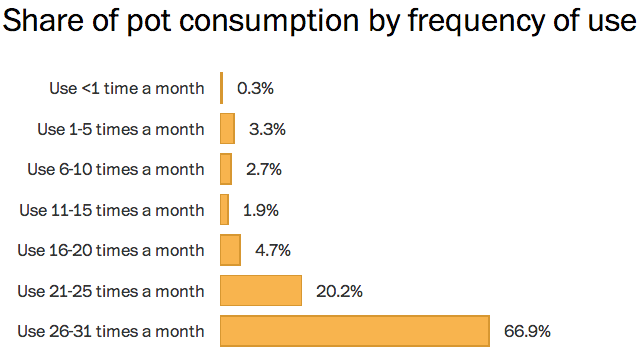
Adult residents either smoke pot (relatively) few times a month or nearly every day—there are few in the middle. More than half of all adult resident users consume the drug in some form fewer than six times a month. (More than 1 in 4 consume less than once a month.) At the same time, about 1 in 5 users are near or at daily consumption. While those roughly daily users account for just a fifth of the user population, they consume fully two thirds of the product.
A particularly interesting finding is where most of the new retail consumers are coming from. Because of the low tax rate on medical marijuana and greater number of medical marijuana stores, most existing patients are not switching their buying outlets for now.
The report finds, “Using the latest retail marijuana tax statistics from the Department of Revenue, we also found that conversions from medical to retail consumption is relatively low. Instead, retail supply of marijuana is growing, while medical marijuana is relatively constant. This may indicate that medical consumers would rather pay the medical registration fees as opposed to the higher tax rates, or that there are currently relatively few retail outlets compared to medical centers. Therefore, the retail demand is derived primarily from out-of-state visitors and from consumers who previously purchased from the Colorado black and gray markets.”
For example, in Denver it is estimated that 44 percent of recreational marijuana sales are to visitors and the rate is even higher in some ski towns. Clearly, many people are coming the Colorado to enjoy the new freedom.
walking by the waters
down where an honest river
shakes hands with the sea,
a woman passed round me
in a slow, watchful circle,
as if I were a superstition;
or the worst dregs of her imagination,
so when she finally spoke
her words spliced into bars
of an old wheel. A segment of air. Where do you come from?
“Here,” I said. “Here. These parts.”
Laverne Cox recently became the first openly transgender woman to receive an Emmy nod. Jos Truitt applauds the news:
Cox is certainly deserving of the nomination: she brings a depth and humanity to the role that is more than what’s in the script. Sophia’s interactions with her wife and fight to get the medical care she needed were powerful moments, and it’s fantastic to see the Emmys take notice.
Cox’s celebrity has been met with some bigoted responses. So, given the occasional fool in the media, like Kevin D Williamson who still thinks that Cox’s gender should be up for debate, it’s nice to see the Emmys committee underscore that Cox is a woman nominated as an actress, full stop.
Parker Molloy considers how far the film industry has come:
In the early 1980s, Caroline Cossey tried to follow up what was at the time a successful modeling career by taking on some acting work. After appearing as an uncredited featured extra in the 1981 James Bond movie For Your Eyes Only, Cossey was outed by the tabloid News of the World when they ran a headline proclaiming “Bond Girl Was Born a Boy.” As she later recounted, the experience not only destroyed her career, but nearly drove her to suicide.
What we’re seeing now is a world in which being transgender is not necessarily the career-killer it once was. These gains – of Laverne Cox scooping an Emmy nomination, Candis Cayne appearing on shows like Elementary and Dirty, Sexy Money, and Jamie Clayton finding herself cast in a recurring role in an upcoming TV show—may be small, but they are a true sign of progress.
Meanwhile, Esther Breger wonders what the full field of nominations says about TV today:
Despite all the silliness, [yesterday] morning’s nominations – the glaring omissions and the boring deja vu – do indicate a larger cultural shift. When the Emmys overlooked The Sopranos‘ first season in 1999, awarding best drama to David E. Kelley’s campy legal procedural, The Practice, instead, the awards show was widely derided for being out of touch, unwilling to recognize cable shows that seemed unfamiliar. Fifteen years later, HBO is racking up 99 nominations, more than any other channel.
But just as shows like The Practice once crowded out innovative shows, the dominance of HBO and HBO-lite can overshadow the actually exciting TV being made today, across all channels. “Quality television is now platform-agnostic,” the TV Academy’s chief said [yesterday] morning, referring to services like Netflix. And he’s right. The defining character of this post-“Golden Age” TV era is plenty; cable, broadcast, and online streaming services all have brilliant shows and boring ones – and the great ones are as likely to look like pulpy fluff as gritty crime drama. Some of them will even have clones.




 The Dish