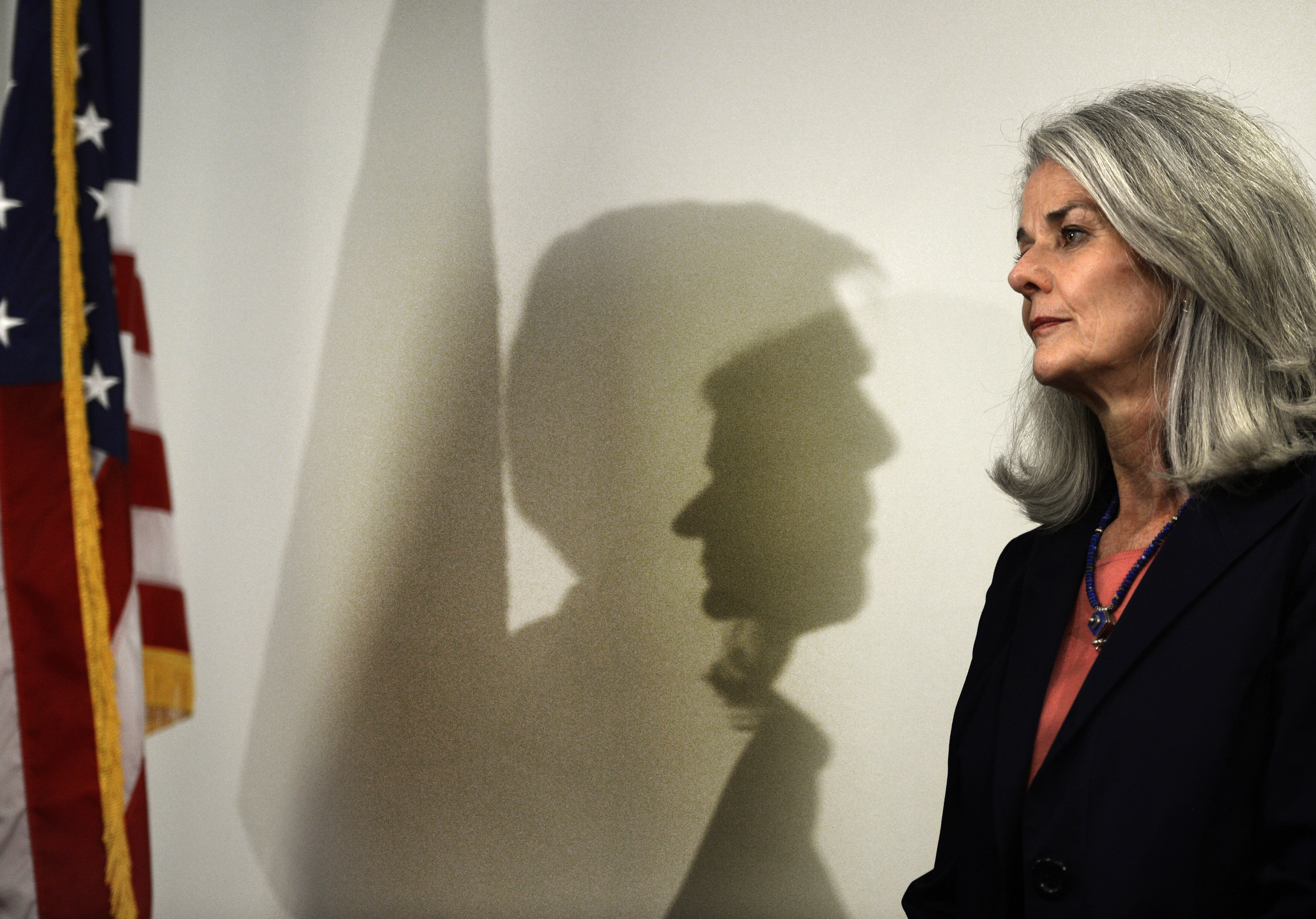
Vicki Cowart, CEO of Planned Parenthood of the Rocky Mountains, listens to Colorado Senator Mark Udall talk during a news conference about a bill to override Hobby Lobby decision, July 11, 2014. The news conference was held at the Denver Place in downtown Denver. By RJ Sangosti/The Denver Post via Getty Images. Details on Udall’s effort here.
Pop-Culture Partisanship
Alyssa has grown tired of it:
As we have become more comfortable discussing the politics of culture, our discussions of art have become a lot more like our discussions of politics. We treat people whose interpretations differ from our own as if they are acting in bad faith. We focus on gaffes and supposed gaffes. And we demand that significant figures in cultural commentary have something to say about every big event so we can check their reactions against our sense of what they ought to feel to remain in good standing. …
The idea that enjoyment is tainted by argument shows up over and over again in our cultural conversations. There are fans of “Game of Thrones” who apparently cannot tolerate the idea that a show that ranges so broadly might not show the same deftness in all aspects of its production that it demonstrates when it is at its best. I regularly hear from readers of comic books who insist that the only way to judge superhero movies is to read them against their source material, which would surely change my feelings about the execution of a storyline or two. When I state an opinion – that the second paintball episode of the cult sitcom “Community” did not engage me as much as the first – that critical judgement is taken in some quarters as an error of fact.
Afghanistan Gets Worse
Reid Standish relays a troubling new report from the UN that shows violence there is on the rise again:
According to newly released United Nations data, the number of civilians who were injured or killed in Afghanistan rose by 24 percent over the first half of 2014, compared to the same period in last year. In total, the United Nations Assistance Mission in Afghanistan (UNAMA) documented 1,564 civilian deaths and 3,289 injuries during the six-month span.
The U.N. data indicates that ground combat has overtaken improvised explosive devices (IEDs) as the leading cause of civilian deaths. Ground combat — which can include the use of mortars, rocket-propelled grenades, and small arms — was responsible for 39 percent of civilian deaths and injuries in 2014, accounting for 474 civilian deaths and 1,427 injuries. The number of casualties caused by ground combat rose 89 percent from the previous year.
Reading the same report, Keating highlights the particularly grave danger women and children are facing:
Child casualties more than doubled and the number of women casualties increased by 60 percent. The reason is the changing nature of the violence. For the first time, more civilians were killed by crossfire in battles between government and anti-government forces than by improvised explosive devices. Suicide attacks are also down this year. This means more violence is taking place in heavily populated areas where women and children are likely to be found. As one U.N. official put it, “the fight is increasingly taking place in communities, in public places, near playgrounds, and near the homes of ordinary Afghans.”
Is Online Betting Less Addictive Than Casino Gambling?
Cameron Tung believes that former is less psychologically involving than the latter:
In 2006, researchers at the University of Guelph published a paper in which they concluded that a specific type of casino design was best for stoking people’s desire to gamble.The study’s authors collected the emotional and psychological responses of subjects to the “playground” model of casinos – distinguished by warm colors, “the presence of accessible green space and moving water” – and the Friedman-design model, in which the “gambling equipment should be the dominant decorative feature in a casino, and décor should be used only to highlight and enhance the equipment layout.”
The researchers determined that the playground model elicited higher responses of pleasure as well as mental restoration, a quality they found to be linked to a person’s willingness to gamble. Appearing to validate these conclusions are the financial reports of the Roger Thomas-designed Bellagio and Wynn hotel-casinos in Las Vegas, which contain extreme archetypes of the playground-style gaming floor and have trounced many of their Friedman-style competitors. One of the authors of the University of Guelph study, Karen Finlay, told the New Yorker that “gamblers in a playground casino will stay longer, feel better, and bet more. Although they come away with bigger losses, they’re more likely to return.”
In other words, it’s possible that many gamblers are not actually seeking the most convenient or efficient place to win money, but the most comfortable space in which to lose it.
Mental Health Break
A mesmerizing look inside everyday objects:
Verschleif from Laurin Döpfner on Vimeo.
With an edge sander, half a millimeter is sanded off each work piece (wood, walnut, transformer, skull or analogue camera) and photographed. About 650 photos are made into a short film, which contrasts the inner structure of nature and technology.
The Root Of The STEM Problem, Ctd
Freddie responds to Danielle Kurtzleben on the supposed shortage of workers trained in science, technology, engineering, and math:
[I]t’s very frustrating that Kurtzleben, and essentially our entire elite policy media, doesn’t go a step further: trying to predict what particular set of discrete and limited skills will be useful in the future is a mug’s game. It’s a fundamentally risky way for an individual to behave, and for policy decisions that are supposed to be based on the most good for the most people, it’s incoherent strategy.
Jobs in petrochemical engineering have been exploding, because of a largely-unpredictable boom in American fossil fuel reserves. Becoming a contracting engineer for a construction firm was a great idea in 1999, but by 2005, was a very risky proposition. Going to law school was the epitome of mercenary self-interest until, suddenly, it was the epitome of laughable, deluded foolishness. Teaching kids how to code Python now, when they’ll be hitting the job market 20 years from now, is ludicrous, especially in a world where there’s every reason to think that tech firms will continue to have very low employee to market cap ratios and where computers might take over the bulk of coding. Individuals can navigate the markets, if they’re smart, privileged, and lucky. But great masses of people never can. If you’re telling me that you know what every freshman should start studying in 2014 so that s/he can get a good job in 2019, I think you’re full of it.
Killed On The Fourth Of July
Last weekend was a veritable bloodbath in Chicago, with 82 shootings and 14 deaths, including two armed teenagers shot by police. Tara Long takes a look at how the Windy City got to be so violent:
Noting that the Chicago PD has come under scrutiny for underreporting violent crime, Josh Voorhees adds that while the murder rate is falling overall, it remains terrifyingly high in the city’s toughest neighborhoods:
Even if a portion of the recent drop in crime numbers is due to a statistical sleight of hand, most observers agree that violent crime is indeed falling in Chicago, as it is in most major cities. But the overall numbers obscure the fact that Chicago is a city of neighborhoods, and much of the violence has been sequestered in poor, predominantly black areas of the city where gang violence goes largely unnoticed unless it comes in bunches, as it did this past weekend. After crunching the homicide numbers for 2000 through 2010, Yale University sociologist Andrew Papachristos found that the murder rate was about 3.1 per 100,000 residents living in the Northwest side’s Jefferson Park. Less than 10 miles away in West Garfield Park, the rate was more than 20 times that, a staggering 64 per 100,000, or roughly in line with the casualty rate for civilians in Iraq at the height of the last war. When people describe parts of Chicago as urban war zones, it is not hyperbole.
Tipping Stereotypes
A reader proves exceptional to the rule on lesbian tippers:
I’m sure this will resonate with any member of a group perceived as being bad tippers, but my partner and I – and most of our lesbian friends – strenuously overtip. (All current or former attorneys, and most former servers.) It’s not just to make up for the cheapness of our cohort, but SF is an expensive town in which to eke a living serving drinks.
(BTW, any mention of San Francisco’s Lexington? All lesbian, all of the time.)
Another veers from the thread:
I promise you that lousy tipping isn’t a lesbian thing; it’s a woman thing.
I waited tables for several years in a half-dozen restaurants (none catering to a gay clientele). If four guys walked in for lunch, at least two would fight for the check and the “winner” would tip 15-25%, guaranteed. With four women, it’s separate checks and you’d get stiffed by at least two of them, also guaranteed.
(By the way, keep up the great work, Team Dish … my $4.20/month is the best bargain in my life.)
Another reader:
I had to laugh when reading this thread. I waited tables for a good chunk of my twenties and ran across two stereotypes: one about women and the other about African-Americans. I was told by a black fellow waiter that “black folks don’t tip.” On that one I discovered that in general, they just expected more for their money. If I had a table of African-Americans and I took good care of them, I would be tipped very well. In fact my best, most insanely generous tips came from them.
I can’t say the same about white women. All of my waiting horror stories had to do with them. Horrible tippers, generally a pain to deal with. The exception there was if the woman had waited tables, but otherwise I would go way out of my way to avoid a table of women. (And for the record, I’m a white woman.)
Update from a reader:
As opposed as I am to stereotyping in general, I can’t disagree with your other readers on white women. I waited tables at various – mostly upscale – restaurants in three states during the bulk of my twenties. The worst experience I ever had was a table of ten white women at a fancy restaurant in Richmond, maybe ten or twelve years ago.
They hit all the marks – separate checks, high-maintenance, etc. But the worst was that they wouldn’t leave. We closed at 10pm, and after working my usual double-shift I was very ready to get off my feet. I was one of the first people cut, but obviously I can’t leave while a table is still sitting. If they had already paid, I perhaps could have bribed the closing busser to wrap things up but I’m not leaving when my biggest table of the night hasn’t closed their check out. After finishing my sidework – and helping several others with theirs – I eventually took to leaning on the wall next to the kitchen entrance, about ten feet from the table, maintaining a thin veneer of patience while they chatted away. As it closed in on midnight, they finally decided to leave brusquely after expressing visible irritation with the time it took me to run ten different checks.
I think I walked away with five percent. Complete waste of a shift. People who have never had that sort of experience just. don’t. get it.
Another:
For a couple of years in the ’90s, when I was in high school and college, I delivered pizzas for a regional chain in the South. For the first year, I worked for the store in the “nice” section of town, where most of the clientele were middle- and upper-middle-class. The tip money was ok, I guess. I was 17 years old at the time, and had no experience by which to judge. The following year, I was transferred to the store on the other side of town, which was solidly working-class. Being young and prejudiced and coming from a middle-class family myself, I was disappointed and expected to see a big decline in my tip income.
I couldn’t have been more wrong. The working-class folks were much more generous tippers than the middle class and well-off pizza buyers I had become used to. My nightly income increased by around 50% or more. Not only that, but they tended to be more welcoming than the wealthier clientele. On the nice part of town, people would greet you on their doorstep, quickly make the transaction, and then return indoors, locking the door behind them. The working-class people would often be waiting for you on the porch, relaxing and drinking a beer. The experience reversed my class prejudices and has stuck with me for all of my adult life.
And another:
What’s the difference between a Canadian and a canoe?
Canoes tip.Regards,
A Canadian
One more:
I am a white woman and am attending a professional conference in a major North American city. I should be in bed right now because of the 8 AM annual business meeting (yes, on a Saturday!) but just read all the posts criticizing my gender and race for tipping. I just came back from dinner with two women friends. Let me tell you how it went:
1. We did ask for separate checks. Do you know why? Because it is a fucking business dinner, and we all work for different employers, and this is going on our individual expense accounts so we need it to be on our individual credit cards.
2. Each of us on our individual checks tipped 20%. Do you know why? LIKE THE WAITERS, WE WORK FOR A LIVING.
Your commenter who mentioned “high maintenance” non-tippers has a point. Years ago, I was an employee of an upscale store. I worked for commission, not tips, so I tried to provide the best customer service I could so they’d buy more. That being said, I could always predict how a customer was going to treat me by just taking a few moments to observe her. If it was a Birkin bag and it was 2:00 in the afternoon, she was probably going to be horrible. If it was a Hugo Boss suit at 7:00 in the evening, she was probably going to be lovely.
Maybe these waiters could use 30 seconds of observation to try to do the same. If you’re pouring wine and they’re comparing yoga studios and one-upping each other on how great their Hampton rental is, you might prepare to get stiffed. If you’re pouring wine and they’re comparing budget processes and one-upping each other on how awful their management committee is, you might prepare not to get stiffed. As noted above, we ALSO work for a living and we ALSO have clients and customers and we know that excellent service is (pun intended) table stakes. Our customers expect it from us, and we expect it from waitstaff. And when we get it, we recognize it.
And when waitstaff treats us like crap?
We still tip 20%. Because, again, we also work for a living. And frankly, the awful service might not be the waiter’s fault, but the kitchen’s (although that is rare and you can usually tell). However, be it your fault or the sous chef’s, we will tell everyone we know in real life (and everyone we don’t know on OpenTable) that the restaurant has awful service and to definitely go someplace else. As businesswomen we understand that revenue is something, but reputation is EVERYTHING. So congratulations – you have our tip; you just lose the future ones from the customers we are now ensuring you don’t get. And businesswomen can provide or negate a heck of a lot more restaurant business than people think. Trust me.
Ask Me Anything: The Perils Of Inequality
If I were in the White House, what would keep me up at night?
Answers to more of your questions here.
Boehner Pulls A Bachmann, Ctd
Beutler isn’t impressed with the details of Boehner’s lawsuit against Obama, which came out yesterday:
It turns out Obama’s vast and indisputable misconduct is limited to one act of enforcement discretion: his decision to delay implementation of an Affordable Care Act’s requirement (one Republicans despise) that businesses with more than 50 employees provide their workers health insurance or pay a penalty. …
[T]he GOP has spent weeks and weeks accusing Obama of unbridled lawlessness, when they didn’t really have the goods. That it unfolded against a backdrop of Republicans demanding Obama fix a child-migrant crisis at the border without providing him the legislative means to do so only underscores the point. Boehner desperately wants to avoid getting ensnared in another maximalist showdown with Obama, just to satisfy the hardliners in his conference. Some of them want to impeach a president they’ve dubbed an outlaw. So he set out to address their grievances in a different way. But in so doing, he actually just refuted them.
Drum catches on to the Speaker’s game:
Boehner is suing over a provision of the law that’s been delayed until 2016. But a lawsuit like this takes a while.
It’ll take a while to file the documents, and then a while longer to get on the calendar of a district court. Then another while for a hearing and a ruling, and then yet another while for an appeal. Then yet another while if the White House asks for an en banc review. And then finally yet another while as it goes up to the Supreme Court.
How long altogether? I’d guess a minimum of a year and a half, and probably more like two years. So the best case for conservatives is that the Supreme Court takes it up in late 2015. By the time they’re ready to rule, it’s moot because the mandate has taken effect and Obama is out of office.
Boehner is smart enough to know all this perfectly well. In other words, he knows that this is purely a symbolic gesture. Not only does Obama not really care much about it, but it’s vanishingly unlikely that the Supreme Court will ever hear the case. That makes it an almost perfect piece of theater. Neither side cares much, and it will never be decided. Boehner gets to say he’s doing something, Obama gets some mileage out of mocking him, and that’s it. The real-world impact is literally zero.
But imagining that the lawsuit goes forward, Andrew Prokop considers “what will happen if the courts decide that the House does in fact have standing to sue the president”:
Overall, the power of the presidency would be weakened, and the power of Congress and especially the courts would be strengthened. In recent decades, conservatives have tended to be suspicious of loosening standing requirements, and have argued instead for restraining the judicial role. Justice Antonin Scalia wrote in a Supreme Court dissent last year that the consequences of loosening standing requirements could be vast. … But overall, those who think the president has grown too powerful and unchecked in recent years would probably be happy if the courts placed a new check on executive power. A favorable ruling for Boehner would likely make life somewhat more difficult for any president in power. For instance, one could imagine a Democratic Congress suing a Republican president for improperly implementing Obamacare, or for refusing to enforce environmental laws.

