Andrew Asks Anything: Matthew Vines, Ctd

A reader gets a conversation going:

I just finished your Deep Dish podcast with Matthew Vines, and found it quite enlightening. More than anything, I found your enunciation of your Catholicism and its comparison to Matthew’s reformed Protestantism instructive in how I read the Dish and your response to evangelical Christianity.

vines-f-image-sqAs someone who is also a Presbyterian like Vines, I found his discussion with you on biblical inerrancy very helpful to the those uninitiated in the reformed/Calvinist traditions. While I am not the target audience of his book (I have oscillated between Mainline and conservative Presbyterianism), I unfortunately do not think his argument will get the job done. Remember, these are folks who split the denomination (in a most painful way) over Paul’s epistles and the issue of women’s ordination, preaching, and even Sunday school teaching.  While I am sympathetic to his cultural relativistic argument regarding Paul and his understanding of same-sex relationships, more conservative Christians will only see this as the camel sneaking further into the tent and the overall erosion of biblical authority.


On your ongoing dissents regarding the biblical view of marriage, I implore you and your readers to pick up Tim Keller’s book The Meaning of Marriage. Like Vines said, I think this book does a good job of the importance of marriage in modern society as well as the biblical rationale and goals of marriage. The book changed the way I look at my own marriage and motivations.

Your dissents also argue that “if only those churches were more accepting, they would have millennials rushing to the pews.” Bull. Shit.

As we are expecting our first child, my wife and I joined a new PC USA Church to ensure our son was raised in the same environment and community I was. The church just signed off on gay marriage, has allowed ordination of gay pastors for years but, despite this, still has a median age of 82 and an average hair hue somewhere between ivory and blue. There is no evident impending wave of millennials now that the last social/cultural barrier of marriage equality has been removed. If young people want to support these institutions that are opening their doors as broadly as possible to all people, from all walks, they can start by showing up on Sunday – but it simply is not happening.

I feel and fear the evangelicals may be right: liberalizing theology will not reinvigorate the church with young faces and energy; it will simply hasten the downward spiral of mainline Protestantism as people leave for more conservative mega churches/lightshows or the faith altogether. At least, that’s the view from my pew.

The reader, piggybacking on another thread, adds a “bonus: my never more relevant black beagle mutt, Kirk”:

Kirk

My previous thoughts on the podcast are here. And don’t forget to check out Matthew’s remarkable new book, God and the Gay Christian: The Biblical Case in Support of Same-Sex Relationships.

Global Warming Happy Talk

Will Oremus is concerned by it:

“I don’t think anybody in this room denies climate change,” the Heartland Institute’s James M. Taylor said in his opening remarks Monday. “We recognize it, but we’re looking more at the causes, and more importantly, the consequences.” Those consequences, Taylor and his colleagues are convinced, are unlikely to be catastrophic—and they might even turn out to be beneficial.

Don’t call them climate deniers. Call them climate optimists.

He fears this nonsense will spread:

The climate-optimist credo aligns neatly with public-opinion polls that show most Americans believe climate change is real and humans are causing it—they just don’t view it as a top priority compared with more tangible problems like health care costs. You can imagine how eager they are to be reassured that their complacency won’t be punished.

“Obama’s Katrina”

That ridiculous comparison, courtesy of Rick Perry, is the latest meme from the far right. The Texas governor on Wednesday insisted that Obama visit the border as a show of leadership, but the president declined, saying he wasn’t interested in photo-ops and didn’t need to be there in person to understand what was going on. But Charles Pierce urges Obama to go, calling his refusal “politically idiotic and morally obtuse”:

There is a massive and growing humanitarian crisis on our southern border. The president can’t be drinking a beer and shooting pool in Colorado, while laughing off the offer of a joint, while we’re rounding up unaccompanied refugee children and sticking them in Army camps. He wasn’t elected to be fundraiser-in-chief. He wasn’t elected even to be the leader of the Democratic party; that’s an honorific that comes with the day job. He was elected to lead the whole country, and it does the country no good to have him up there at a press conference, even telling the truth about the inexcusable dereliction of duty in the Congress and talking airily about how he wouldn’t participate in “theater.” That’s every bit as tone-deaf as anything his predecessor ever said on any subject.

Kilgore agrees:

I’m reminded of an anecdote about former Sen. Chuck Robb … encountering a constituent while campaigning in a grocery store who was beside herself with agony over some obnoxious decision by her local government.

Robb responded by saying something along the lines of: “Your problem, as I understand it, is not within the jurisdiction of the federal government. However, my staff can direct you to the proper authority should you wish.” Some wag contrasted this with how Bill Clinton would have handled it: by hugging her, crying with her, and generally making her feel noticed. Clinton wouldn’t have been able to do anything about the local zoning board or whoever it was, but the constituent would have felt immensely better—a feeling that could easily be projected via media coverage. Instead, Robb basically wrote her a memo.

On occasion just showing up in a messy situation is more important than having a solution or being “right.”

Aaron Blake adds that a firsthand look would probably be more instructive for the president than he thinks:

Obama seemed dismissive Wednesday night of the idea that being on the ground and seeing the situation firsthand would give him any additional insights. “Nothing has taken place down there that I’m not intimately aware of,” he said. But just hours earlier, Obama was talking up the importance of hearing directly from average people who were struggling. In fact, he visited Denver expressly to visit people who had written him letters — something he said in a speech Wednesday morning was as important to his job as his daily national security briefing. We at The Fix are very data-driven, and we prefer numbers to anecdotes. But we also recognize that being on the ground lends perspective that you can’t get through other means — no matter how good your staff or your information is. Obama might not think that visiting the border is a good use of his time, but it’s hard to see how it’s not without some informational value.

Noah Gordon, on the other hand, makes the case against dashing to the border:

A visit can be useful for boosting a region’s battered morale, for shaking hands and airing anodyne messages of support for victims. This is not one of those situations. Rebuilding homes, or supporting the troops, is universally popular, and it’s easy to strike a pose of resolve in the wake of a storm. How to adjust immigration policy is more divisive and complicated. Does Obama embrace the illegal migrants whom Speaker John Boehner wants to dispatch the National Guard to stop? Or stand in the doorway, hands on hips, reminding these children there’s likely no safe haven here? Does he hand out water bottles or Notices to Appear? …

Besides, this isn’t the aspect of immigration policy the administration wants to trumpet, but the part it wants to sweep under the rug. Obama’s balancing act now requires asking Congress for $3.7 billion to pay for the removal (and humane treatment) of some illegal immigrants while using executive action—over the head of a House speaker who is suing him for doing so—to make overall deportation policy more lenient. Obama’s decision not to visit the border is a gamble, but it may still be a smarter bet than making the trip.

And Waldman rolls his eyes, saying the border crisis is the “exact opposite” of Obama’s Katrina:

In that case, it was Bush’s failure of competence and his inability to go beyond photo ops that resulted in so much destruction. In this case, the president’s critics are actually demanding a photo op, while refusing to take any immediate practical steps to address the problem.

Update from a reader:

Another factor in the president’s refusal to do photo ops at the Texas border is that the people most interested in the photo would probably be Central Americans – either those whose children have fled, or those who may be thinking of heading north. And this kind of photo sends the wrong message – unless the president is actually pushing toddlers back into the Rio Grande in person.

Another:

If President Obama were to visit the border to witness the situation there firsthand, the very people criticizing him for not going would be the first to criticize him for being there in person and seeking to turn the migrants/refugees into Democrats. It doesn’t matter what Obama does; conservatives will find a way to demonize him in their loudest voices.

Genes And Our Politics

There’s a lot of truth to the old joke that liberals believe nothing is genetic except homosexuality and conservatives believe everything is genetic except homosexuality. On that spectrum, I remain broadly conservative (I think sexual orientation is almost certainly affected by some genes). I think a huge amount of what we fight over as cultural is much more linked to genes than we want to believe. And so I remain of the view that homo sapiens is not a separate and unique species of animal on planet earth, and has evolved and will continue to evolve in classic response to natural selection.

Mitt Romney Attends Tea Party Rally In New HampshireThat’s why it has always struck me as pretty obvious that there will be genetic differences between various geographic sub-populations in particular regions where humans have evolved and interbred for millennia. This does not translate to our concepts of “race” which are often artificial and crude and unscientific; but that doesn’t mean there isn’t some overlap or that the core underlying argument – that human populations can differ genetically across the planet, just as every single other species on earth differs – is somehow empirically suspect. And that’s the fundamental insight I took away from Nicholas Wade’s flawed recent book on race and genetics: forget the conjecture that takes up more than half the book; forget the arguments about “race” and genetics; and just re-imagine ourselves as very advanced apes with a long evolutionary history on planet earth, with lots of minor, regional variations, like so many other species. It’s a mind-expanding thought experiment.

In some discrete respects, we accept this as unexceptional. So, for example, no one is up in arms about the discovery of a recent and powerful genetic factoid that we covered yesterday: 87 percent of Tibetans have a mutation in a gene called EPAS1, which enables better breathing at very high altitudes. Only 9 percent of Han Chinese have this mutation, and yet the two populations have only been separated for less than three millennia. As proof of principle, that’s hard to beat: dramatic genetic variation just for the last 3,000 years of the roughly 200,000 we’ve been evolving and wandering across the globe in so many starkly different environments with profoundly different genetic US-JUSTICE-GAY-MARRIAGEimplications.

Our extreme intelligence in the animal kingdom means that our evolution has also been one in which culture and genes have intermingled in bewildering ways; and to miss culture as a core factor in our differences is to be just as blind to reality. But to see us as merely cultural beings, or walking blank slate brains, or completely interchangeable across the globe and all sub-populations is to miss the true drama of human history and pre-history. It robs the human story of its depth and richness in pursuit of an ideal – utter equality – that would have struck almost every human generation before three hundred years ago as bizarre.

Which is a very long-winded way (but hey, it’s good to get that off my chest) to say that it was refreshing to see Tom Edsall this week penning a bracing argument that genes may also lie beneath our political dispositions. In other words, a huge amount of what you’re born with may determine or at least strongly influence your liberalism or conservatism:

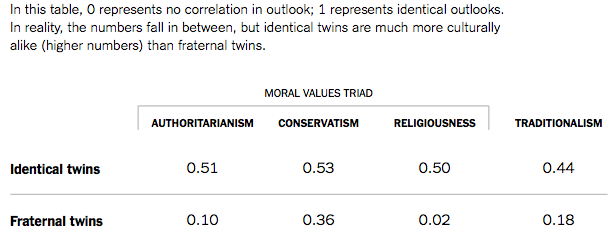
In “Obedience to Traditional Authority: A heritable factor underlying authoritarianism, conservatism and religiousness,” published by the journal Personality and Individual Differences in 2013, three psychologists write that “authoritarianism, religiousness and conservatism,” which they call the “traditional moral values triad,” are “substantially influenced by genetic factors.” According to the authors — Steven Ludeke of Colgate, Thomas J. Bouchard of the University of Minnesota, and Wendy Johnson of the University of Edinburgh — all three traits are reflections of “a single, underlying tendency,” previously described in one word by Bouchard in a 2006 paper as “traditionalism.”

This somewhat acts as a confirmation of Jonathan Haidt’s notions of the values that predominate in conservatives and liberals. And here’s the data from sets of fraternal and biological twins:

Screen Shot 2014-07-10 at 12.11.34 PM

The religiousness differential is particularly stark, followed sharply by authoritarianism. And Edsall is right to note this may help explain why, in a polity riven by core cultural questions, the ability to compromise, or even understand the other side, is in short supply. When it comes to economic questions, the divide is much less stark. There is, in other words, nothing the matter with Kansas. Kansans’ social and cultural value system outweighs in intensity and durability any economic arguments – and it’s our genes in part that facilitates that. Edsall’s conclusion?

Perhaps the most important rationale for research into the heritability of temperamental and personality traits as they apply to political decision making is that such research can enhance our understanding of the larger framework within which public discourse and debate shape key outcomes.

Why are we afraid of genetic research? To reject or demonize it, especially when exceptional advances in related fields are occurring at an accelerating rate, is to resort to a know-nothing defense. A clear majority of those involved in the study of genetics, neuroscience and evolutionary biology are acutely aware of the tarnished research that produced racist, sexist and xenophobic results in the past. But as the probability of a repetition of abuses like these diminishes, restrictions on intellectual freedom, even if they consist only of psychological barriers, will prove counterproductive. We need every tool available to increase our understanding of our systems of self-governance and of how we came to be the political animals that we are.

And we have nothing to be afraid of but the truth.

Quote For The Day

“No single explanation exists for why the War for the Greater Middle East began and why it persists. But religion figures as a central element. Secularized American elites either cannot grasp or are unwilling to accept this. So they contrive alternative explanations such as “terrorism,” a justification that impedes understanding. Our leaders can proclaim their high regard for Islam until they are blue in the face. They can insist over and over that we are not at war with Islam. Their claims will fall on deaf ears through much of the Greater Middle East.

Whatever Washington’s intentions, we are engaged in a religious war. That is, the ongoing war has an ineradicable religious dimension. That’s the way a few hundred million Muslims see it and their seeing it in those terms makes it so. The beginning of wisdom is found not in denying that the war is about religion but in acknowledging that war cannot provide an antidote to the fix we have foolishly gotten ourselves into.

Does the Islamic world pose something of a problem for the United States? You bet, in all sorts of ways. But after more than three decades of trying, it’s pretty clear that the application of military power is unlikely to provide a solution. The solution, if there is one, will be found by looking beyond the military realm — which just might be the biggest lesson our experience with the War for the Greater Middle East ought to teach,” – Andrew Bacevich, speaking truth to power.

(Photo: Seen through splintered bullet-proof glass, US soldiers from 2-12 Infantry Battalion examine their damaged Humvee after an Improvised Explosive Device (IED) detonated on the vehicle, following a patrol in the predominantly Sunni al-Dora neighborhood of southern Baghdad 19 March 2007. By David Furst/AFP/Getty Images.)

Why More Americans Don’t Follow Politics

Causes Of Stress

Maybe it’s because political news stresses them out:

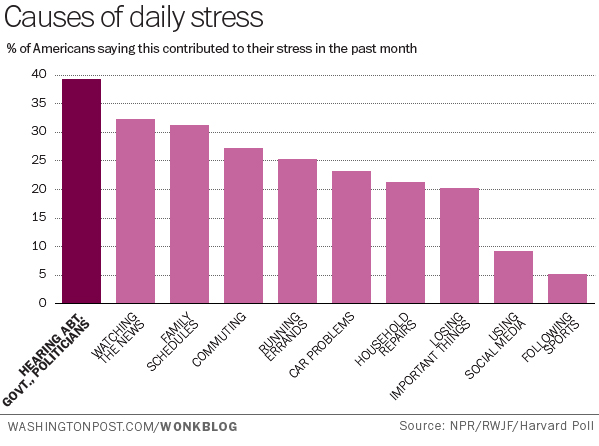
The Robert Wood Johnson Foundation just released a wide-ranging survey on the prevalence and causes of stress in the U.S. Overall, 86 percent of Americans say they’ve been stressed out in the past month, with 26 percent saying they’ve experienced a great deal of stress. When it comes to major stressful life events, health-related issues top the list: More than 4 in 10 respondents who said they experienced a major stressful event in the past year cited health concerns as the primary stressor. But the survey also asked about smaller, daily stressors — the little exasperations that can add up to a miserable day. And here something surprising emerges: Americans cited “hearing about what the government or politicians are doing” as the most frequent daily stressor on their lives, and at a substantially higher rate than the usual annoyances like commuting, chores and general schedule-juggling.

I get it. In a polarized, emotionally fraught polity, the news is almost always stressing you out. The digital media revolution has also meant countless new outlets trying to get market share by revving up one side or the other. For my part, absorbing all the news every day, and being in the arena of opinion from dawn to dusk, week after week, I can only say I am utterly unsurprised. There’s a reason David Brooks just writes chin-strokers and sociology these days: you try being him at the NYT. My response is to try and compartmentalize it so I don’t get completely stressed out, or upset, or just exhausted by the noise. You want to know why I insist on getting to Ptown every summer and not leaving? It’s the yin to the yang of the arena. Without it, I’ve only got the hubby, the hounds, and Angry Birds.

Meanwhile, Drum wants more details from the study:

[B]oy howdy, does this beg for a follow-up. I really, really want to know what news sources cause the most stress. Is it listening to NPR? Watching Fox News? Getting your daily Limbaugh fix? Reading Kevin Drum’s blog? Perhaps the mere act of making you think about this is, at this very moment, making you red in the face. Then again, maybe not. I want to know more. Who’s most stressed out by the news? Liberals? Conservatives? Everyone? And what outlets cause the most stress? Obviously my money is on the Drudge/Fox/Limbaugh axis, but maybe I’d be surprised.

The Revenge Doctrine, Ctd

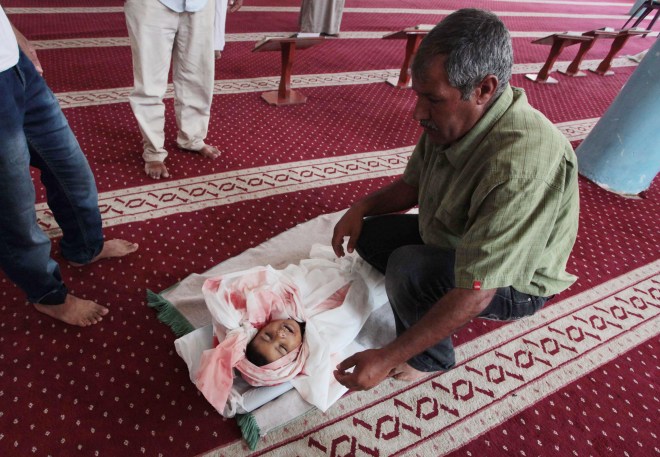
Funeral of a five-year-old child in Gaza

J.J. Goldberg reveals that the official story of what happened after those three Israeli yeshiva students were kidnapped is more hasbara than fact:

Once the boys’ disappearance was known, troops began a massive, 18-day search-and-rescue operation, entering thousands of homes, arresting and interrogating hundreds of individuals, racing against the clock. Only on July 1, after the boys’ bodies were found, did the truth come out: The government had known almost from the beginning that the boys were dead. It maintained the fiction that it hoped to find them alive as a pretext to dismantle Hamas’ West Bank operations.

What more do you need to know about the bigotry, callousness and hubris of Netanyahu? Well, this, maybe:

It was clear from the beginning that the kidnappers weren’t acting on orders from Hamas leadership in Gaza or Damascus. Hamas’ Hebron branch — more a crime family than a clandestine organization — had a history of acting without the leaders’ knowledge, sometimes against their interests. Yet Netanyahu repeatedly insisted Hamas was responsible for the crime and would pay for it.

So Netanyahu knew that the kidnapping wasn’t by Hamas proper, insisted that it was anyway, withheld the truth about the boys’ deaths in order to sustain a massive process of collective punishment of Palestinians in the West Bank, and then unleashed yet another brutal, lop-sided pulverization of Gaza. This is not a rational regime; and it is not a civilized government. J.J. Goldberg notes the Israeli military’s profound ambivalence about where Netanyahu is taking the country, along with the religious fanatics and racist haters who propel him forward.

And yes, yes, and yes again to the notion that Hamas should not be firing rockets into Israel at all, let alone at civilians directly, even though they have incurred no casualties and have bounced off the Iron Dome when they encroached too far into Israel proper. But in this instance, there is no equivalence. One side deliberately and deceptively instigated absolutely unjustified collective punishment of an entire population, and pre-meditatedly whipped up nationalistic and racist elements to back them up. They then went on to bombard Gaza – and many civilians – into another submission – after a period of relative calm and peace. The result is another disproportionate slaughter: around 100 Palestinians dead so far, and no Israelis. If you see nothing wrong with this, your moral compass is out of whack.

Meanwhile,  Obama and other world leaders have offered to broker a ceasefire, but Netanyahu has made it clear he’s not interested. An unnamed Israeli official tells Raphael Ahren that the goal of the bombardment this time is to permanently dismantle Hamas’s ability to strike Israel (didn’t they say the same thing last time?):

“It is quite possible that Hamas would agree to an immediate ceasefire — we’re hitting them hard, they want the situation to cool down,” the senior official told The Times of Israel, speaking on condition of anonymity. Brokering a ceasefire with Hamas would have been possible a week or a two ago, but an agreement that would leave in place the group’s offensive capacities not what Israel wants, the official said.

“Today, we’re not interested in a Band-Aid. We don’t want to give Hamas just a timeout to rest, regroup and recharge batteries, and then next week or in two weeks they start again to shoot rockets at Israel. Such a quick-fix solution is not something we’re interested in.” While refusing to discuss concrete steps the Israel Defense Forces plan to take in the coming hours and days, the official said that the government is discussing a ground invasion of Gaza “very seriously.”

Robert Naiman wants more US pressure on Israel to end the escalation:

The United States government has many levers on Netanyahu. Of course the U.S. gives Netanyahu billions of U.S. taxpayers’ dollars a year, but while it would be politically difficult (to put it mildly) to cut off U.S. military aid – the Obama Administration could not bring itself to cut off military aid to the Egyptian military coup, even when clearly required to do so by U.S. law – the Administration has many other, more subtle levers on Netanyahu that it could deploy without giving AIPAC, the ADL and their allies a convenient target for counterattack. The Administration could raise the volume of its public criticism of Netanyahu. The Administration could let it be known that it might refrain from vetoing a U.N. resolution that condemned Netanyahu. The Administration could “leak” that it is deepening efforts to engage Hamas politically, then issue a non-denial denial when these efforts are criticized. The Administration knows full well that it has all these levers and more. All it lacks is sufficient public political pressure to use them to force an end to the killing.

Au contraire. Most of the political pressure will come from those defending this latest slaughter built on a knowingly false pretext. Know despair.

Update from a reader:

I’m an American currently spending the month in West Jerusalem with my family.  Look: I’m no fan of Netanyahu or the current right-wing coalition here. I’m still trying to understand the implications of the government’s withholding of the information that the three teenagers were likely killed immediately after abduction. But when you say that the rocket fire from Gaza has caused “no casualties” in Israel, this is untrue. For example:

Following a barrage of rocket fire targeting southern Israeli cities, a rocket launched from Gaza hit a fuel tank near a gas station in Ashdod, causing severe damage and a fire. One person was critically injured by the strike, while seven other Israelis were lightly injured, according to Magen David Adom.

Granted the level of casualties is far lower than what we’re seeing on the Palestinian side, but it’s not “no casualties” on the Israeli side.

And when you say that rockets “bounced off the Iron Dome”, you are wrong both figuratively and literally.  Iron Dome only intercepts rockets bound for populated areas; all the rest it lets go. It has an astonishing 90% success rate at interceptions, but even so that means 10% are getting through to cause damage.

Even when the rockets fall harmlessly, they trigger sirens and send thousands of civilians running for cover.  We see relatively few rockets launched toward Jerusalem, but I’ve had to drop everything and run with my family to shelter several times in the past week.  It’s nerve-wracking.  I can’t imagine how bad life is for civilians in Gaza right now.

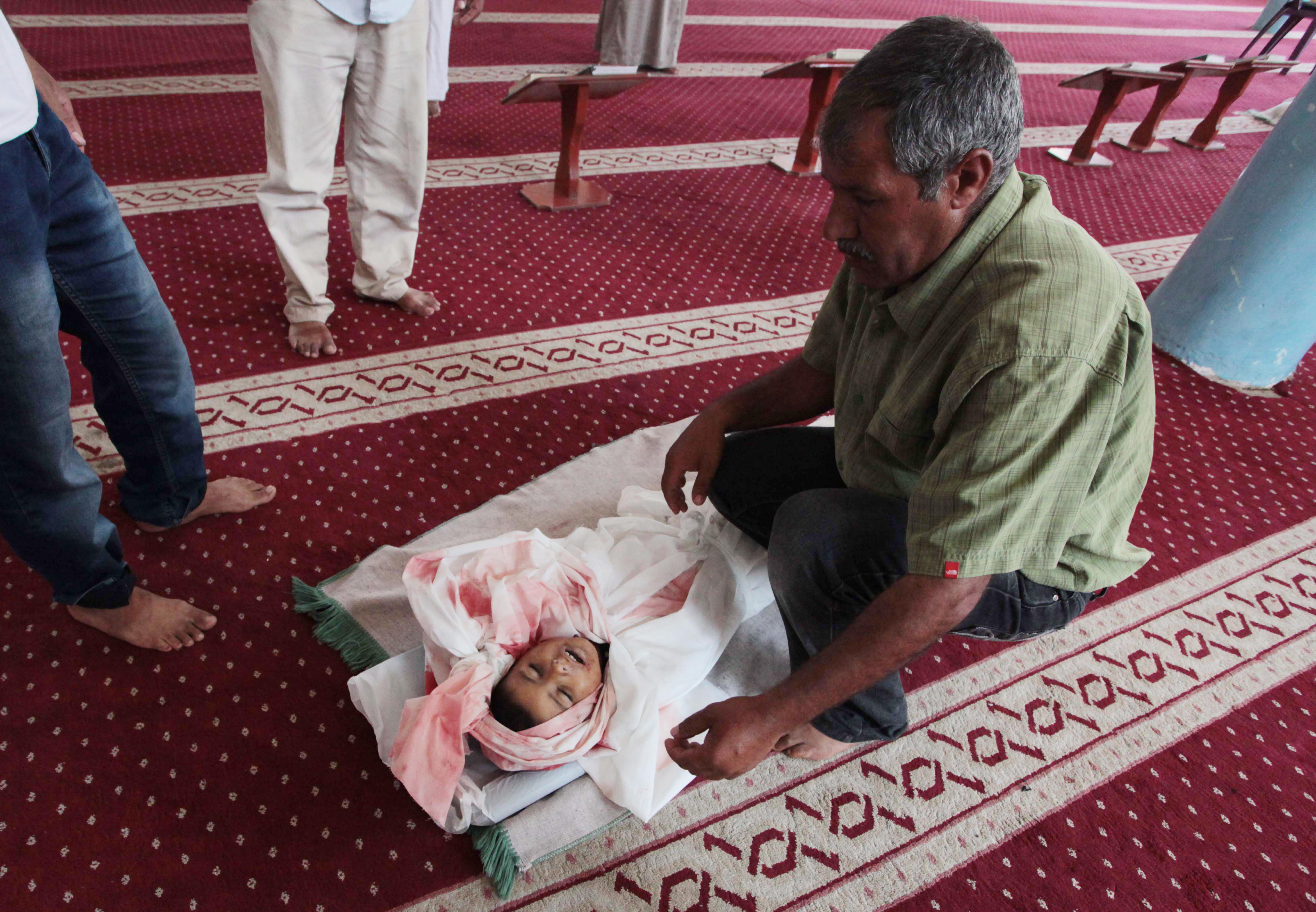
(Photo: A Palestinian man sits next to the body of five-year-old Abdallah Abu Ghazal killed in an Israeli air strike, during his funeral at a mosque in Beit Lahiya, in the northern Gaza Strip, on July 10, 2014. By Ashraf Amra/Anadolu Agency/Getty Images.)

The Battle Over Iraq’s Oil, Ctd

Ariel Ahram argues that the oil and water resources ISIS has captured are forcing it to behave more like a state and less like an insurgency:

Oil and water, unlike diamonds or drugs, contribute to the coherence to the Islamic State and the discipline of its governance. While both the United States and (even more significantly) Iran have dispatched military advisers to Iraq, full-blown outside intervention is difficult to imagine. Other forms of non-violent interventions, such as placing sanctions or embargoing IS’s oil production, are unlikely to be effective. Alternatively, coming to agreements on the disposition and distribution of water and oil resources could form the basis for some modes of negotiation. IS has already cooperated with the Assad regime in the distribution of electricity. While arrangements for sharing water and oil will not bridge the profound ethno-sectarian and ideological gap separating IS from the KRG, Iraq, Syria and the myriad of other belligerents, it could provide a basis for conflict management that mitigate the worst violence and spares civilians further harm.

In the meantime, ISIS’s control over Iraq’s central oil fields is becoming a major revenue stream for the jihadist operation. Steve LeVine highlights its million-dollar-a-day oil smuggling business:

According to an investigation by Iraq Oil Report (paywall), ISIL rapidly captured one and possibly two oilfields south of Kirkuk soon after storming Iraq a month ago. The fields, in the Hamrin mountains, produce relatively small volumes—just 16,000-20,000 barrels a day. But that earns a tidy income even at the knock-down local black market rate of about $55 a barrel, according to the report.

The description of ISIL’s smuggling route into Kurdistan continues the narrative of a ruthlessly managed, financially savvy rebel group that has emerged over the last year first in Syria and now Iraq. That includes control over Syria’s oilfields—on July 3, ISIL captured al-Omar, the country’s largest oilfield—plus some $420 million in Iraqi dinars snatched up in the June capture of Mosul. In all, ISIL may have a cache of some $1.3 billion. If you look at the capture of Iraqi territory as a business expansion, the prudent thing for ISIL to do is to establish new lines of revenue to support its added expenses. This is what the Hamrin mountain oil-smuggling network looks like.

Overall, however, Douglas Ollivant stresses that much less of Iraq’s oil is at risk in this conflict than many assume:

The bulk of Iraq’s oil production, now at about three million barrels per day, occurs in the far south of the country, in and around Basra province. A few smaller but still significant fields in the far northeast of Iraqi Kurdistan contribute another few hundred thousand barrels a day. Neither of these regions are anywhere near the current fighting. Further, each is buffered—by the mountains that rise in the KRG to the northeast, and by hundreds of kilometers of almost exclusively Shia Iraqi geography in the south. The Baiji refinery, a facility that has become a battleground in recent weeks, is focused exclusively on internal oil refinement and distribution and is not a part of Iraq’s export infrastructure. So Iraq is still on a path to be producing four million barrels a day by the end of this calendar year, or shortly thereafter.

The fighting will doubtless slow the further expansion of Iraq’s oil production. Baghdad’s inability to process hydrocarbon contracts, combined with increased security and insurance costs for international oil companies means, that we should now be less optimistic about predictions that Iraq will be producing 6 million barrels a day by the end of the decade. But the idea that Sunni jihadists will be overrunning Iraq’s southern oil fields is extremely far fetched.

Previous Dish on the Iraq conflict’s oil dimension here and here, and on the water dimension here and here.

Don’t Trust Those Senate Polls

Nate Cohn explains why:

There’s always the possibility that the polls could miss the outcome in a close contest. Polls have missed the result in three close Senate races in the last two cycles. But this year is particularly challenging. The rapid growth of partisan polls has contaminated the polling averages in states where surveying public opinion is already difficult. Many of these partisan polls employ dubious weighting and sampling practices. The combination will make it even harder for polls to nail the result.

So far this year, 65 percent of polls in Senate battlegrounds have been sponsored or conducted by partisan organizations, and an additional 10 percent were conducted by Rasmussen, an ostensibly nonpartisan firm that leans conservative and has a poor record.

Bernstein chimes in:

Adjust accordingly: Be wary of any conclusions about Alaska, Louisiana, Colorado, Arkansas and North Carolina. Unfortunately, the reaction of the usually astute Chuck Todd is to throw out the baby with the bathwater: He tweeted: “Reason #5,324 why averaging polls is useless, now more than ever.” Well, no. Polling averaging is sound. Sophisticated polling aggregation, which can assess how much weight (if any) to assign to less reliable polling and otherwise correct for detectable biases, is even more important, not less, when the polls may be misleading.

Sides also examines the predictive value of early Senate polling. His bottom line:

Ultimately, what we found most accurate at this point in the 2008-2012 campaigns was to weight the model roughly the same as polls for heavily polled races, and still more for lightly polled races. Then, it was best to gradually shift that weighting scheme over the coming weeks, so that our predictions heavily favored the polls by early September.