And They Say They Make Up Their Injuries

Ouch:

Javier Mascherano has spoken of the pain he had to endure to help Argentina reach the World Cup final, revealing that he “tore his anus” while making the heroic match-saving tackle on Arjen Robben in the final minute of the semi-final victory over the Netherlands. Describing the perfectly-timed tackle on the flying Dutchman, Mascherano said: “I thought I had slipped, I thought I wouldn’t make it, but I tore my anus on that move, the pain…it was terrible.”

The Complicated Politics Of Millennials

Reason‘s new poll takes a look at them:

These results indicate that social issues largely define millennials’ political judgments. Indeed, when we asked liberal millennials to describe why they are liberal, only a third mentioned economics. Instead, two-thirds said social tolerance is central to their political identities.

Millennials don’t conform to traditional political stereotypes. This generation is pro-business and pro-government. They are free marketeers and a majority (55 percent) say they would like to start their own business one day. They believe in self-determination and that hard work pays off (58 percent). They like profit (64 percent) and competition (70 percent) and strongly prefer a free market economy over one managed by the government (64 percent to 32 percent). Moreover, when asked to choose, millennials opt for meritocracy (57 percent) over a society with little income equality (40 percent).

At the same time, millennials came of a politically impressionable age during or in the wake of the Great Recession. And the ensuing sluggish economy has left a third of millennials under- or unemployed and a third living at home with their parents. As corporate profits soar and millennials’ job prospects remain uncertain, they aren’t sure if free markets (37 percent) or government services (36 percent) better drive income mobility.

Based on the poll, Nick Gillespie unpacks the political language of Millennials:

Millennials use language differently than Boomers and Gen Xers (born between 1965 and 1980). In the Reason-Rupe poll, about 62% of Millennials call themselves liberal. By that, they mean the favor gay marriage and pot legalization, but those views hold little or no implication for their views on government spending. To Millennials, being socially liberal is being liberal, period. For most older Americans, calling yourself a liberal means you want to increase the size, scope, and spending of the government (it may not even mean you support legal pot and marriage equality). Despite the strong liberal tilt among Millennials, 53% say they would support a candidate who was socially liberal and fiscally conservative (are you listening, major parties?).

Allahpundit connects Reason‘s poll to Rand Paul’s chances:

Millennials who think of themselves as “liberals” are far more open to voting for a libertarian-ish candidate like Paul than self-identified “conservatives” from the same age group is. But that makes sense, right? On college campuses, it’s rarely fiscal issues that animate the most passionate activism. It’s social and cultural issues, probably because they’re usually more accessible and because many (most?) young adults are focused more on building their identities than on pocketbook matters. (Although, post-recession, that might be changing.) Fiscal concerns are something you tend to pick up as you age and start paying attention to your paycheck. Go figure that the age demographic that’s closest to its college years might still be more interested in a candidate’s social agenda than his fiscal one, which explains why young liberals might take a hard look at someone who’s socially liberal and fiscally conservative whereas young conservatives are less inclined. Is that good news or bad news for Rand, who’s eager to reach out to Democratic Millennials but has to survive a primary with Republican Millennials first?

The Dish thread “Letters From Millennial Voters” is here.

Are Middle-Age Women More Desirable These Days?

Tom Junod thinks so. He announces, on behalf of Esquire, that 42 in particular is so hot right now:

There are many reasons for the apotheosis of forty-two-year-old women, and some of them have little to do with forty-two-year-old women themselves. In a society in which the median age keeps advancing, we have no choice but to keep redefining youth. Life lasts longer; so does beauty, fertility, and sex. And yet forty-two-year-old women are not enjoying some kind of scientific triumph but rather one of political and personal will. A few generations ago, a woman turning forty-two was expected to voluntarily accept the shackles of biology and convention; now it seems there is no one in our society quite so determined to be free.

Conservatives still attack feminism with the absurd notion that it makes its adherents less attractive to men; in truth, it is feminism that has made forty-two-year-old women so desirable.

Sarah Miller, 44, expresses tongue-in-cheek “relief” that she might still make the cut:

Young women may still be perfect physical specimens. They can put on a bustier and high heels and arrange their legs, as 42-year-old Sofia Vergara has here, in a pose that’s not quite open and not quite closed, but they just don’t have, according to Junod, my “toughness, humor, and smarts.” He doesn’t come out and say that they don’t, but he definitely doesn’t say here, “Oh, the reason 42-year-old women are hot is because of what they look like.” No, it’s because we have a certain gravitas combined with what remains of our beauty. Young women don’t have that gravitas. So we sort of have the best of femininity.

I guess this is supposed to make me feel good.

Update from a reader:

Why would anyone be surprised that 42 turned out to be the magic age for women?  After all, Douglas Adams told us years ago that 42 was the answer to Life, the Universe, and Everything.

Creepy Ad Watch

creepy-ad-transformers

Ugh:

No, that is not a cynically-crafted Photoshop job. You can see the whole thing right here. Publimetro is the Latin American branch of the Swedish Metro media company (no relation to UK’s Metro). What you’re looking at here is indeed their coverage of the escalating conflict on the Gaza strip plastered with a full-page ad for the newest Transformers movie. Perhaps Publimetro has the scoop on Israel’s “Iron Dome” defense system (ACTUALLY AN AUTOBOT, PERHAPS IRONHIDE) or maybe it’s some kind of ironic commentary on the commoditization of war… or maybe it’s just a sad statement about the struggles of print media in a digital age.

Who Will Lead The Reformicons? Ctd

Chait and Vinik recently addressed Paul Ryan’s apparent split with reform conservatism. Douthat lends his perspective:

I think both writers raise useful points, but also possibly exaggerate the discontinuity between Ryanism and the reformist tendency. Chait and I have gone so many rounds on the True Nature of Paul Ryan over the years that I don’t think it’s worth re-litigating those issues; I’ll just say that from the point of view of conservative reformers, the Ryan who matters (and yes, like all politicians he contains multitudes) has always been the Ryan who did more than any other Obama-era politician to save the G.O.P. from policy unseriousness (and often tried to do still more), rather than a Randian Ryan or an apocalyptic Ryan or any other interpretation of his record Chait prefers. And in this sense, many aspects of Ryanism are pretty clearly foundational for reformers:

The wisdom of his basic vision for Medicare reform is taken for granted by most people in our camp (and, happily, by most prominent Republicans), his 2009 alternative to Obamacare, which failed to win over the party at the time, looks a lot like the health care alternative proposed in the recent Room to Grow compendium, and the broad goal of his famous budgets — reforming the welfare state in order to keep the federal government’s share of the economy within its post-World War II bounds — is a broad reformocon goal as well.

But Beutler expects that, should the GOP obtain real power, a more radical GOP agenda will rise from the dead:

The GOP’s 2011 and 2012-era hysteria didn’t disappear completely. But its legacy is confined to the hardline faction that shut down the government last year and continues to paralyze legislative politics. It also, as Chait notes, has transformed into an equally pitched rebellion against Obama’s supposed lawlessness. I expect this legacy will be well represented in the next Republican presidential primary. It’s just that the prospect of unified GOP control of governmentwhich seemed so very within reach just two and a half years agohas faded, and taken the strategic allure of doomsaying along with it.

If it returns, Republicans will be lying in wait to do what they had hoped to do over the past year and a half. And the reformocon version of those plans isn’t much different.

American Teens And Common Cents

American-teenagers-aren-t-all-that-good-with-money-Mean-score-on-global-financial-literacy-test_chartbuilder

Roberto Ferdman charts the findings of a new report on financial literacy:

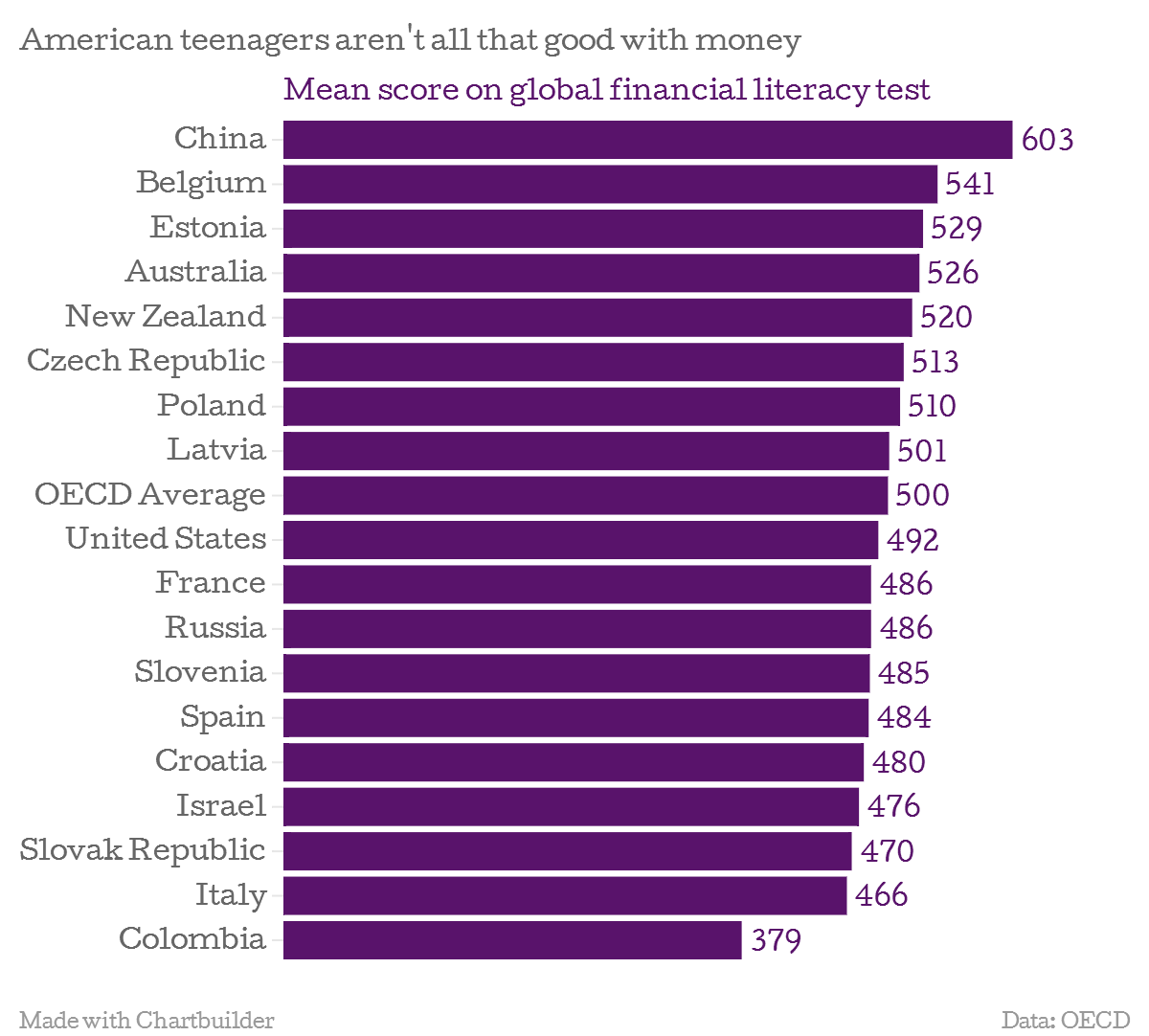
A comprehensive study carried out by the OECD (pdf) has unearthed yet another lagging indicator for the American education system. The study, which examined the results of a financial literacy test that quizzed some 30,000 students in 18 countries around the globe, found that 15-year-olds in the U.S. aren’t all that good with money. In fact, they’re pretty mediocre with it. America’s youth are, according to the results, “not statistically significantly different from the OECD average.”

Laura Shin notes that the top-scoring kids came from Shanghai:

There, students scored 603 points on an assessment run by the Programme For International Student Assessment (PISA) by the Organization for Economic Cooperation and Development (OECD). The average was 500, and the United States’ mean was 492. That put it slightly below the average of the the 13 OECD countries and economies assessed; among all 18 countries and economies included, the U.S. ranked between 8 and 12. The other countries and economies whose students, in addition to Shanghai’s, scored above the OECD average were Australia, the Flemish Community of Belgium, the Czech Republic, Estonia, New Zealand and Poland.

Emily Richmond isn’t surprised by the results:

The ranking of U.S. students in the new assessment is consistent with the nation’s stagnant performance on the most recent PISA for math and reading—two skills that track closely with financial literacy. And it’s in keeping with prior findings. In a 2008 national survey by the JumpStart Coalition for Personal Financial Literacy, high school seniors gave correct responses to less than half – 48.3 per cent – of the questions on the basics of finance.

Allie Bidwell breaks down the findings further:

[M]ore than 1 in 6 American students – 17.8 percent – did not reach the baseline level of proficiency, meaning they could not correctly answer a “level two” question. At best, those students could determine the difference between needs and wants, make simple spending decisions and apply basic numerical operations, according to the report. Conversely, about 1 in 10 American students scored as a top performer, meaning they were able to answer the most difficult “level five” questions on the exam that focused on analyzing complex financial products and demonstrating an understanding of topics such as income-tax brackets and the benefits of different types of investments.

Presumably it’s harder for teens to develop financial literacy when they can’t find a job.

Cartel Coyotes

Caitlin Dickson connects the current border crisis to the Mexican drug cartels, who have taken over the business of smuggling migrants into the US:

Under the cartel-run migration model, migrants typically make arrangements to cross from their hometowns and are told to find their own way to a certain point where they will meet the coyote. The city of Altar, for example, about 112 miles from Nogales in the Mexican state of Sonora, is a popular launching point for border crossers, and as such, it has become a center of immigration commerce. Here, smugglers often tell migrants to wait for days before they cross, during which time they are nickel-and-dimed into buying stealth desert-crossing gear—camouflage backpacks, black water bottles, and carpet booties—from vendors who set up shop around town.

For those coming from Central America, just getting to a meeting place like Altar often means riding buses or atop freight trains from southern Mexico where they may be subjected to robbery, beatings, and getting thrown off the train by cartel lackeys. Those who make it will continue to encounter crippling fees at practically every leg of their journey to the border. Refusal or inability to pay may result in migrants being forced to carry backpacks filled with marijuana, getting kidnapped in order to extort money from their families, or being murdered on the spot.

The cartels are also partly responsible for the gang violence driving these children out of Central America in the first place. Ongoing Dish coverage of the migrant refugee crisis here.

Flexible Work

Ned Resnikoff defends his coverage of yoga instructors’ labor concerns:

Nobody asks why a story about, say, school teachers or truck drivers counts as news. But for whatever reason, yoga instructors don’t count.First International Yoga Championship-Ghosh Cup Semifinals

That seems a little odd to me. It’s a skilled service profession, typically requiring some form of accreditation. People do get paid, albeit not very much, for rendering the services in question. So what makes it not-work? To flip the question around, why are stories about yoga instructors not considered to be labor stories?

I can think of a couple possible reasons. One is the widely held perception that yoga instructors are pursuing a hobby, despite the money involved. Another related reason is the casual, precarious nature of the work, which differentiates it from a full-time, salaried position. And a third, less charitable explanation, has to do with the gender breakdown of yoga instructors. Most of them are women, and feminized labor is often dismissed as not being “real” work.

Another reason yoga instructors may not register as suffering workers is that yoga is seen as something largely by and for rich white people. As Rosalie Murphy demonstrates, the stereotype isn’t entirely unfounded. On the racial component:

A 2009 study in the Journal of Religion and Health found that 63 percent of African Americans and 50 percent of Hispanic Americans pray to improve their health. Only 17 and 12 percent, respectively, reported relying on an alternative spiritual practice like meditation or yoga to stay healthy, and almost everyone in that group also prays. In contrast, twice as many white Americans identify with alternative spiritual practices and don’t pray at all.

“It’s easier for someone who’s not committed to anything to do yoga,” [researcher Amy] Champ said. “Ethnicity is connected to spiritual practice. Culturally, African-Americans and other ethnic Americans have their own [spiritual culture]. To get buy-in from those communities is pretty heavy lifting.”

And on the cost:

[O]ften, yoga is a privilege of the upper class. An average one-hour yoga class in Los Angeles costs $17. Most require students to bring their own equipment. A mat costs around $20; lululemon yoga pants, $82.

(Photo: Noriko Moser, of Pasadena, California, competes in the semifinal round of the 2003 International Yoga Championship-Ghosh Cup July 12, 2003 in Los Angeles, California. By David McNew/Getty Images.)

Get Moving, Already

Physical inactivity is the main reason we’re getting pudgier:

Researchers crunching data from the massive National Health and Nutrition Examination Survey (NHANES) have found that American obesity (as in the epidemic) might not have much to do with calories at all. In fact, over the past 20 years, calorie consumption mainly stayed flat, while daily physical activity went through the floor. We’re gaining weight because we don’t move as much as we used to, according to the investigators.

Specifically, the percentage of women reporting no daily physical activity jumped from 19.1 percent in 1994 to 51.7 percent in 2010, while the same for men jumped from 11.4 percent to 43.7 percent during the same period. The average body mass index spiked for both groups.