Mental Health Break

One reason many Americans can’t take the World Cup too seriously:

Update from a reader:

I appreciated today’s MHB because I think Neymar is the perfect example. Here is Neymar and his various dives. Here is Neymar and his real injury. When a player is acting, he rolls around on the ground and makes a spectacle of himself. When he is truly hurt, he lies still and tries to minimize the pain.

But another reader points to a video compilation “from the American sport with just as much flopping as soccer”:

Readers Hate Sponsored Content

That’s the good news as the journalism industry morphs into a branch of public relations. A new study has followed up on Tony Haile’s evidence that no one reads the damn stuff anyway. Its findings?

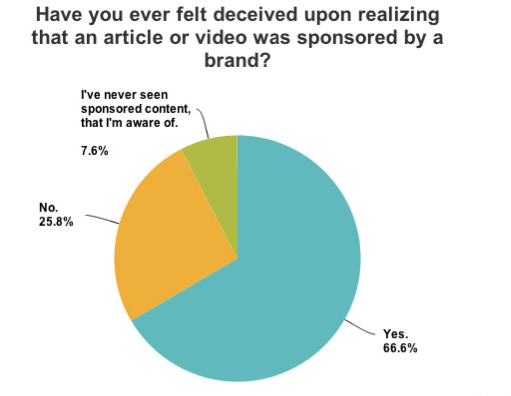
Two-thirds of readers have felt deceived upon realizing that an article or video was sponsored by a brand.
54 percent of readers don’t trust sponsored content.
59 percent of readers believe a news site loses credibility if it runs articles sponsored by a brand.
As education level increases, so does mistrust of sponsored content.

So I’m not alone among the consumers of journalism; I’m just almost alone in being a journalist who is publicly prepared to call this ethical swamp what it is. When asked if they would prefer old-fashioned, honest banner ads rather than this morphing of advertising, journalism and PR, the answer is overwhelming: by almost 2 -1 readers preferred traditional advertising.

But the core legal and political question is whether there is active deception going on, in violation of FCC rules. On that level, today’s media machers have some ‘splaining to do:

Screen Shot 2014-07-10 at 12.43.39 PM

When an industry is engaged in the wholesale deception of its consumers, the public interest is involved. At the very least, it seems to me, we should have Congressional hearings on whether this level of deception can be defended under the law.

Update from a reader:

“But the core legal and political question is whether there is active deception going on, in violation of FCC rules. On that level, today’s media machers have some ‘splaining to do”

Not so fast! The FCC, which regulates radio, TV, and common carriers, does not involve itself with online advertising. Those of us in the Radio/TV industry are familiar with the “sponsorship identification rule,” which requires that advertisers and their related content be identified in those media. There were some serious fines levied recently for this ($44,000 to a Chicago radio station for 11 instances of playing a “news” show that didn’t identify that the content was sponsored, and not actual news). Historically, the practice of payola led to these regulations, to prevent disc jockeys from accepting money to play records and thereby popularize them – a deceptive form of advertising.

Dissent Of The Day, Ctd

A reader quotes an earlier one:

Perhaps we should apply that same formula to heterosexuals. Who needs another human being when there’s God? In fact, it’s pretty obvious that any relationship OTHER than one’s relationship with God is inferior, a distraction from our one and only necessary relationship. Right?

Although I don’t think he sincerely believed it, my evangelical, heterosexual father expressed precisely the theological stance this reader posits sarcastically: Marriage was provided by God as a moral option for humans too weak in the flesh to commit fully to a relationship with God. Of course this in no way supports an argument that heterosexual marriage is fine and homosexual isn’t, but it does display a fascinating worldview. There is a higher morality that humans are invited, but not expected, to achieve.

The evangelical reader who started the thread follows up:

I’m very grateful for your posting of my earlier comments on this topic! I don’t want to fill up your inbox and use too much of your team’s time. But I get the impression that you don’t get too much evangelical input. This email is sent in reaction to your reader in Dissent of the Day, Ctd.

Your reader is absolutely right that the evangelical church cannot talk with credibility about same-sex marriage without a coherent theology of singleness and heterosexual marriage.  Western society seems to treat single people as though they are living a kind of maimed half-life, robbed of ultimate fulfilment and human wholeness (and devaluing aromantic friendship, as you pointed out recently). It’s unsurprising that opposition to same-sex marriage attracts such ire in this context.

The Biblical viewpoint is very different (even if, sadly, that isn’t always what we see in churches). According to the Apostle Paul, singleness (for whatever reason) is a gift, neither superior not inferior to marriage. Indeed, he insists that marriage has tremendous dangers:

the spouse may become an idol, competing with God for attention (1 Corinthians 7:32-35). If a prospective marriage is going to stop the couple from giving “undivided devotion to the Lord”, they shouldn’t get married. Christian marriage is for those who will glorify God better together. It is, emphatically, not to fill some sort of gap in our hearts/ we should be looking to Christ to fill that gap. As Vaughan says, the fulfilment of our relational longings is found in knowing the God who made us: the evangelical position would be inexcusable were it not for this fact.

Every Christian – male or female, gay or straight, married or single – in reality already has a bridegroom. In Hosea 2, God declares his intentions regarding his rebellious people:

Therefore, behold, I will allure her, and bring her into the wilderness, and speak tenderly to her… I will betroth you to me forever. I will betroth you to me in righteousness and in justice, in unfailing love and in mercy. I will betroth you to me in faithfulness. And you shall know the LORD.

And let’s not forget that the word “know” here is the same verb used when Adam “knew” Eve; intimacy with God is total intimacy in every dimension. From the Biblical perspective, earthly marriage is just a shadow of this heavenly union, when Christ will become “one flesh” with his church (Ephesians 5:25-33).  I was foolish to describe God giving himself to us “in return”, as though this were some kind of transaction; I meant that walking more closely with God is always worth it (not just theologically, but emotionally and experientially) because one is walking more closely with God. Whenever we disobey his commands, we are defrauding ourselves of our joy, precisely because we have taken our eyes off God.

Another responds to that reader’s first email:

The “dissent of the day” reflects why all too many Americans, especially young Americans, are moving further and further away from evangelical and fundamentalist churches.  Once, as a very young, enthusiastic (and often naively egotistical) evangelical several decades ago now, I used a “Christian cliche” in a college class, the metaphor from the Revelation about “the blood of the lamb.” Some astute “non-believer” (to me) asked me if I meant literal lamb’s blood.  I had a difficult time explaining what the metaphor even meant, let alone why I was using it, because I was conditioned to use it within “the tribe,” the evangelicals with whom I had associated.

These types of Christians, in their attempt to explain their theology of sex do themselves no favor by wrapping their fear of their own bodes and the world around them with such a high view of God that God ends up being so ultimate, so necessary to our existence that anything short of “Him and Him alone” means a failed life.  How demeaning is that to our full humanity, one shared even by God Himself, to those of us who hold to the incarnation?  How much this clap-trap sounds like the same old tired God who claims to give us free will but only if we willingly deny that free will for him, a God who sounds more like a kidnapper, holding us hostage and saying we have the freedom to leave but He will kill us if we do?  What kind of freedom is that?

I don’t think too many of those in the American evangelical camp can quite grasp the disdain all too many have to them in this culture because no matter how hard they try, sincerity comes across as sanctimony.
Never Listen To A Neocon Again

This embed is invalid

Every now and again, it’s worth remembering that they pretend to know everything but, in fact, know nothing about the Middle East, and have been proven wrong and wrong and wrong again on the subject. Their primary characteristic, of course, is never conceding a single error of judgment or denying responsibility for disasters in plain sight. So here’s a plethora of Dick Morris Award nominees from just last year about the now successfully completed withdrawal and destruction of Syria’s WMDs in the height of the civil war there. Drum roll please. First up – who else? – Krauthammer last September:

This is a clearly a way to get Obama off the hook politically. The chances of these weapons being eliminated from Syria are less than of the Chicago Cubs winning the World Series this year, and they are now mathematically eliminated.

Utterly wrong – and something he won’t ever cop to. Let’s go to Max Boot next:

If the U.S. is not seen as willing to strike Syria, what incentive does Assad have to comply with the terms of any disarmament deal? The most likely scenario is that Assad will agree to something in principle and then fudge on the implementation, knowing that Washington will have lost interest by that point.

Next up: a Kagan (little Freddy this time)! Notice the faux expertise and specificity of the bullshit:

Removing the weapons would require ground forces in large numbers. It appears that Assad keeps his chemical weapons at a variety of sites around the country, which would make it necessary to insert many strike forces simultaneously. Each strike force would need to be able to overcome the guard forces at each facility very quickly and then hold it against regime counterattacks. The strike forces would have to be accompanied by specialists in rendering chemical weapons safe enough to be transported, and those specialists would need to be supported and guarded…

The U.S. military has indicated that such an option could require tens of thousands of troops, and this quick sketch bears out that calculation. Since no one in this debate is advocating sending a large ground force into Syria, we have effectively dismissed the option of seizing the weapons or destroying them and thereby entered the realm of high-risk options.

Look: we all make mistakes. Plenty of other observers said it would be impossible as well (David Kay among them, with egg now all over his face). But when you have been wrong so consistently about so much, and have never copped to it, let alone reflected upon it, you should surely be a little circumspect in these instant, faux-expert opinions. And if you are a booker on cable news or an editor at an op-ed page, are you really going to keep giving these idiots a platform to be wrong yet again? Or are you going to grow some and care just a little about the truth?

Things Are Looking Up For Obamacare

Obamacare Impact

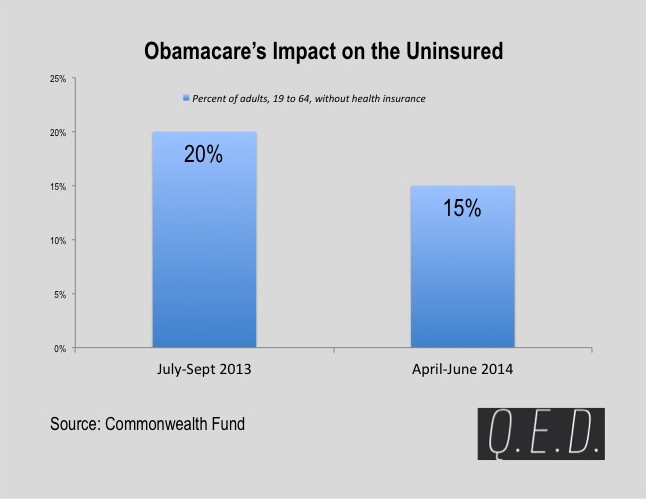
Cohn comments on the new Commonwealth Fund report I highlighted earlier today:

The Congressional Budget Office predicted that, one year into full implementation, Obamacare would reduce the number of Americans without insurance by twelve million. That included the young adults who got insurance before 2014, by signing onto their parents’ plans. There’s been some controversy over exactly how many more young people are insured because of that new option, but the best estimates I’ve seen place the number somewhere between 1 and 2.5 million. Add that number to the 9.5 million from the Commonwealth survey, and you’re close or equal to the CBO projections.

Of course, the Commonwealth survey has a hefty margin of error and the CBO projections, revised to take account of the early technological problems on Obamacare websites, were never that scientific. But the figures seem to be in the same ballpark. That’s what matters.

Douthat isn’t ready to declare Obamacare a success:

[I]f the Commonwealth figure is right we’re probably looking at between 10 and 11 million newly-insured overall for 2014 (I’m relying on “best estimates” for the number of young adults that are slightly lower than Cohn’s), which is lower than the 12 million the C.B.O. projected in April, which is lower than the 13 million it projected after the website problems, which is lower than the 14 million it projected after the Supreme Court decision on Medicaid, which is lower … you get the idea.

All of which means that this new estimate, while useful, doesn’t really bring us any closer to knowing whether Obamacare enrollment will ultimately end up where its advocates hoped — making up ground lost during the disastrous roll-out over the next couple of years, and hitting 25-30 million newly insured by 2017 or so — or whether its current shortfalls will persist and it will end up many millions below that target.

Sanger-Katz focuses on how “people who got the new coverage were generally happy with the product”:

Overall, 73 percent of people who bought health plans and 87 percent of those who signed up for Medicaid said they were somewhat or very satisfied with their new health insurance. Seventy-four percent of newly insured Republicans liked their plans. Even 77 percent of people who had insurance before — including members of the much-publicized group whose plans got canceled last year — were happy with their new coverage.

Kliff points to other details:

About four in ten Obamacare enrollees reported having signed up for Obamacare say they chose a narrow network plan, with lower premiums — but also fewer doctors and hospitals. This explains why just over one third (37 percent) say that all of the doctors they wanted were part of their insurance plan’s network. It’s possible that number could be an underestimate, as 39 percent said they weren’t sure which doctors were and weren’t included.

At the same time, subscribers who did see a doctor generally reported being able to schedule appointments pretty quickly. Most were able to get an appointment within two weeks.

On a less happy note, Flavelle finds that blacks are faring relatively poorly under Obamacare:

The uninsurance rate for whites fell to 12 percent from 16 percent; for Latinos, it plummeted, to 23 percent from 36 percent. For respondents who reported their race as “mixed” or “other,” the share without insurance was cut almost in half, to 11 percent from 20 percent. The exception to that trend was blacks. When the Commonwealth Fund conducted a survey from July to September last year, 21 percent of blacks reported being uninsured. This year, in a similar survey conducted from April to June, that level was effectively unchanged, at 20 percent.

Why?

A big part of the explanation, without question, is that a disproportionate share of blacks live in states that have so far refused federal money to expand Medicaid. Sixty-two percent of black respondents fall into that category, compared with just 39 percent of Latinos.

Ask Me Anything: In Praise Of The Millennials

The difference between them and my generation is stark, and I couldn’t be happier about it:

For more on that generation, check out our Letters From Millennial Voters, a thread in which you younger readers describe your political beliefs and how they were shaped. My previous answers in this video series are here.

The Trouble With ENDA After Hobby Lobby

Jim Burroway has the best and most concise argument I’ve yet read on this. Money quote:

Because ENDA contains an explicit LGBT-only religious exemption, the Supreme Court could, in following the Hobby Lobby precedent, look at that exemption in ENDA and conclude that Congress had effectively expanded the RFRA to cover a whole host of LGBT-rights regulations that have come about since the demise of Section 3 of the Defense of Marriage Act, including health care, hospital visitations, spousal benefits, and so forth. The possibilities for unintended consequences are enormous… The concern here is that the Obama administration may lift the language of the religious exemption clause from ENDA and graft it into his executive order, and thereby effectively eviscerate the order’s effectiveness for large numbers of LGBT people.

Book Club: Montaigne As Your Mentor

Many readers are getting psyched about our latest Book Club selection, Sarah Bakewell’s How to Live: Or A Life of Montaigne in One Question and Twenty Attempts at an Answer. My full intro to the book selection is here. Buy the book through this link to support the Dish. One reader:

Just a note to say that I am delighted that your third book club discussion will be bookclub-beagle-trabout Montaigne. If you haven’t read it, Mark Lillia’s very positive review of Bakewell is worth checking out. She misses Montaigne’s implied critique of Christianity, he argues. And M’s worldview leaves no space for transcendence, or our inescapable attraction to it.

To me, Montaigne cures us of that desire, though only temporarily. In that sense he is a proto-liberal: a skeptic, of course, and a thinker who put stability in politics before truth. I’ve been a lurker until now, but I look forward to a discussion about Montaigne on the Dish. How the ethos Montaigne recommends is challenged today by religion and by unworldly politics would be a great focus. And also the parallels and differences between The Essays and blogging.

That’s exactly why I chose this. It’s not just about life; it’s about politics, ideology, and fanaticism. Montaigne’s disposition is what we lack so much today – and need to reclaim. Another reader exclaims:

Woo Hoo! Montaigne next!

Why did I pick up How To Live last year at my public library? Probably because I saw it mentioned on the Dish or on Maria 513f2INPtgLPopova’s website. I renewed it several times so I could take it with me on vacation … to France. I greatly enjoyed the format, mixing Montaigne’s biography with Sarah Bakewell’s commentary. And I learned so much about Montaigne’s life, his essays and 16th century French history to boot.

I live in the USA, but I am originally from the Bordeaux area of France, and I go home pretty much every year to visit family. So last summer, my one objective was to visit Montaigne’s estate, as it is less than an hour’s drive from my parents’ house. It felt like a pilgrimage. Walking up the stairs of the tower, standing in Montaigne’s library, looking up to decipher the inscriptions on the ceiling. Better than a trip to Lourdes!

I also used several sections of How To Live when I taught a survey of French literature to my Advanced French class this past school year.  And the book is once again on my coffee table, so I can reread it this summer (along with my digital copy of Les Essais). So a big thank you (or should I say “mille mercis”!) to you, Andrew and the Dish, for introducing me to this wonderful book and for making me want to rediscover Montaigne’s essays. I am looking forward to reading what other book club participants will think about it.

Another nerds out even more:

You recommend the Frame translation of the essays, and I understand that translation is widely regarded as the most faithful in English. But I wonder if you’re aware that the New York Review of Books just a few months ago published selections from the 1603 Florio translation.

It’s titled Shakespeare’s Montaigne because Florio’s was apparently the translation Shakespeare read and was inspired by. Nothing against the Frame translation, but reading Florio’s translation has been for me like discovering the masterful poetry of the KJV bible after only reading the bland NIV.

Some groveling fan mail sentiment incoming: Founding member here and I’ve been reading you – pretty much every post – since late 2007. I’ve only written in once or twice, and you published the view from my window several years ago. Pardon the morbidity, but I often measure how strongly a feel about the people in my life by how I would feel if I lost them. When I think about how it would affect me if you were to die or stop writing, well, only the loss of a handful of immediate family members would be more devastating. I follow the output of other public figures as closely – a few songwriters and novelists –  and feel I know them through their work. But I guess there is less artifice, more of your unfiltered self in what you do. The only other writer that even comes close in that respect is, in fact, Montaigne. So it doesn’t surprise me that you view him as a major influence.

Again, I really look forward to the July book club discussions.

Another primes the discussion further:

Not sure if you caught this on PBS several years ago, but they did a cool series on philosophers and the idea of happiness, and this was the portion they did on Montaigne:

https://www.youtube.com/watch?v=BOjDttEtfGI

The Post-Peace Process Era

Considering the political situation in Israel/Palestine and the total collapse of the negotiations into self-parody, Greg Djerejian believes we are beyond any chance of a peace process, unless the Obama administration is willing to finally stand up to our client:

The ‘peace process’ has become a phrase now almost of ribald derision in many quarters, a moniker for seemingly endless cycles of aimless discussion mired in its own rituals, positions, talking points, coteries of drafters and scriveners that come and go, like the seasons. And beyond this, the conventional wisdom has developed into a burgeoning sense that—with everything else afoot in MENA—does Israeli-Palestinian peace really even matter all that much? Deep down, however, true friends of Israel realize it very much does. … What is needed is a convincing leader of a great power (hello, Barack) to tell his client—politely but firmly—that its many untold billions upon billions of aid come with a small price, meaning, a modicum of respect for its patron.

Here instead, we are being played for fools, negotiating with ourselves for the privilege of trying to help a client who pays us too little heed back. Even the hapless Palestinians ‘waiting for Godot’ in Ramallah could not tolerate this theater of transparent chicanery this go around. A ‘process’ like this is indeed a mockery. What is required is an end to the tyranny of such incremental process obsession, instead tabling firmly before the counterparties what everyone knows are the broad parameters of a deal, and exerting real pressure (including suspension of material components of financial and military aid) until people get serious about inking the real deal[.]

Judis is even more pessimistic, doubting that even mighty Washington can salvage the situation at this point:

The United States can influence Israeli politics. It can threaten to withhold economic or military assistance. The Eisenhower and George H.W. Bush administrations were able to use these kind of threats to force concessions. But the Obama administration appears completely unwilling to undertake this kind of diplomacy toward Israel. Obama and Kerry know that if they tried to withhold aid, they would face an immense uproar on Capitol Hill. J Street has acquired some clout among liberal Democrats, but what support AIPAC and the other groups that back Netanyahu have lost among Democrats, they have more than made up among Republicans.

And if Obama and Kerry wanted to restart negotiations, they would also have a problem with the Palestinian side. Abbas has been a receptive negotiating partner – he made significant concessions during the talks with the Israelis, including agreeing to an Israeli army presence in the Jordan Valley for up to five years – but he is increasingly hampered by old age and illness. As a result of the negotiation’s failure, and the cooperation of the Palestinian Authority’s security force with the Israelis, Abbas has also become increasingly unpopular. One Fatah official estimated his support among Palestinians as ten percent. But he has no replacement in sight.

After the current wave of violence dies down, Keating predicts a return to the unsustainable, but not yet critical, status quo:

Both the withdrawal plans pushed by the international community and the annexation moves favored by the Israeli hard right seem fairly unattractive compared with muddling through with the current state of affairs, which again, for most Israelis, hasn’t been all that bad. Of course, the events of the last few days have been demonstrations that this status quo was extremely fragile and, in the long run, probably not sustainable. But when Israel winds down its strikes on Gaza and the rockets stop flying, as they likely will soon, it may once again become very easy to forget the knife’s edge the country is sitting on. Meanwhile, the settlements will continue to grow, even more radical groups in Gaza may eclipse Hamas if it’s decimated in the ongoing assault, the influence of moderates on both sides will diminish, and the prospects for any sort of workable resolution to the conflict will likely continue to recede.

Shmuel Rosen outlines what Israel hopes to achieve in the ongoing bombardment of Gaza. He sees history repeating itself:

Israel’s goals are not at all mysterious. Israel is long past its era of hopeful thinking about its neighbors. It is well aware that Gaza isn’t going anywhere, and neither is Hamas. So what does it hope to achieve? It wants Hamas to be militarily weaker. It definitely wants Hamas to have a smaller number of rockets, and if a ground operation is launched in the coming days, the mission of many of the forces will be to target the piles of ammunition that are stored, well hidden among Gaza’s crowded civilian population.

Israel wants Hamas to be less cocky. But Israel isn’t likely to set the bar higher than that. It isn’t likely to want Hamas completely gone. Not even if the price for it to stay is having a round of mild violence every now and then. Because Hamas, illogical and violent as it is, is the only force that even wants to rule that miserable area. It is currently the only force preventing Gaza from turning totally chaotic. And chaos, as recent Middle East developments keep teaching us, is worse than even despotism.

So I’ll see you in approximately two years for this same column again.

Putin’s Splendid Little War

The Ukrainian government drove pro-Russian separatists out of Slovyansk this weekend and is now vowing to retake the major industrial city of Donetsk. David Patrikarakos reports that the fighters of the “Donetsk People’s Republic” are getting ready to make their last stand:

On July 7, separatists started work protecting the city from attack. They blew up three bridges on key roads leading to Donetsk to slow the advances of the Ukrainian army. (This also damaged the railway lines.) Two other bridges on roads from Slovyansk to Donetsk were also destroyed. The rebels are insulating the city as they get ready to hunker down and prepare for an extended battle.

A siege or stalemate looks like the most likely option.

Poroshenko is determined to recover the east, but shelling Ukraine’s most important industrial city would be disastrous both for the economy and for any hope of reconciling in the future. Meanwhile, the separatists can defend their positions, but the chances of making gains are now unlikely in the extreme. The only real chance now for the rebels to fight back would be if their allies in Moscow accepted separatists’ demands for direct military assistance. But this is equally unlikely, and even the otherwise confident rebels know it.

In fact, Moscow appears to have abandoned the rebels entirely. Ioffe passes along reports that Russia has even closed its border to them:

Not only are they not letting men and materiel into Ukraine from Russia, but they’re also blocking men and materiel from flowing in the opposite direction. That is, the very men that Moscow has riled up to the extent that they have taken up arms and are ready to die in order to get the region out of Ukraine and into Russia are not welcome to seek refuge in Russia. (Not even, it seems, the ones originally from Russia.) A group of 300 fleeing rebels reportedly even came under fire by the Russians as they tried to escape into Russia.

The Russians haven’t confirmed or denied these Ukrainian reports, but it would not be out of step with Russian military history: The Red Army was notorious for its use of so-called barrier troops that were stationed behind active combat troops to prevent retreat. They became especially notorious in World War II when, drowning in the meatgrinder of the German advance, ill-equipped and poorly trained Soviet soldiers (many of them volunteers) were shot for retreating.

But Simon Shuster questions whether Putin can back off from Ukraine without paying a hefty political price:

The rebels were not the only ones to see this as a sign of duplicity. Russian nationalists have begun to turn on him as well, posting diatribes and even music videos that seek to goad Putin into war, juxtaposing his pledges to “defend the Russian world” with images of bombed-out villages and Russian corpses in Ukraine. “We gave them hope,” Alexander Dugin, one of the leading nationalist ideologues in Russia, said during a television appearance last week. “When we said we’re a united Russian civilization, this didn’t just come from a few patriotic forces. It came from the President!” And it will not be easy for Putin to back away from those promises. A nationwide poll taken at the end of June suggested that 40% of Russians supported military intervention in Ukraine, up from 31% only a month earlier.

Drum sees the Russian strongman cutting his losses:

That Putin. He’s quite the guy, isn’t he? It appears that he eventually figured out that Ukraine wasn’t going to fall neatly into his lap, and the cost of fomenting an all-out war there was simply too great. It turned out that Ukrainians themselves didn’t support secession; Western powers were clearly willing to ramp up sanctions if things got too nasty; and the payoff for victory was too small even if he had succeeded. So now he’s had to swallow a new, more pro-Western Ukraine—the very thing that started this whole affair—along with the prospect of renewed anti-Russian enmity from practically every country on his border. But he got Crimea out of the deal. Maybe that made it worth it.

Well, maybe it did. David Silbey still believes Moscow’s meddling in Ukraine was “a pretty deft piece of great power maneuvering”:

Russia has neatly acquired the Crimea, stirred up enough trouble in Ukraine that Western governments have largely stopped talking about that annexation, and all without committing any substantial forces or getting pulled into a Ukrainian civil war. Ukraine is more pro-west, now, sure, but it’s weakened by the loss of the Crimea and the political chaos. Russia’s other neighbors are suspicious of Putin, but, realistically, they’re also aware of their own vulnerability, and are likely to believe (as with the invasion of Georgia) that the west will reconcile with the Russians after a decent interval. What are the statute of limitations for territorial annexation?