Tax Cuts Don’t Pay For Themselves

brownback

Andrew Prokop delivers a reality check:

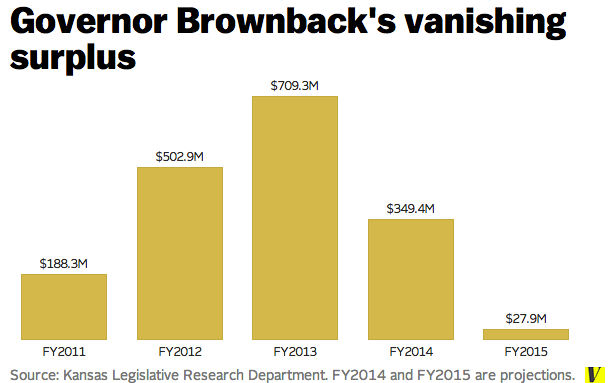
After [Sam Brownback’s tax cuts in Kansas] became law, it was undisputed that Kansas’s revenue collections would fall. But some supply-side analysts, like economist Arthur Laffer, argued that increased economic growth would deliver more revenue that would help cushion this impact. Yet it’s now clear that the revenue shortfalls are much worse than expected. “State general fund revenue is down over $700 million from last year,” Duane Goossen, a former state budget director, told me. “That’s a bigger drop than the state had in the whole three years of the recession,” he said — and it’s a huge chunk of the state’s $6 billion budget. Goossen added that the Kansas’s surplus, which had been replenished since the recession, “is now being spent at an alarming, amazing rate.” You can see that in this chart (the surplus is cumulative, not yearly)

A Plankton Of Action, Ctd

A few readers push back on this post:

As co-author of a marine science book who gives frequent public talks, I get asked about the iron sulfide engineering idea a lot. The downward flux issue is real, but there’s another major problem with the idea that’s even easier to articulate: what happens when those uber-blooms of plankton die off? Even assuming the carbon sequestration worked perfectly, you’ve now filled large swaths of the Southern Ocean with countless tons of dead plant matter. Bacteria will bloom to decompose it, creating enormous anoxic “dead zones” where pelagic fish and other organisms our species enjoys eating/admiring cannot live. Similar phenomena can be observed near major fertilizer runoff sites. The whole point of averting climate change is to prevent the ocean from turning into a sludgy toxic mess! This idea’s side effects are the very problems it means to combat.

Another is on the same page:

You ended your post about Victor Smetacek saying, “Further experiments, however, were halted due to protests from environmentalists.” But you did a disservice to them in not bothering to explain in part why they complained. As was noted in Scientific American:

A similar cruise and experiment in 2009 failed despite dumping even more iron fertilizer over an even larger area of the Southern Ocean. The eddy chosen for that experiment lacked enough silicon to prompt these particular diatoms to grow. Instead, the experiment yielded bloom of algae, which was readily and rapidly eaten by microscopic grazers. As a result, the CO2 in the algal bloom returned to the atmosphere.

In fact, these iron-seeding experiments could backfire by producing toxic algal blooms or oxygen-depleted “dead zones,” such as the one created in the over-fertilized waters at the mouth of the Mississippi River. At present, scientists have no way to ensure that the desired species of silica-shelled diatoms bloom. In short, Smetacek says, the type of bloom—and therefore the ability to sequester CO2—”cannot be controlled at this stage”.

This could be a great way to sink carbon, but we’ve gotten ourselves into problems before assuming a fix will be fine without paying attention to what might go wrong and I can’t blame people for urging caution in going forward here.

Update from a reader:

Not to pile on, but one more issue: Scaling. Thus far, we have data on ocean iron fertilization (OIF) only on a single-trial basis. We have to rely on models to extrapolate from the data at the global scale. However, here is a paper from Nature which makes several assumptions extremely favorable to OIF.

Briefly, I will highlight the favorable assumptions: It assumes a high (RCP 8.5) emissions scenario (thus relative impacts are maximized), continuous fertilization from 2020-2100, instantaneous deployment at full scale, and a full release of iron limitation from all phytoplankton south of 40° latitude.

The sum of this wildly optimistic model? A net loss of -.15°C (Table 2). Even under a low-emissions scenario (or low-sensitivity scenario favored by skeptics) OIF’s maximum potential is to buy us an extra decade at an unknown ecological price.

The Best Of The Dish Today

A couple of items. First up, I have to confess I’ve been a little obsessed with the unfolding horrors of the life of one of Britain’s biggest celebrities in the last few decades, Jimmy Savile. I only covered it on the Dish once (see “When Celebrities Rape Children And Molest the Dead“, because the context is all, and if you didn’t grow up in Britain in the 1970s and 1980s, it’s hard to get why his biography is so deeply disturbing. But for those still curious, here’s a review by David Hare of a new biography of Savile, In Plain Sight, that, apart from some throat-clearing at the start, really sets the scene. Money quote:

In normal circumstances, anyone who declared that the five days they spent alone with their mother’s coffin were the happiest of their life – “Once upon a time I had to share her with other people … But when she was dead, she was all mine” – would be subject to some public scrutiny. So would somebody whose first reaction after quadruple bypass surgery was to grope the attendant nurse’s breast. But by then Savile had pulled off the brilliant trick of seeming to make his surface weirdness part of what he called his “charismatic package”. “Nobody can be frightened of me. It would be beneath anyone’s dignity to be frightened of someone dressed like this.”

This was a pop-cultural icon who turns out to have assaulted, abused or raped hundreds – and was never caught.

Second, a response to Pascal Emanuel Gobry’s response to my post on “reform conservatism.” He says it does too have a grand and unifying theme – a populist and decentralizing politics aimed squarely at the needs of the working and middle classes, with an equally potent critique of cultural libertarianism. But my point was not that this wasn’t a coherent argument – just that it doesn’t really fit easily into an existing American conservative tradition (indeed runs counter to a great deal of it), and has as yet no political leader able to express it simply.

Gobry also argues that my cultural disaffection for cultural and social conservatism says absolutely nothing about the future of reform conservatism. A prosperous gay individualist like me is not exactly their target demographic – which is apparently “the fecund, the married and the lower-middle.” Fair enough. But there’s a class element here that seems a little off to me:

The Democratic Party already has the upper-middle class locked up, precisely because it panders very well at their cultural prejudices (which we hear very little about, as if America in 2014 was the only place in recorded history where only one side engages in demonization of the other side). A Republican Party that tried to go after its slice while dumping its base, which happens to be a plurality of voters in America, would, ipso facto, become a rump.

I prefer the kind of movement that lays out its concerns and seeks to get the widest and broadest public support for it, in all classes and all regions. But perhaps in this polarized age, that is no longer possible.

Today was a day for contraceptives and cup-cakes. We try to mix it up. We also tracked the Palin-Boehner impeachment fight; Khamenei’s depressingly public red line on the P5+1 negotiations; and the bias against black dogs. And I defended a religious exemption in ENDA, as most gay rights groups bailed on the idea, and HRC with it. And some clips from a recent podcast with Matthew Vines, the pioneering gay evangelical.

The most popular post of the day was yesterday’s Best of the Dish on Sarah Palin; followed by Monday’s The Tears of an Elephant.

Many of today’s posts were updated with your emails – read them all here.  You can always leave your unfiltered comments at our Facebook page and @sullydish. 15 more readers became subscribers today. You can join them here – and get access to all the readons and Deep Dish – for a little as $1.99 month.

See you in the morning.
A+ Hairy Legs

A professor at Arizona State is awarding extra credit to students who violate the body-hair norms for their gender:

[O]ne female student told ASU News that cultivating a hairy existence was a “life-changing experience.” Friends were repulsed. Her anti-pervert-hairy-stockings-for-girlsmother was horrified. But she came away from the experience empowered by her newly politicized perception of grooming habits. “It definitely made me realize that if you’re not strictly adhering to socially prescribed gender roles, your body becomes a site for contestation and public opinion.” …

According to [professor Breanne] Fahs, the “labor-intensive” assignment “gives men some insight into what women who shave go through.” The apparently torturous act of grooming is something women–guided by societal norms and media representations–are powerless to fight. Men must “go through” the same horrors to understand the plight of their female classmates because, Fahs says, “male students tend to adopt the attitude of, ‘I’m a man; I can do what I want.’” (One ape-like man, she told the ASU student newspaper, “did his shaving with a buck knife.”)

I think bears should protest the assault on core human rights here. And I am emphatically not reassured by the fact that bearded bros (and ladies) apparently get a pass: ASU men can receive the extra credit simply by “shaving all body hair from the neck down.” Imagine.

(Photo: Anti-pervert hairy leg stockings for girls. The Dish thread on the expectations of women to shave is here.)

Dissent Of The Day, Ctd

A reader writes:

Your reader’s “Dissent of the Day” quoting Vaughan Roberts is maddening. It’s also horrible theology. Basically, the idea seems to be that “a seemingly intractable attraction to the same sex” is a natural disaster, to be ranked with “blindness, depression, alcoholism, [or] a difficult marriage,” but by “learning, no doubt through many difficult times, to look to Christ for the ultimate fulfillment of their relational longings,” they can turn their socially- and religiously-imposed emotional and existential suffering into spiritual bliss.

Very nice. Perhaps we should apply that same formula to heterosexuals. Who needs another human being when there’s God?

In fact, it’s pretty obvious that any relationship OTHER than one’s relationship with God is inferior, a distraction from our one and only necessary relationship. Right? This is nothing more than the same old homophobia dressed up in seemingly sweet words – but strip the “sweetness” away with a modicum of logic, and you again have a God who hates fags, and demands the sacrifice of personal integrity and emotional wholeness to earn His “love”: “God never asks us to give anything up, without giving us something better in return: himself.” So, God works through “deals”? You give up this, and I’ll go steady with you? This is “unconditional” love?

What a twisted theology. And then your reader tops it with the usual sauce of evangelical arrogance: “Of course, anybody who doesn’t experience life in this way doesn’t need moralizing, but rather a deep knowledge of the love of Christ.” In other words, if you disagree with my position, it merely shows you don’t have a “deep knowledge of the love of Christ.” Well, OK. I guess that settles that. End of discussion. Of course, there was never a “discussion” in the first place, was there? There never is: it’s all settled from the get-go.

I feel sorry for Vaughan Roberts. I feel sorry for your reader. But I don’t feel sorry for calling their theology ignorant and twisted, the root of social bias, inequality, self-hatred, and ultimately, always, violence.

How Crippled Is Afghanistan’s Democracy? Ctd

The preliminary results of the Afghan presidential election are out, but they promise only to deepen the country’s political crisis:

[W]hile the numbers show former World Bank official and finance minister Ashraf Ghani Ahmadzai a winner in a landslide, his opponent, Abdullah Abdullah, has been positioning himself for weeks to reject the outcome, complaining that he suspects electoral fraud and tampering by members of the independent election commission could have skewed the outcome. Election results were delayed to allow for more auditing – something Mr. Abdullah welcomed – but in an interview on July 2 he also said that if fraudulent votes were winnowed out, the result would be “very different from what is perceived at this stage.” At that time, Mr. Ghani was felt by many to be in the lead. The results released today give Ghani just under 4.5 million votes, 56.4 percent of the total, with Abdullah’s share 3.46 million, or about 43.6 percent. …

It’s hard to believe the results will not lead to increasing ethnic tensions, since Abdullah estimated that about 2 million fraudulent votes need to be thrown out. That could be enough to overturn Ghani’s 1 million-plus vote lead at the moment (though some fraudulent votes certainly went to Abdullah as well). But it’s hard to see Ghani and his supporters accepting a situation where a huge lead in the preliminary results ends up being overturned.

Aarthi Gunasekaran sketches out what happens now:

Thousands of supporters have called on Abdullah to form his own parallel government, with Abdullah responding that this “is a demand from the people of Afghanistan [and he] cannot ignore this call” and that he would consult with his advisers and make an announcement in a few days.

Though an adviser to Abdullah told the BBC on Tuesday “we don’t believe in setting up parallel government,” the candidate’s comments were still met with sharp concerns. Secretary of State John Kerry declared there was no justification for “extra-constitutional measures” and will be meeting with key parties on Friday, July 11th.

The U.S. government underscored this sentiment stating that any action that would alter constitutional legalities could result in Afghanistan losing the financial and security support of the United States and the international community. This would plunge Afghanistan into a deep economic and security crisis as foreign aid constitutes for over 95 percent of Afghanistan’s GDP and in 2013, government revenues accounted for less than $2.5 billion of that year’s $7 billion adopted budget.

Abdullah’s claims of shenanigans have some merit, though:

In the eyes of Abdullah supporters, it is easy to question how Ghani could have more than doubled the number of votes he received in the runoff (going from about 2.2 million votes to over 4.4 million) while Abdullah, who had been far ahead, only added about three hundred thousand votes (going from 3.2 million to 3.5 millon). Somehow, we are supposed to believe that Abdullah has the support of only 44-45% of the Afghan electorate, no matter how many show up and that Ghani was able to magically obtain the vote of every Afghan who voted for someone other than Ghani or Abdullah in the first round while also getting 56% of those new more than one million voters who turned up for the runoff.

How Our Political Identities Form

Generational Politics

When you were born has a huge impact on your politics:

new model of presidential voting suggests President Obama’s approval rating — currently in the low 40s — will inform not only the 2016 election, but also the election in 2076. The model, by researchers at Catalist, the Democratic data firm, and Columbia University, uses hundreds of thousands of survey responses and new statistical software to estimate how people’s preferences change at different stages of their lives.

The model assumes generations of voters choose their team, Democrats or Republicans, based on their cumulative life experience — a “running tally” of events. By using Gallup’s presidential approval rating as a proxy for those events, Yair Ghitza, chief scientist at Catalist, and Andrew Gelman, a political scientist and statistician at Columbia University, were able to estimate when political preferences are formed.

Leonhardt wonders whether today’s impressionable youngsters will skew conservative:

Some political analysts believe that teenagers are already showing less allegiance to the Democratic Party than Americans in their 20s, based on recent polling data. My own sense is that their argument rests on small, noisy sample sizes, and Mr. Taylor, of Pew, is also skeptical. The larger point, however, remains: The Democrats face challenges with today’s teenagers that they did not face with today’s 25- or 30-year-olds.

By any measure, Mr. Obama’s second term lacks the political drama of his first, when Democrats were passing sweeping legislation and the Tea Party sprang up in reaction. But the generational nature of politics means that the second Obama term still has enormous political import.

Dreher reflects on how his politics have shifted over time:

For me, the ages of 14 to 24 corresponded to the years 1981 to 1991 — the Reagan/Bush years. It was during that time that the feel-bad 1970s were dispelled (the first significant political memory I have was the Iran hostage crisis), and the Cold War concluded with the fall of the Berlin Wall. The liberalism of that era was thoroughly ossified and reactionary. John Paul II was at the height of his influence, and that did a lot to bring me into the Catholic Church.

What shattered my faith in my 1980s conservative worldview were three things that happened in the 2000s: the Catholic sex abuse scandal, the Iraq War, and the financial collapse. These things happened from 2002 – 2008, a period that takes in ages 35 to 41. The connecting thread of these three events is how they all destroyed my belief that the Roman Catholic Church and the Republican Party could be trusted to exercise sound judgment — on moral matters for the Church, and on social, economic, and foreign policy matters for the GOP — and strong leadership.

A High Price For Legal High

Washington state’s legal weed looks like it will fetch a premium, at least in the short-term:

[Hillary] Bricken [an attorney working with Washington marijuana businesses] expects the product that will be available — most likely on Wednesday at most locations, if not later — will be fairly expensive. From what she’s heard, recreational marijuana will likely sell for about $3,000 a pound. In comparison, marijuana on the medical side sells for at most $1,300 a pound.

“Those numbers haven’t been seen in Seattle for five years,” Bricken explains. “I think smart producer-processors are going to gouge away to meet that demand.”

Sullum fears the steep prices will drive people back into the black market:

Until the [Washington State Liquor Control Board (LCB)] develops rules for edibles this fall, Washington’s stores will be selling buds only, and they won’t have much to sell. The LCB started licensing growers in March. So far, according to a list it posted today, it has granted just 86 applications, with more than 2,500 others still pending. In addition to the shortage of legal growers, high taxes and and regulatory costs are pushing prices up.

Although customers lined up today for the novelty of buying legal pot, the new shops probably will have a hard time competing with dispensaries and black-market dealers. “My old supplier just texted me,” Deborah Greene, Cannabis City’s first buyer, told The Seattle Times. “[He] said, ‘I saw you on TV. Now I know why you’re not calling me.'” She may have been joking, but a lot will hinge on whether that sort of anecdote sounds plausible a year from now.

Why Dominic Holden is more than happy to fork over the extra cash:

I bought a bag of marijuana today at Cannabis City, Seattle’s first legal retail pot store, just after they opened at noon. (Surprisingly for a pot store, they opened on time.) It was a different experience from every other time I’ve bought pot—and I’ve bought a lot of pot before—not just because there were dozens of TV crews swarming outside. What legalization provides, prohibition never could: explicit certainty about what I purchased, what it contains, what it doesn’t contain, where it came from, where the money goes, and the promise that every time I purchase this product it will be essentially the same.