Moderate In The Extreme

Ezra wants us to stop referring to “moderate” voters, whom he calls a statistical mistake:

What happens, explains David Broockman, a political scientist at the University of California at Berkeley, is that surveys mistake people with diverse political opinions for people with moderate political opinions. The way it works is that a pollster will ask people for their position on a wide range of issues: marijuana legalization, the war in Iraq, universal health care, gay marriage, taxes, climate change, and so on. The answers will then be coded as to whether they’re left or right. People who have a mix of answers on the left and the right average out to the middle — and so they’re labeled as moderate.

But when you drill down into those individual answers you find a lot of opinions that are well out of the political mainstream.

“A lot of people say we should have a universal health-care system run by the state like the British,” says Broockman. “A lot of people say we should deport all undocumented immigrants immediately with no due process. You’ll often see really draconian measures towards gays and lesbians get 16 to 20 percent support. These people look like moderates but they’re actually quite extreme.”

The result is that voters who hold gentle opinions that are all on the left or the right end up looking a lot more extreme than voters who hold intense opinions that fall all over the political spectrum. … “When we say moderate what we really mean is what corporations want,” Broockman says. “Within both parties there is this tension between what the politicians who get more corporate money and tend to be part of the establishment want — that’s what we tend to call moderate — versus what the Tea Party and more liberal members want.”

Losing Our Taste For Cupcakes?

Crumbs

Roberto A. Ferdman is unsurprised that cupcake company Crumbs is closing up shop:

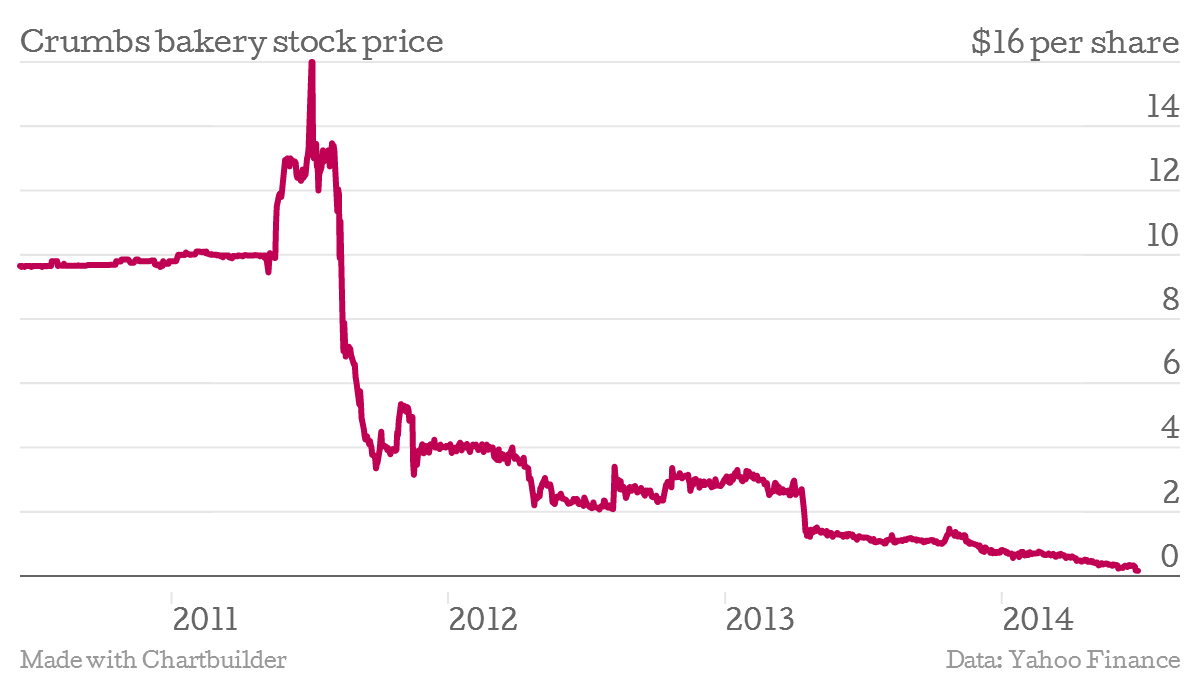
Cupcakes are a fad, not a food staple. The cupcake bubble, after all, was exactly that: a bubble. And bubbles—even cupcake bubbles (paywall)—burst. The market called this one back in 2011.

 has seen this all before:

Crumbs joins the long list of once hot food franchises that couldn’t resist the smell of growth and ultimately had difficulty managing it: David’s Cookies, Krispy Kreme, Einstein Bagels, World Coffee, just to name a few. They can survive, but generally after massive restructuring. Crumbs ran out of time and money. The pattern is similar: a good product or idea becomes increasingly popular, and investors get moon-eyed about the prospects. At the same time, other operators and investors will swear to you that there’s plenty of room for more than one brand—or that if there isn’t much room, their concept is superior.

Daniel Gross predicted this years ago:

Trends often inspire counter-trends. And the latest hot trend in dessert has proven to be something of a backlash to cupcakes. The cupcake bubble has been replaced, as I documented last year, by a fro-yo bubble. Tart instead of sweet, light instead of heavy, low-cal instead of fattening, fro-yo is in many ways the ying to the cupcake’s yang.

But John Aziz believes there “was never a cupcake bubble”:

[C]upcake sales have declined a little — falling 6 percent in 2012, flat in 2013, and falling 1 percent so far this year, according to NPD — but that is nothing like a bursting bubble. That’s a gentle, gradual decline that’s reflective of consumer tastes that have gradually changed, a marketplace that has become crowded, and snacks like the cronut and wonut that have begun to eclipse the cupcake. … Companies like Crumbs who botch their expansion plans, leaving themselves stuck with high levels of debt, tend to fail in whatever industry they are in. That’s not a bubble bursting — that’s business.

Jessica Grose finds all the cupcake hated a “little sexist”:

What’s going on seems to be about more than just the confection, which, like any other, some people enjoy eating and others do not. My theory: It’s about a dismissal and dislike of a certain kind of woman. (Hooooooold on, hear me out.) The kind of woman who watches Sex and the City (an important driver of the cupcake trend) and takes the bus tour to Magnolia Bakery. The kind of woman who gets excited about J. Crew catalogs and Instagrams her “glittery cupcake nail art.”

Mary Elizabeth Williams defends the humble cupcake:

Crumbs didn’t fail because people have stopped loving cupcakes. Put out a tray of cupcakes – Hostess, homemade, you name it – at a partytoday and see how long it lasts. Crumbs failed because the novelty has worn off — and because the product itself simply couldn’t sustain consumer loyalty after it had. But as long as there are mouths, people are going to love cupcakes. It’s cake you can carry around; figure it out. Victory will always belong to cake, even when all that’s left of Crumbs is, well, you know.

David Sax is of the same mind:

After nearly two decades as the reigning dessert trend in America, and increasingly the world, the cupcake will not go away. It will be there at birthdays, graduations and office parties. It will still elicit palpitations of excitement on sight, even from those who cursed its constant attention, because fundamentally the cupcake’s enduring strength is its very essence: a cake you can hold in your hand and eat without a fork. A cake you can eat in the car. America’s perfect cake.

Why So Upset About Contraceptives?

Noah Rothman advises Republicans against going to war with birth control. Dan Savage ponders the right’s motivations:

[W]hy are conservatives fighting so hard to make contraception harder for women to obtain? Because they don’t think people—young people, poor people, unmarried people, gay people—should be able to enjoy “consequence-free sex.” Because it’s sex that they hate—it’s sex for pleasure that they hate—and they hate that kind of sex more than they hate abortion, teen moms, and welfare spending combined. Knowing that some people are having sex for pleasure without having their futures disrupted by an unplanned pregnancy or having their health compromised by a sexually transmitted infection or having to run a traumatizing gauntlet of shrieking “sidewalk counselors” to get to an abortion clinic keeps them up at night.

But Douthat wants to reframe the debate as “less about whether sex should be consequence-free and more about whether, on a societal level, it really can be”:

[T]his argument would not demand that pre-pill consequences be re-attached to sex, to better return women to drudgery and childbearing. Rather, it would make the point that notwithstanding social liberalism’s many victories those consequences haven’t exactly gone away; it would question whether more and cheaper contraception suffices to address some of the social problems associated with sexual permissiveness; and it would raise the possibility that a broader reconsideration of current norms and policies might offer more to American women in the long run than strangling the last craft-store patriarch with the entrails of the last reactionary nun.

Marcotte, on the other hand, looks at how opposition to contraception correlates with the belief that women should be financially dependent on men:

By claiming women are getting something for “free,” conservatives are reinforcing this myth that women can’t actually be independent—they either need to rely on the government or a husband. That’s what Jesse Watters was getting at on Fox News, talking about single female voters who want the contraceptive benefit, who he called “Beyoncé voters”: “They depend on government because they’re not depending on their husbands,” he argued, ignoring that women are actually demanding the right to the health care they are paying for.

Rush Limbaugh sounded a similar note this week, denouncing men who support the contraceptive benefit by saying they are “Pajama Boy types having sex, sex, sex,” and that “Today’s young men are totally supportive of somebody else buying women their birth control pills. Make sure the women are taking them, ’cause sex is what it’s all about.” Yes, men support women’s reproductive rights only so they can have lots of sex while foisting the responsibility of providing for women onto the government, which Limbaugh falsely claims is providing the contraceptive coverage.

(╯°□°)╯︵ ┻━┻

Alice Robb delves into the linguistics of emoticons and emojis:

At the forefront of the research into emoji use today is Stanford-trained linguist Tyler Schnoebelen. By analyzing emoticon use on Twitter, Schnoebelen has found that use of emoticons varies by geography, age, gender, and social classjust like dialects or regional accents.  Friend groups fall into the habit of using certain emoticons, just as they develop their own slang. “You start using new emoticons, just like you start using different words, when you move outside your usual social circles,” said Schnoebelen.

He discovered a divide, for instance, between people who include a hyphen to represent a nose in smiley faces :-)  and people who use the shorter version without the hyphen. “The nose is associated with conventionality,” said Schnoebelen. People using a nose also tend to “spell words out completely. They use fewer abbreviations.” Twitter notoriously obscures demographic data, but according to Schnoebelen, “People who use no noses tend to be tweeting more about Miley Cyrus, Justin Bieber. They have younger interests, younger concerns, whether or not they’re younger.”

In a primer on how to use emoticons more intelligently, Roni Jacobson stresses the gender stereotypes involved in smileys and frownies:

Multiple studies over the past 15 years have shown that women use emoticons more than men. Women also smile more in real life, perhaps because they are expected to be the more expressive gender, says Susan Herring, a linguist at Indiana University who studies online communication. In a 2009 analysis of messages featured on a texting-based Italian dating show, she and her colleagues argued that men and women used their texts to project different identities. The women who sent in their messages seemed to be “performing a kind of socially desirable femininity” characterized by “playfulness” and “fun,” while the men acted more serious.

“There’s this new norm that women are expected to show more happiness and excitement than men do,” said Herring. “If you’re a woman, you may have to realize that if you don’t use a smiley face sometimes, you may be misinterpreted as being in a bad mood or unhappy with the person you’re talking to. I don’t think that’s true for men.”

Ahmad Chalabi? Really?

Chulov and Ackerman report on the suddenly bright political prospects of the erstwhile Bush administration darling. His name has even been tossed in the hat as a potential successor to embattled Maliki:

“In all of Iraq, nobody knows how to punch above their weight or play the convoluted game of Iraqi politics better than Ahmad Chalabi,” said Ramzy Mardini, a Jordan-based political analyst for thinktank The Atlantic Council. “His enduring survival is beyond our comprehension. Unlike Ayad Allawi [another former exile], Ahmad Chalabi is close to Iran. This is the key relationship that makes Chalabi’s candidacy something of a realistic prospect should Maliki be ousted. If Iran has a redline against a candidate, [he doesn’t] have a shot in making it in the end.

“If Iraqi politics were Game of Thrones, Chalabi would play Lord Baelish, a consummate puppet master behind the scenes, constantly plotting his path to power. For him, chaos isn’t a pit, but a ladder and Chalabi knows the ways and means of exploiting a crisis to suit his interests and elevation in Iraq’s political circles. He apparently has good relations with everyone, except Maliki.” The next month will determine how willing Chalabi’s patrons are to throw in their lot with him. Maliki, apparently emboldened after a private talk with the office of Iraq Shia Islam’s highest authority, Ayatollah Ali al-Sistani, said on Friday that he was not going anywhere. Some of those touting Chalabi as leader are now saying he would be a better fit for finance minister.

A palpably amazed Adam Taylor spotlights how the neocons are reprising their old roles as Chalabi cheerleaders:

This week the National Journal’s Clara Ritger spoke to Richard Perle, the famously neoconservative adviser to Bush at the time of the Iraq war. Asked about who should next lead Iraq, Perle said 69-year-old Ahmed Chalabi was best suited for the job. “I think he’s got the best chance,” Perle said. “It would be foolish if we expressed a preference for somebody less competent, which we’ve done before.” …

So, Perle is championing a man who provided false information that led to a war now widely viewed as disastrous, is accused of stealing millions of dollars and is widely thought to have helped spy on the United States for Iran. And Perle isn’t alone. Paul Wolfowitz, another leading neoconservative who was key to Bush’s foreign policy, also has come out to say that for all his flaws, Chalabi is a viable candidate. “The man is a survivor,” Wolfowitz said in an interview on Bloomberg Television. “That’s impressive. I think he wants to succeed in what he does, he’s smart; maybe he’ll figure out a way to do it.”

Does Contraceptive Coverage Pay For Itself?

Austin Frakt considers the question from the insurer’s perspective:

In part because it is so cost-effective, most people are willing to pay for contraception with their own money, if they can afford to. (Many Medicaid-eligible individuals perhaps cannot, but most employed people probably can.) Insurers benefit from this, because every pregnancy avoided is one less they have to pay for. Therefore, when employer-sponsored insurers pick up the tab for contraception, not very many more pregnancies are avoided — most people were already using and paying for contraception.

According to the IMS Institute for Healthcare Informatics, though the proportion of Americans with no cost-sharing for contraceptives rose in 2013 to 50 percent from 20 percent, prescriptions written for contraceptive medications increased only 4.6 percent.

But when they begin to fully cover contraception, insurers take on its full cost, “crowding out” the willingness of individuals’ to self-insure for it. Therefore, the government’s accommodation of religious organizations’ objections to covering contraception (obliging insurance companies to pick up the cost of the coverage, with no offsetting premiums or cost-sharing from either employees or employers) may impose a cost on insurers, even though contraception is cost-effective for society as a whole.

Daniel Liebman’s two cents:

There is strong evidence that public contraceptive funding for underserved populations is cost-saving, and there is a chance that the cost-neutrality observed following the [Federal Employees Health Benefits (FEHB)] and Hawaii mandates will materialize for other insurers as well. There are undeniable economic benefits of contraception for society as a whole, as well as a multitude of social benefits that could fill many posts of their own. Focusing specifically on the economics of insurance, however, the literature on the subject is sparse. All told, we currently have little evidence to indicate the time frame needed for private insurers to realize cost offsets or savings, if there are indeed any to be had.

The Revenge Doctrine, Ctd

The graphic video seen above illustrates some of the devastation caused by Israel’s new bombing campaign in Gaza. At least 22 people have been killed and 90 injured. Meanwhile, militants in the strip are firing rockets with longer ranges than ever before, reaching Tel Aviv and beyond. Those that landed in and around the coastal city forced the evacuation of a peace conference organized by Ha’aretz. Max Fisher comments on the sad irony of that development:

Observers of the Israel-Palestine conflict often say that the violence committed by both sides is self-defeating, but rarely is this so demonstrably and immediately true as with today’s evacuation of the Ha’aretz peace conference. The conference itself is part of a larger effort by the Israeli political left to overcome Israeli apathy toward the conflict and build political momentum for peace; that movement is squeezed between Israel’s political right and militant Palestinian groups, both of which in action and rhetoric tend to polarize Israelis and Palestinians against one another and against even the idea of compromise. It’s often said that there is not enough “political space” for the Israeli pro-peace left, and while typically that is meant metaphorically today it was true physically as well.

While Hamas and other Palestinian groups have launched a number of rockets from the Gaza Strip into Israel over the past week, they almost never reach all the way to Tel Aviv, Israel’s largest city and a cosmopolitan haven rarely touched by the conflict. The rocket siren sounded over the city for the first time since 2012, when Gaza groups fired hundreds of rockets into Israel as Israeli forces bombarded the Palestinian territory. The rockets appear to have landed harmlessly and the conference attendees eventually returned to the hall. The incident ended bloodlessly, but it was a perfect symbol of the conflict’s tragic absurdity and endless cycle of self-perpetuation.

Meanwhile, Goldblog weighs in on the killing of Muhammad Abu Khdeir and the brutal beating of his cousin Tariq:

I think that while the murder of 16-year-old Muhammad Abu Khdeir is a terrible crime, the non-fatal beating of his cousin, the Palestinian-American teenager Tariq Khdeir, by Israel’s Border Police, is, in one way, more consequential. Obviously, murder is the ultimate crime, but this murder was committed, we believe, by thugs operating independent of state authority. The beating of Tariq Khdeir was conducted by agents of the state. We judge countries not on the behavior of their criminal elements, but on 1) how they police their criminal elements; and 2) how they police their police. Those of you who have seen images of the beating of Tariq Khdeir know that this assault represents a state failure.

Unfortunately, this is not a one-off failure. On too many occasions, Israeli police officers and soldiers have meted out excessive punishment to Palestinians in custody. I’ve witnessed some of these incidents myself, both as a reporter and as a soldier. More than two decades ago, I served in the Israeli military police at the Ketziot prison camp, by Israel’s border with Egypt. This was during the first Palestinian uprising (which is remembered now, of course, as the “good” uprising, of stone-throwing and Molotov cocktails, rather than suicide bombers) and the prison held roughly 6,000 Palestinians, many of them street fighters, but many from the leadership of the uprising as well. It was at the prison that I witnessed—and broke up—one of the more vicious beatings I have ever seen. I wrote about this incident, and others, in my book about my time in Ketziot, Prisoners: A Story of Friendship and Terror.

Fisher provides a depressing reminder that getting roughed up at the hands of Israeli police is an all too common experience for Palestinian boys:

According to a February 2013 report by UNICEF, the United Nation’s Children’s Fund, about 700 Palestinian minors are arrested, interrogated, and detained by Israeli security forces every year. That has been sustained for the last ten years, bringing the total to 7,000 under-age Palestinians detained by Israel, or about two per day, every day, for a decade. Almost all are boys, and according to the report many are released with substantial bruising and cuts.

According to the UNICEF report, “The common experience of many children is being aggressively awakened in the middle of the night by many armed soldiers and being forcibly brought to an interrogation centre tied and blindfolded, sleep deprived and in a state of extreme fear. Few children are informed of their right to legal counsel.” The most common charge is stone-throwing — as it was against Khdeir — and most detained children confess, almost always without a lawyer or parent present.

Dissent Of The Day

A reader writes:

In your post yesterday on the American “evangelical” conversion regarding same-sex marriage, you said, “I’m not sure celibacy is a viable long-term argument for countless gay Christians who, by virtue of their very humanity, yearn for intimacy, companionship, love and sex.”

EvangelicalsThis position, I think, dissolves in the face of a God whose love and sustaining grace is sufficient to meet every emotional need; a God, moreover, whom one gets to know better through suffering (especially suffering for the sake of faithfulness to God). In Psalm 27, the Psalmist – although surrounded by enemies – describes his deepest wish like this: “One thing have I asked of the Lord, that will I seek after: that I may dwell in the house of the Lord all the days of my life, to gaze upon the beauty of the Lordand to enquire in his temple.”

The Christian is to be unapologetically obsessed with God. Psalm 73 expresses the same thought: “Whom have I in heaven but you? And there is nothing on earth that I desire besides you.” It’s not that the Christian shouldn’t care about other things, nor that the difficulty of aching longing and loneliness goes away. But the knowledge of God is both necessary and sufficient for Christian joy, even in the midst of deep pain and distress.

Vaughan Roberts is the Rector of St Ebbe’s church in Oxford, and is arguably the UK’s most-respected evangelical preacher. In 2012, he gave an interview in which he spoke at length about his celibacy and his exclusive attraction to people of the same sex:

We’re not called to a super-spiritual positivity which denies the frustration and pain; nor are we to embrace a passivity which spurns any opportunity to change our situation. But we are to recognise the loving hand of God in all we experience and see it as an opportunity for service, growth and fruitfulness… I have found that those I’ve learnt most from have invariably been believers who have grown in Christian maturity by persevering through significant difficulties. The experience of blindness, depression, alcoholism, a difficult marriage, or whatever the struggle may have been, is certainly not good in and of itself and yet God has worked good through it, both in the gold he has refined in their lives and the blessings he has ministered through them.

I have seen the same dynamic at work in some godly believers who have experienced a seemingly intractable attraction to the same sex. By learning, no doubt through many difficult times, to look to Christ for the ultimate fulfilment of their relational longings, they have grown into a deep and joyful relationship with him. Their own experience of suffering has also made them sensitive and equipped to help others who struggle in various ways.

Of course, anybody who doesn’t experience life in this way doesn’t need moralising, but rather a deep knowledge of the love of Christ. God never asks us to give anything up, without giving us something better in return: himself.

The World’s Third-Largest Democracy Votes

Indonesia Awaits Results Of 2014 Presidential Election

Kate Lamb previews today’s presidential elections in Indonesia, in which 190 million voters are participating:

There are many concerns voters could focus on in the election. While Indonesia’s economy has grown steadily in recent years, economic growth has slowed to 5.8 percent in 2013 and some 32 million people still live below the poverty line. Indonesia’s constitution largely protects religious freedom, yet in recent years attacks on Christians and minority Muslim sects have been on the rise. The country also faces significant environmental concerns, failing to properly regulate and police its logging, fishing, and extractive industries.

Yet the ballot, the third direct presidential election since the fall of longtime military ruler Suharto in 1998, has largely been framed in the context of a potential revival of Indonesia’s authoritarian past. Though the country is now a functioning democracy with a free press and strong civil society, its political institutions are still steeped in the personnel and politics that defined the old order.

Yenni Kwok profiles the candidates, who “stand in stark contrast to each other, and make this a showdown between political outsider and political patrician”:

The outsider is Joko Widodo, 53, a onetime furniture entrepreneur who has charmed the public with his down-to-earth demeanor.

Joko, popularly known as Jokowi, grew up poor, living in a riverside slum in Solo, Central Java. He cut his teeth in politics as mayor of Solo, where his blusukan (impromptu visits to constituents) and his push for clean governance set him apart from aloof officials in a country plagued with graft scandals. He even won recognition as one of the world’s best mayors. Riding on his immense popularity, Jokowi teamed up with a maverick Chinese-Christian politician to run in the Jakarta gubernatorial election in 2012 and won.

The outsider Jokowi has also drawn comparisons to a famous former resident of Indonesia:

A look at his rival:

The patrician is Prabowo Subianto, 62, a former military general dogged by allegations of past human-rights abuses. Prabowo comes from a privileged background: his father, the late economist Sumitro Djojohadikusumo, was a minister under Indonesia’s first two Presidents, Sukarno and Suharto. His brother-in-law is a former central banker, while his brother, Hashim Djojohadikusumo, who bankrolls his presidential campaign, is a billionaire with a global business reach.

Prabowo himself pursued a military career, and after marrying Suharto’s daughter (the two are now divorced), he quickly climbed up the ranks and took part in military operations battling rebels in East Timor and Irian Jaya. He went on to lead elite army units: the Special Forces and later the Army Strategic Reserve Command. His career ended abruptly after he was discharged from the military in 1998, months after Suharto’s fall, over his role in the abduction of pro-democracy activists.

If Subianto wins, Malcolm Cook notes, it will fit with the recent pattern of electoral victories by “realist conservatives” in democratic countries throughout Asia:

From Netanyahu and Modi in West Asia to Park, Abe and Ma (less so) in Northeast Asia, Aquino and Najib in Southeast Asia, and Abbott and Key in Oceania, the territory covered by this political trend is truly continental. Modi, Abe, Park and Najib are also stronger conservative nationalists than their party predecessors (Vajpayee, Fukuda, Lee and Abdullah respectively). The same trend is noticeable among East Asian non-democracies with Kim Jong-un and Xi Jinping seemingly more conservative and nationalist than their predecessors. The coup in Thailand is clearly inspired by conservative and nationalist goals and forces. Will the next generation of Vietnamese Communist Party leaders in 2016 follow suit?

The diversity of Asian societies and political systems and the fact that there are few if any exceptions (I cannot think of one) simply adds to the power of this political phenomenon and the need to try to understand it better beyond looking to the unique intricacies of each state. … Looking from India eastwards, I would hazard that the worsening external security environment is a contributing factor to the trend and one that is unlikely to change in the foreseeable future.

Lydia Tomkiw solicits some insight from Indonesia experts, who don’t all agree on how consequential the vote will be:

While the two candidates may be complete opposites on paper and in person, [Northwestern University professor Jeffrey] Winters argues that the media portrayal of a stark choice between a charismatic reformer and an old guard candidate isn’t accurate. “These two individuals are very different. But the constellations of social and political forces backing them are remarkably similar. Both have major business interests in their camp. Both have controversial military figures involved in their campaigns,” Winters said. “Whoever wins, this is not a revolutionary moment for Indonesia.”

Kevin O’Rourke, writer and editor of Reformasi Weekly, a newsletter about Indonesia’s political climate, sees it differently. “This is as stark as it can possibly be,” he says. “Indonesia has had a patronage-style government for centuries and now there is a chance for change. Widodo is a democratic figure. He’s the product of the new democratic system that just started taking place in the last decade.”

The latest on the voting:

Official results may take two to three weeks. Unofficial quick counts showed a slight edge for Widodo. One survey group, Lingkaran Survei Indonesia, showed 53.3% for Widodo and 46.7% for Prabowo with 99% of its data, and another group, Center for Strategic International Studies reported 52% for Widodo over 48% for Prabowo, with 95% of its data. Another independent survey group, Saiful Mujani Research and Consulting indicated 52-53% for Jokowi over Prabowo’s 46% with 99% of data.

Quick counts in Indonesia are usually accurate with a slim 1-2% margin of error, said Kevin Evans, a political analyst. Unlike previous Indonesian elections though, this race is a tight one.

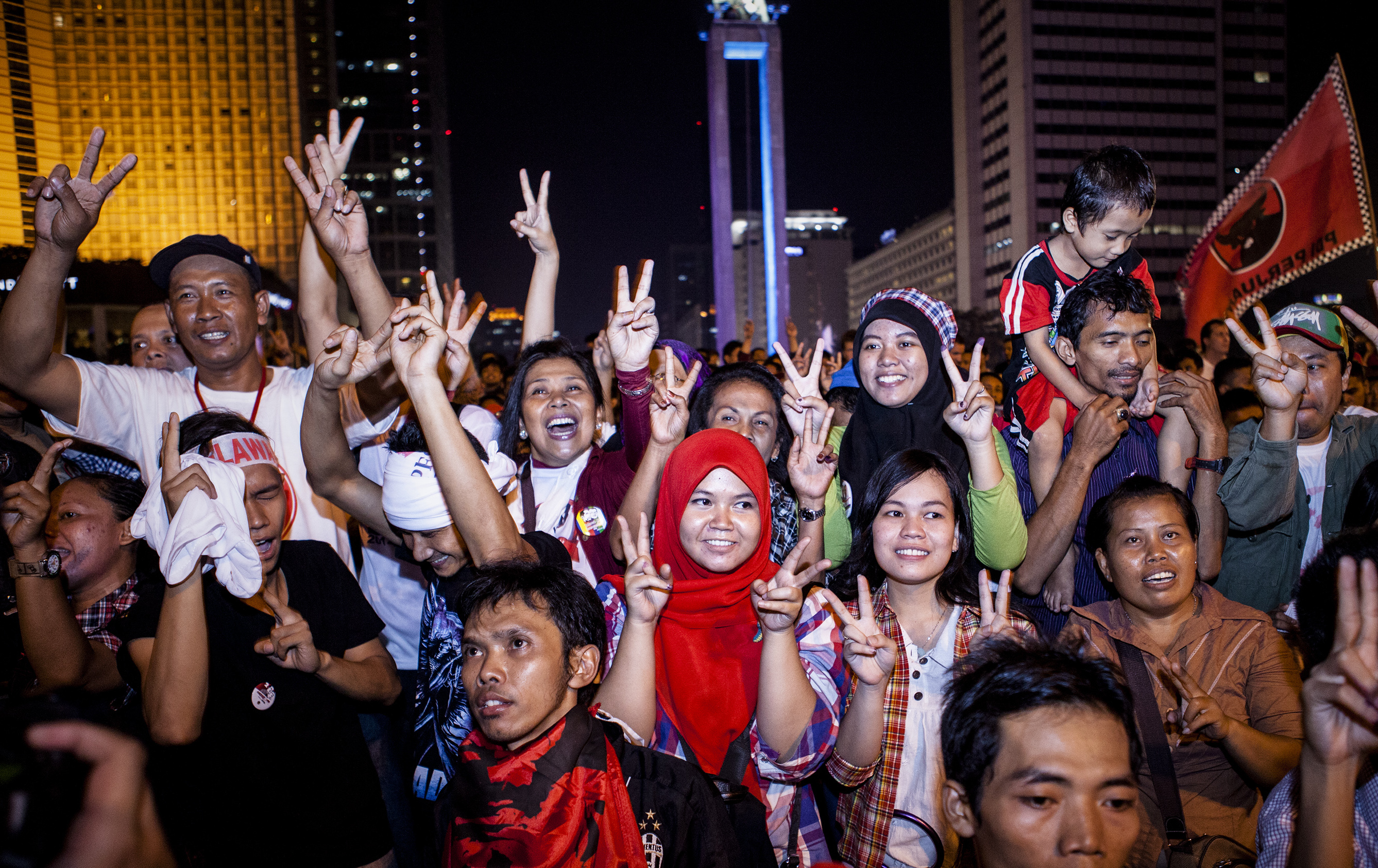
(Photo: Supporters of Indonesian presidential candidate Joko Widodo declare victory, although the vote counting is not complete, the race is very close, and the other candidate, Prabowo Subianto, has also claimed victory in the race on July 9, 2014 in Jakarta, Indonesia. By Oscar Siagian/Getty Images)