When Movies Go Meta

In a clip-laden essay, Oliver Farry surveys a history of cinema that turns the spotlight on itself:

Picture houses became a handy (some might say lazy) plot device for screenwriters, a place for characters to disappear into when pursued by police or the baddies. This was lampooned by Mel Brooks in Blazing Saddles where the villainous Hedley Lamarr ducks into an anachronistic cinema in the Old West and tries to get a student rate at the box office. …

Nostalgia for one’s youth forms much of the nostalgia for picture houses, which, in the movies is often elegiac.

This stands to reason – the cinema is a place for the young, for people with time and just enough money on their hands, for young lovers, student loners and groups of teenage friends. Peter Bogdanovich’s The Last Picture Show uses the closure of the local cinema in a small Texas town as a totem for the passing of an era, and of burnished youth. …

The ultimate cinema-nostalgia film is Giuseppe Tornatore’s Cinema Paradiso, in which a successful film director reminisces about his childhood helping projectionist Alfredo (Philippe Noiret) in the cinema in a Sicilian village. The film doesn’t stint on sentimentalism but it does have a pragmatic heart underneath it all. Alfredo encourages the boy, Toto, to leave the village to do something with his life, even obstructing a blossoming relationship with a local girl to do so. The cinema, palatial as it is for such a small town, exists only thanks to good fortune – after the initial one is burned down, costing Alfredo his eyesight, it is rebuilt thanks to the lottery winnings of a local, not exactly the wisest investment, it must be said. Toto’s future career is made possible by a film industry that stays alive, while the cinema, like many others in small towns, falls by the wayside.

A Water War In The Desert, Ctd

John Vidal argues that “the outcome of the Iraq and Syrian conflicts may rest on who controls the region’s dwindling water supplies”:

“Rebel forces are targeting water installations to cut off supplies to the largely Shia south of Screen Shot 2014-07-03 at 11.21.52 AMIraq,” says Matthew Machowski, a Middle East security researcher at the UK houses of parliament and Queen Mary University of London. “It is already being used as an instrument of war by all sides. One could claim that controlling water resources in Iraq is even more important than controlling the oil refineries, especially in summer. Control of the water supply is fundamentally important. Cut it off and you create great sanitation and health crises,” he said[.]

Isis now controls the Samarra barrage west of Baghdad on the River Tigris and areas around the giant Mosul Dam, higher up on the same river. Because much of Kurdistan depends on the dam, it is strongly defended by Kurdish peshmerga forces and is unlikely to fall without a fierce fight, says Machowski. Last week Iraqi troops were rushed to defend the massive 8km-long Haditha Dam and its hydroelectrical works on the Euphrates to stop it falling into the hands of Isis forces. Were the dam to fall, say analysts, Isis would control much of Iraq’s electricity and the rebels might fatally tighten their grip on Baghdad.

Previous Dish on the water angle of the Iraq conflict here.

Why Many Liberals Are On Edge Over Hobby Lobby

The pro-life movement is surging at the state level:

Monday’s Hobby Lobby decision is part of a deeper trend: even as Obamacare worked to expand access to contraceptives, decisions by both the courts and state governments have left American women with less access to reproductive health care than they did four years ago. Since 2010, states have moved aggressively to restrict access to abortion and taken new steps to defund family planning programs. Advocates on both sides of the issue describe the wave of changes as unprecedented.

States passed a record 205 abortion restrictions between 2011 and 2013, more than the entire 30 years prior. … In Texas, the number of abortion clinics has shrunk by half, from 40 to 20, since 2011. Arizona had 19 abortion providers in 2010; now it has seven. One clinic that shuttered posted a message on its website, directing clients go to the nearest abortion provider, in Houston, 100 miles away.

Many of those restrictions were squarely firing back at the Affordable Care Act. Twenty-five states, for example, now limit or ban abortion coverage in Obamacare’s new insurance markets. None of those laws existed before health reform.

Face Of The Day

China's Hui Muslim Minority Celebrate The Muslim Holy Fasting Month of Ramadan

Chinese Muslims of the Hui ethnic minority eat watermelon as they break fast during the holy fasting month of Ramadan at the historic Niujie Mosque in Beijing on July 3, 2014. The Hui Muslim community, which numbers more than an estimated 10 million throughout the country, is predominantly Chinese-speaking. Muslims around the world are marking Ramadan, where the devout fast from dawn until dusk, and is a time of fasting, prayer and charitable giving. By Kevin Frayer/Getty Images.

This Is A Refugee Crisis, Ctd

A reader testifies to the truth of that statement:

I am a leader in my Catholic parish’s decades-old sister parish relationship with a church in San Salvador. I have been visiting regularly since 2009. In these five years, the level of violence and insecurity has increased dramatically. Our parish supports their parish school and our families sponsor about 45 kids there. We measure this crisis in the impact on these kids, not on partisan hyperbole. Here are some of the concrete situations we’ve encountered:

• A teenager’s mom is killed in front of her, because the mom can’t pay extortion money to the gang. The teenager has dropped out of school because she needs to support the rest of her family.

• Half of the older boys in the program can no longer attend the weekend enrichment programs because they have to cross a newly shifting gang boundary due to a split in the local Calle 18 “chapter”. Before, they knew how to navigate between MS-13 and Calle 18. Now, who knows? They stay in their one-room shacks in sweltering heat as adolescence passes them by.

• Kids from Calle 18  are sent to a neighborhood  controlled by MS-13 on a mission to beat up someone (doesn’t matter who really). They choose a beloved social worker who is one of the few responsible father figures in the neighborhood.

• A young nun gives presentations on human trafficking and the reality of immigration. She tells adolescents that there is a really high risk of rape. They tell her, “I’ve already been raped by (my father; the police; the gangs). What do I have to lose?” She tells them about dying of thirst in the desert. They tell her about death in their neighborhood because of lack of clean water.

The boys and girls on the border are children fleeing for their lives. They are not economic migrants.

Toxic Butts, Ctd

A reader notes an unintended consequence of smoking bans:

It’s not hard to determine why there are more cigarette butts on the sidewalks than ever before. Thanks to the smoking bans in virtually all work places, restaurants and most bars, there are no more ashtrays available outside one’s home. So where else can that butt land? You certainly don’t want a smoldering cigarette butt in a garbage can. That’s a recipe for fire. And telling smokers, “Well, just don’t smoke until you get home” is simply unrealistic given the nature of nicotine addiction.

Update from a reader:

When I was in the Peace Corps my roommate smoked. One day we were standing outside and I noticed he finished a cigarette and wiggled the end of the filter between his fingers until the last bit of tobacco and rolling paper fell off. He then put the filter in his pocket. He did a lot of hiking and camping and didn’t like littering the place with stuff that would just sit there forever.

So there is one answer to your reader. Is it convenient? Probably not, but you know there are a lot of things that go along with this addiction. Compared to the inconvenience of lung cancer, emphysema, and heart disease, I don’t think storing the butts in your pocket until you can get to a trashcan is that much of a burden.

Another adds, “In the army we called this field stripping a cigarette.”

Good Luck Finding A Lesbian Bar In Portland

Alexis Clements ponders the decline of America’s “lesbian spaces”:

Two of the most stark examples are bars and feminist bookstores.

In the 1990s, there were literally 100 feminist bookstores in the U.S. Today there are 14. So in 20 years, they’ve almost disappeared. Then if you start to do any kind of research about lesbian bars, you see that they are also disappearing. Philly lost two of them. Chicago lost one. Portland doesn’t have one anymore. West Hollywood – one of the places many people consider to be one of the gayest areas in the United States – doesn’t have a lesbian bar anymore, and it had one of the oldest, the Palms. That’s gone now. …

A lot of people say, “Oh, well, there’s gay marriage now, so essentially queer people can assimilate into the larger culture; we don’t need places to go.” But for both political and romantic reasons, we still need to be able to spend time with people who we want to partner with or who we want to engage in political activities with. Those two things are in many ways core to a lot of lesbian and queer communities. Not every lesbian is a political activist, and not every political activist is queer, but the collision of politics and lesbian identity is longstanding and a very rich and important history.

Update from a reader:

I think that there are fewer lesbian bars because lesbians are much less at war, or at least high tension with straight men.

I’ve lived in Berkeley/Oakland since 1963, which has long been the lesbian’s lower profile mirror to San Francisco’s gay male community. In the ’70s through ’90s, the tough-ass-dyke-man-hater was a local fixture. At some point there was a shift, and the poster person for the lesbian community became much younger and less confrontive. Still tough, but not defined by anger towards males. This new model is also happy to show off her beauty, and less likely to buy into butch/femme sterotypes. I think that this generation doesn’t want to be beholden to a way that they are “supposed” to act.

Perhaps lesbian bars represent the “old” angry worldview. How does the saying go? “Living well is the best revenge”? From my bi-male standpoint, it looks like this generation’s largely having a great time of it, and in that sense is exacting their revenge quite well.

But I’d really like to hear from your lesbian readership. It’s a good question.

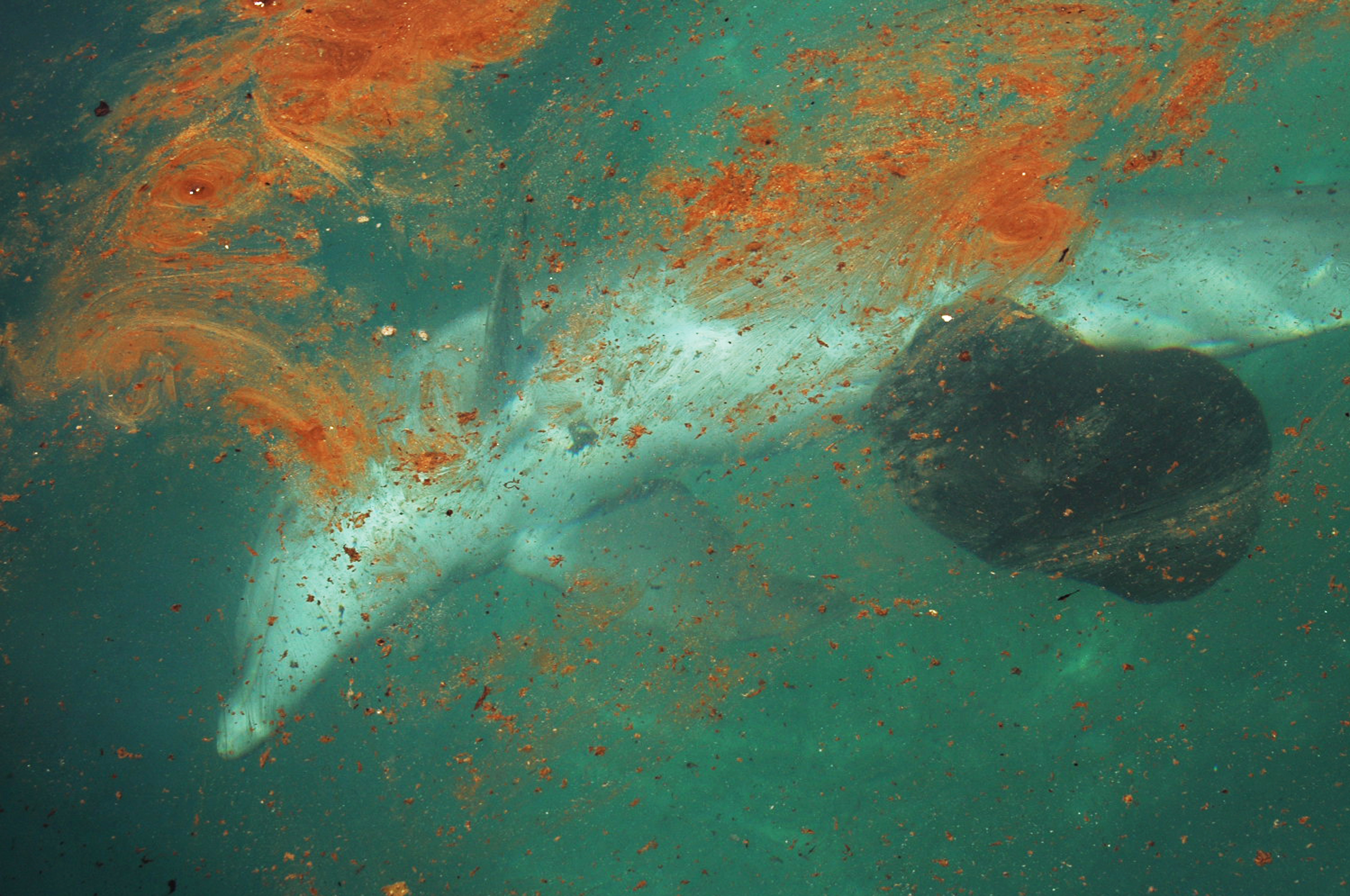
Where’s All The Plastic Going?

Bottlenose dolphin (Tursiops truncatus) swimming in oil slick, black plastic bag is along belly Curacao, Netherlands Antilles

The ocean should be a lot more plasticky than it actually is:

For a decade or more, scientists have assumed our seas carry millions of tons of plastic, much of which should be floating in open water, forming vast midocean “gyres” – islands of man-made mess such as the Great Pacific Garbage Patch. But according to a new study, something more worrying is happening to 99 percent of the ocean’s plastic: it’s disappearing.

The study outlines the findings of scientists who trawled the waters around five large ocean gyres in 2010 and 2011. The data they obtained put them far short of the expected amount of plastic in the ocean — rather than millions of tons, the global load of ocean plastic was calculated at 40,000 tons at most.

So what happened?

Though it’s possible that sunlight is eroding it into nothingness, or that tiny pieces are washing back ashore, researchers are skeptical. What’s probably happening, scientists theorize, is that tiny fish are eating it. The most likely plastic-snackers are lanternfish and other small “mesopelagic” species, meaning those that live in the middle swath of the ocean, swimming to the surface at night to feed. These are far and away the most populous fishes in the sea. …

We don’t have a good sense of what swallowing plastic does to these fish, or even whether they’re able to excrete or throw up their plastic meals. That’s worrisome, since the toxic chemicals in plastic might permeate their tissue – bad for mesopelagic fish, but also potentially bad for humans. Pellets in the 0.5-5-millimeter range are also commonly found in the bellies of the predators who eat these smaller fish, according to the study. Those include tunamackerel and other sushi-menu faves.

For the larger chunks of plastic, drones could help:

[G]etting to the scale needed to map the world’s ocean garbage will require a gigantic remote-controlled swarm of nautical drones. Ultimately the idea is to deploy thousands of swarming, meter-long sailboats equipped with sensors and dragging nets behind them to scoop up the garbage.

Protei’s shape-shifting robotic hull is the project’s breakthrough technology, and the design is open source for anyone to use. The hull bends and curves like a snake in order to control the boat’s trajectory through the water. Touted as unsinkable, self-righting, and hurricane-ready, the drone uses wind power, and the latest prototype can tow a payload of under five pounds, the group claims. The vessel would use a custom plastic sensor to locate the trash; the sensor is able to measure “slices” of pollution at various depths.

Recent Dish on plasticky sedimentary rocks here.

(Photo: A bottlenose dolphin (Tursiops truncatus) swims in oil slick alongside a black plastic bag off the shore of Curacao, Netherlands Antilles. By Wild Horizons/UIG via Getty Images)

We The Profligate People

Libby Nelson considers the failings of personal finance education:

Just 17 states require personal finance courses for students, and only six test students on what they’ve learned. But those classes don’t seem to make much difference anyway: students who took a semester-long class in personal finance fared below average on the Jump$tart survey. There is no evidence that the classes actually made students worse at managing money, the group wrote in its report. But it certainly didn’t make them any better.

Academic research backs up that conclusion. A 2008 study from two Harvard Business School professors studied the relationship between education and saving and investing behavior. They found state-required financial literacy education had no effect on graduates’ saving behavior later in life. The money spent on financial literacy education, they concluded, produced little in return.

McArdle chides Americans for spending so much and saving so little:

[W]hat we have is people spending more than they have to on the big basics. The average car loan, for example, is more than $25,000, and for people with the worst credit ratings, it’s actually higher: almost $30,000. This is not because you have to spend $27,000 to get yourself from Point A to Point B. It’s because people are pouring a big fraction of their income into driving something “nice.”

By the same token, raising your kids in a modestly sized home is not physically impossible. But we’ve come to regard as deep deprivation anything less than one bathroom and one bedroom per person. Cash-strapped people mention giving up vacations as if doing so were as great a sacrifice as giving up food or heat.