Because it's Friday of a Holiday weekend:
The Legacy Media And Torture, Ctd
Marcy Wheeler finds that the NYT's defense doesn't hold up:
Three years passed before the NYT started balancing those defending waterboarding with quotations calling it torture in less than half of their articles discussing the practice.
So what explains the delay?…It’s possible the formal admission of waterboarding to Congress by Michael Hayden on February 5, 2008 changed things. It’s also possible that John McCain’s presidential campaign–heating up in 2007–offered a reason to consider calling waterboarding torture okay. Or, it’s possible that the NYT didn’t want to call torture torture until the Iraq war made Bush so unpopular that it became okay to let torture critics have a voice in the paper.
Whatever it is, the NYT’s own narrative about how they balanced their capitulation to the Administration with quotes from torture critics is anachronistic.
In Breitbart’s World
My lengthy response to unfounded charges of hypocrisy in my criticism of offering $100,000 to get emails written under the assumption of privacy got quickly buried by a fast blogging day yesterday. If you’re still interested, here it is. Andrew has invited me to debate this with him in public. I hope we can do that soon.
Palin’s War Story
Deborah Newell Tornello points to a double standard she finds "exceedingly sexist and unfair":
A man who says he has fought in combat–an act that is fraught with life-and-death decisions and details that would spin the heads of the more squeamish among his audience; that affects a person, both emotionally and physically, for the rest of his life; and the retelling of which narrative treads through extremely sensitive grounds–does so knowing he'll incur the admiration and support of a large, electorally significant group of voters.
A woman who says she has carried and given birth to a special-needs infant (after first satisfying her speech-giving obligations as governor, then, incredibly, flown across a continent while in labor)–an act that is, by any stretch of the imagination, fraught with life-and-death decisions and details that would spin the heads of the more squeamish among her audience; that affects a person, both emotionally and physically, for the rest of her life; and the retelling of which narrative treads through extremely sensitive grounds–does so knowing she'll incur the admiration and support of a large, electorally significant group of voters.
With the former candidate, any inconsistencies and lies in his narrative are dug up and military records–personal and sensitive as they may be–are called for and examined.
Reporters might talk to those who served with him (if indeed he served); newspapers and televised news programs discuss the serious problem with his story. … Yet with the latter candidate–who in this case is embodied by one Sarah Palin, former half-term governor of Alaska, vice-presidential running mate and likely, if not certain, presidential candidate in 2012–the vast sea of inconsistencies and outright lies in her narratives is simply accepted, or else acknowledged in private by those with functioning ears and eyes but never questioned fully and responsibly by our national media, and, to a great extent, by bloggers of any political persuasion.
Malkin Award Nominee
"We support the clear will of the people of Montana expressed by legislation to keep homosexual acts illegal," – the new platform of the Montana Republican party.
A couple of things: "keeping" private homosexual acts illegal is impossible, since the Montana Supreme Court decriminalized them in 1997 and the US Supreme Court struck them down as unconstitutional in Lawrence vs Texas. And, really? This is 2010, and one of the major parties want to make criminals of 2 percent of the population for private consensual, adult behavior.
What If Krugman Is Right?
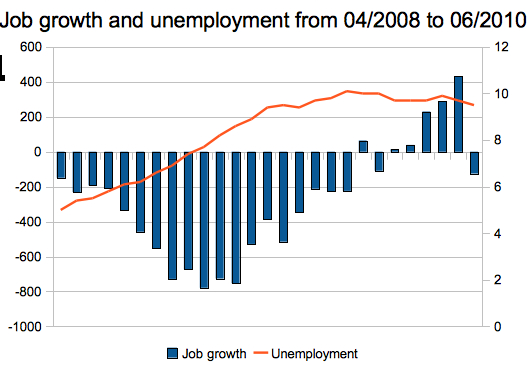
We'll probably have to wait until we get rid of all the Census and seasonality noise to fully understand the way the labor market is evolving. But the narrative essentially sounds something like: job growth wasn't quite as strong as we thought it was during the spring, and probably won't be as resilient as we hoped it would be during the summer. With private sector jobs continuing to grow, though at a crawl, at least we're on the right path. It's just going to be a slow recovery for employment.
Unemployment dropped sharply, to 9.5%. But why?…If people are just giving up and removing themselves from the workforce, then a falling unemployment rate only serves to hide the bad news. What’s more, the only important statistical decline in the unemployment rate was among white women, who already have lower unemployment than just about anybody else. The rest of the country — including, crucially, men overall — was pretty much unchanged.
The overall picture isn’t so much of a double-dip recession as it is of a badly wounded economy recovering at a slow pace.
Calculated Risk digs into the details.
(Image via Ezra Klein)
Is Iran Still Suicidal?
Kevin Sullivan compares American-Japanese relations at mid-century to the contemporary American-Iranian relationship:
Even history's most suicidal of states can – and have – changed. Iran is already one of them. So if Iraqis can trust a once suicidal Iran, why can't Americans and Israelis?
Gaza’s Tunnels
The Economist has a video interview with photographer Bruno Stevens:
Osama, No Superhero
Robert Wright turns his attention to Afghanistan:
If you ask people — right, left or center — why we can’t withdraw from Afghanistan, they start talking about the catastrophe that would ensue: The Taliban would take over, provide bases for al Qaeda, and suddenly it’s 9/11 again. Now, the consequences of withdrawal would certainly be messy and in some ways bad — and this subject is way too complicated to deal with in my remaining few paragraphs. But enough holes have been poked in standard catastrophe scenarios (by, for example, Paul Pillar, former deputy chief of the C.I.A.’s counterterrorism center) without much reducing the grip these scenarios have on people’s minds that you have to wonder whether our fears are grounded in something other than pure reason. You have to wonder whether we’re…taking a genuinely pretty scary bunch of enemies and making them much scarier — attributing so much unity and relentlessness and cunning to them that it’s hard to imagine beating them without military victory.
Chart Of The Day
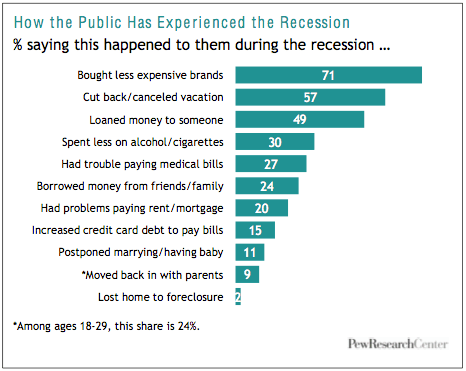
Pew has a new report on the recession:
The work-related impact of this recession extends far beyond the 9.7% who are unemployed or the 16.6% who (according to the U.S. Bureau of Labor Statistics) are either out of work or underemployed. The Pew Research survey finds that about a third (32%) of adults in the labor force have been unemployed for a period of time during the recession. And when asked about a broader range of work-related impacts, 55% of adults in the labor force say that during the recession they have suffered a spell of unemployment, a cut in pay, a reduction in hours or an involuntary spell in a part-time job.
William Galston is somber:
As recently as 2002, 61 percent thought their children’s standard of living would be better than their own; only 10 percent thought it would be worse. Today, the optimists’ share has declined to 45 percent, while pessimists now constitute fully 26 percent of the population. And doubt tends to reinforce caution. We don’t have enough evidence to conclude that the Great Recession will generate the kind of long-lasting risk aversion that characterized the Depression-era generation throughout their lives. But we do have reason to believe that for some time to come, what Keynes famously called “animal spirits” will remain subdued, which suggests that we’re in for a slow recovery and historically high levels of unemployment for much of this decade. If the Pew report is on target, the “new normal” will be more than a slogan.
 The Dish